


The AI-first mindset places AI at the center of operational thinking, right from the design stage of financial and accounting processes, rather than waiting until "problems arise before using tools to solve them." In other words, the AI-first mindset is a proactive approach where AI is prioritized for integration into all activities, from decision-making and innovation to communication and problem-solving.
This article by Bizzi will analyze in detail the nature of AI-first thinking as well as the role of AI in modern financial management.
What does AI First thinking mean when applied to the CFO's problem of controlling costs, invoices, and cash flow?
The AI-First mindset in finance is about designing processes and making decisions based on data, controlling and auditing the trail from the outset, to automate the processing of expenses, invoices, and accounts receivable according to measurable KPIs, without increasing tax risks and operational errors.
AI-First thinking in cost control.
Instead of asking, "Will expenses exceed the target this month?", an AI-First CFO would ask, "Which expenses are showing signs of exceeding the target in the next 2–4 weeks?"
Practical applications:
- AI automatically categorizes expenses by behavior (not just by account code).
- Compare current vs. historical costs vs. internal benchmarks
- Early warning:
- Marketing costs have increased unusually.
- The vendor is old, but the unit price is gradually increasing.
- Hidden cost, but low cost due to high frequency of occurrence.
AI First in invoice control
With invoices, the risk doesn't lie in a single incorrect invoice, but in the recurring pattern of fraud. This is a transition from "post-audit" to "continuous monitoring."
The AI First mindset helps CFOs:
- Automatic:
- Read and understand the contents of the invoice.
- Matching invoices – purchase orders – contracts
- Detect:
- High-risk NCC
- The invoice shows signs of irregularities (split into smaller parts, repeated patterns, illogical industry practices).
- Warning before filing taxes
The CFO doesn't need to "review every single invoice," but See risk table.
AI First in Cash Flow Management
CFOs are shifting from "looking at the numbers" to proactive cash flow managementIf you have the old way of thinking:
- Check your account balance today.
- Create a cash flow plan using Excel.
So the AI First mindset would be:
- WHO Simulating future cash flows
- If I stick to my current payment schedule, when will I run out of money?
- If payment to supplier A is delayed by 7 days, what will be the impact?
- If payment is delayed from customer B, is a short-term loan necessary?
AI helps CFOs answer: “This decision How will cash flow be affected after 30–60–90 days?"
How is the AI First mindset different from "using AI for fun"?
The AI First mindset isn't about adding AI at the end of the process, but rather redesigning the process so that AI can control, monitor, and detect risks right from the start.
For CFOs, the greatest value of AI lies in:
- Single source of truth for financial data
- Internal controls are "hard-coded" into the workflow.
- Reduce risk related to costs, bills, and cash flow – not just reduce manual labor.


Axis 1: Objectives
For the CFO, the question is not... "How many minutes does AI save accountants from data entry?" but "Can AI help reduce cost and bill risks and improve cash flow?"
| Using AI for fun | AI First |
| Increase personal productivity (work faster, reduce manual labor) | Optimization the entire Finance Ops system |
| AI provides personalized support. | AI attached process – policy – control |
| Local benefits | Enterprise-level benefits |
Axis 2: Data
AI is only truly valuable when it works on single source of truth, not in the file sent via Zalo.
| Using AI for fun | AI First |
| Disjointed files: Excel, PDF, email | Single source of truth |
| Static data, manually entered. | Automated data collection and normalization |
| Untraceable | Have data lineage (Knowing where the data comes from → how to process it → what decisions to make with it) |
A CFO needs:
- A single data source for expenses – invoices – payments
- Any number can be traced back during an audit or inspection.
Axis 3: Control
The AI First mindset does not replace control, but It helps to control automated execution.Consistent and independent of human intervention.
| Using AI for fun | AI First |
| No clear log | Full Audit Trail |
| Difficult to delegate authority | Follow SoD (Segregation of Duties) |
| Identify the following risks | Risk detection right in stream |
The CFO needs to address this issue:
- Who creates the costs?
- Who approves it?
- Who's paying?
- Is it possible to have someone "create, approve, and fund" the project all at once?
Axis 4: Operation
A CFO doesn't need everything to be "automated 100%". A CFO needs:
- Preparation → automatic running
- An anomaly → be processed as an exception, ensuring the right person is held accountable and the right evidence is available.
| Using AI for fun | AI First |
| Spontaneous processing | Clear workflow routing |
| There is no standard time. | It has SLA |
| Random processing error | There is an exception queue. |
What are the 7 essential attributes of an AI-First mindset in Finance Ops?
A business truly prioritizes AI in finance only when it possesses all seven attributes: decision-first, data-first, control-by-design, automation-ready, risk-aware, explainable, and human-in-the-loop, all of which are measurable by operational and financial KPIs.
(1) Decision-first – Which decision does AI serve?
AI First doesn't start with data, it starts with... decision map.
Example decision:
- This cost Is this the correct policy?
- This invoice Is there a tax risk?
- This payment Should we prioritize today?
KPI measurement
- % decision-making is supported by rule/AI.
- Average approval time (TAT approval)
- The percentage of decisions that need to be "reviewed after the period"
(2) Data-first – clean master data before intelligent AI
AI is only good when master data Good:
- Supplier
- Client
- COA
- Cost center
- Tax code, payment term
Do not have single source of truth → AI only adds more risk.
KPI measurement
- % invoice map correctly with supplier/COA/cost center on the first try.
- Number of duplicate/incorrect master data records
- End-of-period data reconciliation time
(3) Control-by-design – embedded control in workflow
AI Thinking First not accepted For example: "Check again at the end of the month to see if there are any mistakes."
Instead:
- Policy → consent matrix
- Approval → workflow routing
- Workflow → Embedded SoD
Control occurs before money leaves the business.
KPI measurement
- % transaction blocked before payment
- Number of errors detected before vs. after closing
- Number of SoD violations
(4) Automation-ready – increase STP, decrease touchpoint
AI First aims to:
- STP (Straight Through Processing) High
- A bill/expense goes straight through if there is no risk.
Not automation at all costs, but automation. what can be standardized
KPI measurement
- STP rate (% contactless transactions)
- Number of touchpoints / transactions
- Cost per invoice / expense
(5) Risk-aware – prioritizing risk detection over optimization
AI First Cost optimization based on risk data is not feasible..
The correct order:
- Detecting risky invoices
- Preventing violations
- Only then can we talk about optimization.
KPI measurement
- Rate of early detection of risky invoices
- Exception rate
- The value of expenses that are blocked before payment.
(6) Explainable – AI must be explainable
In Finance:
- "AI says so" is insufficient
- You should know: Why was I warned?
Explainability includes:
- Reason
- Rule / pattern
- Data trace
This is crucial for CFOs, auditors, and tax professionals.
KPI measurement
- %'s warning is well-founded.
- Exception handling time
- Number of cases requiring escalation due to "misunderstanding of warnings"
(7) Human-in-the-loop – humans handle exceptions, not all.
AI First doesn't eliminate humans, but:
- Design exception points
- Humans handle what AI is uncertain about.
All exceptions:
- Added to the exception queue
- Assign the correct responsibility group.
- Save evidence → audit trail
KPI measurement
- Exception processing time
- % exceptions are handled correctly by the SLA.
- AI decision override rate
How is the AI First mindset changing Procure-to-Pay to reduce bill processing costs?
The AI-first approach in P2P focuses on "touchless invoices": automatically receiving invoices, extracting data, performing 3D verification, streamlining approval processes according to policy, and only pushing exceptions to the designated handler, thereby reducing cycle time and cost per invoice.
Standard P2P chain in businesses: PR/PO → GR → Invoice → Approval → Payment → Posting
Traditional problem:
- Control is concentrated in the final approval.
- Manual invoice processing → multiple touchpoints
- Late detection exceptions → increased AP costs, delayed payments
AI First rephrases the question for each step:
- Which steps should be automated (STP / touchless)?
- Which step requires maintaining control?
- How early are the exceptions detected?
How did AI First redesign each stage of the P2P market?
PR/PO – Control from the start instead of "firefighting"
What does AI First do? Apply the policy and approval matrix directly at the PR/PO level:
- Budget according to cost center
- NCC according to master data
- Expenditure threshold by role
GR (Goods Receipt) – Data standardization for STP readiness
AI First requires:
- GR has a clear data structure.
- Mapping is possible with Purchase Order & Invoice.
If GR is "dirty" → AI cannot run STP in the next step.
Invoice – The heart of the AP costing equation.
This is the place AI First is completely different from "using AI for fun".. AI First in Invoice:
- Automatic Extract – Normalize – Compare: PO – GR – Invoice
- Pressure tolerance thresholds:
- Price discrepancies?
- Quantity discrepancy?
- Is NCC risky?
Bill Those that meet the criteria will be approved for direct STP approval. Conversely, those that do not, bill exception → go to exception queue
Bizzi Bot:
- Automatically check invoices according to Decree 123.
- Data matching & risk labeling
- Save the entire audit trail.
Approval – From mass approval to exception approval
The AI First mindset shifts from "Browsing all invoices" to "Only approve invoices with exceptions.
- Approval focuses on:
- Excess tolerance invoice
- NCC risk
- Unusual transactions
CFO control based on risk, not by weight
Payment & Posting – Automatic but controlled
- STP Invoice: Automatic Payment & Posting
- Exceptional invoice: Only runs after the exception is closed.
No more "closing the books only to discover problems later."
Core operational KPIs in P2P under the AI First mindset
- Cost per invoice
(Cost\ Per\ Invoice = \frac{Total\ AP\ Operating\ Cost}{Number\ of\ Invoices\ Processed})
- Touchless rate
(Touchless\ Rate = \frac{Invoices\ Processed\ STP}{Total\ Invoices})
- Cycle time
(Cycle\ Time = Payment\ Ready\ Date – Invoice\ Receipt\ Date)
In short, AI First in Procure-to-Pay isn't about speeding up an old process, but about redesigning P2P to:
- Fewer invoices require human processing.
- The exception was detected early.
- Processing costs decrease structurally, not trend-driven.
How does 3-way matching (PO–GR–Invoice) work in AI First thinking to prevent incorrect payments?
3-way matching is the core control mechanism of AI First in Accounts Payable: matching purchase orders, delivery receipts, and invoices against rules and discrepancy thresholds; discrepancies are pushed to an exception with an audit trail before payment.

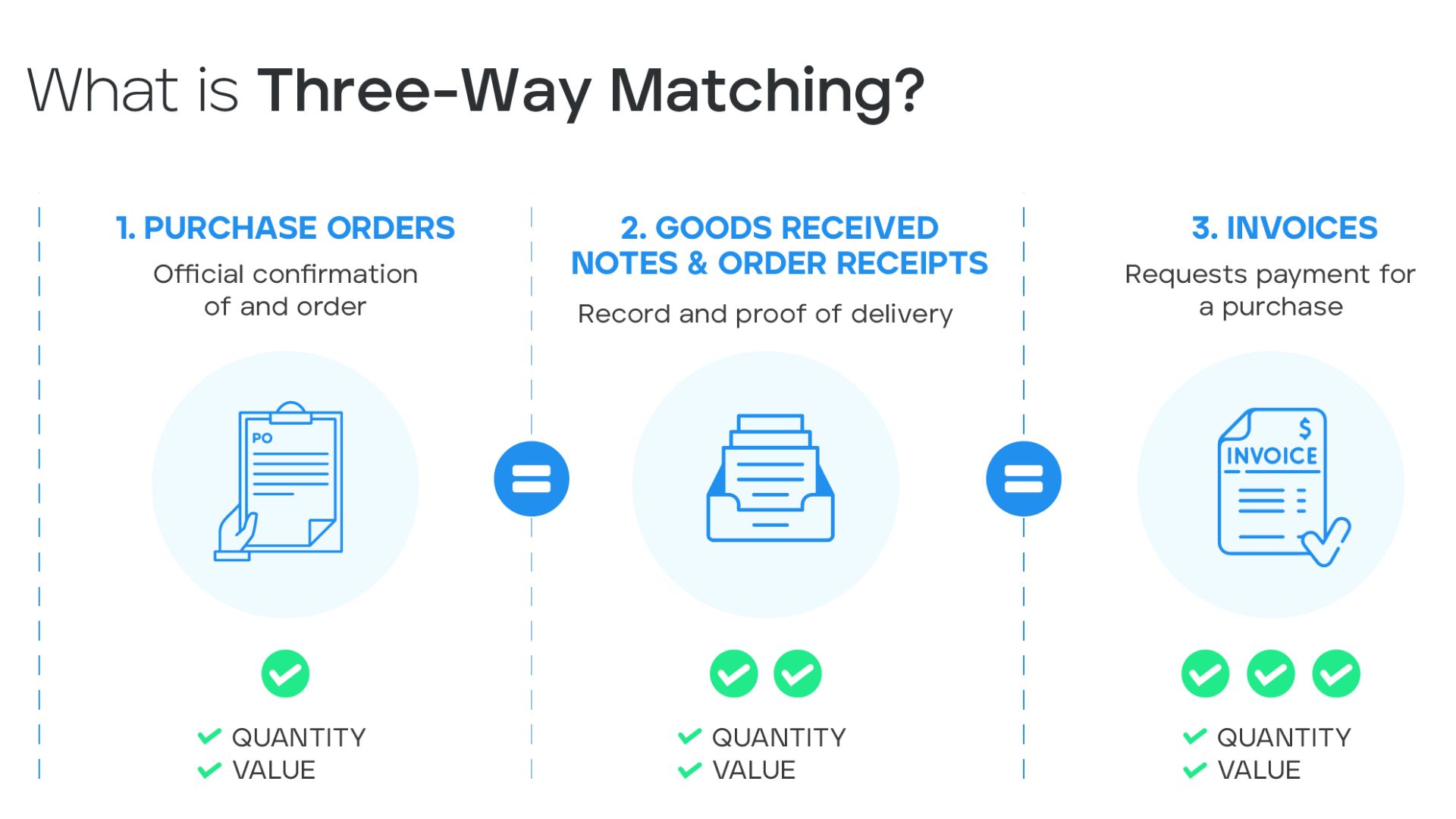
How does 3-way matching in AI First differ from traditional methods?
The goal is not to "match," but to Prevent incorrect payments and reduce cost per invoice..
Traditional
- AP manually or semi-automatically reconciles PO – GR – Invoice.
- The discrepancies were only discovered when the accountant "re-checked" the data.
- Numerous exceptions → delayed payments → additional processing fees
AI First
- Matching is rule and policy-based automation
- Order control right at the point of receipt.
- Push only genuine exception into exception queue
- Have audit trail + explainability for each decision
Types of 3-way matching in First-Intellectual AI
3-way matching in AI First thinking is not intended to "reduce the workload for accountants". which aims Prevent incorrect payments, protect cash flow, and reduce AP operating costs..
3.1 Exact Match
Condition
- Unit price = PO
- Quantity = GR
- Correct tax rate & supplier
Handle
- Automatic STP (touchless)
- No human intervention is needed.
Suitable for high standardization costs, large suppliers
3.2 Tolerance Match (matches within acceptable limits)
AI First allows CFOs to set up tolerance thresholds according to policy.
For example
- Unit price difference ≤ 1%
- Difference amount ≤ 200,000 VND
- Taxes are rounded according to regulations.
Handle
- Still allowing STP
- Flag the log for audit trail.
The exception rate decreased significantly, but... not out of control.
3.3 Partial Match
Situation
- GR receives in installments.
- Invoices issued in multiple batches.
- The PO has remaining quantity.
AI First Processing
- Allow payment based on received portions.
- Follow the rest on the PO.
- Prevent payments exceeding the purchase order.
Reduce instances of "pending invoices" due to incomplete order fulfillment.
How does AI-First thinking help control budget-actual costs in real time?
AI First transforms budgets into a "guardrail" right at the point of request and approval, instead of waiting for end-of-month reports. The system automatically alerts users to budget overruns, categorizes approvals according to policy, and continuously generates real-time data for the CFO.
AI-First thinking helps control Budget – Actual in real time by switching from post-audit report luxurious monitoring – forecasting – early interventionThis can be understood through the following five layers:
1. From Static Budget → Living Budget
Traditional
- Budget created at the beginning of the year/quarter.
- Compare Actual after spending.
AI First
- Budget is Attach rules + alert thresholds
- Automatic allocation based on:
- Cost center
- Campaign / project
- Vendor
- Time (months – weeks – days)
Budget becomes a monitoring systemIt's not just about numbers.
2. Actual is updated in real time (Real-time Actual)
AI First pulls expense data as soon as it's incurred, instead of waiting for the books to close.
Data sources
- The purchase order has been approved.
- GR (Goods Receipt)
- Electronic invoice
- Bank payment
- Real-time marketing costs (Ads, KOL booking, e-commerce platforms, etc.)
Real-time control formula
Budget Utilization Rate=Actual+CommittedApproved BudgetBudget\ Utilization\ Rate = \frac{Actual + Committed}{Approved\ Budget}Budget Utilization Rate=Approved BudgetActual+Committed
In there:
- Actual: spent
- Com decisive: Purchase order created but payment not yet made
The CFO sees it. future costs not just the past.
3. AI detects budget deviations before exceeding the budget (Early Warning)
AI doesn't just report "overtaken," but reports... "about to overtake".
AI models used:
- Trend analysis: burn rate
- Seasonality: Costs increase seasonally
- Vendor patternNCC often incurs additional costs.
- Campaign pattern: campaign or team at which stage of the cost
For example
- Budget for June campaign: 500 million VND
- On the 15th, I burned 65%.
AI warns: "At the current pace, we'll surpass 18% by the end of the month."
4. Pre-spend control
AI First doesn't wait until "the money is spent before comparing." When creating a purchase order (PR/PO):
AI verification:
- Remaining budget
- Burn rate of the cost center
- History of similar budget overruns.
- Spending priority level
Decision Engine
- Auto-approve (within safe limits)
- Requires higher approval
- Block / Suggest adjust amount
Budget is Protecting the source of expenditure right from the start..
5. Automatic Forecast: Budgeting is no longer "passive"
EAC=Actual+AI Forecast RemainingEAC = Actual + AI\ Forecast\ RemainingEAC=Actual+AI Forecast Remaining
CFO & Brand Manager know:
- Expected end of month/quarter:
- How much is missing?
- How much is left?
- Should:
- Amputation
- Limb transfer
- Increase the budget appropriately.
Decision making proactive, not firefighting.
6. Dashboard AI First: Understand at a glance – no need to wait for reports.
Realtime dashboard
- Budget vs Actual vs Forecast
- Top cost overrun
- Cost center risk
- Campaign burn is unusually fast.
Questions that AI can answer
- "Which item is burning through the budget the fastest?"
- "If we maintain this speed, when will we be able to overtake?"
- Which vendors typically cause budget deviations?

How does the AI First mindset in Accounts Receivable improve DSO and cash flow?
AI-First thinking in AR optimizes debt collection by automatically categorizing risks based on debt age, prioritizing debt lists, triggering debt reminders based on scenarios, and monitoring results using DSO/aging so that CFOs can see the clear cash impact. Based on 4 core mechanisms:
1. Forecast the risk of late payments by customer.
AI analysis:
- Payment history
- Contract terms
- Repeated late payment behavior
Use a Payment Risk Score and focus on collecting debts from the right customers at the right time, instead of reminding them indiscriminately.
2. Automated debt reminders and follow-up, at the right "golden time".
AI determined:
- When should you remind someone (before the deadline / close to the deadline / past the deadline)?
- Most effective channels (email, Zalo, call)
Reducing debt collection and reliance on human resources leads to faster cash flow and lower DSO (Demand on Sales).
3. Prioritize collecting payments based on cash flow impact.
AI sorts the debt collection list by:
- Amount
- Overdue date
- Impact on cash flow
The AR team focuses on "collecting the most valuable funds first," improving short-term cash flow.
4. Cash In Forecast
AI predictions:
- When will the money actually arrive?
- Best/Basic/Worst Scenarios
The CFO can proactively:
- Spending
- Short term loan
- Adjust the sales plan.
How to calculate ROI when applying AI to AP/AR to help CFOs make investment decisions.
The ROI of AI in Finance is not just about reducing data entry personnel, but also about reducing errors, incorrect payments, tax risks, and improving cash flow. CFOs need a formula that separates operational benefits from working capital benefits.
General ROI formula framework:
ROI=Financial Benefits−Total AI CostTotal AI CostROI = \frac{Financial\ Benefits – Total\ AI\ Cost}{Total\ AI\ Cost}ROI=Total AI CostFinancial Benefits−Total AI Cost
In there Financial Benefits They come from the four main groups below.
- ROI from Accounts Payable (AP):
-
- Reduce invoice processing costs.
SavingsAP Ops=(Cost/InvoiceBefore−Cost/InvoiceAfter)×#Invoices
-
- Avoid incorrect and duplicate payments.
SavingsError=ValueDuplicate+Overpayment Avoided
-
- Optimize early payment discounts.
GainEarly Pay=Discount Earned−Opportunity CostGain_{Early\ Pay} = Discount\ Earned – Opportunity\ CostGainEarly Pay=Discount Earned−Opportunity Cost
- ROI from Accounts Receivable (AR)
-
- Reduce DSO → free up cash
Cash Released=Annual Revenue365×DSO ReducedCash\ Released = \frac{Annual\ Revenue}{365} \times DSO\ ReducedCash Released=365Annual Revenue×DSO Reduced
-
- Reduce bad debt & write off
SavingsBad Debt=Reduction Rate×Total ReceivablesSavings_{Bad\ Debt} = Reduction\ Rate \times Total\ ReceivablesSavingsBad Debt=Reduction Rate×Total Receivables
- Total AI Investment Cost
Include:
- License / Subscription
- Implementation
- Training & change management
- Emergency
How can AI be integrated into existing ERP systems (SAP/Oracle/MISA, etc.) without disrupting operations?
Integrating AI into ERP systems doesn't require a complete overhaul if businesses standardize master data, map data fields, implement access control, and conduct audit trails from the design stage. Deploying API connectivity and data synchronization along business workflows helps reduce downtime risks.
To Integrate AI into existing ERP systems (SAP / Oracle / MISA…) without disrupting operations.Right thinking is not about "Replace ERP" but "Wrapping AI around the outside – plugging it in at the right spot – running in parallel"CFOs and IT professionals typically follow these six principles:
1. Architectural principle: "AI as a Layer," avoiding interference with the ERP core.
- ERP = System of Record (standard data)
- AI = System of Intelligence (analysis – forecasting – warning)
AI reads, analyzes, and recommends; ERP records and executes. No core modifications, no impact on ERP upgrades.
2. Integration via standard API/Connector
Safe method
- Use the available API of:
- SAP (BAPI / OData)
- Oracle (REST API)
- MISA (Accounting and Invoicing API)
- AI tool only:
- Pull data (invoice, PO, AR/AP, master data)
- Push back flag / recommendation / approval status
3. Run a parallel run before going live.
Standard procedure
- ERP is still operating as before.
- AI running shadow mode:
- Analysis
- Compare the results
- Do not interfere with decisions.
- Compare discrepancies → fine-tune the model
4. Integration based on small use cases, not the "big bang" approach.
Prioritize use cases low risk – high ROI:
- AP: bill reading, 3-way matching, duplicate detection
- AR: DSO forecast, customer scoring
- Budget: Budget overrun warning
- Expense: detecting abnormal limbs
5. The "Human-in-the-loop" mechanism
It's about both adhering to internal controls and building user trust.
- WHO not automatically make decisions
- Only:
- Flag
- Propose
- Priority processing
- The final approver remains in the ERP system.
6. Security & Compliance (the top concern for CFOs/IT staff)
Meets audit, tax, and IT security requirements.
- Read-only access
- Assign permissions by role
- Full log (AI audit trail)
- Data storage according to legal standards (10-year invoice validity)
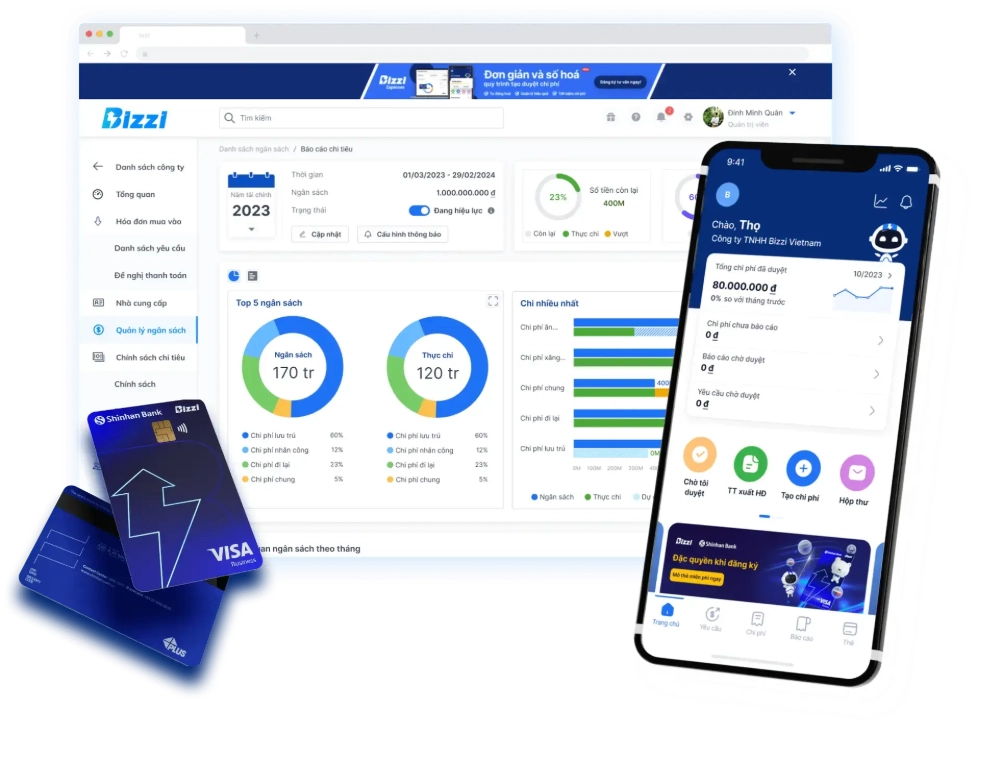
Similarly with Bizzi. Bizzi doesn't replace ERP, but transforms it into "AI-ready": better control, greater transparency, and uninterrupted operations.
Bizzi applies the "AI as a Layer" model to its ERP system.
Step 1 – Connect, do not replace the core.
No changes to the ERP core will be made, and current operations will not be affected.
- Bizzi ERP/accounting integration (SAP / Oracle / MISA…) via API
- Get the standard data:
- PO, GR
- COA, cost center
- ERP is still single source of truth
Step 2 – AI processing & real-time synchronization
Finance tracks expenses and liabilities as soon as they arise, without waiting for the books to close.
- Bizzi AI:
- Reading and standardizing invoices
- Reconciliation of PO–GR–Invoice
- Detection of discrepancies, duplications, and risks.
- Processing status realtime synchronization Regarding ERP:
- Pending / Exception / Approved
Step 3 – Traceability & Compliance
Ready for tax audit and inspection.
- Note:
- Who did what – when – why
- Proof of reconciliation and approval
- Document storage according to legal standards (10 years)

How does AI First thinking automate invoice risk control and tax compliance?
In compliance, AI First isn't about "guessing correctly," but rather about automatically checking supplier/invoice data according to rules, detecting risk indicators, storing traceability evidence, and ensuring that documents meet archiving standards, thereby reducing the probability of errors and post-audit processing costs.
1. Standardize and automatically read invoices (Input Control)
Reduce manual data entry errors – a major source of risk.
- AI OCR + NLP reading:
- Tax identification number, invoice number, date of issue
- Tax rate, tax amount, total amount
- Seller - Buyer
- Standardize data according to tax format.
2. Smart Matching (Multi-dimensional intelligent matching)
Prevent incorrect payments before they happen..
- 3-way matching: PO – GR – Invoice
- Tolerance rule according to company policy
- Identification:
- Duplicate invoice
- Incorrect unit price/quantity
- Tax rate differential
3. Invoice & Supplier Risk Scoring
AI analysis:
- History of misconduct
- Irregular invoicing practices
- NCC is on the risk/absconding list.
- A "beautiful but dangerous" invoice template
Assign Invoice Risk Score andPrioritize thorough examination of high-risk invoices.
4. Tax compliance control based on rules + machine learning
Reduce risk Disallowed payment – retroactive collection – penalty.
- Check:
- VAT deduction conditions
- Deadline for filing
- Valid/legal invoice
- AI learns from:
- Cases that are exempt from tax
- Results of previous inspections
5. Audit trail & digitized evidence
Ready to explain Tax - Auditing.
- Save:
- Original data
- Reconciliation results
- Decision & Approver
- Full time-based tracing
In what ways is AI First better at detecting expense fraud than manual approval?
Manual approvals often rely on intuition and lack comparative data, making it easy to miss sophisticated fraud. AI First detects anomalies based on behavioral patterns, quotas, duplicate documents, and historical discrepancies, then pushes the correct exception to the appropriate authority.
1. Detection pattern Fraud – not just surface flaws
Sophisticated fraud uncovered, without revealing the perpetrators.
Handmade
- Look at each individual invoice.
- Clearly pointed out the error (wrong name, wrong amount).
AI First
- Look sequence of behaviors:
- Splitting bills into smaller amounts to avoid credit limits.
- Repeat the "familiar" NCC
- Spending increased unusually over time.
- Compare with baseline of normal behavior
2. Cross-check
It's difficult to do multiple things simultaneously in a craft.
AI comparison:
- Staff ↔ Department
- Expenditure ↔ Type of work
- Location ↔ Time ↔ Work Schedule
- Expense ↔ approved budget
3. Learn from the past and become smarter.
- AI learns from:
- Fraud case has been discovered.
- Expenditure that was previously disallowed
- Each review round → more accurate model
4. Real-time detection, no need for post-verification.
Genuine loss reduction, not just detection for the sake of "making reports look good".
Handmade
- Fraud is usually detected when:
- Paid
- Payment has been made.
- Settlement completed
AI First
- Warning immediately upon submitting the expense
- Block the money before it leaves the company.
5. Consistency & Freedom from Emotional Influence
- WHO:
- Apply the same rules to everyone.
- No regard for rank.
- Handmade:
- It's easy to overlook "familiar cases".
- Depends on the reviewer.
In short, the AI First mindset doesn't replace the reviewer, but rather acts as a "radar" to detect fraud before money is withdrawn from the business.
A 5-Step Roadmap to Building an AI-First Mindset for the Finance and Accounting Department
An effective AI First roadmap begins with the CFO's commitment, assessing current data and processes, selecting impactful use cases (AP/Expense/AR), implementing a KPI-driven pilot, and only then scaling up. Doing it in reverse order often leads to costly projects that yield no results.
Step 1 Mindset: KPI-based goals, which risks need to be addressed.
Core Objectives
- It's not about "making AI for fun," but rather:
- Optimize financial KPIs
- Lock critical financial obstruction
Key KPIs
- DSO, DPO
- Cost leakage
- Exception rate (invoice / expense)
- Budget variance
- Audit recordings
Risks must be locked in.
- Overpayment / duplicate payment
- VAT non-compliance
- Fraud and expense abuse
- Cash flow volatility
Step 2 Assessment: data readiness, process maturity, control points
Evaluating the three pillars
- Data Goodness
- ERP / accounting system
- Invoice/transaction data quality
- Master data (vendor, COA, cost center)
- Process Matter
- AP / AR / Expense / Budget workflows
- Level of standardization
- Manual vs automated ratio
- Control Points
- Approval matrix
- Matching rules
- Evening travel schedule
Step 3 Strategy: Choose a use case based on ROI/risk.
Use case selection criteria
- AI Spirit
- Risk reduction impact
- Implementing mindfulness
Quick-win use cases
- AP: AI invoice processing & 3-way matching
- AR: DSO prediction & collection prioritization
- Budget: real-time budget control
- Expense: fraud & anomaly detection
Step 4 Pilot: 6–8 weeks (suggested), before/after measurements.
Pilot range
- 1–2 processes
- 1–2 business units
- Parallel run (AI shadow mode)
Before/After Measurement
- Cycle time
- Exception rate
- Cost per transaction
- DSO / overpayment avoided
Step 5 Scale: Scaling along the flow and normalizing governance
Expand by stream
- From AP → AR → Budget → Expense
- From warning → recommendation → proactive control
Standardizing governance
- Human-in-the-loop
- Model monitoring
- Policy & rule ownership
- AI audit trail & compliance
6 barriers that cause AI First in Finance to fail and how to overcome them.
AI-First often fails not because the AI is weak, but because of fragmented data, unstandardized processes, lack of control, insufficient System of Documents (SoD), and vague KPIs. Addressing these issues in the correct order reduces deployment risks and increases the success rate when scaling up.
Barrier 1: Dirty master data
Problem
- Duplicate vendor
- COA / cost center are not consistent.
- Lack of naming standards
Consequences
- AI learns incorrectly → gives false warnings → loses trust.
How to remove
- Data cleansing & standardization
- Single owner for master data
- Data validation rules before feeding into AI.
Barrier 2: Non-standardized P2P processes
Problem
- Each room is decorated in a different style.
- Ignore PO/GR
- Flexible Approval
Consequences
- AI has no baseline to compare against.
How to remove
- Standardizing P2P flow end-to-end
- Define mandatory control points
- Lock down the process before "AI-izing" it.
Barrier 3: Lack of audit trail and evidence
Problem
- I don't know who approved it, or why.
- Lack of evidence during an audit.
Consequences
- AI is not acceptable in a compliant environment.
How to remove
- Enforce digital audit trail
- Evidence-based approval
- Full log of AI and human decisions
Barrier 4: No exception playbook
Problem
- The AI is reporting an error but doesn't know how to fix it.
- Each person handles it differently.
Consequences
- Exception backlog, user quits.
How to remove
- Define exception taxonomy
- Standardize actions according to each exception type.
- Clear RACI for Finance – Procurement – Ops
Barrier 5: Resistance to change (adoption)
Problem
- Fear of being controlled.
- Fear of AI "spotting flaws"
Consequences
- AI is correct, but nobody uses it.
How to remove
- Position AI = assistant, not auditor
- Quick wins in 6–8 weeks
- KPIs linked to adoption, not just compliance.
Barrier 6: Poor ERP integration
Problem
- Slow data sync
- Incorrect mapping
- Interfering with the ERP core
Consequences
- Operational disruption
- IT protests
How to remove
- AI as a Layer Architecture
- API-based, read-first integration
- Parallel run before go-live
Comparison table of "AI First in Finance Ops" vs. "AI First in general"
This table helps CFOs differentiate AI First based on financial-operational KPIs, quickly identify priority use cases and mandatory conditions (data, controls, integration) before investing.
| Use case | Objective (Finance Ops – AI First) | AI First in general | Data needed | Mandatory checkpoints | Financial and operational KPIs | Risks if done incorrectly |
| AP Invoice | Prevent overpayments, reduce cost leakage, and improve tax compliance. | Automatic invoice entry | PO, GR, Invoice, vendor master | 3-way matching, tolerance rule, audit trail | Exception rate, overpayment avoidance, cycle time | Incorrect payment, VAT loss, audit finding |
| Expense | Detecting fraud, enforcing policies, and reducing overspending. | Digitizing the expense form | Receipt, policy, employee data | Policy rule, anomaly detection, approval matrix | Fraud rate, cost per claim, approval time | Internal fraud, loss of control over spending. |
| AR Collections | Reduce DSO, optimize cash-in. | Send automated debt reminder emails. | Invoice, payment history, contract | Risk scoring, collection prioritization | DSO, cash collected, overdue ratio | Inflated cash flow, increased bad debt. |
| Cash Forecast | Accurate cash flow forecasting is essential for decision-making. | Balance summary dashboard | AR/AP aging, payment pattern | Forecast model, scenario control | Forecast accuracy, liquidity buffer | Wrong decision, lack of cash. |
Frequently Asked Questions about AI-First Thinking in Finance and Accounting
Below is a summary of answers to some questions related to AI-first thinking in the field of Finance and Accounting.
Does the "AI First" mindset simply mean buying and using AI software?
Are not. AI First is a management mindset.This is not a decision to buy a tool. AI is only valuable when:
- Directly attached to Financial KPIs
- Plug it in correctly. checkpoint in the process
- Have audit trail and comply
Buying AI but not changing the control method → Low ROI.
Should you start AI First with AP or AR?
AP is often the best starting point., because:
- Clear data (PO – GR – Invoice)
- Fast ROI (3-way matching, spend control)
- High risk if mistakes are made (overpayment, VAT).
AR is suitable when businesses want to Optimize DSO and cash flow.
What are the minimum KPIs to measure AI First's effectiveness over 30–60 days?
- Touchless rate (Non-intervention processing rate)
- Exception rate (Invoice/expense flagged)
- Cycle time (processing time)
- Overpayment avoided
KPIs could not be measured after 60 days because the AI was not in the right place.
How can AI help predict cash flow better than Excel?
WHO:
- Analysis AR aging based on payment behavior
- Learn from payment history and seasonality.
- Real-time updates when invoices are generated.
Excel is static, AI is living forecast.
How do you calculate ROI when using AI for invoices and accounts receivable?
ROI comes from:
- Reduce invoice processing costs.
- Avoid duplicate/incorrect returns.
- Reduce DSO → Release cash
- Reduce bad debt
The CFO should consider this. ROI on P&L + Cash Flow, not only saves manpower.
Will integrating AI into ERP disrupt operations?
No, if:
- Applying architecture AI as a Layer
- ERP connection via API
- Run parallel run before go-live
ERP is still System of recordsAI is an analytical layer.
Does AI First increase tax risk if the AI extracts incorrect data?
No, if yes:
- Rule-based validation
- Human-in-the-loop
- Full Audit Trail
The real risk comes from Manual input and unchecked, not AI.
Which businesses are suitable for Bizzi Bot/Expense/ARM?
Matching word SME to Enterprise.
- Bizzi Bot / B-Invoice: For businesses with multiple input invoices, a 3-way matching and tax compliance system is needed.
- Bizzi Expense: Businesses with high travel expenses need to control fraud.
- Bizzi ARM: B2B business, high debt, needs to reduce DSO.
When should we scale AI First to the entire Finance Ops system?
When the pilot meets its target KPIs and the exception process is stable:
- Touchless rate
- Exception rate
- Cycle time
- Full Audit Trail
Scaling before stabilization often causes exception queues to get stuck, breaks SLAs, and erodes user trust.
Conclude
In the context of rising costs, stricter tax regulations, and increasing pressure for efficiency, AI First has become a mandatory management capability, especially for Finance and Accounting.
For CFOs, the AI First mindset isn't about using ChatGPT to ask for data or relying on AI to generate reports quickly.
AI First thinking = a financial system design mindset where:
- AI is placed at the core of the process, not as a decorative element.
- Data-controlled operations are built around the ability to automatically detect risks and exceptions and optimize cash flow.
In short, it's not about "AI helping me work faster," but rather "AI helping the financial system operate correctly, completely, and in a controlled manner, right from the start." AI First doesn't make businesses "more technologically advanced," but makes them "better managed."
Bizzi is partnering to transform the AI First mindset into a proactive, transparent financial control system that generates real monetary value.
To receive personalized solutions tailored specifically to your business, register here: https://bizzi.vn/dang-ky-dung-thu/