


Variable costs are expenses whose total amount changes depending on the level of activity, such as the number of products, orders, or hours of service provided. Ingredients for each cup of bubble tea, packaging according to orders, and sales commissions are common examples. Market price fluctuations can cause unit prices to change, but this is not the only criterion for identifying variable costs.
To calculate correctly, it's necessary to select the same period, the same cost range, and the correct operating unit. Then, separate the total variable costs, variable costs per unit, and the remaining revenue to offset fixed costs. A product selling for more than its variable cost does not necessarily mean the business has made a profit.
What are variable costs?
A variable expense is defined as the level of expenditure or amount of money incurred in relation to a specific activity. Identify the activity that causes the cost to change before relying on the account name, department, or payment date. The same name, such as “labor cost” or “transportation,” may contain both fixed and variable components.
| Expenditure | Activities that cause costs to change | Conditions to be checked |
|---|---|---|
| Raw materials, packaging | Number of finished products, quantity of materials used | Use actual consumption or standard consumption with explanation of losses; the quantity purchased does not necessarily reflect the quantity used during the period. |
| Piecework wages | Number of products that meet requirements or hours worked that are paid for | Monthly wages are guaranteed not to automatically become variable costs simply because employees are involved in production. |
| Sales commission | Revenue, number of eligible orders or transactions | Check the rates, bonus tiers, reimbursement options, and fixed compensation components. |
| Shipping and packaging | Order, weight, trip, or distance | Minimum fares, monthly rentals, and per-trip fees have different policies. |
| Electricity, water, gas | Operating hours, usage level, or output | Separate subscription fees, system maintenance fees, and consumption fees; do not consider the entire bill as a variable cost. |
| Payment fee | Number of transactions or payment value | The portion calculated as a percentage may vary, and the monthly fee or minimum amount needs to be handled separately. |
For example, a garment factory buys fabric to stockpile for several months. Cash flow to suppliers increases in the month of purchase, but the variable cost for the number of garments produced must be based on the amount of fabric used for those garments. If you add up the total cost of fabric purchases to the variable cost for the month and divide by the number of garments sold, the result may be incorrect due to inventory and time differences.
In the service industry, the number of consultation hours or customer visits may be more relevant than the number of products. With shipping, the number of orders alone is insufficient if the orders vary significantly in weight or distance. A well-performing unit should be able to explain the majority of the variation in the expenditure under consideration.
Does the unit variable cost always remain constant?
The unit variable cost is only assumed to be stable within a linear model and a defined operating range. If each cup uses the same amount of ingredients, the unit price remains constant, and the rate of loss is stable, the variable cost per cup may remain the same when selling more. In reality, quantity discounts, recipe changes, productivity, overtime, or input costs can all cause it to change.
Therefore, it is necessary to clearly state which standards are being used, for what time period, and to what production level. When switching to a new production shift or exceeding current capacity, update the assumptions instead of extending the old cost curve for all scales.
Distinguish between variable costs, fixed costs, and mixed costs.
Variable costs are identified by the level of activity; fixed costs typically keep their total amount stable over a period and range of capacity; mixed costs have both components. This is a management-oriented analysis. It does not automatically determine whether an expense is tax-deductible or which account it should be recorded in.
| Criteria | Linear variable costs | Fixed fees within the scope of review | Mixed costs |
|---|---|---|---|
| Total when activity increases | Increase based on activity if unit price/standard remains unchanged. | Remain unchanged until commitment or capacity changes. | The fixed part remains unchanged, the variable part increases. |
| Cost per unit | Stability under linear assumption | The cost decreases when the same total fixed cost is divided among more units. | Changes according to the two-part ratio |
| When output is zero | The net variable cost per unit of output can be zero. | Rent, insurance, or salary commitments may still accrue. | The remaining fixed part |
| Hypothetical example | 12,000 VND for materials/packaging/labor per cup | 10 million VND in rent and fixed fees each month. | Phone subscription with a per-use fee. |
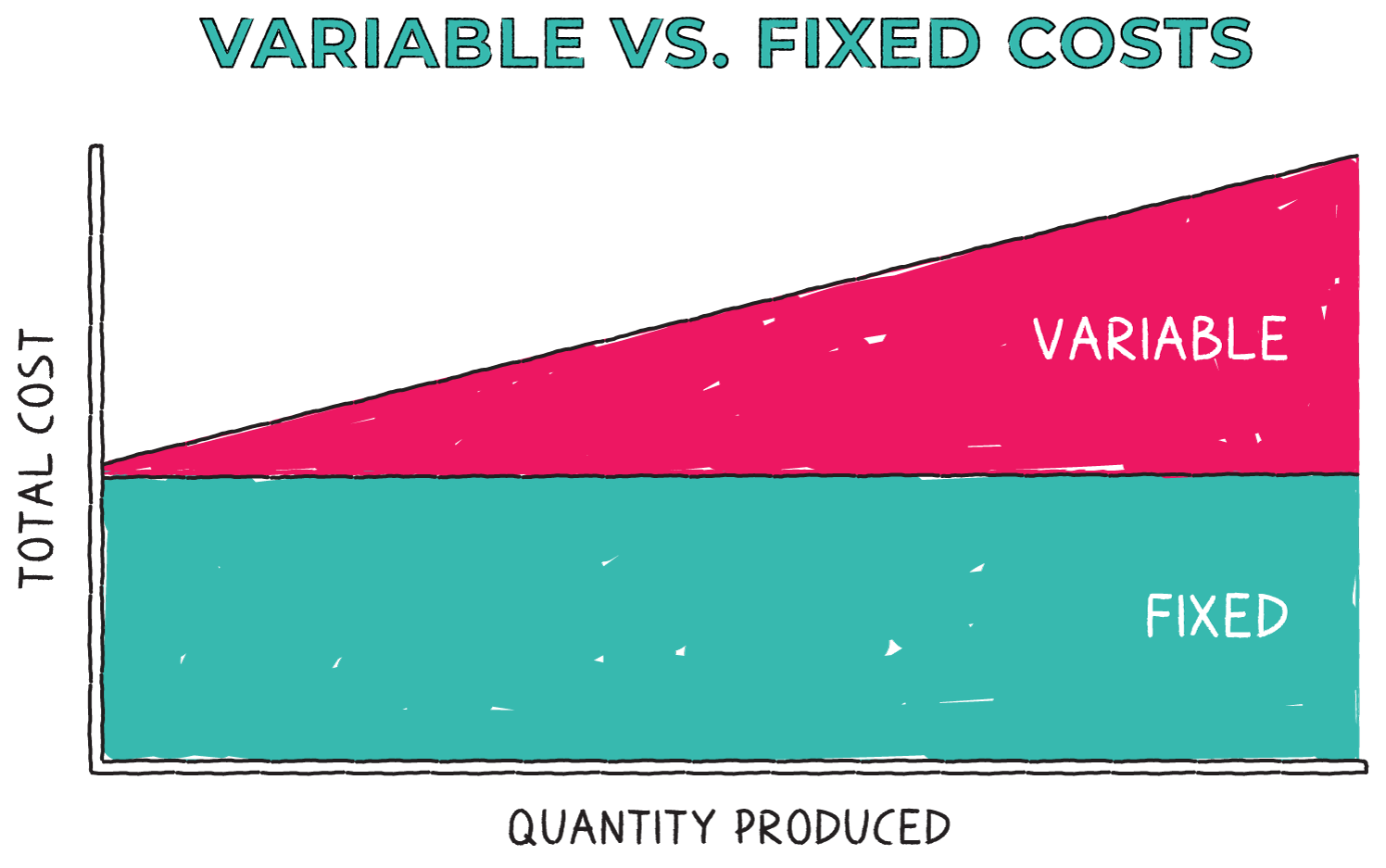
A bubble tea shop that rents a space for 10 million VND/month may still have to pay rent even if they don't sell a single cup that month. When selling 500 cups, the average rent is 20,000 VND/cup; when selling 1,000 cups, it's 10,000 VND/cup. What decreases is... average fixed costs, This is not evidence that variable material costs per cup have decreased.
If a detailed analysis of commitments, capacity, and average fixed costs is needed, a comparison can be made. Characteristics of fixed costs. When creating your own business model, use contracts and actual pricing methods instead of a generic, standardized pricing system.
How are expenditures that increase in a tiered or non-linear manner handled?
The total cost doesn't increase uniformly for each product. For example, let's assume a truck can carry a maximum of 100 packages. The per-trip fee might remain the same from 1 to 100 packages and then increase when a second trip is needed. The number of trips and capacity should be clearly stated, rather than defaulting to the same shipping fee per package for all order levels.
Tiered costs may remain constant for a period and then jump when a threshold is exceeded. Whether they are called tiered variable costs or tiered fixed costs depends on the level of flexibility and scope of management being considered. This cannot be inferred solely from the names "maintenance" or "indirect labor." With tiered pricing, material cost reductions, or productivity changes, it is advisable to create a cost breakdown by interval rather than using a straight line for the entire system.
Formulas for calculating total variable costs and unit variable costs.
Once the unit variable cost has been determined and stabilized within the calculated range, the total variable cost equals the unit variable cost multiplied by the volume of operations. If you already have the total actual variable costs, divide them by the corresponding activity volume to find the average. These two calculations answer two different questions.
| Target | Recipe | Conditions/Units |
|---|---|---|
| Total variable cost (TVC) | TVC = v × Q | v: VND/unit; Q: number of units in the same period; v remains stable within the scope of consideration. |
| Average Variable Cost (AVC) | AVC = TVC ÷ Q | Q>0; using the right product/service and within the same price range. |
| Total cost of the calculation (TC) | TC = FC + TVC | FC and TVC are both sums for the same period; do not multiply this sum by Q again. |
| The proportion of variable costs in total costs. | TVC÷TC× 100% | TC > 0, same range; not to be confused with TVC ÷ revenue |
If each item has a different activity, calculate it separately and then add them together. For example, raw materials based on the number of cups, commission based on sales, and shipping based on the number of orders require three different calculation bases. Do not simply divide everything by the number of cups and assume that the relationship remains the same when the order structure changes.
For example, calculate the standard price for a cup of bubble tea.
Assume the shop tracks the same type of drink for a month. Variable costs per drink include ingredients 8,000 VND, packaging 2,000 VND, and labor cost per product 2,000 VND: total 12,000 VND/cup. This simplified model assumes no other variable costs have been incurred, and the standards and unit prices remain unchanged.
- 500 glasses: 12,000 × 500 =6,000,000 VND total variable costs.
- 1,000 glasses: 12,000 × 1,000 =12,000,000 VND total variable costs.
- At both levels, the variable cost per unit is 12,000 VND/cup. The total increase is due to the addition of more cups, not because each individual cup costs more.

If next month the restaurant has actual variable costs of 13.2 million VND for 1,000 cups of the same type, the AVC is 13,200 VND/cup. The difference of 1,200 VND/cup needs to be analyzed based on raw material prices, usage volume, losses, or labor costs; it cannot be simply explained as the business "expanding its scale" and therefore the unit variable cost must increase.
Short calculations to check units
The hypothetical examples below use USD to maintain the basis of each calculation. Do not add them with the Vietnamese Dong example or compare the unit prices of other products.
| Data | Operation | The result is truly meaningful. |
|---|---|---|
| 50 products, $100 variable cost per product. | 50 × 100 | $5,000 total variable costs |
| 400 USD total variable costs, 80 shirts | 400 ÷ 80 | $5 average variable cost per shirt |
| Selling price: $20 per shirt, variable costs: $12 per shirt | 20-12 | The $8 USD contribution margin per shirt is not the final profit. |
| Fixed fee of $1,200 USD/month, contribution balance of $8 USD/shirt | 1,200 ÷ 8 | 150 shirts break even according to the model's assumptions. |
From actual data to variable cost estimates
A helpful approach is to separate the costs, activity levels, and fixed costs before creating a budget. A single "previous month's expenses" column is not enough to determine the unit variable cost or conclude that the following month will exceed the budget.
- Final deadline and target audience: Select the month, product, store, or service. Determine whether you are calculating production or sales volume and handle inventory discrepancies.
- Select the operating unit: Product meets standards, order number, weight in kilograms, or service hours. Write the unit next to the amount; do not mix the number of cups with the number of orders delivered.
- Gather documents and data for use: Link purchase price, quantity used, labor costs, and fees by activity. Separate purchases for inventory, prepaid, or other periods.
- Categorize each item: Determine the purely variable, fixed, and mixed components. Using the contract terms/standards as a basis, review the minimum and tiered fee levels.
- Unit calculations and scenario planning: Calculate the standard rate × unit price or total actual value ÷ Q. Record the assumed price, product mix, losses, and capacity range.
- Comparison at the same production level: Calculate the estimated amount based on the actual quantity, then assess the difference. Assign responsibility for investigating the cause and updating assumptions when conditions change.
With mixed costs, the fixed portion should be separated using a chargeable clause or a tested estimate. If there is insufficient data, keep the label “mixed/not yet separated” instead of forcing the entire amount into variable costs. The high-low method can be used to estimate from two activity levels but is susceptible to the influence of an unusual month; the model should be tested with multiple periods and actual transactions.
For production costs, classification by cost behavior does not replace the determination of raw materials, labor, and manufacturing overhead within the scope of cost calculation. Further information can be found here. Production cost groups and how to group them when it is necessary to delve deeper into that task.
The total increase in spending is not sufficient to conclude that it exceeded the budget.
Assuming a sales estimate of 1,000 cups at 12,000 VND/cup, the total variable cost would be 12 million VND. In reality, 1,200 cups were sold, resulting in a variable cost of 14.4 million VND. Compared to the initial estimate, the cost increased by 2.4 million VND, but... The price remains at 12,000 VND per cup.. The estimated cost based on the actual quantity is also 14.4 million VND, so this example does not yet show an overspending of variable costs per unit.
If the actual expenditure is 15 million VND for the same 1,200 cups, the average price is 12,500 VND/cup, and the difference compared to the budget for the same quantity is 600,000 VND. In this case, it is necessary to check the price, losses, beverage mix, additional work, or fees not included in the budget. Do not use the total increase compared to a month with fewer customers as evidence of waste.
How does contribution margin help determine profitability and break-even point?
The selling price minus the unit variable cost is the unit contribution margin, also known as the profit on variable costs. This portion is used to offset fixed costs and then generate profit within the model. Directly calling it "net profit" would omit the expenses that still need to be covered.
With a selling price of 30,000 VND/cup and variable costs of 12,000 VND/cup, the contribution margin is 18,000 VND/cup. If the shop sells 1,000 cups, the revenue is 30 million VND, total variable costs are 12 million VND, and the contribution margin is 18 million VND. Assuming total fixed costs included in the model are 10 million VND/month, the remaining profit is 8 million VND. This is a hypothetical result within the calculated scope, not a definitive statement of profit after all interest, taxes, or omitted expenses.
Break-even point for a product: Q = FC ÷ (p − v), when p − v > 0. With 10,000,000 ÷ 18,000 ≈ 555.56 cups, at least 556 cups are needed if sold in whole units and assumptions remain unchanged.
When dealing with multiple products, varying prices, spoilage rates, or delivery rates, a suitable sales mix must be considered. A single-product formula doesn't automatically apply to a constantly changing mix. Framework ACCA cost-volume-profit analysis Clearly state the assumptions regarding linear relationships, scope of operations, and product mix.
Can variable costs be used as the minimum selling price?
Variable costs are a data point for short-term decisions, not a price that guarantees a business won't incur losses. An additional order requires consideration of actual increased costs, available capacity, additional fixed costs, the impact on existing customers, and resources tied up. If a business consistently sells at only slightly more than variable costs but not enough to cover fixed costs, it can still incur losses.
Average variable costs also differ from the cost of increasing one unit. When exceeding capacity or requiring a new trip, the additional cost may differ from the average cost currently in use. Guidance on marginal cost appropriate for this decision; do not use the two concepts interchangeably.
Optimize variable costs while maintaining quality and service.
Instead of cutting every expense at the same rate, we should reduce waste per unit and control purchasing conditions. The objectives need to be considered in conjunction with quality, return rate, service time, and cash flow. Lower purchase prices but higher defect rates can increase overall costs.
- Materials: So, the total price includes delivery, quality, and consumption rate. For bulk purchases, consider expiration dates, storage, and tied-up capital; discounts do not automatically compensate for damaged goods.
- Labor: Improve operations, shift scheduling, and training to reduce rework time. Don't assume replacing the entire workforce with temporary workers or reducing commissions will improve results.
- Packaging/Shipping: Test options that suit the weight and level of protection required for the shipment. Monitor reshipment fees, claims, and lost/stolen goods before choosing the lowest shipping rate.
- Revenue-based fees: Review contracts, rates, fee tiers, and refund/cancellation transactions. Compare within the same sales channel, avoiding misinterpreting channel structure changes as errors in pricing.
- Energy: Separate the base cost from the time-based machine operation cost, and monitor the downtime losses. Automation investments need to account for additional fixed costs and the volume required to utilize the capacity.
Choose an area with a significant difference, try a small measure, and remeasure at the same volume of activity. If changing ingredients reduces the cost by 1,000 VND/cup but increases the return rate, consider both the return and processing costs. Do not report savings based solely on the difference in quoted prices.
When it is necessary to organize personnel to review, assign responsibilities, and verify expenditures before/after they occur, this can be continued with... business cost control process. This is an operational step following the cost analysis, and does not replace cost classification.
The budget should include scenarios for activity levels rather than just a fixed amount for the entire year. The connection between plan, reality, and adjustment responsibilities is outlined in the guidance. budgeting and management.
When is the Bizzi solution suitable for controlling expenses?
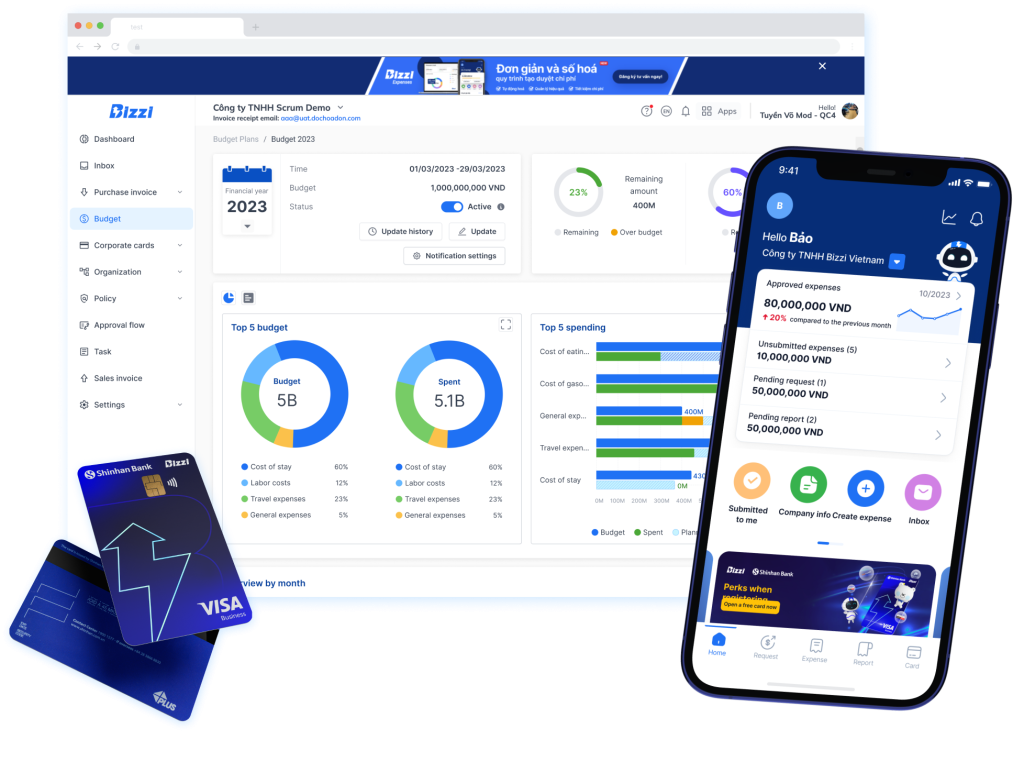
Bizzi Expense is well-suited for proposing, approving, and tracking spending against budgets. When multiple departments incur expenses, data regarding the requester, purpose, category, supporting documents, and actual expenditure must be kept consistent to provide a basis for management verification.
To analyze variable costs, businesses still need operational data from their production/sales systems. The finance department decides which items are variable, the accounting period, and the applicable standards. It's not advisable to assume that expense tracking software will automatically classify variable costs, calculate cost of goods sold, or determine the break-even point for every product.
When evaluating a solution, you can start with a checklist: consistent input, approvers, budget scope, and how to export/reconcile actual data. Then, check the fit with existing processes before scaling. Requirements such as system integration, update methods, or output analysis need to be validated according to the specific configuration.
Frequently Asked Questions about Variable Costs
Are variable costs the same as variable costs?
In activity-based classifications, "variable costs" and "variable expenses" are often used to refer to variable costs. It is necessary to read the definition and scope in the document being used; do not confuse them with "switching costs" or supplier switching costs.
If there is no production, does that mean all costs are zero?
No. Net operating variable costs may not arise when production stops, but rent, committed salaries, maintenance fees, and other obligations may remain. Expenses or inventory carried over from the previous period also do not disappear when production ceases.
Is it possible to calculate the average variable cost when output is zero?
It is not possible to divide TVC by Q=0. Note that the average is undetermined, check the category of the remaining expenditure, and use a period with relevant activity to establish the standard; do not replace the division with 0 for convenience.
Are advertising costs variable or fixed costs?
It depends on how it's generated. Commissions per transaction or fees per visit may be tied to activity; a fixed-budget advertising package may not fluctuate with the number of items sold. Don't categorize it solely by the name "marketing".
Are direct labor costs always variable costs?
No. Pay based on actual output/hour and a committed monthly salary have different treatment. The contract, minimum wage, overtime, and capacity need to be checked to differentiate between fixed, variable, or tiered pay.
Is a lower variable cost ratio always better?
There is no single optimal ratio. Models with low variable costs but high fixed costs require sufficient activity to offset committed costs. Comparisons must be made within the same scope, quality, and business model; do not draw conclusions about efficiency from a single ratio.
With established spending limits, is it necessary to maintain consistent spending data when multiple departments are involved? Connecting proposals, approvals, and expenditure tracking helps management teams monitor spending against agreed-upon budgets and responsibilities.