


“EPM and BI: The Brain and Eyes of the Enterprise in the Data Age”. If BI is where data is seen and understood, then EPM is where data is transformed into action.
Comparing EPM vs BI helps businesses understand the nature to make the right choice, solving the problems the team is facing.
Why do businesses easily confuse EPM and BI?
Many businesses view EPM (Enterprise Performance Management) and BI (Business Intelligence) as the same type of data analytics system. In reality, the two tools serve different purposes in the management cycle — but they complement each other closely.
The reason why businesses easily confuse EPM and BI is because both process and analyze data. However, when comparing EPM vs BI, you will see that BI helps “see” the current situation, while EPM helps “control” the future. When combined, they create a Data-driven Performance Management platform – where all decisions are based on data, not emotions.
Understand correctly What is EPM? – Enterprise Performance Management
Before comparing EPM vs BI, it is necessary to understand the nature of each solution. Benefits of EPM for Business is to optimize performance, control costs, and improve forecasting accuracy – thereby helping leaders make decisions based on data, not emotions.
1. EPM in the context of business management
EPM (Enterprise Performance Management) is a system that helps CFO and FP&A department coordinate the entire process planning – forecasting – consolidated reporting – performance analysis.
If ERP reflects current operations, then EPM is the financial “brain” that looks to the future. – where data is transformed into strategic planning and decisions.
2. Functional pillars of EPM
- Planning & Budgeting – Plan and allocate budgets by department, project or region.
- Forecasting – Dynamic financial forecasting (rolling forecast) helps businesses respond quickly to market fluctuations.
- Consolidation & Close – Consolidate multi-unit financial reports, shorten closing cycles and ensure compliance with accounting standards.
- Variance Analysis – Analyze the difference between Plan vs Actual to determine the cause and improvement measures.
- Performance KPIs – Measure and monitor strategic performance against core financial and operational metrics.
3. Who should use EPM?
EPM is particularly suitable for:
- CFO and Financial Controllers – to monitor and make strategic financial decisions.
- FP&A teams – to optimize planning, forecasting and analysis processes.
- Corporate Planning departments – to ensure the entire business operates towards the same financial and performance goals.
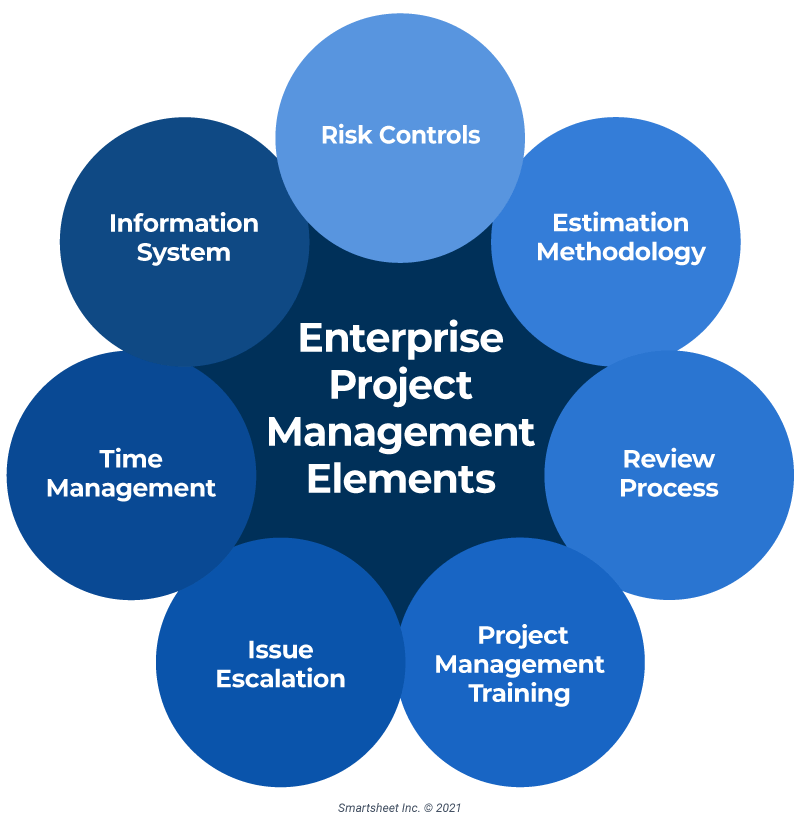
What is BI – Business Intelligence in the data age
If EPM is strategic brain Looking to the future, BI is the “eyes” of the business – allowing a real-time view of the entire business situation.
1. Definition and core role
BI (Business Intelligence) is a system that analyzes and visualizes past and present data, helping businesses understand operational performance, detect trends, and make timely decisions.
2. Core features of BI
- Data Visualization – Data visualization through dashboard, chart, heat map, helping users easily grasp insight.
- Reporting – Automation periodic or custom reports, reducing dependence on IT personnel.
- Ad-hoc Analysis – Allows users flexible analysis and ask questions directly with the data.
- Data Mining & Predictive Analytics – Exploiting big data to detect behavioral patterns and predict trends.
- Real-time Dashboard – Continuously update data to help managers make instant decisions based on factual information.
3. Who uses BI?
BI is used across departments:
- Sales – track sales, employee performance, sales opportunities.
- Marketing – Measure campaign effectiveness, optimize advertising costs.
- Operations – control production process, supply chain.
- Finance - analysis of costs, revenue and profits.
- HR – monitor staff performance and turnover rates.
From analysts to executives, everyone can make faster, more accurate decisions thanks to insights from BI.
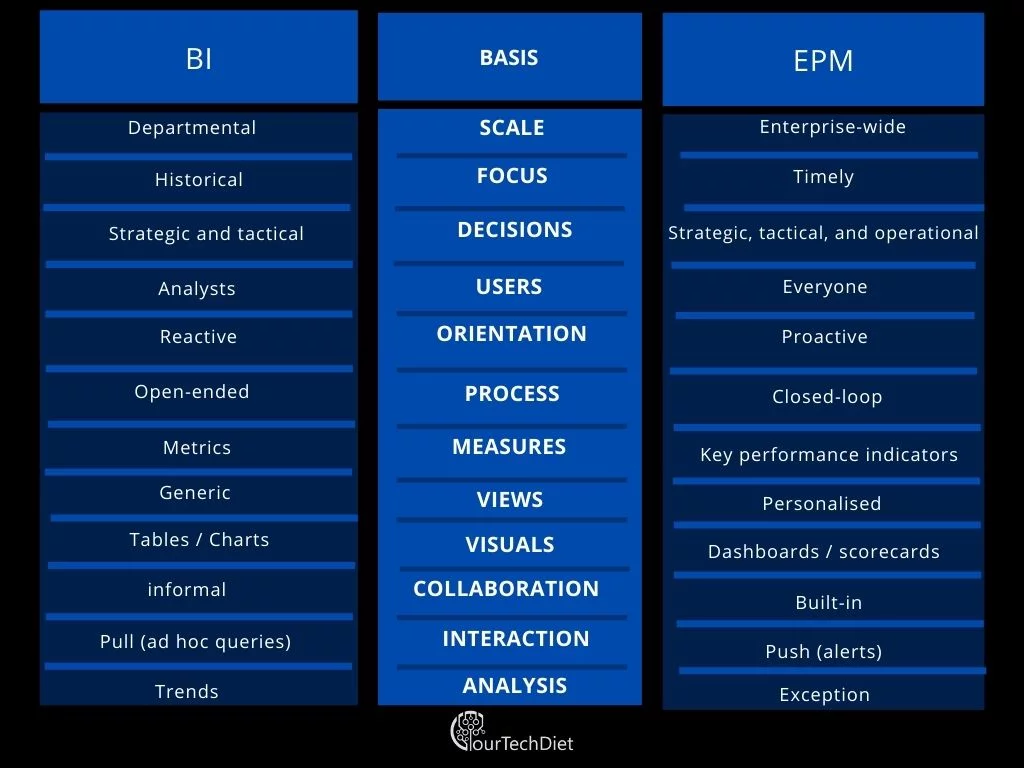
Detailed EPM vs BI comparison table
BI helps businesses see and understand what is happening, while EPM helps plan what should happen next. When the two systems are combined, businesses have a complete performance management cycle – from observation to action.
Below is a comparison table of EPM vs BI based on some basic criteria:
| Criteria | EPM (Enterprise Performance Management) | BI (Business Intelligence) |
| Time direction | Forward-looking – Focus on the future | Backward-looking – Analysis of past and present |
| Main objective | Planning – forecasting – performance measurement | Data analysis – reporting – visualization |
| Main users | CFO, FP&A, Controllers | All departments: Sales, Marketing, Finance, HR, Operations |
| Data sources | Plan, Budget, Forecast – simulation data and strategy | Historical & Real-time Actual – actual data |
| Workflow | Have approval process, version control, audit trail | No workflow; more about instant analysis |
| Typical tools | Sactona, Oracle EPM Cloud, Anaplan | Power BI, Tableau, Qlik |
EPM vs BI Comparison: Two Complementary Pieces in Performance Management
BI helps businesses look back at the past and understand the present, providing intuitive insights for all levels of management. EPM helps businesses look to the future, transforming data and insights into specific action plans.
These two systems do not compete but complement each other – creating a comprehensive Data-driven Performance Management platform.
1. How two systems are linked
In the modern data governance ecosystem, EPM (Enterprise Performance Management) and BI (Business Intelligence) do not exist in isolation operate in a closed loop:
- BI provide data Actuals give EPM to compare with Plan and performance measurement.
- EPM create again Plan / Forecast data – is the foundation for BI analytics and visualization.
- When two systems are seamlessly connected, the business achieves a “Closed-loop Performance Management” – where data is continuously fed back, updated and improved through each business cycle.
2. Specific integration use case
When combined, these two systems create a comprehensive performance management cycle – helps businesses not only know where, but also know where to go next.
- Sales Planning
- EPM Set up revenue plans by region, product, or sales channel.
- BI monitor actual sales, detect variance and provide early warning to adjust plans.
- Cost Control
- EPM set up cost budget and allocated to each department.
- BI monitor real-time spending, helping businesses control budget deviations in a timely manner.
- Profitability Analysis
- BI analysis profit margins, cost structure and product efficiency.
- EPM use that result to forecast model adjustment and make more accurate strategic decisions.
When should businesses invest in EPM, BI, or both?
It depends data governance maturity and organizational size, businesses can prioritize investment EPM, BI, or combine both for optimal results.
1. Prioritize EPM if:
- Still budgeting and forecasting using Excel, leading to data discrepancies and difficulty controlling.
- Need to version control, approve and consolidate data from multiple units or branches.
- FP&A departments spend too much time crunching data, instead of focusing on analysis and strategic consulting.
When the CFO or Controller is constantly “running numbers” and doesn’t trust internal data — it’s time for EPM.
2. Prioritize BI if:
- Fast, intuitive, real-time reporting serving daily operations management.
- Data is being distributed across multiple systems (ERP, CRM, POS, HRM, etc.), need to be merged for analysis.
- Leaders want track performance KPIs (sales, sales performance, marketing costs…) instead of just financial planning.
When departments have to “ask for numbers” from each other or reports take days — BI is the preferred choice.
3. Both are needed when:
- Revenue > 200 billion and has a separate FP&A department.
- Have implemented large scale ERP such as SAP, Oracle, or Microsoft Dynamics.
- The strategic goal is to shift from “reporting” to “performance management”, creating a closed management cycle from data to action.
BI helps to see the current situation, while EPM helps to orient the future. Comparing EPM vs BI and integrating the above two solutions at the same time, businesses achieve comprehensive performance management capabilities - both understand, fit act data-driven
Case Study: Businesses effectively combine EPM and BI
Besides comparing EPM vs BI, analyzing hypothetical case studies also helps businesses have a clearer perspective on solutions.
Background
A large retail business deployed Power BI to track sales and inventory in real time. However, the revenue and expense forecasting process was still done manually in Excel, resulting in:
- Version conflicts between plan files.
- Difficult to consolidate data from multiple branches.
- It takes a lot of time to summarize before each financial reporting period.
Solution
The business decided to deploy EPM – Sactona, directly integrated with existing BI systems. Specifically:
- EPM (Sactona) used to Automate forecasting and budgeting processes, standardize planning models.
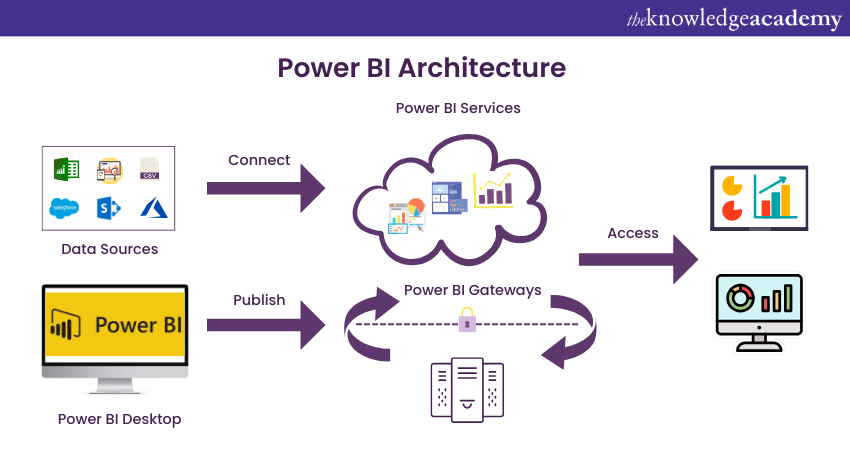
- Power BI continue to play a role display actual data (Actuals) and visualize the results.
- Two systems are two-way connection: Actual data from BI is poured into EPM to compare with Plan/Forecast, creating Closed-loop Performance Management.
Results achieved
- Data consolidation time reduced by 50% – consolidation is automatic instead of manual.
- Forecast accuracy increased by 20%, thanks to continuously updated data and unified forecasting model.
- The FP&A team shifts its focus from “data preparation” to analysis and providing business insights, enhancing its strategic consulting role for the leadership.
The most typical example is LIXIL – Japan’s leading manufacturer of bathroom equipment and building materials. Using Excel to collect and summarize data is very time-consuming. The problem for LIXIL is to find a unified global financial system, but still flexible enough to adapt to continuous organizational changes.
When implementing EPM solutions – specifically Satona, LIXIL achieved the following results:
- The system becomes flexible, internal units operate autonomously and respond quickly to organizational changes.
- Easier data entry and reporting, reducing the burden on user input
When EPM and BI are properly integrated, businesses not only save time processing data but also improve decision-making capabilities – from past reporting to future planning, based on a single, reliable source of data.
See more EPM case studies here
The Convergence Trend Between EPM and BI in the AI Era
Not only stopping at comparing EPM vs BI, grasping the convergence trend between EPM and BI in the AI era is very important, because it helps businesses not only keep up with technology but also optimize strategic decision-making capabilities.
1. Convergence Trend – Inevitable Convergence
The boundary between EPM (Enterprise Performance Management) and BI (Business Intelligence) is fading away.
- The Vendor BI expand capacity by adding Planning & Forecasting module, helping users not only “analyze the past” but also “plan the future”.
- On the contrary, the EPM platform is integrating intuitive dashboard, KPI monitoring and predictive analytics, helping financial and operational information to be more closely connected.However, the market still There is no truly optimal “all-in-one” platform yet. – where planning, reporting, and analytics operate seamlessly on a unified data source.
2. AI & Machine Learning – Catalyst of Convergence
Artificial Intelligence (AI) and Machine Learning are becoming a natural bridge between two systems:
- AI in BI help detect abnormalities (anomaly detection), market sentiment analysis (sentiment analysis), and automatically derive insights from unstructured data.
- AI in EPM focus again automated forecasting, predictive scenario modeling and what-if simulation, making the planning process flexible and adaptable in real time.
3. Future: Unified Platform for Continuous Planning & Intelligent Analytics
In the era of real-time data, businesses will need a unified platform - place:
- Data from BI is automatically updated into EPM to continuous planning.
- AI proactively suggests adjustment plans based on market fluctuations.
- FP&A teams can make decisions faster, based on proactive analysis instead of reactive reaction.
BI and EPM are no longer two separate systems – but two sides of the same intelligent decision-making process, powered by AI. Comparing EPM vs BI is both to understand the nature and at the same time to grasp the trends in the AI era. Enterprises not only keep up with technology, but also optimize performance management capabilities, make quick and accurate decisions, and create sustainable competitive advantages.
Conclude
Through comparing EPM vs BI, we can see that the two systems are not substitutes for each other. perfect complement in the journey of modern performance management. While BI help businesses understand the present – what is happening, why, and to what extent. Then EPM help businesses future orientation – what to do next, and how to achieve the goal.
In other words, BI helps you “see” the business, EPM helps you “lead” the business. When combined, the business not only reacts quickly but also proactively create the future.
The ideal roadmap for businesses looking to implement technology solutions is:
- Getting Started with BI to build a data foundation, creating a habit of making decisions based on insight.
- EPM Investment As operations scale, tighter planning, forecasting, and performance control are required.
- Integrate both systems to move forward “data-driven performance management” – where every strategic decision is supported by unified, transparent, real-time data.
For businesses to aim for data-driven performance management, choosing a reliable EPM platform is an important step. In Vietnam, Sactona is exclusively distributed by Bizzi in Vietnam. is a solution worth considering, helping FP&A and leaders make quick, accurate and transparent decisions.
Sactona not only supports data planning and consolidation, but also Integrated predictive analytics and scenario modeling, in line with the trend of EPM & BI convergence in the AI era. Case studies of EPM successfully implementing Sactona include large corporations such as Panasonic, Fuji Film, Monex, LIXIL,...
Sactona – EPM solution is the trusted assistant of modern CFOs. Sign up here to get advice!