


Decision 345/QD-BTC is creating pressure for FDI enterprises and listed companies to transition their reporting systems from VAS to IFRS. However, the biggest challenge for CFOs is not just the difference between "form" and "substance," but rather the processing of millions of fragmented data lines to perform VAS-IFRS account mapping and retroactive application under IFRS 1.
This article by Bizzi, developed by the Bizzi & Finevo expert team, provides a 5-step technical roadmap for converting VAS to IFRS, an in-depth analysis of key standards, and an automated Record-to-Report (R2R) solution using RPA & EPM to optimize capital costs and control compliance risks.
Why do CFOs need to activate the IFRS transition roadmap under Decision 345 this fiscal year?
Before discussing the technical aspects, CFOs need to consider the issue from a capital strategy perspective. Converting VAS to IFRS is no longer an experimental option but a necessary preparatory step for the period after 2025.
Activating the IFRS transition roadmap early is a prerequisite for preparing data for IFRS 1 – First-time Adoption, especially requiring the provision of comparative information at least one year before the implementation date. Besides complying with Decision 345/QD-BTC, converting financial statements to IFRS helps to increase transparency in financial capacity, improve credit rating, and reduce the cost of capital when raising international capital.
The voluntary phase, until 2025, applies to parent companies of state-owned corporations, listed companies, and FDI enterprises that require it. After that, the mandatory phase will be extended. This means businesses will only have 1–2 years to prepare historical data.
If there are delays, the biggest risk lies not in the consulting fees but in the “profit shock” caused by Retrospective Application. Retrospective adjusting entries can significantly alter after-tax profits and equity if historical data is incomplete.
Bizzi & Finevo approaches the conversion of VAS to IFRS as a capital strategy. IFRS helps businesses access low-interest capital, enhances their ability to conduct international IPOs, and improves valuations. This is not just about compliance, but a strategic financial tool.
However, the biggest obstacle is not the budget, but the conflict of accounting philosophies between the two systems.
Technical Analysis: The Conflict Between Formal Thinking (VAS) and Substantive Thinking (IFRS)
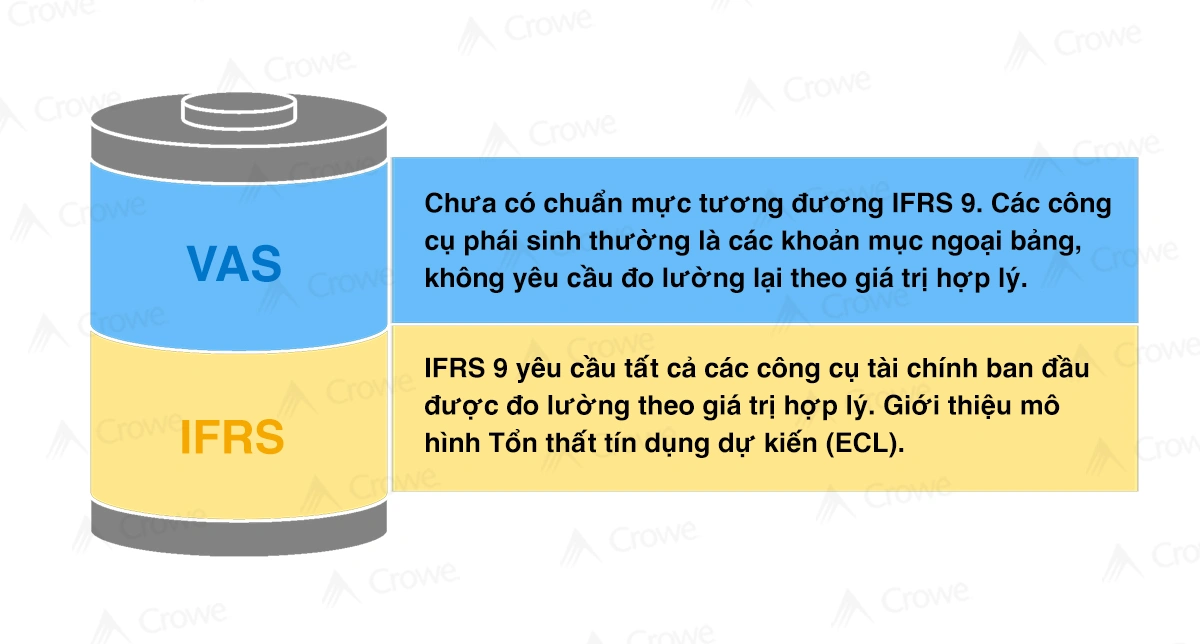
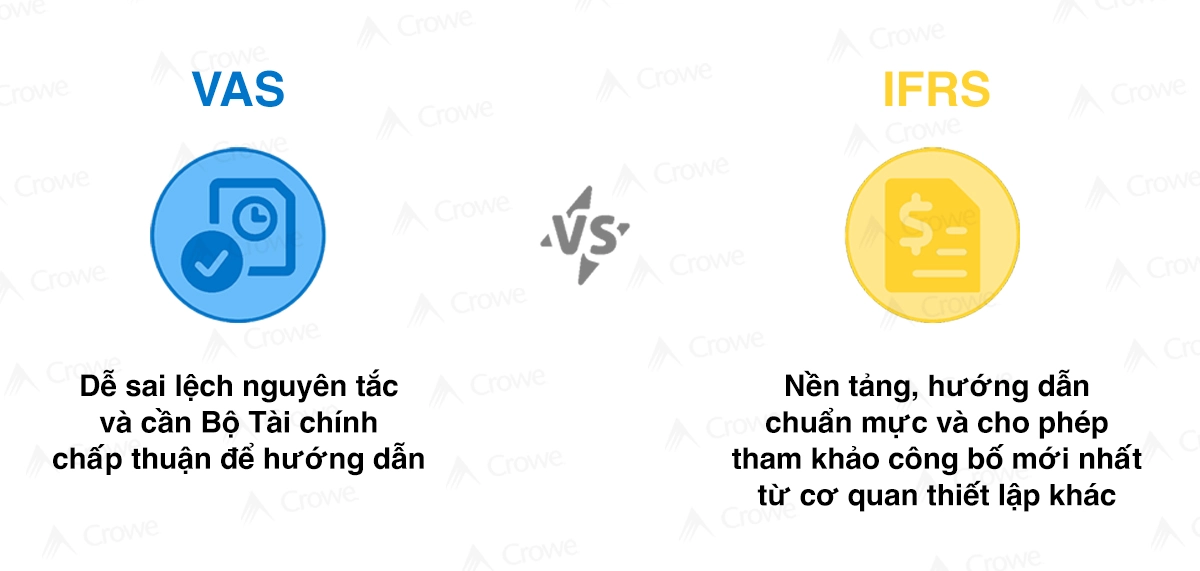
Before performing VAS-IFRS account mapping, CFOs need to understand the nature of the conflict between the two standards. VAS is based on Legal Form and Historical Cost, while IFRS prioritizes Substance over Form and Fair Value. This difference leads to material discrepancies in revenue recognition, leases, and financial losses.
A typical example is Sale and Leaseback. According to VAS, revenue can be recognized if legal conditions are met. According to IFRS 16, if control has not actually transferred, the transaction may be considered a secured loan.
Regarding asset measurement, VAS tends to focus on cost. IFRS allows for a Revaluation Model, especially with IAS 16 and IAS 40. This directly affects equity and financial ratios.
Table of key benchmark comparisons
| Topic | VAS | IFRS |
| Revenue | VAS 14 – Transfer of Risks and Benefits | IFRS 15 – The 5-Step Model, Transfer of Control |
| Property leasing | VAS 06 – Distinguishing between finance lease and operating lease | IFRS 16 – Right-of-Use Asset Recognition & Lease Liability |
| Fixed assets | VAS 03 – Full Depreciation | IAS 16 – Component Accounting |
| Financial instruments | No specific regulations have been established yet. | IFRS 9 – ECL (Expected Credit Loss) |
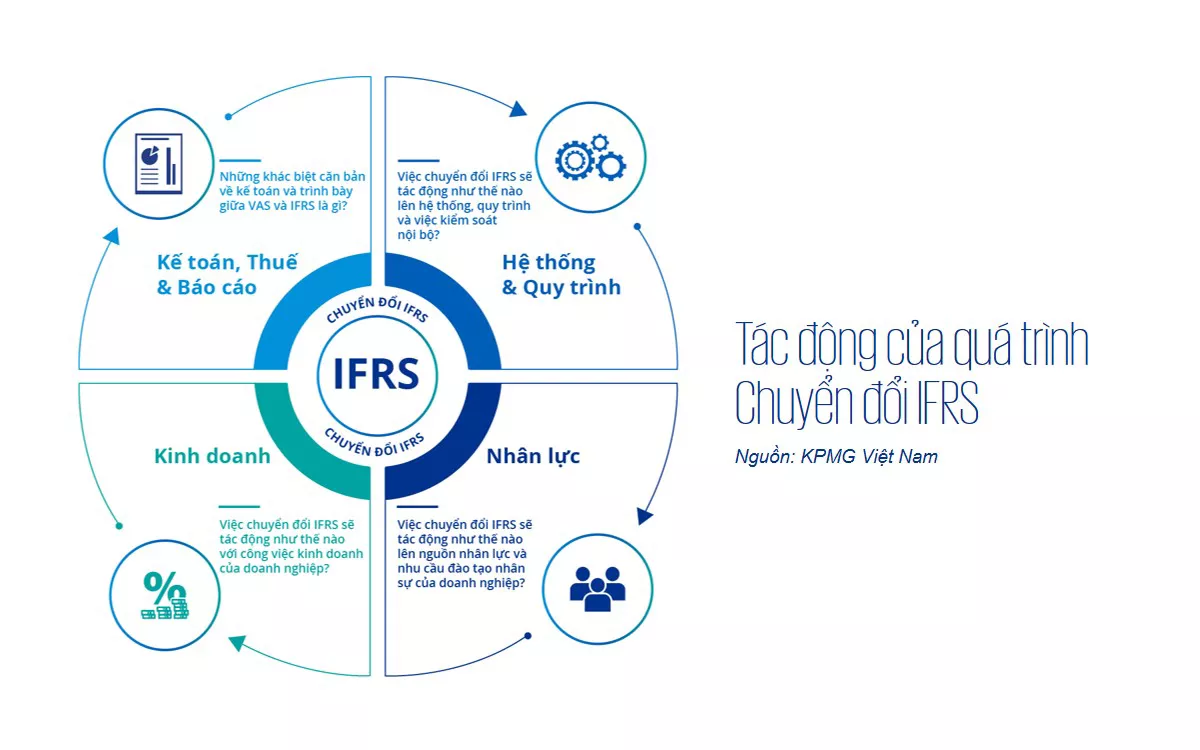
Handling these discrepancies in Excel is nearly impossible for a multi-company business. This is why converting financial statements to IFRS requires an EPM system to manage Adjustment Entries in a controlled manner.
The 5-step technical process for converting financial statements to IFRS standards (First-time Adoption).
Once the standard gap is understood, the next step is to build a standardization process. The process of converting VAS to IFRS consists of 5 steps: Gap Analysis, Account Mapping, Non-Financial Data Collection, Adjustment Implementation, and IFRS Reporting according to IFRS 1.
Step 1: Gap Analysis
Businesses assess Policy Gap and Data Gap on the transition date. This step identifies standards that have a significant impact, such as IFRS 15. IFRS 16 and IFRS 9.
Step 2: Mapping VAS IFRS account
This is the most significant bottleneck. VAS IFRS account mapping can follow a 1-1, 1-n, or n-1 model. For example, account 242 (Prepaid Expenses) can be mapped to Right-of-Use Assets or Prepayments depending on the nature of the contract.
Manual mapping is prone to errors and lacks an audit trail. The EPM solution allows for the establishment of fixed mapping rules and the storage of adjustment history for audit purposes.
Step 3: Collect non-financial data
Converting VAS to IFRS requires data that does not exist in the ledger: implicit interest rates, contract renewal probabilities, estimated liquidation values. This is why many projects fail even after completing account mapping.
Step 4: Conversion & Adjustments
Businesses can apply a Dual-Ledger or Sub-Ledger mechanism to run VAS and IFRS in parallel. Reversal entries are made periodically.
Step 5: Reporting according to IFRS 1
This includes preparing the Statement of Financial Position, Comprehensive Income, and detailed notes. This is the final step in the process of converting financial statements to IFRS.
Automated strategy for “Non-financial data” and report consolidation with Bizzi RPA & EPM
The biggest challenge is not the accounting but processing contract data on a large scale.
Automating non-financial data uses RPA to extract contract information and EPM to model IFRS entries. This helps shorten closing times and reduce errors in discounted cash flow calculations.
Bizzi Bot automatically reads invoices and contracts using OCR, extracting data such as lease terms, payment terms, and interest rates. EPM acts as a consolidator and modeler for IFRS 16, automatically allocating RoU depreciation and interest, and excluding insider transactions.
Instead of replacing the existing ERP system, the overlay solution allows for the preservation of the existing system while adding an IFRS layer. This enables a rapid transition from VAS to IFRS within 3–4 months at a reasonable cost.
Financial Risk Management: The Impact of IFRS on EBITDA, Covenants, and Deferred Taxes
Converting VAS to IFRS affects not only financial reporting but also financial ratios. IFRS 16 increases EBITDA because lease expenses are converted into depreciation and interest. However, the increased lease availability leads to a higher D/E Ratio, potentially violating bank covenants.
Deferred tax arises from the difference between the IFRS book value and the tax base.
Basic formula: Deferred Tax = (Carrying Amount – Tax Base) × Tax Rate
The EPM system can pre-simulate the impact of IFRS on EBITDA and D/E Ratio, enabling CFOs to proactively work with banks before releasing financial statements.
[Case Study EPMLessons from Panasonic: Consolidating financial reports for over 500 units with EPM.
To understand the value of automation in VAS to IFRS conversionWe need to look at the practical problem of a multinational corporation operating hundreds of subsidiaries with a fragmented ERP system. The case of... Panasonic This shows that the challenge lies not in accounting standards, but in data architecture and the speed of consolidation.
1. Background: Fragmented data, manual merging, control risks.
Panasonic had to consolidate data from over 500 member units globally, each using a different accounting structure and ERP system. The data aggregation relied heavily on Excel, causing the consolidation process to take nearly a week, heavily dependent on manual operations, and prone to errors.
In the context of preparing for the transition of financial reporting to IFRS in many markets, this model is no longer suitable. When the standards require asset revaluation, multi-currency handling, and the elimination of insider transactions in real time, the lack of a “Single Source of Truth” will make mapping VAS accounts to IFRS (or between different GAAPs) complicated and difficult to audit.
2. Solution: EPM acts as a consolidation layer and adaptive modeling tool.
Panasonic implemented EPM as a centralized, unified platform. This system automatically aggregates data from various ERP systems, standardizes Chart of Accounts, and performs currency conversions according to Functional Currency.
The key point is that EPM not only consolidates data but also models adjusting entries. In the scenario of converting VAS to IFRS, this is equivalent to establishing an “IFRS Adjustment Layer” – where IFRS 15, IFRS 16, or IFRS 9 entries are recorded separately without disrupting the original accounting records.
3. Quantitative impact: Speed, control, and scalability
Following implementation, forecasting time decreased from 7 days to 5.5 days, and the number of reporting forms decreased by 75%. However, the biggest impact lies in the ability to respond quickly to organizational structural changes without relying on IT.
If this mindset is applied to the conversion of financial statements to IFRS, the CFO can:
- Running VAS and IFRS in parallel within a single system.
- Automatic exclusion of intercompany transactions (Intercompany Elimination)
- Track adjustment differences by individual member unit.
This is especially important when mapping VAS accounts to IFRS at the corporate level, where a VAS account may need to be broken down into several different IFRS components.
4. Lessons for Vietnamese businesses
The Panasonic case illustrates that the problem isn't "complex standards," but rather the lack of a centralized data platform. If businesses continue to manage the conversion of VAS to IFRS using Excel, the risk of errors and a lack of audit trail is very high.
The overlay solution – using EPM as an intermediary layer instead of replacing ERP – helps Vietnamese businesses shorten implementation time to 3–4 months. When Finevo's consulting services are combined with the Bizzi & EPM platform, the process of mapping VAS and IFRS accounts can be standardized and a history of adjustments can be stored, serving audit and IPO purposes.
The Panasonic case illustrates a crucial principle: converting VAS to IFRS is essentially a problem of integrated data architecture and management. Mapping VAS accounts to IFRS is only successful when supported by a system capable of storing, tracing, and modeling adjustments according to international standards.
With an approach combining strategic consulting from Finevo and the Bizzi & EPM technology platform, businesses can build a process for converting financial statements to IFRS not only for compliance but also to improve capital management capabilities and reduce fundraising costs in international markets.
Expert FAQ on frequently asked questions about operating IFRS & VAS systems in parallel.
Operating in parallel with IFRS and VAS requires establishing an accounting system capable of double-entry recording or automatic data conversion. Experts recommend focusing on building a unified chart of accounts, clearly identifying significant differences (such as revenue recognition, lease income, and asset impairment), and implementing ERP software that supports multi-ledgers to automate year-end adjusting entries.
Below is an in-depth answer to frequently asked questions (Expert FAQ) regarding the parallel operation of IFRS and VAS:
Does a business need to replace its current accounting software to run IFRS?
It's not necessary to replace the entire ERP system to convert VAS to IFRS. Businesses can use an EPM solution as an overlay, mapping VAS accounts to IFRS and recording IFRS adjusting entries in a subsidiary ledger. This approach saves investment costs and avoids disruption to existing operating systems.
Where do the biggest switching costs lie?
The biggest cost is often not in the software itself, but in the data cleaning process and personnel training. If historical data is inconsistent, businesses will lose significant resources standardizing it before converting financial reports to IFRS. RPA and EPM automation significantly reduce long-term operating costs and limit reliance on manual processing.
How to effectively run VAS and IFRS in parallel?
The most effective model is the “Single Source of Truth” model – data is entered once, but the system automatically records it in two sets of ledgers based on configured mapping rules. When converting VAS to IFRS, adjustments are stored in a separate IFRS layer, ensuring transparency and traceability. This allows CFOs to control discrepancies without maintaining two separate accounting systems.
How are exchange rate differences treated differently in IFRS compared to VAS?
IFRS requires the functional currency to be determined based on the primary economic environment, rather than defaulting to the book currency as in VAS. This can lead to significant exchange rate discrepancies when consolidating multi-country reports. The EPM system supports automatic multi-currency conversion and allocation of differences according to IFRS standards, reducing the risk of discrepancies when converting financial statements to IFRS.
Conclusion: Converting VAS to IFRS is not an accounting project, but a data project.
Converting VAS to IFRS is a technical, strategic, and technological challenge. Mapping VAS accounts to IFRS is just the first step. Success depends on the ability to standardize non-financial data and automate R2R (Return on Demand).
Businesses that adopt IFRS manually face high personnel costs and the risk of audit errors. Conversely, combining strategic consulting from Finevo with the Bizzi & EPM technology platform helps build a sustainable, transparent, and cost-effective system for converting financial reports to IFRS.
IFRS is not just a standard. It is the foundation for elevating the financial capabilities of Vietnamese businesses in the international market.
For more detailed advice and to experience Bizzi's solution suite, book an appointment here: https://bizzi.vn/dat-lich-demo/