



Most Vietnamese businesses are currently doing this. Corporate budget control It's like an autopsy: money has already been spent, invoices have been received, and reports have been prepared before the overspending is discovered. At that point, the CFO is left with no choice but to explain instead of proactively managing cash flow. In the context of constant economic fluctuations, this method is no longer suitable.
This article by Bizzi will provide a design for one. budget control system Preventive control, based on real-time data, prevents the risk of overspending right from the procurement request stage.
What is a budget control system? Redefining it from a risk management perspective.
Before discussing technology or processes, it's essential to understand the true nature of the system.
Budget Control System It is a set of continuous monitoring processes aimed at comparing actual figures with the approved financial plan (Budget). The goal is not only to save costs but also to ensure that all resources are allocated strategically through the timely detection and correction of deviations.
Essentially, this is a closed management loop: Planning → Execution → Measurement → Deviation Analysis → Corrective Action.
One budget control system Operational efficiency is assessed at three levels: strategic (does the budget serve long-term goals), managerial (are cost centers using resources efficiently), and operational (are each transaction valid?).
A common mistake is equating Corporate budget control In relation to cost accounting, from a CFO's perspective, this is a tool for managing performance and risk. The question isn't "is the invoice available?" but rather "what is the ROI for this expense?".
To answer this, businesses need real-time data at the point of occurrence. Bizzi acts as a real-time data collection gateway: from spending requests on... Bizzi Expense The invoice is processed via Bizzi Bot. Without real-time data, any system is just theoretical.
However, more than 70% businesses still rely on Excel – and this is the biggest bottleneck.

Why does budget control using Excel fail?
Many CFOs believe that simply compiling data into Excel files monthly is sufficient. However, Excel creates data lag and information fragmentation, leading to real-time budget tracking It's almost impossible.
When the report was compiled, incorrect decisions had already been made. Shadow IT occurs when each department tracks its budget using its own file, leading to discrepancies with the ledger. Audit risk increases due to the lack of a clear audit trail. Merging multiple file versions leads to a loss of version control and the potential for internal fraud.
The problem isn't just time-consuming. Excel creates security risks and undermines data integrity – something CFOs at large corporations absolutely hate.
The solution is to build a "Single Source of Truth," where all spending data is synchronized in real time instead of being updated manually and piecemeal. To achieve this, businesses must shift from a detective-based approach to a preventive-based approach.
- See more content about How to create a budget plan
The shift from the Detective to the Preventive Control model.
This is a crucial turning point in thinking. Corporate budget control.
Detective Control operates in a chain: invoices received → accounting → reporting → detection of overspending. By the time it's detected, the budget has already been breached. Preventive Control works in the opposite way: a purchase request is created → the system checks the budget → approves or blocks → only then is the purchase order issued.
The difference lies in the technology. Traditional ERP systems are strong in bookkeeping, but to implement preventative controls, businesses need to integrate sophisticated expense management tools into the approval process. Bizzi Expense is designed to stop overspending at its source.
Here's how to put this mindset into practice.
Set up a dynamic budget with Rolling Forecast.
Static budgets established at the beginning of the year quickly become outdated when the market fluctuates. Rolling Forecast helps CFOs continuously update their forecasts, adding a new one to the future as each period ends.
This approach transforms budgeting into a guiding tool rather than a "shackles" locking down spending. CFOs can simulate "what-if" scenarios and flexibly reallocate resources.
After developing a flexible plan, the next focus is on controlling daily spending.
Budget control at the point of procurement.
This is the heart of the Preventive system. When an employee creates a purchase request, the system automatically compares it to the remaining budget. The formula for calculating the available budget includes committed costs from signed purchase orders (POs) that have not yet been invoiced.
Many businesses ignore Committed Costs, leading to the illusion of having budget and continuing to sign new purchase orders. When invoices pile up, the budget collapses.
On Bizzi Expense, every spending request is automatically checked. If the limit is exceeded, the system triggers a warning. Warning of budget overspending. or block the process. The CFO can review exceptions directly on the platform, ensuring control without disrupting operations.
Control at source is a prerequisite for control operating costs effective.
Automation 3D comparison Preventing fraud
Once the purchase order (PO) is issued and the goods are received, the risk shifts to the payment stage.
Three-way reconciliation verifies the exact match between the Purchase Order (PO), Gross Receipt (GRN), and Invoice. If done manually, accountants would spend hours comparing each line item, easily causing payment bottlenecks.
Bizzi Bot uses AI to automatically match data. If there is a perfect match, the system proceeds to payment. If there is a discrepancy, the system flags it and sends a notification. Warning of budget overspending. or price discrepancy warnings.
As a result, businesses can both speed up processing and reduce fraud. This is the second layer of control. budget control system modern.
Intelligent budget alert system
A good system should not only record information but also proactively provide reminders.
The alert system sets thresholds of 50%, 80%, and 100% for multi-channel notification. However, "alert fatigue" should be avoided by tiering alerts: employees receive alerts early, department heads receive alerts when the threshold is close, and the CFO only receives notifications when the critical threshold is exceeded.
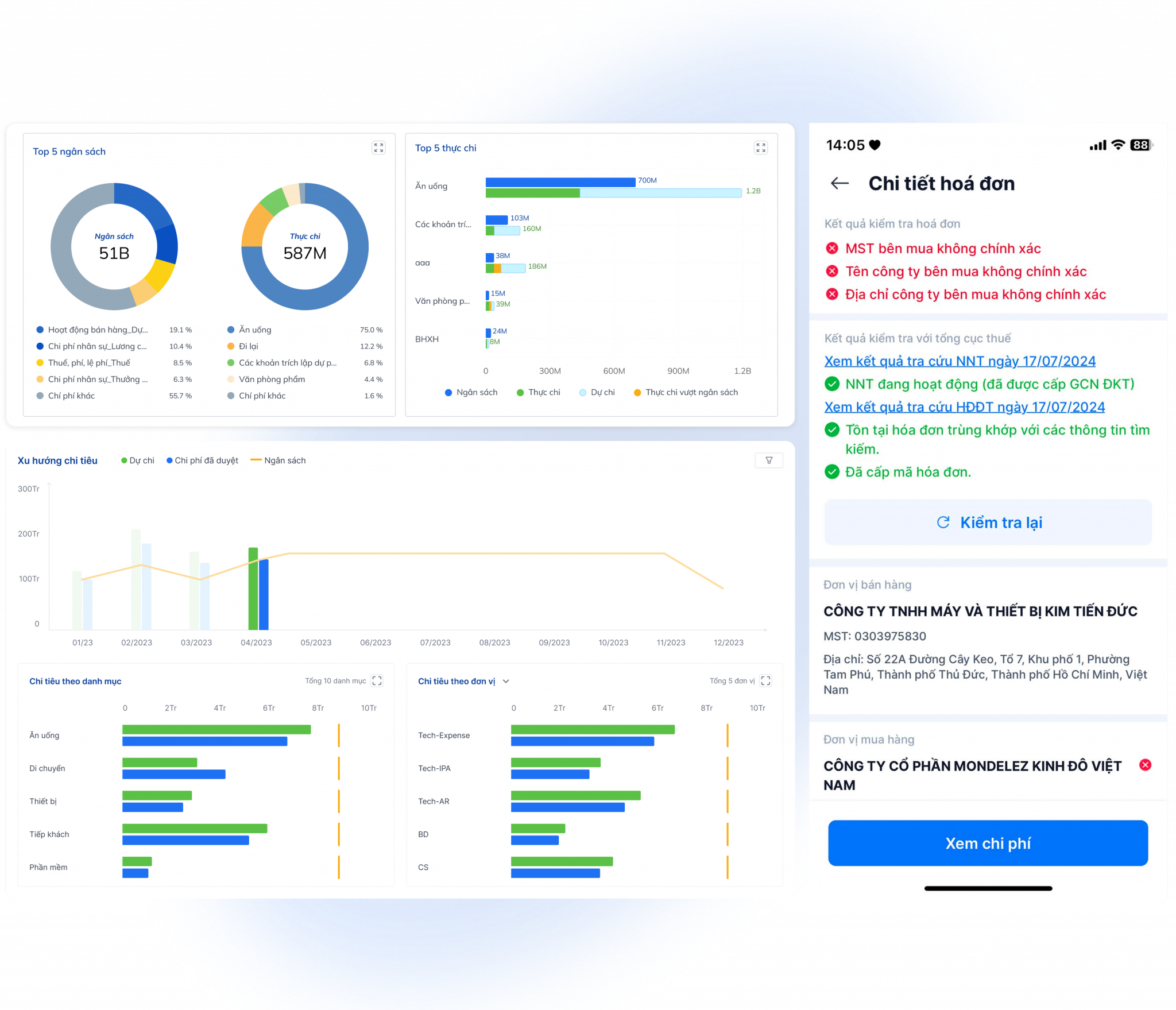
With Bizzi's Dashboard, businesses can real-time budget trackingBy observing consumption levels in each cost center and identifying overspending trends before a crisis occurs,
Analyzing volatility and optimizing cash flow.
After controlling costs, the next step is to optimize cash flow.
Variance analysis helps identify the causes of discrepancies between Actual and Budget. But CFOs need to go further: budget control must be linked to the cash conversion cycle (CCC = DSO + DIO – DPO).
A business can control operating costs While good, poor debt management still carries liquidity risks. Bizzi ARM supports accounts receivable and payable management, automatically sends debt reminders, and forecasts cash flow, helping... Corporate budget control Closely linked to overall financial health.
Sandbagging Effect and Behavior in Budgeting
Besides processes and technology, the human factor is the most difficult variable to control. Corporate budget controlIf organizational behavior is not handled properly, everything budget control system No matter how modern something is, it can still be "deactivated" from the inside.
What is sandbagging and why should CFOs care?
Sandbagging is the practice of department heads intentionally underestimating revenue or overestimating costs to ensure they easily meet KPIs and receive bonuses. In the short term, the department may meet its targets. However, in the long term, the business suffers the consequences of misallocated resources and reduced capital efficiency.
From a CFO's perspective, sandbagging is not simply a matter of professional ethics but a strategic risk. When budgets are intentionally inflated, the system... real-time budget tracking This will reflect inaccurate data right from the input stage. This leads to inaccurate capital reallocation decisions and reduces efficiency. control operating costs the entire enterprise.
Signs and symptoms, and consequences.
A common manifestation of sandbagging is the "use it or lose it" phenomenon. In the fourth quarter or December, departments accelerate spending to "burn through the budget" out of fear that if they don't use it all, the budget for the following year will be cut.
As a result, businesses incur unnecessary expenses, distorting volatility analysis data and putting pressure on end-of-period cash flow. In that case, even with... Warning of budget overspending.However, the CFO still faces a difficult situation because the spending has already been legitimized according to the original plan.
The solution lies not only in the tools but also in the incentive mechanisms. Businesses need to shift from a mindset of "rewarding budget compliance" to "rewarding efficient use of capital." Departments that optimize costs and generate high ROI should be recognized, rather than being encouraged to spend beyond their allocated budget.
This is a high-level management perspective that many typical SEO articles don't address. For the CFO, Corporate budget control It's not just an arithmetic problem, but a problem of organizational behavior.

Applying transparent data to reduce sandbagging.
Technology plays a crucial role in curbing this behavior. When historical data is stored transparently on the EPM system, CFOs can compare current forecasts with the past performance of each department.
If a department consistently forecasts high costs but the actual costs are significantly lower, the system will clearly show the discrepancy. This gives management a basis to challenge the unreasonable forecasts. When all data is properly monitored... real-time budget trackingThe space available for sandbagging will be significantly reduced.
Below are some frequently asked questions when businesses begin implementing an automated budget control system.
Frequently Asked Questions about Budget Control (FAQ)
When switching to the model budget control system With automation, many businesses are concerned about costs, scale, and suitability. Below are the most common questions from a CFO's perspective.
Do SMEs need this? EPM software Are not?
Small-scale SMEs with simple structures can start with Excel. However, as the business grows rapidly, expands to multiple branches, or operates a chain of stores, Excel will no longer meet the requirements. real-time budget tracking and merge the data.
EPM software helps ensure scalability, multi-unit data synchronization, and consistency in data. Corporate budget control.
How do we handle urgent expenditures that exceed the budget?
In practice, emergencies inevitably arise. Therefore, businesses need to establish an approval workflow for exceptions.
On the Bizzi platform, when issues arise Warning of budget overspending.The system allows for requests for detailed explanations and forwarding them to higher management levels (CEO/CFO) for approval. This ensures flexibility while maintaining control and a clear audit trail.
How do operating expenses (OPEX) and capital expenditure (CAPEX) differ in their control mechanisms?
OPEX typically involves recurring expenses and is monitored periodically through tools such as Bizzi Expense, which helps control operating costs by month or quarter.
Meanwhile, CAPEX represents a long-term investment and is managed throughout the project lifecycle, often integrated with EPM or ERP systems to track depreciation, asset performance, and its impact on cash flow.
Can automation replace the role of the chief accountant in budget control?
The answer is no. Automation eliminates manual data entry and reconciliation, but the chief accountant's role in strategic analysis and advice is even more crucial.
When the system real-time budget tracking By providing real-time data, the chief accountant can focus on analyzing volatility, forecasting cash flow, and supporting the CFO in strategic decision-making.
What are the costs of implementing an automated budget control system?
Costs depend on the size of the business and the level of integration required. SaaS solutions like Bizzi typically charge based on processing capacity or the number of users, helping to optimize initial investment costs.
In many cases, ROI is achieved within 6–12 months by reducing losses, limiting overspending, and improving efficiency. control operating costsMore importantly, businesses not only save costs but also minimize long-term financial risks.
Conclusion: From passive control to proactive management
Corporate budget control It's no longer just about compiling end-of-month figures. In a highly volatile environment, a CFO needs a budget control system operates in real time, capable of real-time budget tracking, detect and activate Warning of budget overspending. Right at the source.
By combining Rolling Forecast, PR point control, automated 3-way matching, and intelligent alert systems, businesses not only prevent overspending but also enhance efficiency. control operating costs and optimize cash flow.
The Bizzi ecosystem – from Expense and Bot to ARM – provides a full range of control layers from planning and execution to analysis. More importantly, it shifts the role of the CFO from someone who “records the past” to a financial strategy builder based on real-time data.
In a world where cash flow determines survival, post-control is too late. Preventive control is the new standard of modern financial management.
Book an appointment now to receive a 1:1 consultation and experience Bizzi's solutions here: https://bizzi.vn/dat-lich-demo/