


The transition from VAS to IFRS is not simply a change in accounting entries, but a revolution in data. While VAS accepts aggregated data based on invoices, IFRS requires granular data based on economic conditions.
This article by Bizzi analyzes... Data gap between VAS and IFRS This study identifies the three biggest vulnerabilities (IFRS 15, 16, and 9) and proposes an automation roadmap using RPA and EPM to help CFOs build a "clean data source" before entering IFRS 2026.
The difference between VAS and IFRS: A Data Structures Perspective
Before delving into the details of each standard, CFOs need to redefine the issue from a data architecture perspective rather than purely accounting law.
The data gap between VAS and IFRS lies in the difference in granularity and attributes of the information to be collected. While VAS focuses on legal documents and historical cost, IFRS requires data on economic nature, market value, and future estimates that traditional accounting systems often overlook.
In other words, when comparing IFRS and VAS, the difference lies not only in the standards but also in the metadata – that is, the hidden data fields behind a transaction.
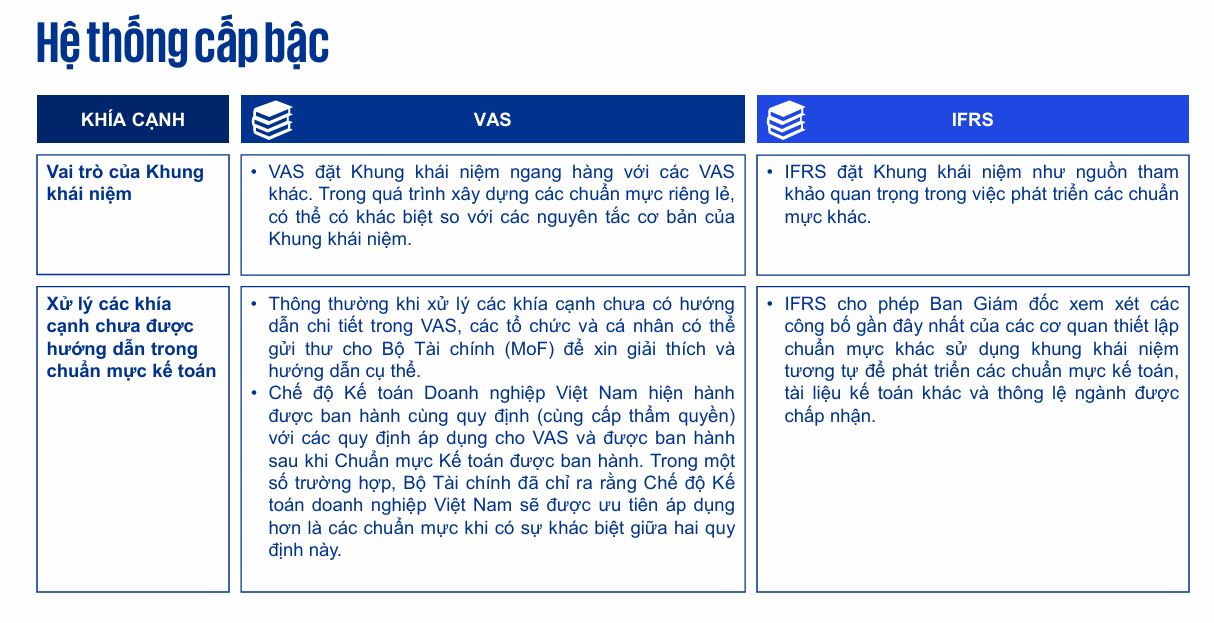
Rule-based vs. Principle-based: Differences in thinking create differences in data.
When analyzing The difference between VAS and IFRSThis can be reduced to two philosophies:
| Criteria | VAS (Rule-based) | IFRS (Principle-based) |
| Thinking | The hard rule | Principle of Flexibility |
| Recording basis | Legal form | Substance over Form (economic nature) |
| Data | Static, based on invoices. | Dynamic, based on contract terms. |
| For example | Bill date | Date of transfer of control |
This difference leads to a dangerous reality: Current accounting databases often lack non-financial data fields such as extension terms, performance obligations, implicit interest rates, probability of default, etc.
If a business attempts to "patch" the situation using Excel, the risk of losing the Audit Trail and encountering consolidation discrepancies is almost certain.
Why is "Data Granularity" the biggest obstacle?
Switching from Historical Cost to Fair Value requires CFOs to process continuously changing data instead of a single transaction at the time of purchase.
For example, a contract worth 1 billion VND:
- VAS: 1 revenue stream of 1 billion.
- IFRS: May need to be broken down into 8–10 lines including goods, services, discounts, and implicit interest rates.
This is the center of Data gap between VAS and IFRSIFRS requires "breaking down" transactions into multiple components. Excel becomes nearly impossible when the volume increases.
Asset Value (IFRS) = Market Price at the reporting date ± Adjustment
This makes the data dynamic rather than static. CFOs need EPM systems like EPM to store multiple versions of valuations and run Scenario Planning instead of manually adjusting each period. This difference in data structure will be most evident in three standards: IFRS 15, IFRS 16, and IFRS 9.
3 Critical Data Gaps & Automation Solutions
Below is an overview table when Comparison of IFRS and VAS From a data perspective:
| Criteria | VAS data | IFRS data | Processing technology |
| Recording basis | VAT invoice | The nature of the contract | Bizzi Bot – line-item extraction |
| Valuation | Historical Cost | Fair Value / PV | EPM – Multi-scenario |
| Revenue | Total bill | Obligation to perform | Bizzi AI Allocation |
| Preventive | Incurred Loss | Expected Credit Loss | Bizzi ARM |
| Compare | Excel | Automated | RPA 3-way matching |
Revenue Recognition Gap under IFRS 15
In Differences in revenue recognition between VAS and IFRSIFRS 15 creates the largest data gap. The revenue recognition gap under IFRS 15 lies in separating performance obligations from the total invoice. The data needed includes not only the amount but also independent retail prices, return terms, and completion schedules – information often missing from the VAS system.
VAS records transactions based on VAT invoices. IFRS records transactions in five steps, specifically allocating the Transaction Price to each Performance Obligation.
Example: Selling a car with free maintenance included.
- VAS: 1 revenue line.
- IFRS: Vehicle revenue (recorded immediately) + Maintenance revenue (recorded retrospectively).
The discrepancies here directly impact KPIs and EBITDA. The technological solution:
- Bizzi Bot extracts each line item.
- Automatic mapping for classifying goods/services.
- EPM allocates revenue according to IFRS accounting periods.
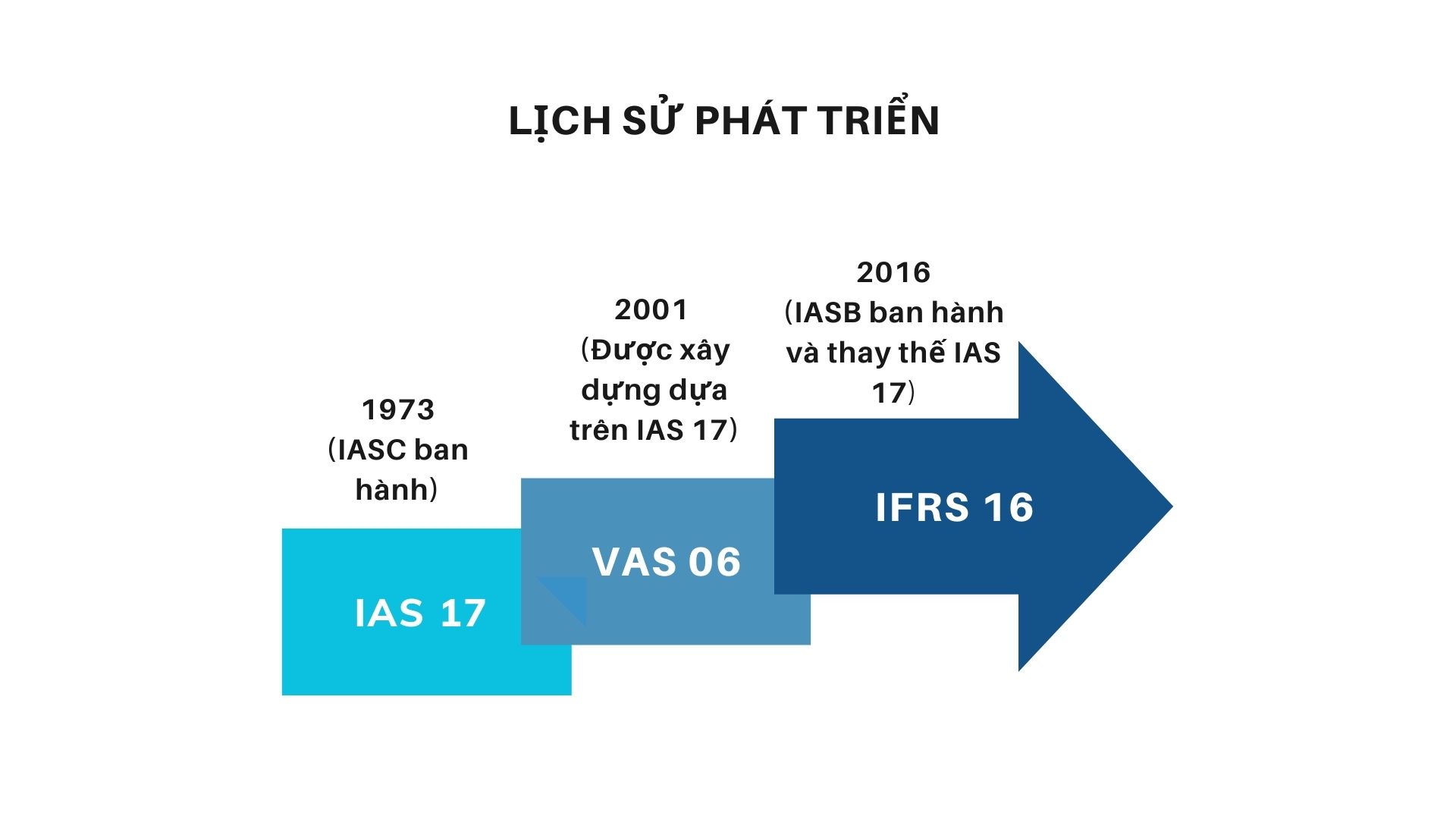
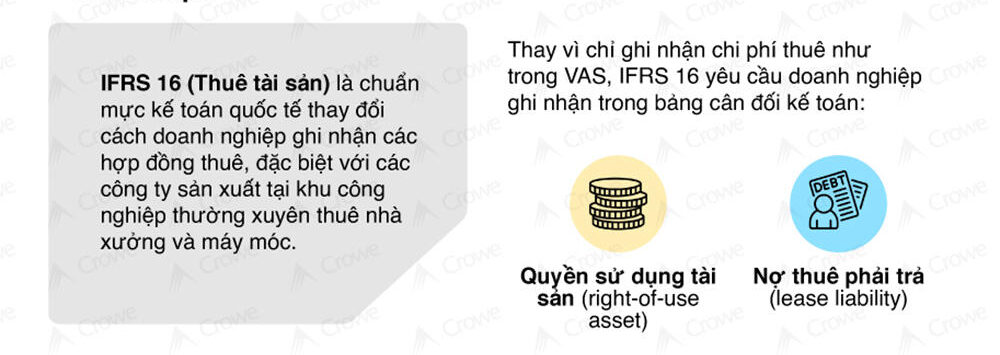
Processing Lease Agreement Data under IFRS 16
If IFRS 15 changes revenue, then... IFRS 16 This alters the balance sheet. IFRS 16 requires capitalization of the right to use assets and recognition of lease liabilities, instead of accounting for lease expenses on a periodic basis as in VAS.
The data gap is located at:
- Implicit interest rate
- Lease term
- Option to renew
- Future cash flows
These data are contained in the contract PDF file – that is, unstructured data. Right-of-Use Asset and Lease Liability increased EBITDA but significantly boosted the Debt Ratio. This is a sensitive point for banks.
Solution:
- Bizzi Contract digitizes contracts.
- Extract data fields into structured data.
- EPM automatically calculates the Amortization Schedule and generates Journal Entries IFRS.
Expected Credit Loss (ECL) model under IFRS 9
IFRS 9 standards create Data gap between VAS and IFRS Regarding risk mitigation.
IFRS 9 requires provisions to be made based on Expected Credit Loss instead of Incurred Loss.
ECL = PD × LGD × EAD
The problem is that Vietnamese businesses often don't keep enough payment history to calculate provisioning. IFRS requires provisions even if a customer is not yet overdue if they belong to a high-risk group.
Bizzi ARM helps:
- Summary of payment history.
- Analyze Payment Trends.
- Assisting CFOs in building PD parameters based on real data rather than estimates.
This is where many businesses fail when transitioning.
The "Middleware" strategy: Operating VAS & IFRS in parallel without double data entry.
Maintaining two sets of manual accounting records is high-risk and labor-intensive. The optimal strategy:
Single Source of Truth → Transformation Layer → Dual Reporting.
Bizzi and EPM acting as an intermediary layer:
- Clean the input data.
- Automatic mapping of VAS to IFRS.
- Automated Reconciliation between the two standards.
- Simultaneously generate VAS (for tax purposes) and IFRS (for shareholders) reports.
Result: Fast Close and Audit Trail are transparent.
Comparison Table of VAS vs IFRS Data
Here is the detailed table:
| Category | VAS Data (Current) | IFRS data (Required) | Processing technology (Bizzi/Finevo) |
| Revenue (IFRS 15) | Total invoice value | Details of obligations and retail prices. | Bizzi AI: Line-item Extraction |
| Leases (IFRS 16) | Rental costs for this period | Future cash flows, interest rates | Bizzi Contract: Digitizing contracts |
| Contingency (IFRS 9) | Age of overdue debt | Past payment behavior | Bizzi ARM: Payment data analysis |
| Asset valuation | Original price (Historical) | Fair Value | EPM EPM: Multi-scenario management |
Financial Digital Transformation Roadmap for IFRS 2026
The narrowing Data gap between VAS and IFRS This cannot be achieved with a single end-of-period adjustment project. It must be a financial digital transformation program with a clear roadmap, linked to a long-term data strategy. From a CFO's perspective, the goal is not just to "produce IFRS reports," but to build a data infrastructure that is clean, detailed, and traceable enough to meet international transparency requirements.
The roadmap for digital financial transformation under IFRS 2026 needs to be implemented in three consecutive phases:
- Data Standardization
- Process Automation
- Implementing an integrated reporting system (EPM Implementation)
The focus of this roadmap is to create a “Single Source of Truth”—a unified data source that enables businesses to operate alongside VAS and IFRS without incurring massive manual adjustments.
Phase 1: Standardizing Source Data – The Foundation of IFRS
Before discussing automation or reporting systems, CFOs need to confront the current state of their data. The majority of Vietnamese businesses face problems with their Master Data: duplicate customer codes, incorrect supplier codes, non-standardized materials, and a lack of product category or cost center categorization.
In context Comparison of IFRS and VASThe biggest difference lies in the level of data detail. IFRS requires the ability to break down revenue by contract, by performance obligation, and by expected cash flow. If the original data is already messy, the conversion will only create more complex discrepancies.
At this stage, businesses need to:
- Standardizing customer codes by risk segment (for IFRS 9 – ECL)
- Standardization of contract codes (for IFRS 15 – Revenue Allocation)
- Standardization of the leased asset portfolio (for IFRS 16)
- Redesign the cost center system and project code.
This is a crucial step in the process. Data gap between VAS and IFRSWithout cleaning the input data, all subsequent automation will be inaccurate.
Phase 2: Automating the trading process – Creating "sufficiently smooth" data
After standardizing the underlying data, the next step is to ensure that the generated data is accurate and complete. This is where automating P2P (Procure-to-Pay) and O2C (Order-to-Cash) processes becomes a mandatory strategy, no longer just a cost-effective option.
The core issue of Data gap between VAS and IFRS IFRS requires line-item data, contract terms, and performance timelines – information that is often lost when entered manually.
By implementing automation solutions like Bizzi in P2P and O2C, businesses can:
- Automatically extract line items from invoices.
- Attach invoices to contracts and purchase orders.
- Store payment terms, deadlines, and discounts.
- Track payment history for ECL model
The key difference here isn't about "reducing accounting staff," but about creating structured data from the start. When the input data is detailed enough and traceable, the CFO will no longer have to manually reprocess it to meet requirements. Differences in revenue recognition between VAS and IFRS Or calculate the contingency according to IFRS 9.
Automation at this stage is essentially "Input Data Automation"—the first line of defense against IFRS discrepancies.
Phase 3: Deployment of a unified reporting system – Reporting Automation
Once data is standardized and transaction processes are automated, businesses are truly ready to implement an integrated reporting system (EPM).
This is the "Transformation Layer" processing step – where VAS data is mapped to IFRS.
EPM systems like EPM allow:
- Automatically allocate revenue based on performance obligations.
- Calculate Right-of-Use Asset and Lease Liability
- Fair Value simulation under multiple scenarios
- ECL calculations are based on historical data.
Instead of maintaining two separate sets of accounting records, CFOs can operate VAS and IFRS in parallel on the same data platform. This significantly streamlines the process. Data gap between VAS and IFRS, while also ensuring transparency in the audit trail.
From a strategic perspective, this represents a shift from "Excel Adjustment" to "Reporting Automation"—a structural change.
The difference of this route
Unlike legal documents that focus solely on regulations and deadlines, the above roadmap is a specific Tech Roadmap:
- Start with the data.
- Standardize the process
- Input automation
- Implement consolidated reporting.
CFOs no longer view IFRS as a short-term compliance project, but rather as a program to upgrade financial infrastructure. Comparison of IFRS and VASBusinesses will realize that international standards are just the "tip of the iceberg." The core is the underlying data architecture. If this architecture is built correctly now, IFRS 2026 will no longer be a burden.
Frequently Asked Questions about VAS – IFRS Data Conversion (FAQ)
When it begins to narrow Data gap between VAS and IFRSCFOs often lack not just determination, but technical and systemic clarity. Below are some of the most common questions encountered during implementation.
Question: Does switching to IFRS require changing accounting software?
Answer: It's not necessary to replace the expensive ERP core.
Many businesses mistakenly believe that to comply with IFRS, they must completely rebuild their accounting system. In reality, the current trend is to keep the core ERP system and add satellite systems like Bizzi or Finevo to handle the IFRS data layer.
ERP still records transactions according to VAS for tax purposes.
The satellite layer will:
- Extracting detailed data (line-item, contract)
- Mapping VAS – IFRS
- Automatically generate IFRS adjusting entries.
This approach helps reduce investment costs and limit the risk of operational disruption.
Question: What data is most difficult to collect when implementing IFRS 16?
Answer: Non-financial data in lease agreements is often the most missing element.
Specifically, this includes:
- Option to extend the contract
- Rental price index change clause
- Early termination clause
- Implicit interest rate
This information is usually found in PDF files, attached documents, or exchanged emails, and is not stored in the accounting system.
When Comparison of IFRS and VASThe major difference is that IFRS 16 requires capitalization of asset use rights and recognition of lease liabilities based on future cash flows. Without digitizing contracts and standardizing data, businesses would have to manually read each contract – a very high risk of errors.
Question: What is the biggest difference between VAS and IFRS revenue recognition?
Answer: VAS is based on the transfer of risk and invoices; IFRS is based on the transfer of control and performance obligations.
This is the central point of Differences in revenue recognition between VAS and IFRS.
- VAS: When goods are delivered and the invoice is issued → revenue is recognized.
- IFRS: When control is transferred and each performance obligation is fulfilled → recognize the corresponding revenue.
This leads IFRS to require allocating the transaction price to each component of the contract. If the system only stores a single total revenue stream, the CFO will have difficulty preparing IFRS reports.
Question: How do I handle the tax discrepancies between VAS and IFRS?
Answer: Use the Deferred Tax account to record temporary differences.
When processing Data gap between VAS and IFRSHowever, many IFRS adjustments will not be accepted by the tax authorities (e.g., recognizing revenue in different periods, capitalizing leases, making provisions for ECLs).
This difference creates:
- Temporary difference
- Deferred tax assets
- Deferred tax debt
The consolidated reporting system needs to separately track IFRS adjustments to ensure that tax obligations under VAS are not misrepresented.
Question: Can Bizzi replace accounting software when implementing IFRS?
Answer: Are not.
Bizzi is not an ERP system and does not replace accounting software. Bizzi's role lies in the pre-accounting layer (processing incoming data).
Specifically:
- P2P and O2C automation
- Clean and normalize data
- Store line-item details
- Connect contracts – invoices – payments
As a result, ERP systems can perform more accurate accounting, and IFRS systems have enough data to perform mapping. This is a crucial step in narrowing down the process. Data gap between VAS and IFRS without changing the entire core system.
Question: How much does it cost to convert a data system to IFRS?
Answer: The initial investment cost for automation (RPA/EPM) can be significant, but it is much lower than the long-term cost of maintaining dual entry.
If businesses don't automate, they will have to:
- Maintain two sets of accounting records.
- Manual data entry for IFRS
- Increase personnel for control and verification.
Hidden costs include:
- Audit errors
- The closing time is extended.
- Missed opportunity to raise capital.
Over a 3–5 year period, investments in data infrastructure and automation typically yield a positive ROI.
Question: What data is most commonly missing when transitioning to IFRS 9?
Answer: Customer payment history data – especially the actual number of days overdue – is used to calculate the Loss Rate and the probability of default (PD).
IFRS 9 requires the Expected Credit Loss (ECL) model, while many businesses only report static debt aging at any given time.
To calculate accurately, the following is needed:
- Years of payment history
- Actual recovery rate
- Customer risk segmentation
This lack of data is the main reason why many businesses are unable to process it. Data gap between VAS and IFRS in the credit loss provision section.
Conclusion: IFRS is a data problem, not an accounting problem.
From the above analysis, it can be seen that Data gap between VAS and IFRS It's not about a few adjusting entries, but about how businesses collect and store information from the very beginning.
When Comparison of IFRS and VASThe biggest difference is:
- IFRS requires more detailed data.
- IFRS requires predictive data.
- IFRS requires high traceability.
The three vital points include Differences in revenue recognition between VAS and IFRSBoth lease contract processing and ECL models have one thing in common: a lack of structured data.
From a CFO's perspective, instead of waiting until 2026 to address the transition, businesses should start by building an automated financial data platform. Once P2P, O2C, and contract management processes are systematically digitized using solutions like Bizzi, the data will be ready for both VAS and IFRS without doubling the workload.
IFRS is not an accounting project. It's a financial data infrastructure restructuring project. Businesses that start automating early will not only meet international standards but also upgrade their financial management capabilities in the long term.
Register here to experience Bizzi's solutions and receive one-on-one consultation from a financial expert: https://bizzi.vn/dat-lich-demo/