



Faced with the pressure of optimizing costs and managing risks, digital transformation of businesses Digital transformation is no longer an option but a mandatory "operating system" for modern finance departments. However, many statistics show that the majority of digital transformation projects fail not because of a lack of technology, but because of a lack of a clean data foundation and a clear implementation roadmap.
For the CFO, the issue isn't about what software to buy, but about how to design it. digital transformation process To ensure measurable ROI, minimize tax risks, and optimize working capital, this article provides an implementation framework. steps of digital transformation In-depth financial services, focusing on practical value for B2B businesses.
The nature of digital transformation in finance in the data age.
Digital transformation in finance is the process of integrating digital technologies (AI, RPA, Cloud) to comprehensively change the way operations are conducted, from digitizing raw documents to building automated data analysis systems, in order to optimize CFO's business decisions.
The core difference between Digitization and Digital Transformation lies in the level of impact. Digitization is limited to converting paper documents into PDF or Excel files. Digital Transformation, on the other hand, restructures the entire process, eliminating manual operations, standardizing data, and creating a foundation for real-time analytics.
Data integrity is a crucial element in the digital transformation process. If input data is not standardized, even the most powerful AI system will fall into the "Garbage In - Garbage Out" trap. Many businesses rush to deploy software but skip the data cleaning step, leading to inaccurate reports, loss of leadership trust, and wasted budget.
In reality, "data cleaning" is the crucial step that determines success or failure – yet it's often the most overlooked.
Distinguishing between information digitization and process digital transformation.
Digitizing information is the conversion of data into an electronic format. Digital transformation of processes is the restructuring of how operations are based on that data to completely eliminate repetitive tasks.
According to the Digital Maturity Model, businesses typically go through three levels:
Level 1 – Discrete digitization;
Level 2 – Partial Automation;
Level 3 – A comprehensive data integration ecosystem.
A key concept that CFOs need to consider is "Operational Latency." The higher the latency, the slower the reporting, the later the decisions are made, and the higher the cost of capital. Therefore, the goal of digital transformation is not just to save data entry time, but to reduce information latency throughout the entire P2P and O2C supply chain.
Once the fundamentals are understood, the next question is: what roadmap should businesses follow to implement digital transformation steps and ensure effective investment?

6 steps to digital financial transformation for B2B businesses.
The standard financial digital transformation process consists of 6 stages: (1) Readiness assessment, (2) Digitization of input data, (3) Automated reconciliation, (4) System integration, (5) Compliance control and (6) Governance analysis. These digital transformation steps are closely related. If the first step is skipped, the entire chain that follows will operate on a mismatched foundation.
For B2B businesses, the P2P process should be prioritized because it involves a large volume of transactions, directly impacting cash flow and tax risks. Applying the Impact vs. Effort matrix shows that automating input invoices often yields the most significant "quick-win" results.
Step 1: Assess readiness and clean up data.
This is a foundational step in digital transformation processThe CFO needs to review the entire current accounting process, identify bottlenecks, and standardize Master Data.
Standardizing the supplier catalog, product codes, and Chart of Accounts is a prerequisite. Junk data from previous years needs to be processed, duplicates removed, and tax identification numbers and legal names standardized. Otherwise, the automated system will replicate inaccurate data on a larger scale.
This is also the time to assess the digital capabilities of accounting staff, preparing for a role shift from "data entry" to "data control".
Step 2: Automate invoice extraction using AI Bot
After the data has been normalized, the next step in steps of digital transformation It frees accountants from manual data entry.
OCR technology combined with Machine Learning allows the AI Bot to recognize and extract more than 20 data fields from invoices in just seconds with an accuracy of over 99%. This reduces invoice processing time by up to 80%. With Bizzi Bot, invoices are automatically collected from email or tax portals, AI extracts data, and checks the supplier's operational status. Accountants only need to check the warning fields instead of entering each line of information.
Step 3: Set up an automated 3-tier reconciliation process.
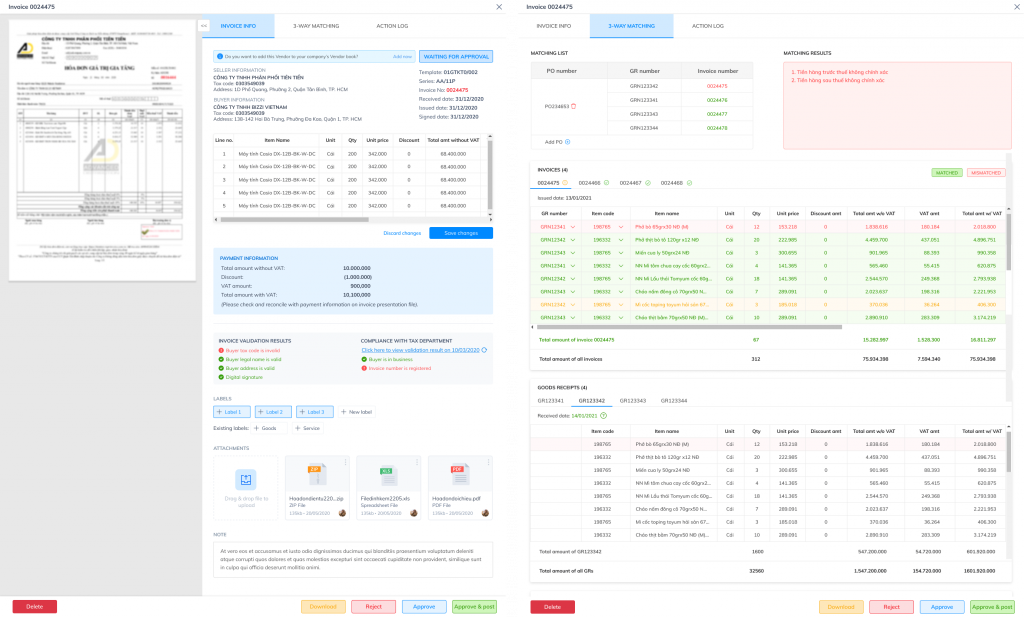
3-way matching is a crucial control step in the financial digital transformation process. The system automatically matches invoices, purchase orders (PO), and gross receipts (GR) to ensure that businesses only pay for goods/services actually received. If there are discrepancies in quantity or unit price exceeding the threshold, the CFO receives an immediate alert. Bizzi can connect PO/GR data from the ERP system and reconcile each line-item on the invoice, minimizing losses and fraud risks.
Step 4: Integrate the SaaS solution with the core ERP system.
One of the key steps in digital transformation is integrating APIs between SaaS and other solutions. ERP such as SAP, Oracle, or Microsoft Dynamics.
The goal is to eliminate data silos and ensure bidirectional data synchronization. With many Vietnamese businesses using legacy systems, integration through an intermediary API helps avoid the risk of operational disruption.
Step 5: Monitor budget compliance in real time.
CFOs need to shift from post-control to pre-control. Real-time Budget Check allows the system to check spending limits as soon as a spending request arises.
Bizzi Expense allows employees to submit requests via the app, the system automatically cross-checks with departmental budgets, and sends online approvals. This prevents overspending before the money leaves the account.
Step 6: Build a multi-dimensional management reporting system.
The final step of digital transformation process It's about transforming operational data into a decision-making tool. Integrating accounts receivable and payable data helps CFOs calculate working capital in real time, accurately forecast cash flow, and optimize payment cycles to take advantage of early discounts.
Bizzi ARM/AP enables debt aging analysis and provides a visual dashboard, helping CFOs proactively manage capital instead of reacting passively.
How to quantify the ROI of a financial digital transformation project.
How to calculate ROI for automation projects It is calculated by comparing the total benefits obtained with the total investment and implementation costs.
Formula for calculating personnel savings: Saving = (Time_manual – Time_auto) × HourlyRate × Volume
Additionally, CFOs need to factor in the benefits of reduced tax errors, reduced penalties, and optimized cash flow to lower interest expenses.
Performance comparison table
| Criteria | Manual process | Automated process (Bizzi) | The value received by the CFO. |
| Invoice processing time | 5–10 minutes/page | <30 seconds/sheet | Speed up book closing. |
| Data accuracy | 90–95% | >99% | Reduce tax risk. |
| Budget control | After spending | Instant alert | Prevent over-limiting |
| Cash flow | Reports are delayed by 5–10 days. | Real-time | Fast capital decision |
The CFO also needs to consider Opportunity Cost – the opportunity cost when the accounting team is stuck in data entry instead of strategic analysis.
Addressing the legal risks of digital documents during inspections.
Accounting documents Digital documents have the same legal value as paper documents if they meet three core requirements: data integrity, a valid digital signature, and proper storage in accordance with legal regulations for the required period. The issue isn't whether "storing on the cloud is legal," but rather how businesses design their data control and retrieval processes.
1. Understanding the legal value of electronic documents correctly.
According to the Accounting Law and related decrees on electronic invoices, digital documents are recognized as valid if:
- It has a valid digital signature from the issuer.
- The content will not be edited or altered after release.
- It is stored and can be retrieved when requested by the regulatory authority.
A key point for CFOs to note is "traceability." During audits, tax authorities not only require invoice files but also proof of the transaction process: who created it, who approved it, when it was approved, and what changes were made. If a business only stores PDF files without a process management system, legal risks still exist.
2. Common risks when switching to digital documents
During the implementation of digital transformation, many businesses encounter the following risks:
- First: Lack of Audit Trail.
If the system does not record the history of edits and approvals, it is difficult for businesses to prove the transparency of transactions.
- Secondly: Loose delegation of authority.
An employee who both creates a payment request and approves the payment is violating the principle of internal control (segregation of duties).
- Third: Distributed storage.
Invoices are in email, contracts are on an internal server, and acceptance reports are on a personal computer – this poses a significant risk when inspectors require complete documentation within a short timeframe.
- Fourth: Data is not synchronized with the ERP system.
If the figures in the accounting system differ from the data stored in electronic invoices, the tax authorities may question the accuracy of the report.
3. Design an Audit Trail to Protect the CFO
In a standard digital transformation process, Audit Trail must ensure:
- Record the time the transaction was created.
- Acknowledge the creator and the approver.
- Save your edit history.
- Transactions that have already been recorded cannot be deleted; only adjustments with new entries are permitted.
Systems like Bizzi automatically track the entire expense approval process, from the moment an employee submits a request to when the accountant processes the payment. When tax audits are conducted, the CFO can extract the entire processing chain in minutes instead of sifting through paper records. This is the difference between "digitalizing storage" and "digital transformation of control".
4. Is cloud storage secure?
A common question from CFOs is: Is there a risk that financial data stored in the cloud will be rejected during an audit?
In principle, the law does not prohibit cloud storage if:
- The data is encrypted.
- It has a backup mechanism.
- It has the capability to recover in the event of a failure.
- There are clearly defined access permissions.
The issue isn't the storage location, but the control and security mechanisms. SaaS platforms that meet international security standards are generally safer than internal servers that lack rigorous monitoring.
5. Ten-year storage period – cost and control challenge
Accounting documents must be stored for a minimum of 10 years. For B2B businesses that issue tens of thousands of invoices annually, the cost of storing paper documents and the risk of loss are significant.
An effective digital transformation process helps to:
- Centralized storage, instant retrieval.
- Search by tax identification number, invoice number, or transaction date.
- Generate a complete set of documents (invoice – purchase order – general store – payment voucher) in just a few clicks.
This not only reduces legal risk but also lowers annual independent audit costs.

What are the frequently asked questions (FAQs) about the digital transformation process?
Below is a summary of answers to some frequently asked questions related to the digital transformation process.
1. Where should you begin with digital transformation in finance?
It's best to start with the process that has the highest transaction volume and is most repetitive, usually incoming invoice processing (AP Automation). This is a clear quick-win point in the digital transformation process because it immediately reduces data entry time and tax errors.
2. Do SMEs need to implement all digital transformation steps simultaneously?
Not necessarily. SMEs should implement a phased approach, prioritizing digital transformation steps with high impact and low effort. Typically, digitizing invoices and managing expenses is a logical first step before investing in a complex EPM system.
3. What are the hidden costs involved in implementing a digital transformation process?
Three cost categories are often underestimated:
- Cost of cleaning up old data.
- The cost of training and changing the mindset of the workforce.
- The cost of integrating APIs with existing ERP systems or software.
If these factors are not anticipated, the project's ROI may be delayed longer than expected.
4. How can accounting staff avoid feeling replaced by AI?
CFOs need to redefine the role of accounting. In the new model, accountants are no longer data entry clerks but rather data controllers and risk analysts.
When the digital transformation process is implemented correctly, AI handles repetitive tasks, while human resources focus on:
- Analysis of bias.
- Compliance control.
- Cost optimization.
- Decision support.
This enhances the value of professions rather than replacing people.
5. Does Bizzi's system protect financial information?
Bizzi employs data encryption, role-based access control, and comprehensive audit trail recording. Data is stored centrally, avoiding the risk of document loss. For CFOs, the most important thing is not just security, but the ability to control and retrieve information transparently when needed.
6. Does the three-tiered reconciliation process apply to services?
Yes. For services, the contract or purchase order will be reconciled with the acceptance report and invoice. The system can still perform 3-way matching based on value and payment terms, ensuring payment is only made when the obligation is fulfilled.
7. How long does it take to see results from digital transformation?
With SaaS solutions like Bizzi, businesses typically see a 70–80% reduction in data entry time within 2–4 weeks of deployment. Full ROI is usually achieved within 3–6 months, depending on transaction size.
8. What should a business prepare for if it is subjected to a surprise inspection?
The CFO needs to ensure:
- The system can extract the entire set of documents related to a transaction.
- There is a history of approvals (Audit Trail) reported.
- There are system access logs.
- There is a clear process for assigning permissions.
A well-designed digital transformation process will help businesses shift from a "passive accountability" to a "proactive proof" approach.
Conclusion: Digital transformation is not just an IT project, but a long-term financial strategy.
One digital transformation process Effective finance doesn't start with software selection, but with the CFO's data management mindset. When data is cleaned up, processes are restructured, and digital transformation steps are implemented according to schedule – from invoice automation, three-tier reconciliation, ERP integration, budget control to working capital analysis – the finance department will transform from a recording department to a strategic value creation center.
The key takeaway is: digital transformation isn't about changing tools, but about reducing operational latency, increasing transparency, and enhancing real-time decision-making capabilities. For CFOs, the ultimate benefit is... digital transformation process It's not just about saving on personnel costs or reducing tax errors, but about optimizing working capital, improving cash flow forecasts, and protecting the business from audit risks.
However, many businesses fail because they implement solutions in a fragmented manner, lacking a comprehensive architecture. Adopting a closed-loop digital transformation process – from data input to management reporting – is the key to determining true ROI.
In this context, Bizzi is not simply a billing automation tool, but a platform that supports CFOs in building a comprehensive digital financial ecosystem:
- Bizzi Bot helps standardize and extract input data using AI.
- Bizzi Matching 3-way matching control reduces losses.
- Bizzi Expense Real-time expense and budget management.
- Bizzi ARM supports accounts receivable analysis and working capital optimization.
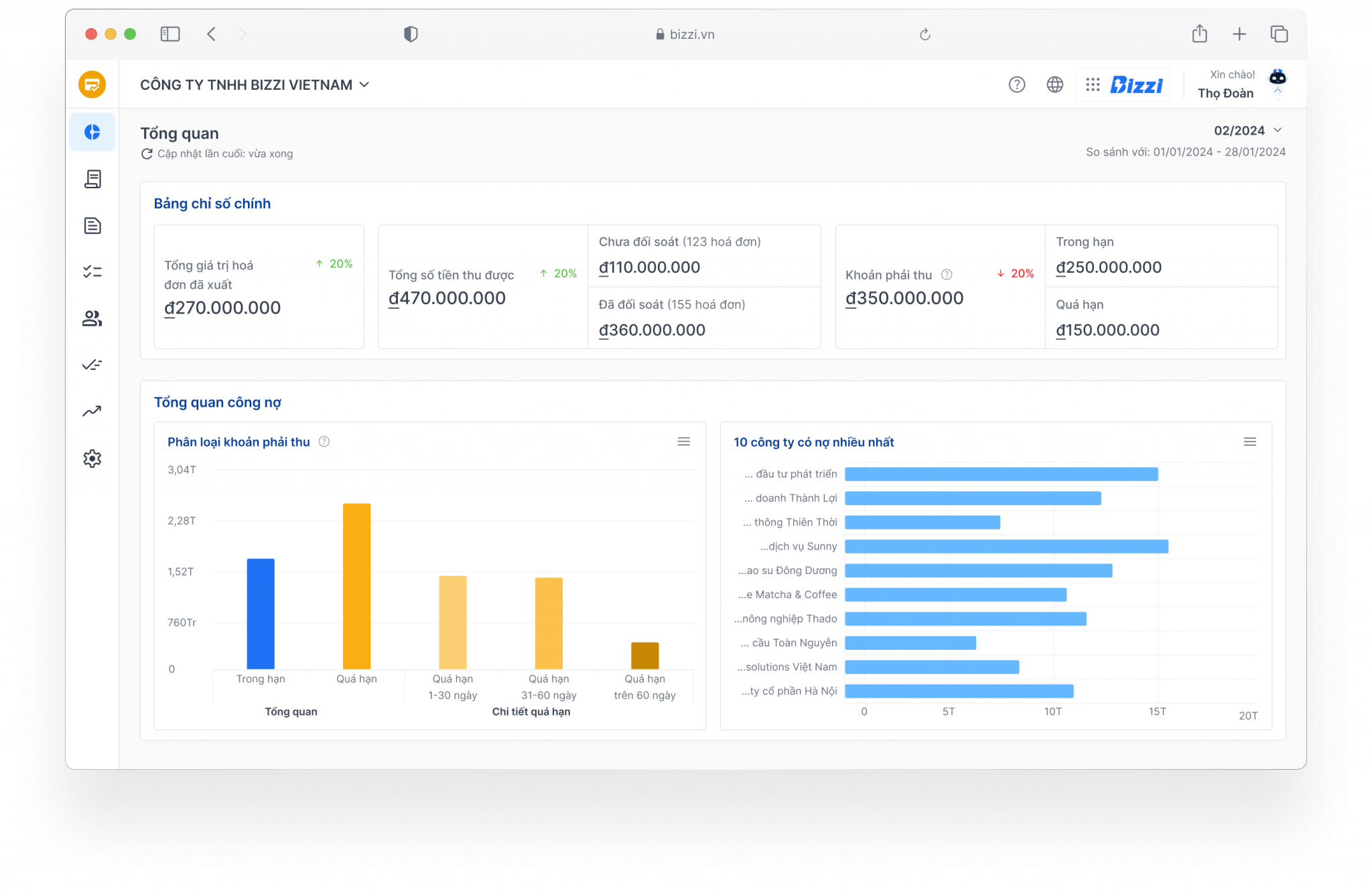
When all data is connected and displayed on a unified dashboard, CFOs can shift from a "post-control" mindset to a "proactive management" mindset. That is the core value that a CFO should strive for. digital transformation process The key benefit is transforming the finance department into a central hub for coordinating cash flow and growth strategies.
In the data age, businesses that can access information faster will make better decisions. And to achieve that, digital transformation steps should not be viewed as an investment cost, but as a lever to create a sustainable competitive advantage.
To receive personalized solutions tailored specifically to your business, register here: https://bizzi.vn/dang-ky-dung-thu/