


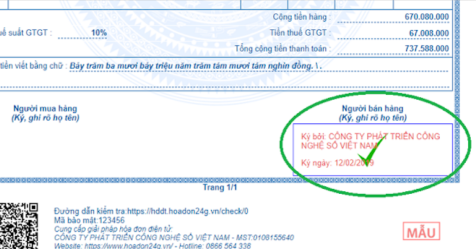
Many businesses, accountants and customers are still confused when switching from traditional paper invoices to electronic invoices (E-invoices). Among them, the issue of common concern is whether E-invoices need to be stamped or not.
Let's find the answer in the article below by Bizzi.
Why do businesses still wonder whether electronic invoices need to be stamped?
Umbrella Electronic invoice, has become a mandatory standard for more than 3 years, but in reality, many accountants and customers still ask: "Is the invoice valid without a red stamp?", "Will the customer accept it?", "Will the tax authority refuse it?". In particular, the question "Do electronic invoices need to be stamped?” is a common question of many businesses, especially in the transition period from paper invoices to electronic invoices. Below is an explanation of why businesses are still hesitant, despite clear regulations:
1. Habits from the time of paper bills
- Previously, paper invoices required the seller's signature and red seal to be considered valid.
- When switching to electronic invoices, many businesses still have the mentality that "if there is no seal, it is not legal".
- The change from "red seal" to "digital signature" makes many people unfamiliar and still want to "stamp to be sure".
2. Not understanding legal regulations
According to Decree 123/2020/ND-CP and Circular 78/2021/TT-BTC, a valid electronic invoice is not required to have the seller's stamp, as long as:
- Contains all required information (tax code, name, value, VAT, etc.)
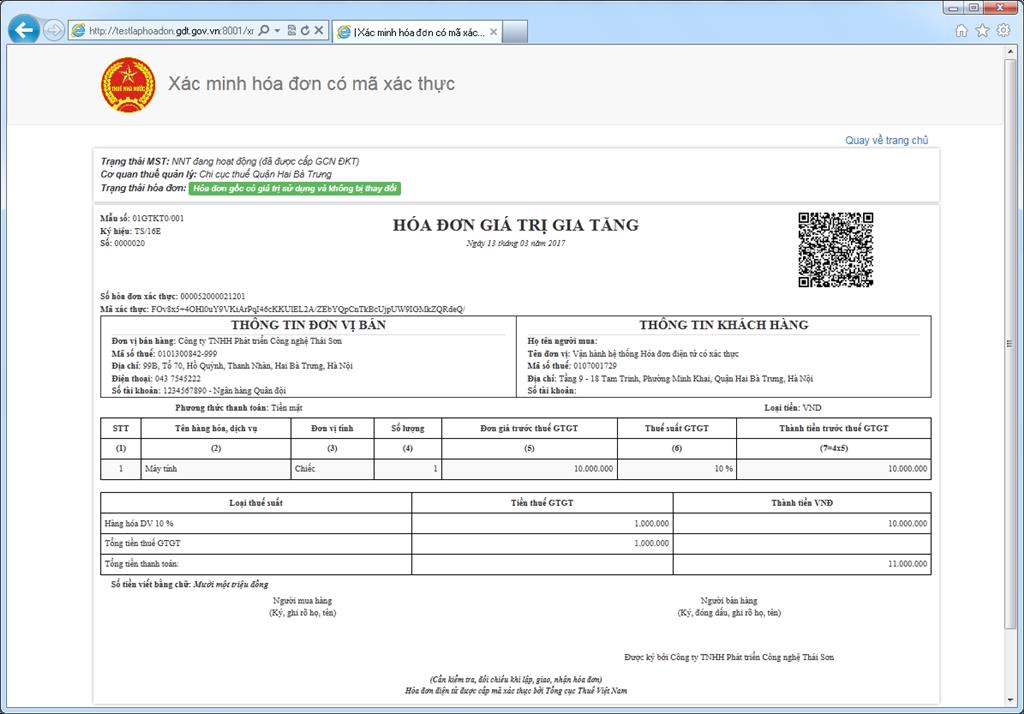
- Has digital signature or code of tax authority authentication.
That is, digital signature = legal “seal and signature” in the electronic environment.
3. Some special cases still require a signature.
- Some partners, administrative agencies or internal accounting units still require electronic invoices with seals because internal procedures have not been updated.
- Some export businesses, or those needing to submit bank loan applications, are still required to "stamp" them to avoid disputes.
4. Concerns about legal value when checking and comparing
- Many accountants fear that the tax authorities will reject invoices without a stamp.
- In fact, the legal value lies in the valid digital signature and authentication code of the General Department of Taxation, not in the seal image.
This article helps explain the legal basis, distinguish between digital signatures and seals and whether electronic invoices need to be stamped based on Decree 123/2020/ND-CP, Circular 78/2021/TT-BTC and instructions of the General Department of Taxation.
Basic concept – What is an electronic invoice and what is its legal value?
An electronic invoice (E-invoice) is a document with the same legal value as a paper invoice, but is created, signed, sent, received and stored entirely in a digital environment.
1. Definition & nature
According to Clause 2, Article 3, Decree 123/2020/ND-CP: “An electronic invoice is an invoice expressed in electronic data form, created by an organization or individual using electronic means when selling goods or providing services.”
Currently, there are two types of valid electronic invoices:
- Electronic invoice with tax authority code: issued by tax authority with authentication code (popular with small businesses and business households).
- Electronic invoices without tax authority codes: enterprises self-issue, digitally sign and periodically send data to tax authorities (applicable to large, reputable enterprises with guaranteed infrastructure).
2. Distinguish between electronic invoices and paper invoices
| Criteria | Electronic invoice (E-invoice) | Traditional paper invoices |
| Form | Digitally signed XML or PDF file | The paper has a handwritten signature and red seal. |
| How to sign confirmation | Digital signature (recognized by law) | Handwritten signature + seal |
| Release & Send & Receive | Send via email, software or API | Send directly or by post |
| Storage | Electronic storage for at least 10 years, easy to search | Hard copy storage takes up space and is susceptible to damage. |
Do electronic invoices need to be stamped?
This question is very common when businesses switch to electronic invoices — and below is a detailed explanation, in accordance with current regulations.
1. Answer: No company seal is required when valid digital signature is provided.
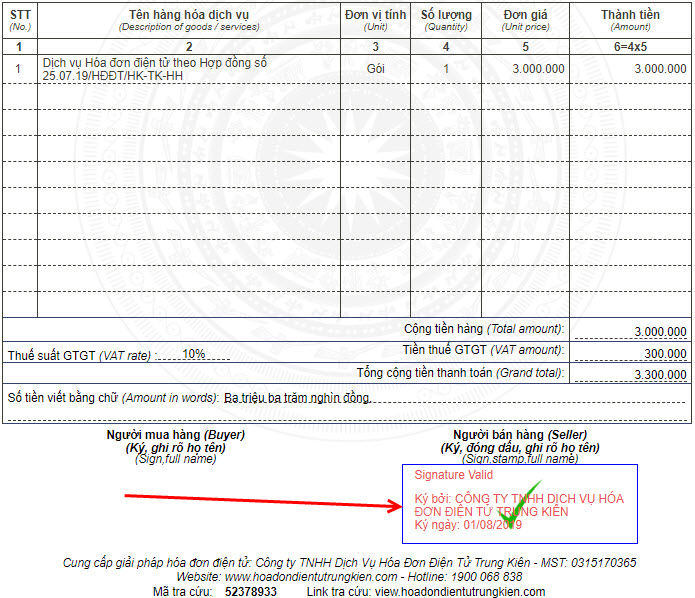
According to Clause 7, Article 10 of Decree 123/2020/ND-CP, an electronic invoice is valid when it has the seller's digital signature. The digital signature completely replaces the seal - this is a factor certifying legality. Therefore, there is no need to stamp the company seal on the original electronic invoice.
2. When is the buyer's signature required?
Electronic invoices are not required if the buyer:
- Not an accounting unit.
- Have sufficient other documents proving the transaction (contract, delivery note, payment document).
3. Special cases
Some partners, customers or financial institutions may require a company-stamped copy for internal verification, but this is not a legal requirement. In this case, the business can:
- Print the PDF invoice on paper → stamp "Certified copy of electronic copy" or "Copy from electronic invoice" for convenient file storage.
- However, the original XML file must still be stored to serve the tax authorities during inspection.
In short, the legal value of electronic invoices located in the original signed XML file, not in the stamp or PDF printout.
Do electronic invoices need to be stamped after being printed on paper?
This question is one of the most common misunderstandings when businesses first switch to using electronic invoices (E-invoices). Below is the most detailed explanation and the most accurate legal basis according to Decree 123/2020/ND-CP & Circular 78/2021/TT-BTC on e-invoices.
1. The converted printout is for archival purposes only, no signature required.
The printed copy is just a “representation” of the electronic invoice — easy for users, customers, accountants, and auditors to read and compare, not the original.
- Printed electronic invoices (PDF files printed from XML) are for storage only and have no payment value.
- Stamping is not required if it is only for internal storage and accounting purposes.
- Must clearly state: "INVOICE CONVERTED FROM ELECTRONIC INVOICE".
Learn more about how to print electronic invoices here
2. Exception: When circulating tangible goods
In case the electronic invoice needs to be stamped after printing, it will still be needed if it is for the purpose of proving the origin of the goods in transport. In that case, the invoice needs to have:
- Signature of legal representative.
- Seller's stamp (according to Circular 32/2011/TT-BTC, only when circulating goods).
Note: Can only be converted once.
Comparison: Signature and Seal – What is the difference?
This content is one of the important bases to answer the question of whether electronic invoices need to be stamped or not. In the digital environment, digital signatures (digital signatures) play a role equivalent to seals and handwritten signatures on paper documents.
When a business issues an electronic invoice with a valid digital signature, there is no need for an additional red seal - because the digital signature has fully guaranteed legal value according to the Law on Electronic Transactions.
| Criteria | Digital Signature | Company Seal |
| Form | Electronic, encrypted with USB Token or HSM | Physical stamp on paper document |
| Mechanism of action | Based on digital certificates issued by digital signature certification service providers | Engraved and registered seal with the police |
| Legal scope | Authenticating the integrity, origin and legal value of electronic documents | Confirm the legality and issuer of paper documents |
| Management agency | Ministry of Information and Communications | Ministry of Public Security |
| Interchangeability | Seals can be replaced in electronic transactions according to legal regulations. | Digital signature cannot be replaced in electronic environment. |
| Popular applications | Electronic invoices, electronic contracts, online tax declaration | Paper contracts, official documents, traditional administrative records |
Important legal basis for electronic invoices in general and whether electronic invoices need to be stamped or not
The following regulations are the basis for businesses to be completely assured when using electronic invoices or avoid misunderstandings about whether electronic invoices need to be stamped or not. Digital signatures have replaced seals and handwritten signatures, ensuring full legality, security and value of accounting documents according to current Vietnamese law.
| Legal documents | Main content |
| Decree 123/2020/ND-CP | Detailed regulations on the establishment, management and use of electronic invoices and documents; classification of electronic invoices with and without codes of tax authorities; guidance on the process of issuing, handling errors, storing and looking up electronic invoices. |
| Circular 78/2021/TT-BTC | Detailed instructions for implementing Decree 123, including how to digitally sign, format XML files, send and receive electronic invoice data with tax authorities, and regulations on converting, storing, and looking up valid electronic invoices. |
| Tax Administration Law 2019 | Laying the legal foundation for tax management by electronic means, which stipulates the responsibilities of taxpayers and tax authorities in storing and providing electronic invoice data when requested for inspection. |
| Official dispatch 5113/TCT-DNNCN (November 22, 2022) | The General Department of Taxation affirms: Electronic invoices with valid digital signatures do not need a company stamp. When printing for storage or transactions, the printed copy is for reference only, the legal value lies in the original digitally signed XML file. |
Common practical situations and how to handle them correctly regarding whether an electricity bill needs a stamp or not
In fact, there are many cases where businesses or accountants are still confused about stamping electronic invoices. Below are some common situations and how to handle them correctly.
1. Email invoice to customer – no punctuation
It is completely valid if the invoice has the seller's legal digital signature. It is not required to be printed on paper or stamped with the company seal. Businesses only need to send the signed XML or PDF file via email.
2. Invoice rejected due to “missing red stamp”
Explain to customers that according to Official Dispatch 5113/TCT-DNNCN (2022) and Circular 78/2021/TT-BTC, digital signatures have replaced seals. Electronic invoices do not require a red seal.
You can resend the XML file or the search link on the portal. einvoice.gdt.gov.vn for customers to check validity.
3. Invoice for foreign customers
The invoice must still have a valid original digital signature. If required by the international payment process, the business can add a confirmation or scanned signature (supporting, not replacing legal value). The valid original is still a digitally signed XML file.
4. Adjustment of electronic invoices / replacement
Business Correcting incorrect electronic invoices as prescribed in Article 19 of Decree 123/2020/ND-CP. No company seal is required, just re-sign the adjustment/replacement invoice to be valid.
Instructions for printing and storing valid electronic invoices
The printed copy of the electronic invoice is for illustration purposes only, while the signed XML file is the “legal original invoice” recognized by the tax authority.
1. When to print electronic invoices
- Print only on request from:
- Tax, audit and state inspection agencies.
- Or when the business needs to serve internal audits (for example, book reconciliation, transaction verification).
- No need to print in bulk or bind for storage like previous paper invoices.
- Printing purpose is for reference, exchange, and professional proof only – not a legal original.
2. How to print properly
- Print directly from standard electronic invoice software (Bizzi Invoice, MISA, Viettel, VNPT, Fast, etc.).
- Printed invoices must have the following information:
- Note line: “Electronic invoice converted from electronic invoice”.
- Full name and signature of the person performing the conversion (can be handwritten, no need for company seal).
- Date and time of conversion.
- Do not modify the content, logo, or original format of the digitally signed invoice.
3. Store electronic invoices in accordance with regulations
- Force parallel saving:
- Original XML file (with digital signature) – is the only legal document.
- PDF file (presentation) – for reference and printing when needed.
- Storage period: At least 10 years, according to the 2015 Accounting Law and Decree 123/2020/ND-CP.
- Recommended: Store on a cloud platform with data security certification to avoid loss (e.g. Bizzi Cloud, AWS, Google Cloud).
Questions users often search for about whether electronic invoices need to be stamped
Below is a collection of questions related to the article topic.
| Question | Short answer |
| Do electronic invoices need to be stamped? | No, just a valid digital signature is required. |
| Can unsigned electronic invoices be tax deductible? | Yes, if the valid invoice criteria are met. |
| Does the printed electronic invoice need a stamp? | Not required, unless used for the circulation of goods. |
| Is an electronic invoice without the buyer's signature valid? | Yes, if the transaction can be proven. |
| When should I print an electronic invoice on paper? | When required by tax authorities or for internal storage. |
| What is the difference between a signature and a stamp? | Digital signature has the same legal value as a red seal on an electronic copy. |
Conclude
The above article has answered all questions related to the question: Do electronic invoices need to be stamped? In short, electronic invoices do not need to be stamped and businesses still ensure full legal value.
- It is not required to stamp the electronic invoice with a red stamp, even when sending it to the customer.
- Digital signature (USB token or HSM) has completely replaced traditional seals in electronic transactions.
- Electronic invoices (XML files) with full tax authority codes, digital signatures, and seller/buyer information are legal original invoices.
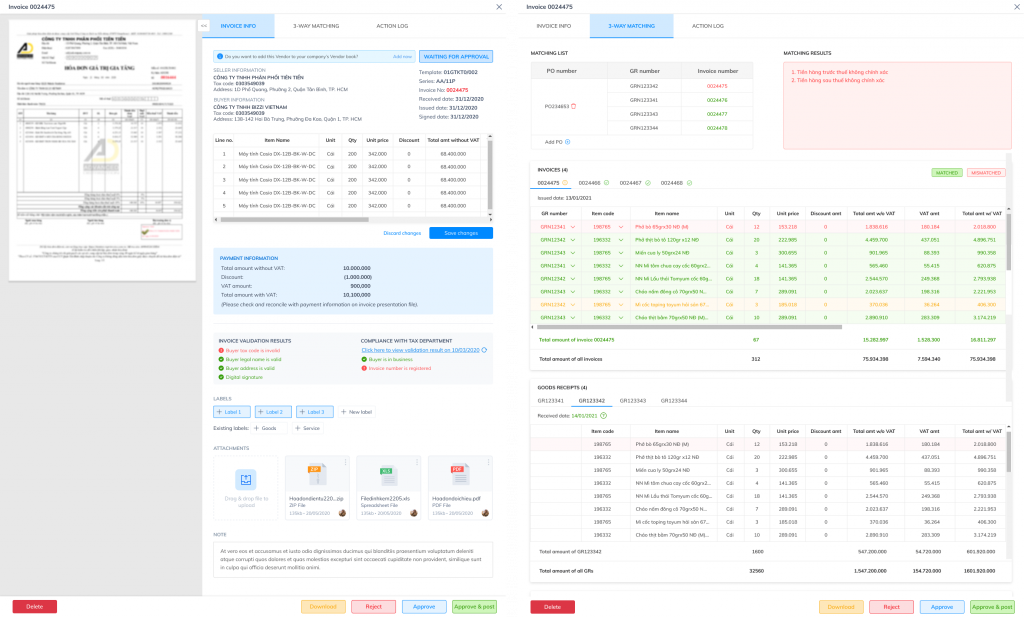
With the complete transition to electronic invoices and the increasing number, businesses need to solutions like Bizzi to manage, issue and store electronic invoices in an efficient way automatic - transparent - legal, reduce risks and save maximum operating costs. Bizzi's e-Invoice feature helps businesses:
- Sign and issue valid electronic invoices right on the cloud platform – no manual operation required.
- Automatically store, classify and look up invoices according to the data standards of the General Department of Taxation.
- Fully integrated with ERP/accounting to synchronize sales data - accounts receivable - reports.
- Control the invoice approval process, prevent errors and fraud in the issuance stage.
- Ensure data security with ISO/IEC 27001 standard infrastructure and multi-layer backup.
Registration here Experience tax-compliant electronic invoice management with Bizzi today!