

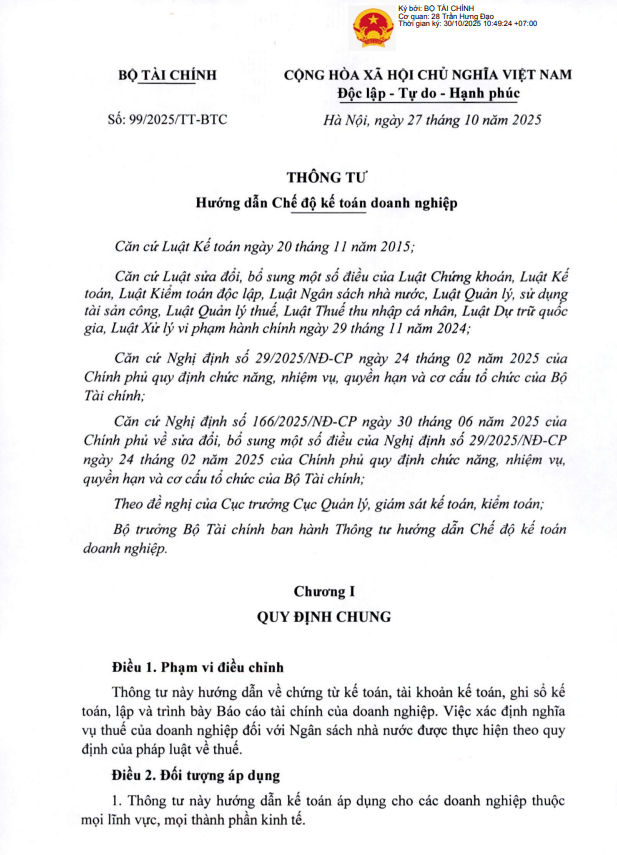
Guidance on business accounting regime from 2026
| Number: | 99/2025/TT-BTC | Text type: | Circular | |
| Place of issue: | Ministry of Finance | Signed by: | Nguyen Duc Tam | |
| Date of issue: | October 27, 2025 | Effective Date: | Known | |
| Date of announcement: | Known | Gazette number: | Known | |
Specifically, the Minister of Finance has provided guidance on the enterprise accounting regime from 2026.
For example, Article 4 of Circular 99/2025/TT-BTC stipulates the currency unit in accounting as follows:
(1) “Accounting currency unit” is Vietnamese Dong (national symbol is “đ”; international symbol is “VND”) used to record accounting books, prepare and present the enterprise’s Financial Statements. In case an enterprise mainly receives and spends in foreign currency, and meets the factors specified in (2), (3), (4), it may choose one foreign currency as the accounting currency unit to record accounting books and be responsible for that choice before the law.
(2) Enterprises shall base on the following factors to determine the currency unit in accounting:
– The currency that primarily affects the selling price of goods and services and is often the currency used to list the selling price of goods and services and for payment;
– The currency that primarily affects labor costs, raw material costs, production costs, and other business costs, and is often the currency used to pay for those costs.
(3) In case, based on the factors in (2), the enterprise has not yet determined the accounting currency, the following factors shall also be considered as the basis for determining the accounting currency of the enterprise:
– Currency used to mobilize financial resources (currency used when issuing debt instruments, equity instruments, etc.);
– Currency regularly obtained from business activities and used for storage.
(4) The accounting currency reflects transactions, events, and conditions related to the business's operations. Once the accounting currency is determined, the business must not change it, unless there is a major change in management and business operations leading to a material change in those transactions, events, and conditions.
See Circular 99/2025/TT-BTC effective from January 1, 2026 and applicable to fiscal years starting on or after January 1, 2026.