

1. Update on Key Legal Risks Impacting Business Costs
– According to the Corporate Income Tax Law No. 67/2025/QH15, in conjunction with current accounting regulations in Decree 70/2025/ND-CP and Circular 99/2025/TT-BTC, the mandatory non-cash payment threshold for incurred expenses has been significantly reduced from VND 20,000,000 to VND 5,000,000 per transaction.
– Legal consequences: Business trip expenses such as airfare and accommodation bills of 5 million VND or more, if paid in cash, face the risk of being disallowed and not recognized as deductible expenses when settling Corporate Income Tax.
2. Optimizing Costs Through Contract-Based Pricing
– Faced with stricter regulations on invoices and receipts, applying a fixed allowance for business trip expenses (travel costs, accommodation, and lodging allowances) is an optimal risk management method. This fixed allowance offers a double benefit:
– Protecting corporate income tax expenses: Accepted by the Tax authorities as legitimate and reasonable expenses without requiring the submission of actual invoices.
– Optimizing personal income tax: Fixed-rate allowances are not included in the taxable income of employees.
– Mandatory requirement: Businesses must issue written Financial Regulations/Travel Expense Regulations, specifying the eligible individuals and detailed fixed allowance rates.
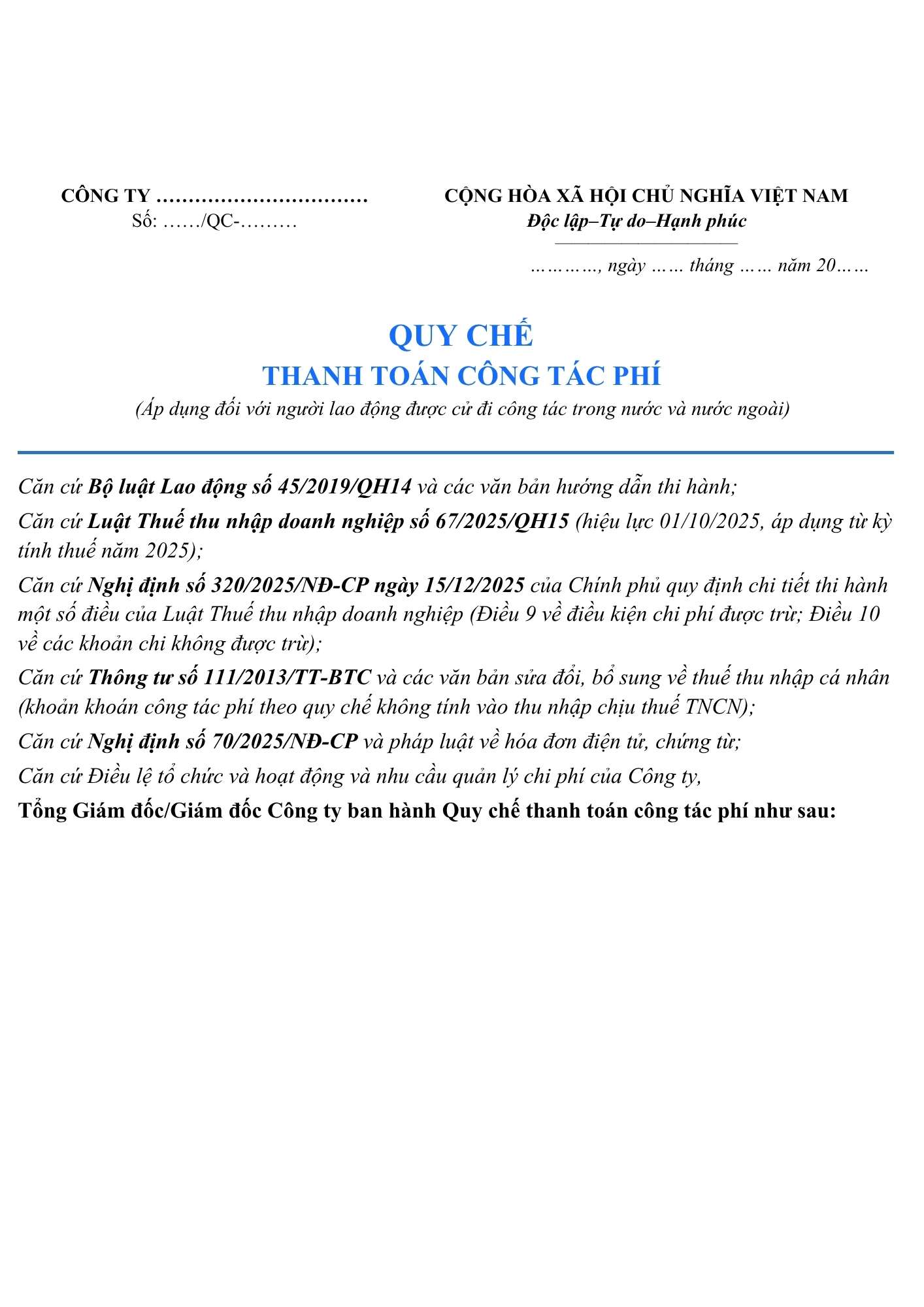
3. Standard Content of the 2026 Regulations on Business Trip Expenses
– This document is developed in accordance with Circular 99/2025/TT-BTC and Decree 70/2025/ND-CP, providing direct operational tools for the Accounting department with the following structure:
– Parallel payment mechanism: Clearly defines the cases in which payment based on actual costs (actual expenses) and payment in the form of a lump sum are applicable.
– A scientifically designed allocation system:
– Detailed classification according to 04 groups of management and personnel positions.
– Classified into 3 groups of work locations (major cities, other provinces/cities, remote areas).
– Specific regulations regarding train/bus/plane ticket classes, limits on entertainment expenses, and overseas business travel arrangements.
– Standardize processes and records: Integrate the Advance Payment – Repayment – Settlement process seamlessly. Provide a complete set of standard accounting forms, ready for application.
RecommendationIf a business continues to pay travel expenses habitually without a written regulation, this is a mandatory step that must be completed before the accounting season. When the inspection agency examines the expenditure, a properly issued regulation will serve as legal documentation with decisive influence on the business's behalf.