


Most businesses evaluate employees based on subjective feelings, manual reports, or disjointed Excel templates. This article by Bizzi provides a list of the most common employee evaluation criteria and guides you on how to build a data-driven employee evaluation criteria table, helping CFOs and managers assess performance based on real financial evidence, rather than subjective feelings.
What is an employee performance evaluation criteria sheet and how does it differ from an employee performance review form?
Employee performance evaluation criteria and "employee evaluation forms" are often used interchangeably, but they differ fundamentally in their management thinking. Understanding this distinction helps businesses avoid common pitfalls. evaluation for the sake of giving an opinion but it didn't improve performance.
The employee performance evaluation criteria are a defined standard framework. What factors do businesses use to evaluate their employees? and What constitutes good, satisfactory, or unsatisfactory performance?.
It answers the core questions:
- What does a business consider to be work efficiency?
- What skills, behaviors, and outcomes are required for this position?
- What specific index or description is used to measure each criterion?
Characteristic
- Strategic and directional
- In line with organizational goals, culture, and job roles.
- Few changes, long-lasting use.
- It is the "backbone" of the evaluation system.
The employee performance review form is a deployment form used for record the evaluation results in each period (month/quarter/year).
It replied:
- Evaluate whom, when?
- Where to leave scores and comments?
- How are the results compiled?
Characteristic
- Operational in nature
- This may vary by period and by department.
- It is a recording and summarizing tool.
- It depends entirely on the criteria table.
In summary, the Employee Performance Evaluation Criteria are: foundation of thinkingThis determines whether the evaluation is fair and creates value. The employee evaluation template is: execution toolIt cannot be good without the right criteria.
Top 12 most common employee evaluation criteria today.
Below is Top 12 most common employee evaluation criteria today., structured according to thinking performance – risk – capabilityThis helps businesses measure results while minimizing subjective evaluations. The content is suitable for use with... standard criteria tableIt's not just a formal checklist.
Group A — Results & Performance (Performance-based)
Criterion 1: Level of KPI/OKR completion
Measure the extent to which employees achieve committed goals regarding output, quality, schedule, or impact. This is a fundamental metric that directly reflects performance. output It's not about how busy you are.
Common measurement methods: % completed KPI/OKR, exceeding/falling short of targets.
Criterion 2: Financial impact (Revenue / Cost impact)
Assess the level of employee contribution to increase revenue, cut costs in business or optimize resourcesThis is especially important for roles in finance, sales, and operations.
How to measure: Revenue generated, cost savings achieved, cost avoidance.
Group B — Compliance & Risk (Compliance-based)
Criterion 3: Level of compliance with procedures and policies
Measure the extent to which employees adhere to internal procedures, regulations, and legal requirements related to their work. This metric helps reduce operational and legal risks.
How to measure: Number of violations, degree of procedural deviation, audit results.
Criterion 4: Integrity (measured by data)
Don't judge based on emotions, but on facts. work tracesReporting must be accurate, complete, and timely; no errors should be concealed; and no data fraud should occur.
How to measure: Comparison of reports – system, number of data adjustments, cross-checking results.
Group C — Behavior & Capability
Criterion 5: Sense of responsibility and proactiveness
Employee performance evaluation Take the job to the end.Instead of shirking responsibility, proactively propose solutions instead of waiting for instructions.
Measurement indicators: Job feedback, problem handling, level of reminders needed.
Criterion 6: Discipline & adherence to work procedures
Unlike criterion 3 (business processes), this criterion focuses on personal disciplineDeadlines, reports, work standards.
How to measure: Meet deadlines, adhere to work schedules and internal regulations.
Criterion 7: Ability to cooperate and work in a team
Assess the level of effective collaboration with colleagues, other departments, and stakeholders to achieve common goals.
How to measure: 360-degree feedback, conflict level, and cross-departmental project effectiveness.
Criterion 8: Professional Skills & Execution Capabilities
Measure the level of proficiency in knowledge, professional skills, and the ability to apply them to real-world work, not just qualifications.
How to measure: Output quality, level of support required, business error rate.
Criterion 9: Ability to learn and adapt
Assess the speed of acquiring new knowledge and the ability to adapt to changes in processes, tools, and objectives.
How to measure: Time to master a new task, level of improvement after receiving feedback.
Criterion 10: Project Time Management & job priorities
Measures the ability to allocate time effectively, focus on important tasks, and minimize wasted time.
How to measure: Late payment rate, personal cycle time, multitasking ability.
Criterion 11: Problem-solving and decision-making ability
Evaluate the level of problem analysis, choose solutions, and take responsibility for the decisions made.
How to measure: Decision quality, number of recurring incidents, and the extent to which it escalated to management.
Criterion 12: Contributions to process improvement and optimization
Measure the level of employee participation in improving work methods and proposing initiatives to help Reduce costs, reduce time, reduce risks..
How to measure: Number of feasible proposals, value of improvements that can be applied in practice.
In summary, the top 12 criteria above help businesses comprehensive employee evaluation:
- There are results (Performance)
- Balance
- Capability
See more content about the 9-Box Grid Model – How to evaluate personnel using performance data and budget. here
How to build a data-driven employee performance evaluation framework (4-layer framework)
An effective employee performance evaluation system should incorporate criteria, weighting, data sources, and evaluation cycles to ensure fairness and minimize subjectivity.
Level 1 — Output (Outcome / Performance)
The core question: This employee created What results can be measured??
This is the most important layer, reflecting the actual value that employees bring.
Typical criteria
- KPI/OKR completion level
- Revenue, output, and quality of production.
- Financial impact: increased revenue, reduced costs, reduced waste.
Principle
- Measure by data, not by vague descriptions.
- Aligned with department and company goals
- There are clear thresholds for passing, exceeding, and failing to meet the requirements.
If this class is weak, the entire evaluation will become merely a formality.
Level 2 — How to Produce Results (Process & Efficiency)
The core question: That result was produced. How?
Two people achieving the same KPIs but using different methods can create very different risks.
Typical criteria
- Adhere to procedures and policies.
- Individual/Group Cycle Time
- Error rate, rework, exceptions
Principle
- Evaluate making, not only result
- Avoid encouraging the practice of "achieving KPIs at all costs."
- Data is derived from the system, not from management's subjective feelings.
Grade 3 — Competence & Behavior
The core question: The staff have appropriate competence and behavior Is this to maintain sustainable results?
This class reflects potential for growth, not just short-term performance.
Typical criteria
- Professional and execution skills
- Ability to cooperate and communicate
- Proactive, responsible, disciplined
- Time management & task prioritization
Principle
- Description of behavior observable
- Avoid using sentimental language like "good" or "enthusiastic."
- There are specific examples for each score level.
Grade 4 — Integrity & Risk
The core question: This employee created hidden risks Is this for the organization?
This is a layer that is often overlooked but is extremely important for businesses that are scaling.
Typical criteria
- Honesty in reporting and data
- Compliance with internal controls (SoD)
- Attitude when mistakes occur (transparent or concealed)
Principle
- Prioritize system data and audit trail.
- No "compensation points" will be given for serious violations.
- Use as a criterion gate (Pass/Fail)
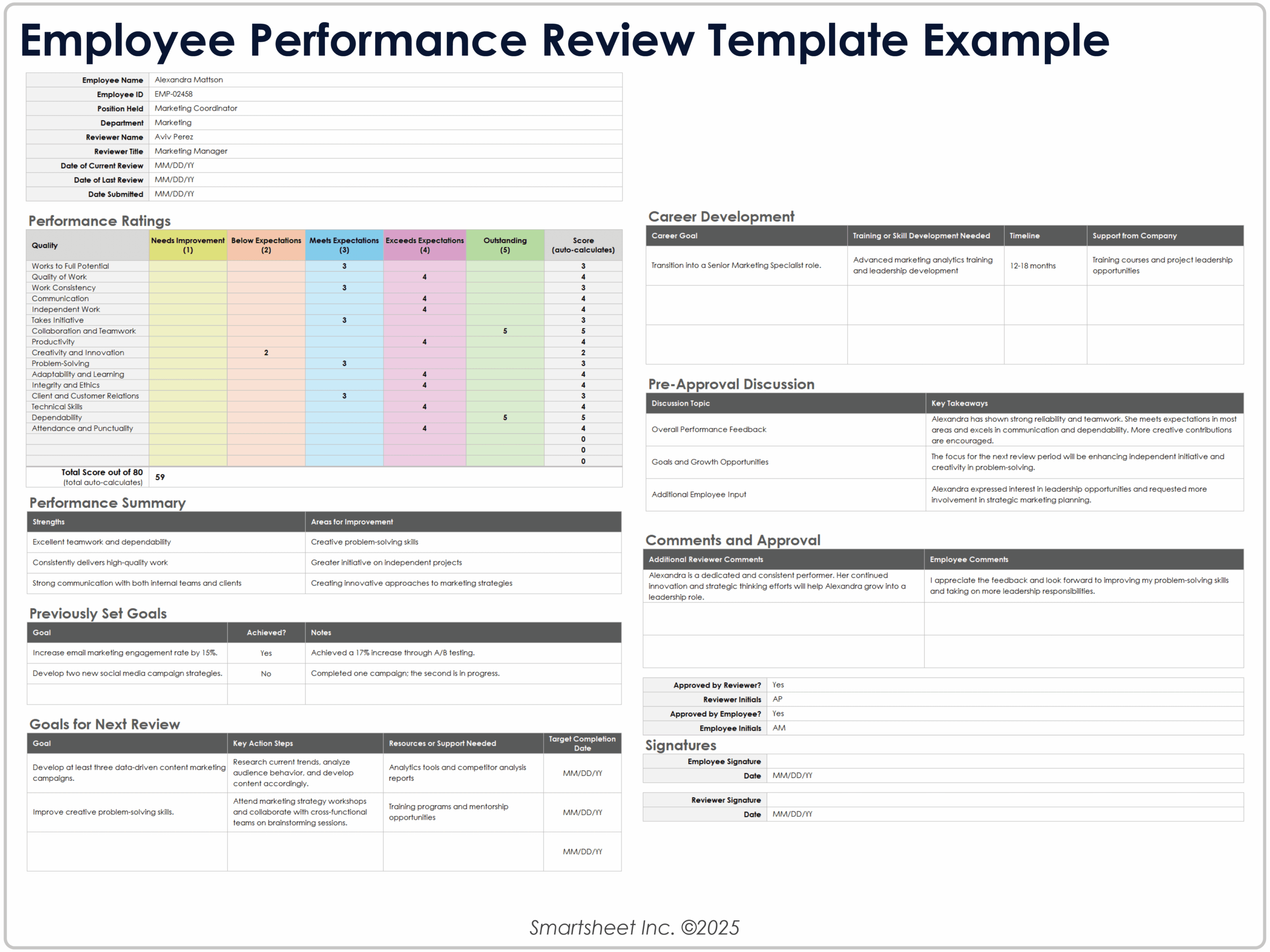
3 sample employee performance evaluation criteria forms by department.
Each department needs a different employee evaluation criteria framework to accurately reflect the specifics of the job and its financial impact. Below are three sample employee evaluation criteria frameworks by department, designed with a data-driven mindset – measurable and directly linked to financial performance, not just subjective evaluations.
Sample Sales Employee Performance Evaluation Criteria
This employee performance evaluation criteria expands from revenue KPIs to include the quality of cash collection. Salespeople are evaluated not only on how much they sell, but also on how much they collect and how quickly they collect it.
| Criteria group | Evaluation criteria | Measurement index | Management significance | Data sources |
| Result | Revenue achieved | % Revenue KPI | Measure revenue generation potential. | CRM |
| Result | Order profit margin | % Gross Margin | Avoid selling at any cost. | ERP |
| Cash flow | Individual/Group DSO | Number of days | Measure the speed of cash flow. | Bizzi ARM |
| Cash flow | Aging accounts receivable | % debt >30/60 days | Identify recall risks | Bizzi ARM |
| Cash flow | Collection rate | % collected / receivable | Assign sales and collection responsibilities. | Bizzi ARM |
| Follow | Comply with payment terms. | % on time | Reducing post-sales disputes | ERP / Bizzi |
| Behavior | Coordinate with AR | Qualitative assessment | Avoid the "once sold, done" mentality. | Manage |
Sample evaluation criteria form for accounting and finance staff.
This employee performance evaluation template focuses on speed, accuracy, and risk control. The key difference is that it doesn't evaluate "doing a lot," but rather "doing it quickly, correctly, and with few exceptions."
| Criteria group | Evaluation criteria | Measurement index | Management significance | Data sources |
| Efficiency | Invoice processing number | Monthly Bill | workload | ERP |
| Efficiency | Invoice processing cycle time | Hour/Day | Measure wasted time | Bizzi Bot |
| Quality | Exception rate | % exceptional invoice | Accuracy measurement | Bizzi Bot |
| Quality | Rework rate | % | Repeatability measurement | ERP |
| Follow | Adhere to the expenditure approval process. | % is correct | Reduce internal risks. | Bizzi Expense |
| Risk | Incorrect/Duplicate payment | Number of cases | Avoid losing money. | Bizzi Bot |
| Attitude | Departmental coordination | Qualitative | Reduce congestion | Manage |
Sample employee performance evaluation criteria form for purchasing staff.
Sample employee evaluation criteria form linking procurement with risk control and financial discipline. The difference with this form is that Procurement doesn't just buy cheap, but buys right – buys clean – buys with control.
| Criteria group | Evaluation criteria | Measurement index | Management significance | Data sources |
| Result | Purchase price versus budget | % deviation | Cost Control | ERP |
| Follow | Comply with the PO. | % purchase with valid purchase order | Reduce out-of-control purchases. | Bizzi Bot |
| Risk | Invoice risk | % invoice incorrect PO/GR | Avoid disputes and incorrect payments. | Bizzi Bot |
| Efficiency | Purchase Cycle Time | Day | Avoid delays | ERP |
| Follow | NCC meets standards. | % | Reduce legal risk | ERP |
| Combination | In coordination with AP | Qualitative | Reduce payment congestion. | Manage |
| Improve | Proposed optimal supplier | Number of proposals | Long-term optimization | Manage |
With these three employee evaluation models, modern employee valuation goes beyond attitude or effort, measuring impact on money, time, and risk.
5 common mistakes when using employee performance evaluation criteria.
Below are five of the most common mistakes businesses make when using employee performance evaluation forms, resulting in a time-consuming, ineffective, or even counterproductive evaluation system.
1. Judging subjectively instead of based on data.
The most common mistake is using vague criteria such as:
- "Work hard"
- "Good attitude"
- "Be responsible"
When there are no clear metrics, the evaluation results depend on:
- Manager's personal opinion
- Near-distant relationship
- Recency bias
Consequences: Good employees don't see fairness, while underperforming employees don't know what to improve.
How to avoid: Shift criteria to measurable indicators (KPIs, cycle time, error rate, DSO, etc.), using systematic data instead of subjective opinions.
2. Incorrect KPIs or KPIs that deviate from organizational goals.
Many businesses measure the easy to measure, not measured the thing to measure:
- Sales measures revenue, not cash collected.
- Accounting measures the quantity of invoices, not the quality of processing.
- Management measures "on time," not value created.
Consequences: Employees optimize their individual KPIs but at the expense of cash flow, risk, or internal experience.
How to avoid: Design KPIs linked to final result (cash-in, cost, risk), not just intermediate tasks.
3. Dirty data or lack of reliable data sources.
The evaluation is based on:
- The Excel file is automatically compiled.
- Manual adjustment report
- Data is inconsistent across departments.
Consequences: The evaluation process undermines credibility, and management wastes time explaining instead of improving performance.
How to avoid: identify single source of truth (ERP, CRM, automation systems) minimize manual data entry and editing.
4. Lack of calibration among managers.
Same criteria, but:
- Manager A gave 4 points.
- Manager B only gave 2–3 points.
Consequences: Unfair evaluations lead to dissatisfaction and a loss of trust in the system.
How to avoid: organization calibration session Among managers, data and real-world examples should be used to agree on evaluation standards.
5. Evaluation too late (only done at the end of the term)
Many businesses only evaluate:
- End of quarter
- End of the year
Consequences: Performance reviews have become merely "closing the books," no longer effective in improving performance.
How to avoid: switch continuous performance evaluation, monitor metrics in real time and provide early feedback.
In summary, establish a criteria for evaluating employees. That's correct., But misuse will:
- Time-consuming
- Create conflict
- No improvement in work efficiency.
For a rating system to truly create value, businesses need:
- Clean data
- KPIs in their true nature
- Unified evaluation standards
- Provide timely feedback, don't wait until the end of the period.
FAQ – Frequently Asked Questions: What are the criteria for evaluating employees?
Below are answers to frequently asked questions regarding employee performance evaluation criteria.
1. What does the employee performance evaluation criteria include?
A standard criteria table It's not just a list of KPIs., which usually consists of 4 layers:
- Key Objectives/KPIs: Linked to the final outcome (revenue, cash collection, costs, quality).
- Process metrics: cycle time, error rate, exception rate, debt aging
- Compliance & Risks: The process was followed correctly, within the specified timeframe, and without any serious errors.
- Behavior & abilities: Be proactive, collaborative, and willing to learn – but this must be supported by examples or data.
If any of these four layers are missing, the assessment is likely to be biased or subjective.
2. How often should employee performance reviews be conducted?
There's no single "standard" frequency for every business, but the best practice is:
- Track data: weekly / monthly
- Official evaluation: quarterly
- Salary/bonus adjustments: every 6 months or 1 year.
Most importantly: Don't wait until the end of the period to review the data..
3. Which is more suitable: KPI or OKR?
You don't have to choose one over the other.
- OKR Suitable for:
- Strategic objectives
- New project
- Improvement, innovation
- KPI Suitable for:
- Daily operation
- Measure steady-state performance
- Linked to rewards and punishments.
The most effective approach: OKRs are for guidance, KPIs are for measurement and compensation.
4. How can we conduct an honest and objective evaluation?
4 core principles:
- Use data instead of intuition.
- Measure only what is verifiable.
- There is a common evaluation standard (calibration).
- Acknowledge the evidence, don't just give points.
If you cannot answer the question "On what basis are the scores given?" That criterion is not objective enough.
5. Should we use DSO to evaluate sales?
Yes, but not for use alone.
DSO reflects:
- Revenue quality
- Revenue
- Level of coordination with accounting and accounts payable
It's recommended to combine:
- Revenue
- Collection rate
- Aging accounts receivable by customer group
DSO helps avoid this situation. Sales are booming, but the money isn't coming in..
6. How can we reduce the time spent compiling evaluations?
The reasons for the time-consuming nature of this process often stem from:
- Manual data collection
- Disjoint files
- The manager had to "go and ask for the phone number".
Ways to reduce:
- Standardize the index
- Retrieve data directly from the system (CRM, ERP, ARM, Expense).
- Automated dashboards replace Excel reports.
Objective: The evaluation is based on operational data, not a final project.
7. Can continuous assessment replace periodic assessment?
Not a replacement, but a supplement.
- Continuous evaluation: helps detect problems early and provide timely feedback.
- Periodic performance reviews: used for decisions regarding salary, bonuses, and promotions.
An efficient business is one that combines both.
8. Is software necessary for employee evaluation?
Not mandatory, but essential as scale increases..
The software helps:
- Automatic data collection
- Reduce manual data entry and errors.
- Transparency of results
- Reduce management time.
The important thing isn't whether or not you have the software, but rather... Can the software connect to real operational data?.
Conclude
An effective employee performance evaluation system isn't about a beautiful template, but about the right data – measuring the right things, at the right time, and with the right people. A data-driven employee evaluation system doesn't ask "who does better," but "who creates more sustainable value for the organization."
A four-tiered framework helps businesses:
- Fair evaluation
- Linking performance to risk
- Suitable for use in compensation, bonuses, training, and succession planning.

Employee performance evaluation criteria only truly create value when they are built on real financial data and operate through automation. When KPIs, behavior, and compliance are measured by cycle time, DSO, exception rate, or cost-cash flow impact, businesses will move beyond subjective evaluations and "end-of-period memory."
Bizzi acts as a data infrastructure for employee performance evaluation: automatically recording supporting documents such as invoices, expense approvals, and accounts payable; standardizing metrics in real time; and transforming individual performance into a financial language that allows CFOs and executives to make immediate decisions. As a result, employee evaluation is no longer just an HR procedure, but becomes an effective management tool for risk control and ROI optimization.
Register here to experience solutions from Bizzi: https://bizzi.vn/dang-ky-dung-thu/