



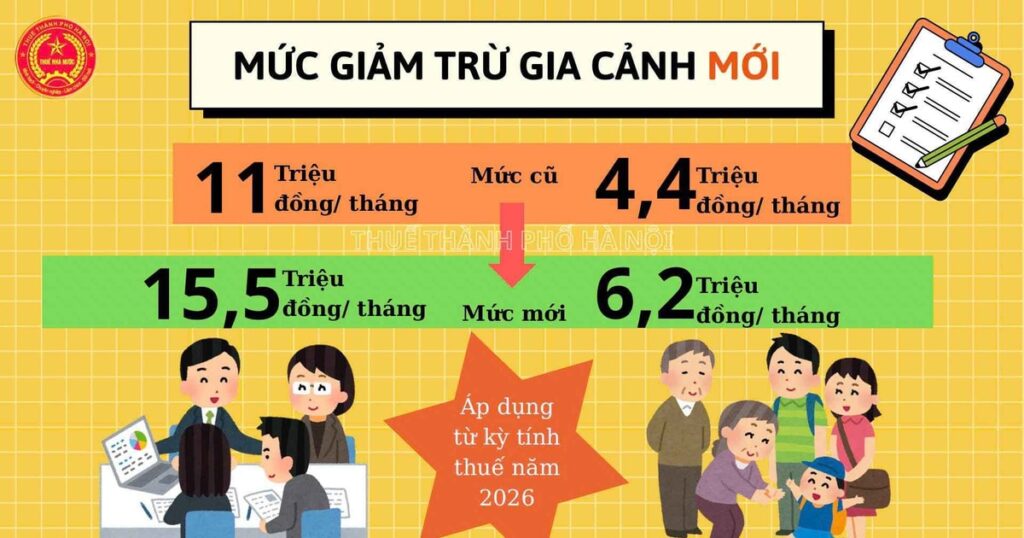
Correct understanding of family deduction help millions of businesses avoid overpaying taxes, avoiding back taxes and being more proactive in financial planning. Especially in the context The proposed family deduction level is being raised to 15.5 million/month from 2026., question "Are business households eligible for family deductions?" become hotter than ever.
The following article is a synthesis of Law on Personal Income Tax, Circular 40/2021/TT-BTC, Circular 111/2013/TT-BTC, and the latest documents of the General Department of Taxation, help you understand accurately - completely - legally.


Why do business households need to understand clearly about "family deduction"?
Many individual businesses are currently operating under a contract or declaration system – but do not necessarily have full information about the tax incentives they may be entitled to. Especially when the Law & policy are constantly changing, not understanding the “family deduction” can easily cause the business to overpaying taxes, suffering financial losses, or missing out on legitimate tax savings opportunities.
1. Millions of businesses may be paying taxes unwisely
In Vietnam, there are many small businesses: grocery stores, restaurants, online shops, personal services, etc. Revenue from these businesses often fluctuates, costs are unclear, and most choose the form of lump sum tax for simplicity. However, this form no family deductions allowed, although individual or family living standards may vary widely.
If the homeowner does not understand the tax regulations, they will not know that they are “not deductible” – resulting in higher taxes being paid than the income that should be reduced. This is a loss at the root, affecting profits, cash flow and the ability to reinvest.
2. As the proposed family deduction increases – the opportunities & risks become greater
In context The proposed family deduction level is being adjusted to 15.5 million VND/month. (compared to 11 million currently), the tax difference between salaried employees + individual declarants and household contract even bigger.
This has two consequences:
- Opportunity for households to declare:If switching to the form of declaration, bookkeeping, and valid expenses, the household will enjoy a higher deduction level - significantly reducing personal income tax.
- Risks for householdsIf the contract form is still maintained, households will face the risk of costs and taxes not commensurate with the actual burden of life, especially when living expenses and family expenses are increasing.
3. Understand clearly to choose the appropriate form of business and tax declaration
Correct understanding of family deductions helps householders consider:
- Should I continue using it? lump sum tax – simple but less flexible; often switched to declaration – more complex but can be beneficial in terms of tax, cost effectiveness, scalability.
- Consider costs - profits - risks when declaring valid expenses, keeping invoices and documents.
For households planning to expand, cooperate, or sign large contracts, understanding and applying deductions at the right time can significantly save tax costs, helping businesses operate much more effectively.
What is family deduction? How is it applied in personal income tax?
1. Definition & purpose of family deduction
Family deduction is an amount deducted from personal income tax before the progressive tax schedule was applied.
Purpose:
- Reduce the tax burden on taxpayers.
- Ensure a minimum standard of living for individuals and dependents.
2. Latest family deduction level (2026)
| Object | Deduction/month | Deduction/year |
| Taxpayers themselves | 11 million | 132 million |
| Each dependent | 4.4 million | 52.8 million |
The Ministry of Finance is submitting an adjustment plan:
- Personal deduction: 15.5 million/month
- Dependent: 6.6 million/month
👉 Now not yet effective, but will greatly affect the tax calculation of both working individuals and business individuals.

What is a business household and what taxes must it pay?
Understanding correctly individual business households and taxes payable to avoid errors, avoid tax arrears and overpayment. This section briefly summarizes - in accordance with regulations according to Law on Tax Administration, Decree 01/2021/ND-CP, and Circular 40/2021/TT-BTC.
1. Concept of individual business household
Sole proprietorship (SPP) is a form of business:
- Because an individual or the whole household registered
- Small scale, usually less than 10 workers.
- No legal status as a business.
- Responsible by all assets of households and individual household heads.
Business households can choose:
- Pay lump sum tax (common) – tax authorities determine revenue & taxes.
- Pay tax declaration - self-declare revenue, expenses, profits.
→ This is the key factor to determine Are business households eligible for family deductions? in the next part.
2. Types of taxes that business households must pay
Below is 3 main taxes Applicable to business households according to Circular 40/2021/TT-BTC.
Summary table of taxes that business households must pay
| Tax type | Calculation method / Calculation level | Important notes |
| VAT (value added tax) | Calculated by % on revenue, depending on the profession: 1% – 5% | No cost based, no input deductions |
| Personal income tax (PIT) | Calculated by % revenue, 0.5% – 2% depending on the industry | Family deductions are NOT applicable to household contract |
| Business license fee | Fixed amount based on annual revenue: 300,000 - 1,000,000 VND | Exempt if revenue ≤ 100 million/year |
Detailed explanation by industry
According to Circular 40:
- Commerce: VAT 1% + PIT 0.5%
- Service: VAT 5% + Personal Income Tax 2%
- Production – transportation – construction: VAT 3% + PIT 1.5%
These rates apply on revenue, regardless of real profit → this is why Households are not eligible for family deductions..
Are business households eligible for family deductions?
Family deduction is one of the important contents of personal income tax (PIT). However, not everyone is entitled to this deduction, especially individual business households. Below is a detailed analysis of each case so you know whether you are eligible for a deduction or not.
1. Business households pay lump-sum tax – NO family deduction
This is the most common group of households in Vietnam: small retail, service businesses, grocery stores, restaurants, small spas, online sales without invoices...
Reasons for not being deducted
- Lump-sum tax is calculated by revenue × ratio %, not based on real income.
- No step to determine cost – income → no basis for family deduction.
- Law 71/2014/QH13 (effective 2015) has abolish deductions for individuals paying lump-sum tax.
Illustrative example
- Contract revenue: 30 million/month
- Personal income tax rate (services): 2%
→ Tax payable = 30,000,000 × 2% = 600,000 VND/month
No deductions:
- 11 million personal deduction
- 4.4 million dependent deductions
Conclude: Contracting household never family deduction, even if supporting dependents.
2. Business households pay and declare taxes – can be deducted
Unlike the contracted households, this group is taxed based on real profit = revenue – valid expenses.
If business households settle taxes based on actual income, they will be considered as self-employed individuals and family deduction.
Conditions for deduction
You are in this category if:
- Have personal tax code (MST)
- Have accounting books, revenue and expense statement
- Have valid expense documents
- Submit personal income tax settlement (Form 02/QTT-TNCN)
Illustrative example
- Actual revenue: 60 million
- Eligible expenses: 30 million
→ Profit: 30 million
→ Personal deduction: 11 million → Taxable income: 19 million
Apply tax rate 5%:
→ Personal income tax = 19,000,000 × 5% = 950,000 VND/month
Conclude: Declarant family deduction, but only when have tax settlement.
3. Business households have multiple sources of income (both salaried and business)
This is a common case with people who:
- Go to work for a company but do online business
- Work full-time and sell live stream
- Own a small restaurant and work as an office worker
Important regulations
- Family deductions can only be calculated in one place.
- End of year must consolidated settlement of both sources of income.
Note to avoid being charged
If the company salary has been deducted for personal gain, then Business income will no longer be deductible..
If the household arbitrarily deducts more → the tax authority will:
- Tax collection
- Calculating late payment penalties
- Can check tax records in depth
Illustrative example
- Company salary: 20 million
- Business profit: 15 million
Total income: 35 million
→ Deduct 11 million for personal deduction
→ Taxable income: 24 million
→ Personal income tax level 2: 2.4 million/month
Conclude: Even though there are 2 sources of income, Deduction is only calculated once.
4. Small business households (revenue ≤ 100 million/year)
According to Circular 40/2021/TT-BTC, business households with revenue ≤100 million/year belong to:
- Free VAT
- Free personal income tax
- Free business license fee
Because no personal income tax is incurred → no need to apply family deduction.
For example
Small online business, revenue 6-8 million/month → total annual revenue: 72-96 million → tax-free → no deduction applied.
Conclude: Not because of “no deduction”, but because no deduction required because of tax exemption.
Why business households are not entitled to family deductions?
Although they are both individuals paying taxes, business households pay lump-sum tax again no family deductions apply, different from salaried employees or self-employed individuals according to declaration. The reason comes from Legal regulations and specific tax calculation methods for business households.
To understand clearly, we need to look at 02 factors: (1) nature of the tax, and (2) Legal basis for excluding family deductions for contract households.
1. The nature of lump-sum tax prevents business households from getting deductions.
For business households paying lump-sum tax:
- Personal Income Tax not based on actual income.
- Taxes are calculated by revenue × ratio %, not determining real cost-profit.
- Tax authority fixed revenue, households only pay according to notice.
Because There is no step to determine actual taxable income., should family deductions cannot be applied (applies only to taxes on net income).
2. Legal basis for excluding family deductions for contract business households
Here is the full summary table. legal documents regulations Contractual business households are NOT entitled to family deductions.:
Table: Legal basis for family deductions for business households
| Legal documents | Related regulations |
| Personal Income Tax Law No. 04/2007/QH12 | Determine the subjects eligible for family deductions (only applicable to income calculated according to the progressive tax schedule - not applicable to income calculated according to the % rate) |
| Law 71/2014/QH13 | Eliminate family deductions for business individuals; from 2015 onwards, contract households are not allowed to deduct for themselves or their dependents. |
| Circular 40/2021/TT-BTC | Regulations on lump-sum tax calculated based on % revenue, no income determined → no basis for family deduction |
| Circular 111/2013/TT-BTC | Instructions on family deduction levels (11 million for self, 4.4 million/dependent) → but only applies to income calculated according to the progressive table, not applicable to contracted households |
| Official dispatch 897/TCT-DNNCN (2022) | The General Department of Taxation affirms that "Business households paying lump-sum tax are not eligible for family deductions" |
| Official dispatch 14828/BTC-TCT (2024) | Detailed instructions for individuals who both have a salary and do business → deduction is only calculated once for one source of income |
New policies and directions: What might change in the future?
In recent years, the issue of “tax fairness between salaried workers and business households” has received special attention from the Ministry of Finance and the General Department of Taxation. This has led to a number of proposals for policy adjustments. expected period 2025–2026.
1. Proposal to raise the taxable revenue threshold from 200 million → 400 million/year
According to the new orientation, only businesses with revenue over 400 million/year must pay VAT and personal income tax.
Adjustment target:
- Reduce tax burden for small businesses.
- Increase the similarity with the employee deduction (132 million/year).
- Limit the situation of "taxes being too high" compared to actual revenue.
Expected Impact:
- Many small businesses are exempt from taxes, reducing the pressure of declaration.
- The middle-class household group (200-400 million/year) will be the ones to benefit the most.


2. Proposal to increase family deduction to 15.5 million/month
The current personal deduction is 11 million/month, but is being proposed to be increased. 15.5 million/month.
Target:
- Updated with rising living standards.
- Deduct accordingly for inflation 2020–2025 (~20%).
However: this deduction applies ONLY to employees and individuals with declared income., not applicable to contract households.
3. Compare the “tax fairness” level: How much revenue does a business need to equal the deduction?
Assuming the average profit margin of a business household ≈ 10%, then:
- Want to achieve profit of 132 million/year (equivalent to employee's personal deduction)
=> Need revenue over 1.3 billion/year.
This shows that:
- Job No deductions for households This is somewhat unfair as revenues are low but the flat tax rate is still applied based on revenues, not profits.
- This is the reason why there are many recommendations for policy changes in the coming time.
When should I convert from a sole proprietorship to a sole proprietorship/company?
Not every household needs to convert to a business, but there are cases where conversion will help optimize taxes, increase credibility, and make scaling easier.
1. Signs that it's time to switch
You should consider converting from a sole proprietorship to a business if:
- Revenue exceeds 100 million/year, the model is increasingly expanding.
- Need VAT invoice to work with large companies or international partners.
- Want reasonable cost optimization, instead of being taxed on revenue.
- Need advance capital - bank loan - sign long-term contract.
- Want enjoy family deduction when settling taxes (businesses help apply personal income tax more accurately).
- Want limit legal risks (because the business household has unlimited liability with all assets).
2. Benefits of switching to a business
Converting to a business offers many significant advantages, especially in terms of tax and financial management.
Fully charged at reasonable cost
Business eligible expenses when determining taxable income.
For example:
- Employee salary
- Office expenses
- Asset depreciation
- Marketing costs
- Travel and transportation fees
➡ Helps reduce corporate income tax significantly compared to lump-sum tax.
Enjoy family deduction when settling personal income tax
If the business owner directly receives salary or distributes income:
- Personal deduction: 11 million/month
- Dependent deduction: 4.4 million/person/month
➡ Significant reduction in personal income tax.
Easy access to capital and scale
Businesses have:
- Legal status
- Transparent financial reporting
- Clear invoice and document system
➡ Banks are easier to approve than businesses.
Enjoy corporate tax incentives
Some cases are:
- Corporate income tax exemption/reduction
- Startup tax incentives
- Support for loans from policy banks
Solution to support cost and invoice management when converting models
When a business household converts to an enterprise (LLC or private enterprise), the most important problem is not "changing the type" but transparently manage invoices - expenses - debts, according to business standards. This is also the point where many new conversion models encounter difficulties due to lack of systems, lack of processes and lack of suitable tools.
Below are two sets of practical problems and their accompanying solutions.
1. Practical problems after a business household converts to an enterprise
When operating as a business, you are required to:
- Cost management according to tax regulations (with valid invoice)
- Tracking accounts payable and receivable transparent
- Separate personal and business expenses
- Demonstrate valid expenses at year-end settlement
- Store – compare – check electronic invoices for correct standards
When transforming their models, businesses often face a series of challenges:
1.1. High cost but cannot prove validity
Single invoices, lost paper invoices, expenses without valid documents → when the tax authority inspects, part of the expenses are eliminated, leading to increase in taxes payable.
1.2. Cost management by “remembering in mind” is no longer suitable.
At household level, the householder can remember the expenses himself. But when it comes to business:
- Many departments incur costs
- Many projects, many contracts
- Multiple participants approved
→ Without a system, it is difficult to control who spends, what they spend on, and whether it is within budget.
1.3. Tax authorities require more transparency
When operating as a business:
- Financial reports, accounting books, cost documents must be clear
- Cost must have valid invoice, full information, in accordance with tax regulations.
→ Businesses need to prove: This expense is real – for business purposes – with valid documentation.
1.4. Increased invoice and supplier risk
Not a few cases:
- Mistakenly received invoice from defunct supplier
- Invoice with incorrect tax code, incorrect tax rate, incorrect content
- Using risky invoices without knowing
→ When the tax authority reviews, these invoices may be disqualified, even be punished.
Therefore, when "upgrading" to a business, the problem is not just pay taxes correctly, but also Manage costs and invoices proactively, transparently, and systematically.
2. Bizzi Solution – Automate business cost management
To solve the above problems, many businesses choose financial automation platform application right from the start of the transformation. Bizzi is a prime example of this group of solutions, focusing on:
- Automate input invoice processing
- Control spending according to budget
- Transparent, real-time debt management
Here's how Bizzi can help new businesses transition from sole proprietorship to corporation:
2.1. Automatic processing & reconciliation of input invoices (IPA + 3-way matching)
Instead of:
- Accountants must download each bill, compare each data line with the purchase order (PO) and the warehouse receipt (GR).
- Risk Incorrect amount, tax code, tax rate, invoice date entered…
Bizzi allows:
- Automatically download invoices from email, e-invoicing portal or supplier system.
- Use AI + RPA to:
- Identify the content on the invoice (amount, tax, tax code, date, supplier…)
- Automatic reconciliation with:
- Purchase Order (PO)
- Receipt/Signature Form (GR)
- Contract, budget
Benefit:
- Minimize manual data entry.
- Limit erroneous invoices from entering the accounting system.
- When the tax authorities inspect, businesses easily full retrieval of relevant data and documents.
2.2. Warning of incorrect invoices or risky suppliers
One of the major risks of a new business is lack of experience to distinguish risky suppliers, or do not regularly monitor their legal status.
Bizzi supports:
- Check Tax Identification Number (MST) and supplier performance.
- Warning when:
- Invoice from Supplier has MST locked or is out of business.
- Invoice has amount, tax rate, unusual content.
- Duplicate or over-budget invoices.
Benefit:
- Reduce risk excluded from settlement due to using "problematic" invoices.
- Helping business owners more secure when expanding the number of suppliers.
2.3. Manage business expenses with Bizzi Expense
When still a business household, the household owner often emotional spending decisionsBut once you have become a business, you need to:
- Clear budget for each department, project, campaign.
- Procedure approve transparent, traceable spending.
- Cost report by month/quarter/year to work with taxes and banks.
Bizzi Expense supports:
- Establish budget for each department/project.
- Personnel sent payment request / payment request on the system.
- Procedure multi-level approval:
- Department Head → Board of Directors → Accounting
- Automatically record cost data, allocate according to:
- Project
- Unit
- Type of cost (marketing, office, transportation, personnel…)
In addition, Bizzi provides monthly/quarterly cost reports, support:
- Easier tax filing
- Prepare settlement documents
- Compare actual costs with plans → make timely adjustments
Benefit:
- Control spending according to budget, avoid overspending.
- Create data footprint for all expenses – very important when explaining to the tax authorities.
2.4. Accounts Receivable Management (ARM) – Don’t let cash flow “drown” when revenue increases
When moving to a corporate model, debt becomes a central issue:
- Accounts receivable from customers
- Accounts payable to suppliers
- Payment deadline, discount, late penalty…
Bizzi ARM supports:
- Automatic debt recognition from invoices & documents.
- Set up debt aging report (aging report): shows due and overdue debts.
- Send automatic debt reminders via email for customers.
- Helping accountants and business owners:
- Know who owes how much, debt since when
- Plan your income and expenses proactively
Benefit:
- Limit customers' "money withholding" due to forgetting to remind them to pay their debt.
- Ensure healthy cash flow, support reinvestment plans and business expansion.
When a business household changes to an enterprise model, the problem is not just changing the license but entering a completely new financial management system, requiring more transparency, accuracy and stricter compliance.
To operate effectively, businesses need to understand tax regulations correctly, make reasonable use of family deductions and valid expenses, and must control invoices - expenses - debts throughout.
This is the foundation that helps businesses avoid "tax shock" during inspections, maintain a stable cash flow and build a solid financial system for future expansion. At this stage, Bizzi does not replace accounting but acts as a powerful "support system", helping to automate invoice processing, control costs, track debts and warn of risks according to regulatory standards.
This gives accounting teams and business owners peace of mind, smoother operations, and less room for error in the early years of transition – when risks are most likely to arise. Bizzi offers transparency, automation, and compliance, helping newly formed businesses quickly create a foundation for sustainable growth.
Real-life example – Comparison of 3 tax calculation cases
To better understand the application of family deductions in each model, below is a comparison table of the 3 most common cases that business households often encounter:
| Case | How to calculate tax | Family deduction | Tax payable |
| 1. Households paying lump-sum tax | 30 million × 2% | Not applicable | 600,000 VND/month |
| 2. Business households declare | (60 – 30 – 11) × 5% | There is a self-deduction | 950,000 VND/month |
| 3. Working with a salary of 20 million + doing business with 15 million | (35 – 11) × 10% | Only calculated at one place | 2.4 million/month |
The table above shows:
- Always contracted not deductible because taxes are calculated on revenue, not on actual income.
- The declaring household has an advantage when deductible for self and dependents (if any).
- People have multiple sources of income Special care should be taken to avoid duplicate deductions upon settlement.
Frequently asked questions
- Are individual business households eligible for family deductions?
→ No. If paying lump-sum tax, business households no family deductions apply as prescribed by Law 71/2014/QH13. - Are individual business declarations eligible for deductions?
→ Yes. If there are books, invoices and tax settlement based on actual income. - What is the current family deduction level?
→ 11 million VND/month for yourself and 4.4 million VND/month for each dependent. - Can a business household with less than 100 million/year get a deduction?
→ No need, because this group is personal income tax exemption, so no deduction is incurred. - What if you work for a company and do business at the same time?
→ Family deductions are only calculated once in a placeAt the end of the year settlement, all income will be added together to calculate tax. - Where to register dependents?
→ Register online on Electronic Tax Portal, or submit the declaration at the Tax Department of the place of residence.
Conclusion – Understand correctly to optimize legal taxes
Depending on the form of operation, business households may or may not be entitled to family deductions:
- Taxpayers: No deductions according to current law.
- Household declaration with books: Deductions may apply. if qualified and tax settlement is made.
- Individuals who both work and do business: Only deductible one time only when settling
In the context of tax authorities increasingly tightening requirements on valid documents, reasonable costs and invoice reconciliation, converting from a business household to an enterprise will help optimize legal taxes, make costs transparent and control cash flow better.
This is also the right time to apply automation systems such as Bizzi, support the management of invoices, costs and debts according to regulations, reduce risks during inspection and create a solid financial foundation for business expansion.