



Intercompany Reconciliation is often a manual "nightmare" that prolongs the closing cycle for weeks and distorts the corporate financial picture. In the age of big data, relying on Excel not only creates the risk of errors but also deprives CFOs of the opportunity to make timely decisions.
This article will provide an in-depth analysis. Five-step international standard for internal transaction reconciliation process., how to handle discrepancies in goods in transit, and the roadmap for applying AI/RPA to comprehensively transform the Record-to-Report (R2R) process – from manual to automated.
What does "excluding insider trading" mean?
Before discussing technology or automation, CFOs need to understand the nature of it. Exclude insider transactions.This is not simply an accounting technique but a mechanism to protect the integrity of consolidated financial statements.
Intercompany transaction elimination is the process of eliminating revenues, expenses, liabilities, and profits arising between entities within the same group when preparing consolidated financial statements. In principle, the group should be presented as a single economic entity (entity concept), therefore all "self-buying and self-selling" transactions need to be eliminated to avoid inflating the size of assets, revenues, and profits.
From a CFO's perspective, the issue isn't just about debit/credit entries, but about the quality of the input data. Internal revenue accounting If not properly categorized from the start, the implementation Intercompany transaction exclusion journal entry This will later become a complex, resource-intensive, and error-prone adjustment process. Errors in exclusions can lead to distortions of indicators such as ROA, ROE, and EBITDA, directly affecting the assessment of management effectiveness.
Why is internal transaction reconciliation a "bottleneck" when closing the books?
If exclusion is the final step of the merger, then Internal transaction reconciliation process This is the crucial step that determines the book closing schedule. This is often the biggest bottleneck in the entire Record-to-Report (R2R) cycle.
Internal reconciliation is the process of matching accounts receivable and payable, revenue and expenses, and financial transactions between member units. Problems arise when each unit records transactions at different times and uses different systems. ERP They may differ or have different ways of classifying accounts. These differences create Insider trading difference, causing delays in the implementation of the exclusion.
For CFOs, the consequences extend beyond just delayed reporting. When internal data isn't cleaned up, the assessment of the corporation's actual working capital becomes inaccurate. Decisions regarding capital transfers, cash flow allocation, or dividend payments may be based on flawed data. This is why many corporations are shifting from a "end-of-period reconciliation" model to "continuous accounting"—performing reconciliations continuously to reduce pressure at the closing date.
The core principles of reciprocity in internal audits.
For effective control Insider trading in consolidated financial statementsThe CFO needs to ensure that the principle of reciprocity is strictly enforced throughout the corporation.
The principle of reciprocity requires that all internal transactions be recorded correspondingly and in reverse order in the books of both parties. Ideally, total internal receivables should equal total internal payables after adjusting for time and exchange rates. When this is not achieved, it is a sign of systemic discrepancies.
One often overlooked item is intercompany interest expense. If not fully excluded, this can distort deferred corporate income tax and skew the consolidated earnings structure. For CFOs, standardizing recognition rules from the outset will significantly reduce the volume. Intercompany transaction exclusion journal entry Needs to be processed at the end of the period.
See more content about Internal Control System Framework (COSO)

The 5-step internal transaction reconciliation process helps optimize operations.
One Internal transaction reconciliation process Standardization not only helps reduce errors but also significantly shortens the bookkeeping cycle. Below is a 5-step model widely applied in international practice.
The first step is to standardize the account portfolio (COA mapping) across different entities to ensure data compatibility. Next, centralized data collection is implemented to eliminate fragmentation across multiple systems. Once the data is consolidated into a common platform, the system performs transaction matching using intelligent matching mechanisms, potentially employing Fuzzy Logic techniques to identify transactions with different interpretations but similar underlying meanings.
When it arises Insider trading differenceThe resolution process will then categorize the cause, such as discrepancies in the payment period, incorrect exchange rates, or goods still in transit. Finally, the parties confirm the balance and perform a sign-off before closing the books.
From a CFO's perspective, this process is not just about accounting control, but about redesigning the financial data flow to reduce reliance on manual processing.
Applying the Bizzi Bot solution and EPM to automate the R2R process
As transaction volumes increase exponentially, Excel is no longer the right tool for handling intercompany transaction exclusions. Switching from a file-based to a platform-based model is a strategic move.
Bizzi Bot can automatically collect internal electronic invoices and extract data. The system performs a three-way reconciliation between invoices, purchase orders, and delivery notes, helping to clean up data before consolidation. The data is then pushed to the EPM via API, where intercompany transaction exclusion entries are automated according to established rules. The CFO can perform a drill-down from a metric on the consolidated report down to the source document at the subsidiary, creating a true “Single Version of Truth”.
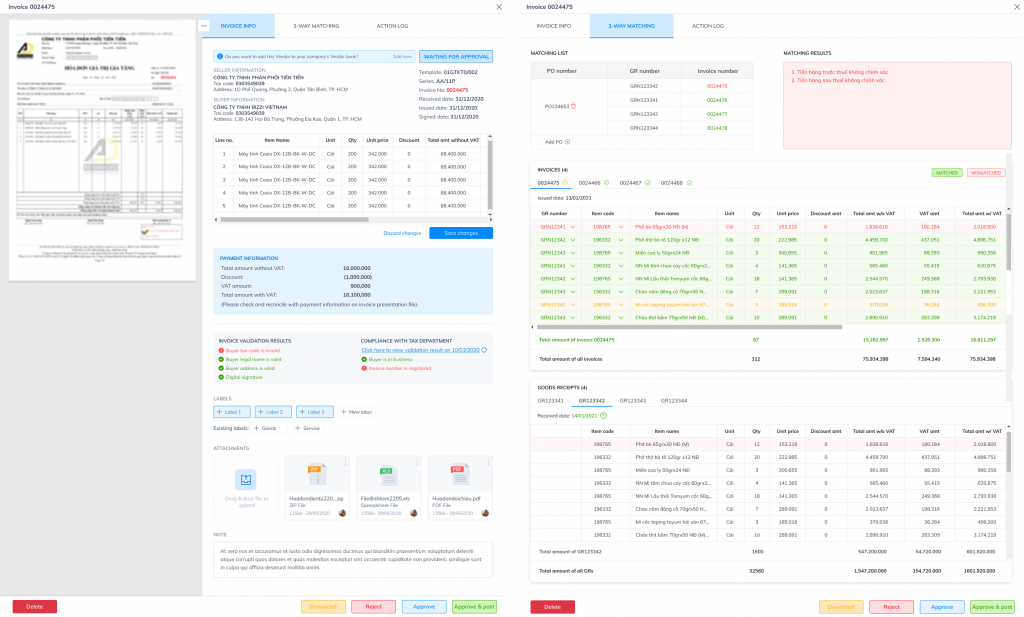
The result is not only a reduction in bookkeeping time, but also improved analytical capabilities and decision-making based on real-time data.
Table: Manual vs. Automatic Matching via the Bizzi Ecosystem
| Criteria | Manual comparison (Excel) | Automation (Bizzi + EPM) | Impact of the CFO |
| Processing time | 3-7 days/cycle | < 1 hour | Fast Closing ($Fast Close$) |
| Accuracy | Data entry errors are common. | Absolute accuracy ($AI-driven$) | Eliminate audit risk. |
| Transparency | Difficult to trace origin | Drill-down to the original document | Transparency in governance |
| Operating costs | Requires significant human resources. | Optimizing labor productivity | Reduce $ Cost of Finance$ |
Internal transaction control checklist for corporate accountants.
Before signing off on consolidated reports, the CFO needs a clear control framework to ensure everything is in order. Insider trading in consolidated financial statements The matter has been fully resolved.
First, it is necessary to confirm that the internal accounts receivable and payable balances have fully matched after reconciliation. Next, review the entries that exclude unrealized profits in inventory and fixed assets. Internal loans in foreign currency need to be checked for exchange rate differences to avoid discrepancies in consolidated profits.
Additionally, the CFO should consider implementing intercompany netting to reduce the number of money transfer transactions and optimize working capital across the entire group. Maintaining complete reconciliation records is also crucial when working with auditors and tax authorities.
Frequently Asked Questions (FAQ) on Internal Reconciliation and Exclusion Procedures
In the actual operation of the corporation, Exclude insider transactions. Consolidated accounting is not just a technical requirement, but also a crucial component of financial risk management. For the CFO, the challenge lies in building this framework. Internal transaction reconciliation process transparent, controllable Insider trading difference and automation Intercompany transaction exclusion journal entry to ensure the accuracy of Insider trading in consolidated financial statementsBelow are frequently asked questions and analyses from a senior financial management perspective.
1. How do you handle discrepancies when a parent company and its subsidiary use two different ERP systems?
When different units within a corporation use various ERP systems, Insider trading difference These discrepancies often arise due to differences in account codes, recording times, or data structures.
To ensure Internal transaction reconciliation process For efficiency, businesses should build an intermediate data standardization layer. Bizzi can play this role by:
- Collect invoice data
- Standardize account formatting and mapping.
- Synchronize data to a unified system such as EPM.
From a CFO's perspective, this solution reduces reliance on internal IT, minimizes discrepancies, and shortens the time to close consolidated accounts.
2. Does the accounting entry for internal transactions affect the amount of VAT paid?
Intercompany transaction exclusion journal entry This only applies at the consolidated reporting level and does not alter the tax obligations of individual legal entities.
Value Added Tax (VAT) is still declared and paid independently by each company. When doing so... Exclude insider transactions.The system only adjusts on the consolidated report to eliminate duplicate revenues and expenses.
The CFO needs to clearly distinguish between:
- Legal entity tax obligations
- Adjustment in Insider trading in consolidated financial statements
Understanding this boundary helps avoid the risk of errors when working with auditors and tax authorities.

3. Why should internal profit be excluded from inventory?
In the event that a subsidiary performs Internal revenue accounting When selling goods to other companies within the group, the profit is recognized at the corporate level.
However, if the goods have not yet been sold externally, that profit has not actually been generated at the corporate level. If this is not done... Exclude insider transactions.The consolidated report will:
- Recording fictitious profits
- Faulting the gross profit margin.
- The impact on KPIs is a financial indicator.
For CFOs, eliminating internal interest is a key step to ensure profitability. Insider trading in consolidated financial statements It accurately reflects the actual business performance.
4. What percentage of discrepancy is considered material in internal reconciliation?
In Internal transaction reconciliation processTherefore, determining the materiality threshold plays a fundamental role.
Typically, a ratio of 1–5% of total assets or pre-tax profit is used as a benchmark. However, for listed corporations or those with foreign investment, this threshold may be lower.
More important than the absolute number is the fact that:
- Establish clear policies.
- Automatic alerts when issues arise. Insider trading difference exceed the threshold
- Track the trend of deviations over time.
CFOs should view materiality as a risk management tool, not just an accounting standard.
5. Does EPM support consolidation under both VAS and IFRS?
In the context of IFRS transition in Vietnam, handling Insider trading in consolidated financial statements Adherence to multiple standards is an increasingly common requirement.
EPM supports reporting according to both VAS and IFRS on the same data platform, enabling:
- Comparing the impact of different standards
- Automatically apply exclusion rules based on criteria
- Reduce manual adjustment volume.
For the CFO, this is a strategic factor when a business is preparing to raise capital or expand into international markets.
6. How do we handle internal transactions that arise using multiple currencies?
In multinational corporations, Insider trading difference This often arises due to exchange rate fluctuations and different recording times.
An effective solution must ensure:
- Convert using the configured standard exchange rate.
- Automatically calculate exchange rate differences at the time of merger.
- Recorded fully Intercompany transaction exclusion journal entry relate to
Integrated systems like EPM can automate this process, significantly reducing the risk of errors that can occur when handling it manually using Excel.
Conclusion: From transaction processing to strategic financial management
Exclude insider transactions. It's not just a technical step in the merger, but a measure of the maturity of the corporate financial system. Internal transaction reconciliation process A systematic approach will help:
- Reduce Insider trading difference
- Standardization Internal revenue accounting
- Automation Intercompany transaction exclusion journal entry
- Improve quality Insider trading in consolidated financial statements
The combination of Bizzi (standardization and automation of input data) and EPM (multi-standardization consolidation and exclusion) creates a closed ecosystem for corporate financial management.
For the CFO, the ultimate goal is not to "eliminate for the right reasons," but to build a transparent financial foundation that controls risk and supports strategic decision-making based on accurate and timely consolidated data.
Schedule a one-on-one consultation to find the right solution for your business here: https://bizzi.vn/dang-ky-dung-thu/