



In the data-driven era, if CFOs still measure accounting department efficiency by "overtime hours" or "data entry speed," businesses are limiting themselves to the management mindset of the previous decade. Those metrics only reflect busyness, not the value created for cash flow, profits, or working capital. As transaction volume increases with scale, outdated evaluation methods inadvertently encourage doing more – rather than doing it smarter.
This article by Bizzi not only provides a standard set of accounting department KPI templates, but also redefines performance management thinking: shifting from compliance control to optimizing cash flow and automating processes (P2P, O2C, R2R) with the support of AI & RPA technology.
Download the KPI & Dashboard Template Set for Accounting Department Management (Excel/PowerBI)
In a context where CFOs need to make real-time decisions, a KPI template for the accounting department should not only include employee performance metrics but also integrate financial formulas, automatically update data, and accurately reflect the health of cash flow.
- Level of job responsibilities fulfilled
- Quality of work
- Risk control capability
- Spirit of innovation & internal collaboration
- Technology application capabilities
Unlike KPIs accounting (Measuring the financial effectiveness of the process), the following set of KPIs measures individual performance in that role.
Download the Accounting KPI Set now. here
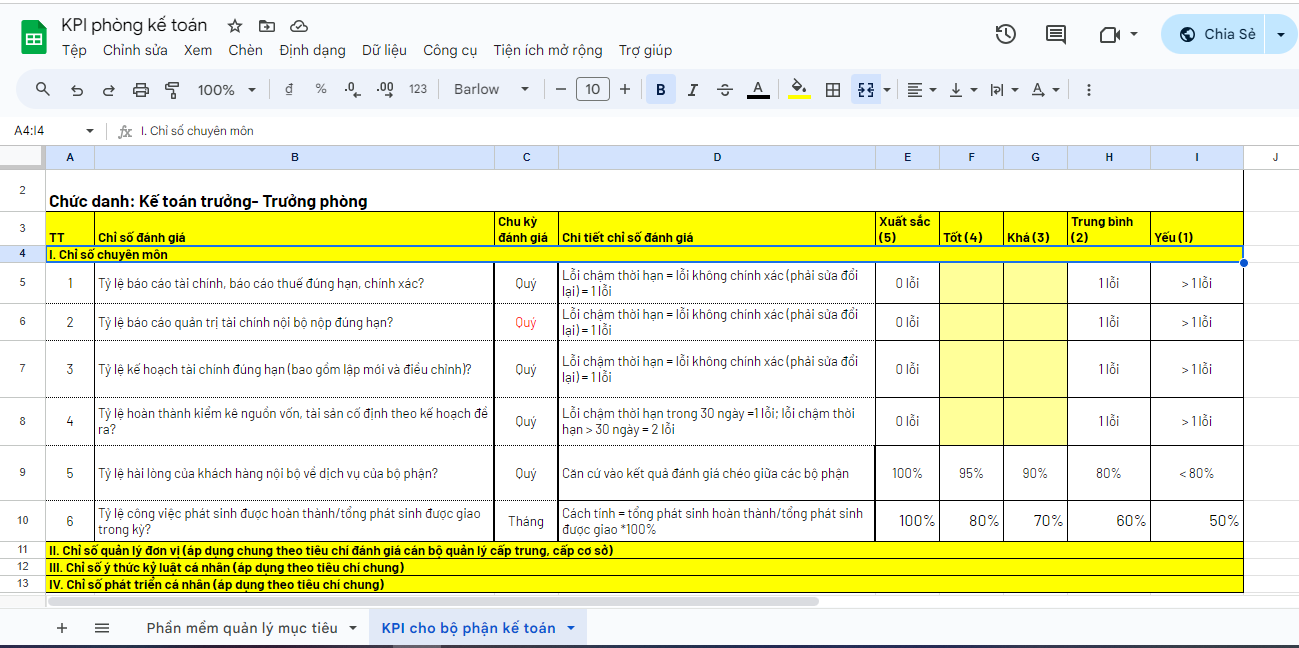
KPIs for evaluating the Chief Accountant
1. Ability to organize and coordinate work
- Index: Accounting department's plan completion rate
- Purpose: Assessing planning and resource allocation capabilities
- Measurement: Number of tasks completed on time / Total tasks as planned
- Cycle: Quarterly
- Suggested weighting: 20%
2. Quality of internal control
- Index: The number of material errors arising from a lack of control.
- Purpose: Assessing supervisory capabilities and establishing procedures.
- Measurement:
- Number of errors detected through internal/external audits
- Adjustment entries due to system errors
- Target: Decreasing gradually year by year
- Weight: 20%
3. Management and Reporting Capabilities
- Index: The level of satisfaction of the Board of Directors with the financial report.
- Purpose: Assessing the role of a “strategic partner”
- Measurement: Internal survey on a 1–5 scale
- Weight: 15%
4. Digital transformation and innovation capabilities
- Index: % process improvement initiative implemented
- Purpose: Measure the ability to lead change.
- Measurement: Initiatives Implemented/Total Proposals
- Weight: 15%
5. Team Development
- Index: Percentage of employees achieving individual KPIs
- Purpose: Assessing training and coaching capabilities
- Measurement: Number of employees meeting KPIs / Total number of employees
- Weight: 10–15%
KPIs for evaluating accounts payable (AP)
1. Accuracy of document processing
- Index: Percentage of invoices processed without errors.
- Purpose: Assess caution
- Weight: 30%
2. Average processing time
- Index: Average time from receipt to completion of inspection
- Purpose: Individual productivity assessment
- Measurement: Hour or day
- Weight: 25%
3. Follow the procedure.
- Index: Number of payment procedure violations
- Purpose: Measure the level of compliance.
- Weight: 15%
4. Coordination capabilities
- Index: Level of response from the purchasing department and suppliers.
- Measurement: Internal survey
- Weight: 10%
5. Application of technology
- Index: The percentage of files processed correctly according to the system (not done outside of a separate Excel spreadsheet).
- Purpose: Assessing digital discipline
- Weight: 10%
KPIs for evaluating accounts receivable (AR)
1. Recording accuracy debt
- Index: The amount of discrepancies in accounts payable due to incorrect data entry.
- Target: 0 or minimum
- Weight: 30%
2. Proactive debt recovery
- Index: Rate of timely debt reminders
- Measurement: Number of timely debt reminders / Total scheduled reminders
- Weight: 25%
3. Customer response time
- Index: Timeframe for processing debt claims
- Measurement: Average hour/day
- Weight: 15%
4. Quality of accounts receivable reconciliation
- Index: Error reconciliation report number
- Purpose: Measurement accuracy & professionalism
- Weight: 20%
KPIs for evaluating general accounting performance
1. Accuracy of accounting entries
- Index: Adjustment rate
- Measurement: Adjusting entries/Total entries
- Weight: 35%
2. Adhere to reporting deadlines.
- Index: % report completed on time
- Weight: 25%
3. Data analysis skills
- Index: Number of useful analytical recommendations approved by leadership
- Purpose: Measure competence beyond written records.
- Weight: 15%
4. Proactive control of deviations
- Index: Number of discrepancies detected before being pointed out.
- Weight: 15%
KPIs for evaluating tax accounting
1. Rate of timely application submission
- Measurement: On-time returns/Total returns
- Weight: 35%
2. Errors in declaration
- Index: Number of times the declaration form has been amended
- Weight: 25%
3. Prepare inspection documents.
- Index: Time required to prepare a complete application
- Weight: 15%
4. Update on new tax policies
- Index: Number of internal training/sharing sessions
- Purpose: Assessing the spirit of professional development
- Weight: 10–15%
Overall assessment framework
A 100-point scale can be applied:
- 70% Professional KPI (Accuracy + Timeliness)
- 20% KPI Attitude & Collaboration
- 10% KPI Improvement & Technology Application
Key principles when designing KPIs for accounting personnel.
- Do not use overall financial metrics to evaluate individuals (for example, the company-wide DSO is not entirely determined by one employee).
- Each KPI must have clear, measurable data and avoid subjective assessments.
- Evaluations should be conducted on a monthly/quarterly basis, not just at the end of the year.
- Combine quantitative and qualitative KPIs to comprehensively reflect capabilities.
Why are traditional accounting KPIs stifling growth?
The majority of KPIs accounting department Currently, KPIs still revolve around "submitting reports on time" or "no errors." These are necessary metrics, but they only reflect the past. As businesses grow, this type of KPI turns the accounting department into a logistical support unit instead of a strategic partner.
The problem lies in the confusion between lagging indicators and leading indicators. If KPIs only measure the number of invoices entered each day, accountants might achieve their target of 100%, but the business will still waste resources due to high processing costs.
The new mindset calls for a shift from Transactional KPIs to Strategic KPIs. Instead of measuring "number of invoices processed," CFOs need to measure:
Cost per Invoice = Total AP Operating Costs / Total Number of Invoices
When implementing automation like Bizzi, KPIs are no longer about "faster data entry" but about "better exception handling" and "deeper analytics".
KPI Group for Optimizing the Procure-to-Pay (P2P) Process
The P2P process directly impacts costs and working capital. Therefore, Accounting department KPI template Modern systems must prioritize processing efficiency and the ability to leverage payment terms.
Two core metrics:
1. Cost per Invoice
Cost = (AP Personnel + Technology + Storage) / Number of Invoices
International benchmarks show that manual processing costs range from $5–10 per invoice. When automation is implemented, the cost can drop to below $1.
2. Touchless Processing Rate
The percentage of invoices processed fully automatically via 3-Way Matching without human intervention. The 2026 standard target should be >80%.
When Bizzi automatically reconciles Invoices – Purchase Orders – GRNs, processing time is reduced from 3–5 days to under 24 hours, while also increasing the potential for taking advantage of Early Payment Discounts. In addition, another important KPI in General accounting KPIs Related to P2P is Invoice Cycle Time – the time from receiving the invoice to recording the debt.
KPI Group for Optimizing Cash Flow & Accounts Receivable (Order-to-Cash – O2C)
If P2P helps control spending, then O2C determines the speed of revenue collection. KPI template for the accounting department A CFO's standard requires placing the Data Storage and Operations Manager (DSO) at the center.
DSO (Days Sales Outstanding)
DSO = (Average Accounts Receivable / Credit Sales Revenue) x 365
The lower the DSO, the faster the capital turnover. However, measuring DSO alone is not enough. CFOs need to add:
- Automated Reminder Coverage Rate
- Automatic payment reconciliation rate
- Overdue loan ratio >30/60/90 days
When using Bizzi ARM, debt reminders and bank reconciliation are automated, reducing DSO without increasing staffing pressure.

Reporting & Compliance KPI Group (Record-to-Report – R2R)
In the system Chief Accountant KPIsR2R reflects the ability to provide strategic information to the executive board.
1. Fast Close Time
The 2026 target should be less than 5 days after the end of the period. This requires Continuous Accounting – recording and reconciling daily instead of accumulating at the end of the month.
2. Cash Flow Forecast Accuracy
Cash Flow Forecast Accuracy is a measure of the difference between projected cash inflows and outflows and the actual amounts incurred, helping businesses assess their financial planning capabilities. A common formula is:
Accuracy rate = [1 - (actual cash flow - projected cash flow) / actual cash flow] * 100%
High accuracy helps CFOs optimize liquidity and investment plans.
When data from P2P and O2C is automated through Bizzi and fed into the EPM system, fast closing and accurate forecasting become achievable KPIs instead of slogans.
Specific KPI matrix for each Accounting position (Role-based KPIs)
To implement this in practice, the strategy needs to be translated into KPI templates for accounting staff based on their specific roles.
| Position (Role) | Primary KPIs | Digital Transformation KPIs |
| Chief Accountant (CFO/Chief) | – Working Capital Ratio
– Cash Flow Forecast Accuracy – ROI of investment projects |
– % Process is automated
ROI of the software system |
| AP Accounting (Accounts Payable) | – % Payment discount achieved
– Zero goal (Double/Error Payment Rate) |
– Touchless Processing Rate
– Processing time for one invoice |
| Accounts Receivable (AR) Accounting | – DSO (Average Daily Revenue Collection)
– Overdue Ratio |
– % Automatic Accounts Reconciliation
– Automated debt reminder response rate |
| Tax Accountant | – Tax penalty amount (Zero goal)
– Deadline for submitting the declaration |
– % Input invoices are automatically checked with the General Department of Taxation. |
A new feature in the modern accounting department KPI template is the addition of digital transformation KPIs, encouraging the application of technology instead of increasing working hours.
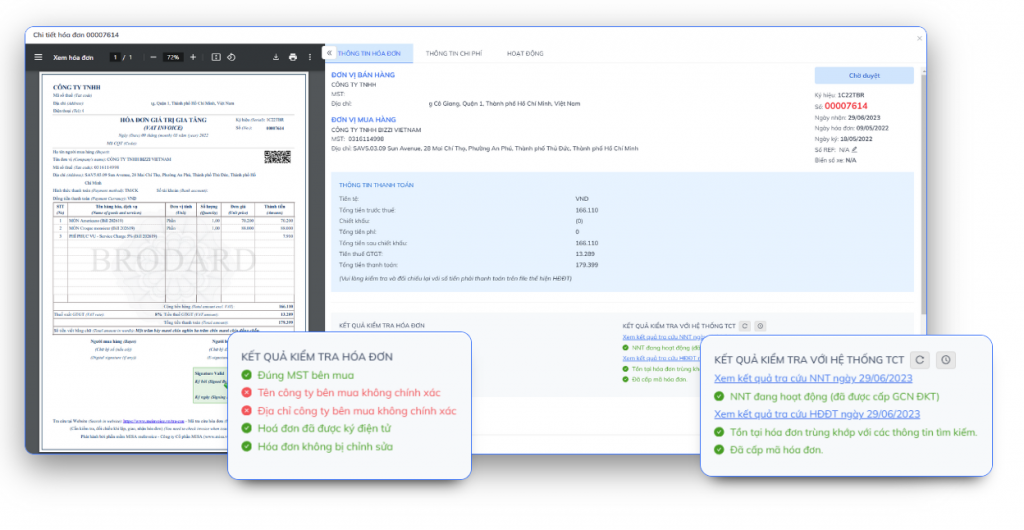
Bizzi Dashboard allows you to track the number of invoices processed, approval time, exception rate, etc., for each employee, making KPI evaluation transparent and quantifiable.
Frequently Asked Questions about Building Accounting KPIs (FAQ)
Develop accounting KPIs Focusing on accuracy, legal compliance, and timely reporting is completely different from business KPIs.The metrics are typically evaluated monthly/quarterly to link rewards and penalties, helping to optimize the financial process.
Frequently Asked Questions about Building Accounting KPIs (FAQ)
What is a good level of automation?
Businesses should aim for at least 70–80% invoices to be processed automatically. With AI & RPA platforms like Bizzi, this rate is entirely achievable if the P2P process is standardized from the input stage.
How do you strike a balance between high DPO and supplier reputation?
An effective strategy is to process internal transactions quickly but make payments on time as committed. Technology helps shorten the processing cycle, allowing CFOs to proactively choose the optimal payment date while maintaining credibility.
How does Bizzi support KPI measurement?
Bizzi automatically records processing times, exception rates, invoice numbers, and approval status. This data is displayed on the dashboard in real time, allowing Chief Accountants and CFOs to monitor performance without manual aggregation.
Conclusion: Redefining the role of the accounting department in 2026
One accounting department KPIs The 2026 benchmark will no longer revolve around "accurate record-keeping" but rather measure the ability to optimize cash flow, reduce costs, and provide strategic data. Chief Accountant KPIs In partnership with Working Capital, DSO, DPO, and Forecast Accuracy, the accounting department officially became a strategic partner of the CFO.
However, KPIs are only effective when there is a robust data system to measure them. Applying Bizzi to P2P, O2C automation and R2R integration helps businesses eliminate manual KPI data entry, increase touchless processing rates, and provide a real-time management dashboard.
If a company's 2026 goal is to increase financial performance without increasing staff, then building Accounting department KPI template Implementing process automation alongside other strategies is a strategic move.
To receive advice on effective corporate financial management solutions, schedule an appointment with Bizzi here: https://bizzi.vn/dat-lich-demo/