


The 9-Box Grid model is not just a "Performance × Potential" matrix for classifying employees, but a tool that helps CEOs/CHROs/CFOs make decisions about development, succession, retention, rotation, and performance improvement based on data.
This article by Bizzi will explain the nature of the 9-box grid model, how to build performance/potential measurement criteria to avoid subjectivity, the calibration process to reduce bias, and how to translate 9-box results into personnel costsTraining ROI/retention cost. It also suggests a digitalization roadmap using operational data for faster decision-making.
What is the 9-Box Grid model and how is it used for decision-making?
The 9-Box Grid is a performance and potential-based employee evaluation matrix that helps businesses categorize talent to make systematic decisions about development, succession, retention, rotation, or PIP (Project-Investment Planning).
The 9-Box Grid model is a human resource management tool used to evaluate and classify personnel based on two main axes:
- Current performance
- Potential for future growth
How is the 9-Box Grid used for decision-making?
The primary goal of the 9-Box Grid is to help leaders make the right decisions about developing, retaining, rotating, or replacing personnel, especially in key person roles and succession planning.
Training & Development Decisions
- Boxes 7, 8, 9 → Priority:
- Leadership training
- Mentoring / Coaching
- Stretch assignment
Succession and Promotion Decisions
- Boxes 8 & 9 → Main source for:
- Success planning
- Promotion track
- Assign lead/manager roles
Decision to retain staff
- Boxes 3, 6, and 9 are needed.
- Clear career path
- Competitive compensation policy
- Recognition
Decision to rotate or improve performance
- Boxes 4 & 7 → Action plan:
- Change to a more suitable location.
- Skills training is lacking.
- Follow-up for 3–6 months
Decision to replace or remove
- Box 1 → After:
- Coaching
- PIP (Performance Improvement Plan)
If there is no improvement: consider exiting.

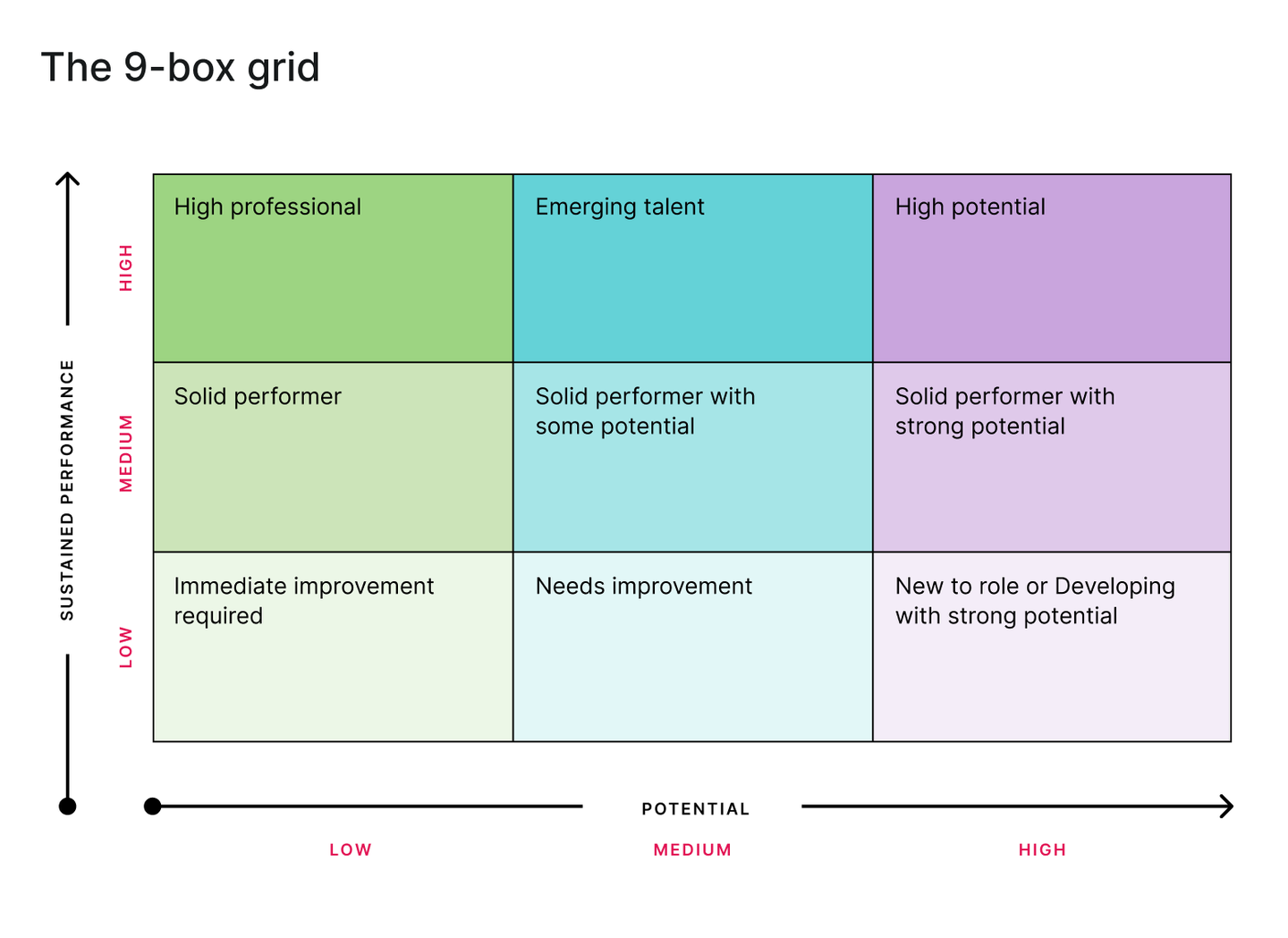
How does the 9-Box Grid categorize personnel along the Performance and Potential axes?
The 9-Box Grid uses two axes: Performance reflects the results of achieving goals; Potential reflects the ability to take on a larger role in the future. Combining the two axes creates 9 different action groups, from "star/HighPo" to "needs improvement".
The model is a 3×3 = 9-cell matrix, with:
Vertical axis – Performance
- Short
- Medium
- High
Horizontal axis – Potential
- Short
- Medium
- High
Each employee will be placed in one of nine cells. The meaning of each group in the 9-Box Grid.
| Box | Characteristic | Common way of calling |
| 1. Low Performance – Low Potential | Poor performance, limited growth potential. | Underformer |
| 2. Medium Performance – Low Potential | Stable job, difficult to break through. | Draw propose |
| 3. High Performance – Low Potential | Highly skilled in their field but find it difficult to advance to management positions. | Expert / Specialist |
| 4. Low Performance – Medium Potential | Not yet met KPIs, but has potential. | Unpolished talent |
| 5. Medium Performance – Medium Potential | Key personnel | Core salary |
| 6. High Performance – Medium Potential | If you do well, you may be promoted to a higher role. | Emerging leader |
| 7. Low Performance – High Potential | Not performing well, needs training. | High potential – low delivery |
| 8. Medium Performance – High Potential | Potential successors | Dual leader |
| 9. High Performance – High Potential | Strategic talent | Hi-Po / Top Talent |

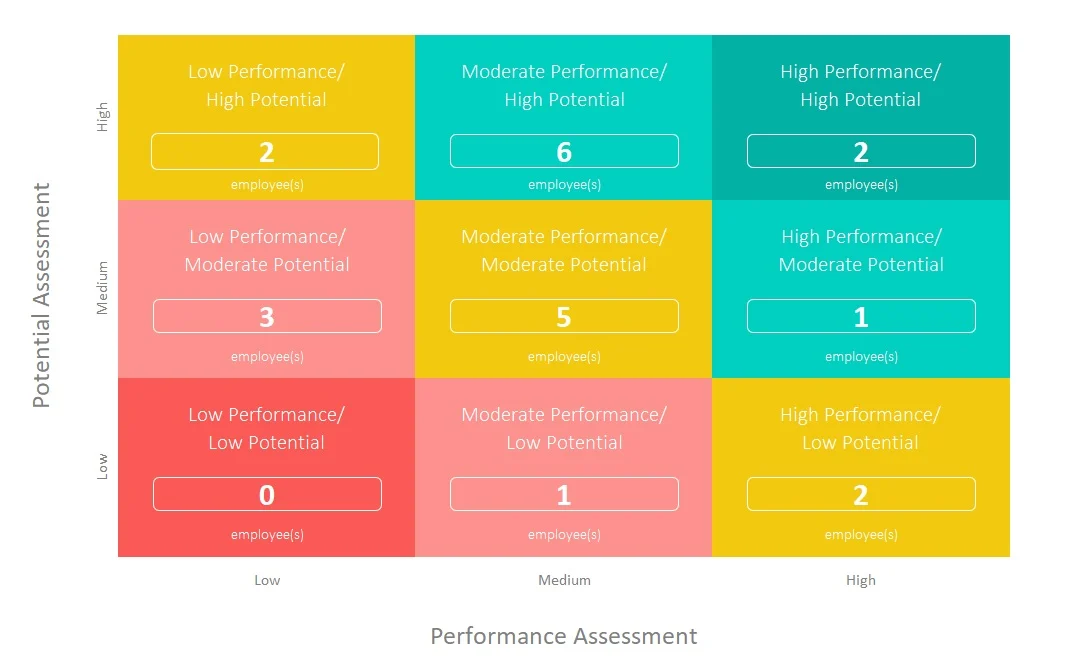
What performance metrics should be used in a 9-Box Grid to gain the CFO's trust?
Performance must be measurable, verifiable, traceable, and comparable. It shouldn't be based on subjective feelings or "assessments for the sake of appearances." Below is a standard CFO-grade performance index framework, used by many businesses when linking the 9-Box Grid to compensation, benefits, and human resource budget decisions.
(A) KPI/OKR results – obligatory
| Role type | CFO Trust Index |
| Sales | % achieved revenue, Gross Margin, and DSO. |
| Marketing | Campaign ROI, CAC, Revenue attributed |
| Finance | Closing cycle, Error rate, Cash forecast accuracy |
| Ops / SCM | Inventory turnover, OTD, Cost saving |
| HR | Cost/Headcount, Attrition key role |
| Brand / Beauty | Sell-out, GM%, inventory aging |
Scoring method (example):
- ≥110% target → 5 points
- 95–109% → 4 points
- 80–94% → 3 points
- 65–79% → 2 points
- <65% → 1 point
(B) Execution quality & risk – The CFO is very interested.
| Index | Meaning |
| Error rate | Errors, rework, claim |
| Deadline | Late payments impact cash flow. |
| compliance | Procedure violations, audit |
| Cost variance | Budget deficit |
Employees meet KPIs but pose risks → Performance cannot be ranked highly.
(C) Execution behavior (measurable)
Don't measure "attitude," only measure consequential behavior:
| Index | How to measure |
| Employment | % tasks completed without reminder |
| Cross-function impact | Number of interdepartmental projects |
| Improvement initiative | Cost-saving/efficiency improvement initiatives |
| Manager feedback | There's a form, no verbal feedback. |
What criteria should be used to measure the Potential axis in a 9-Box Grid to avoid becoming a mere "feeling"?
If Performance is a number, then Potential must be a number. The probability of generating higher performance in the future. – not just a feeling of "having the aptitude." To prevent the Potential axis from becoming subjective, it needs to be measured by predictable future behavior with repeatable evidence.
Potential should be based on evidence of competence, leadership behavior, and learning agility, linked to the level of readiness for succession. Potential doesn't mean "currently excellent," but rather "capable of handling greater responsibilities."
(1) Learning Agility – speed of learning & adaptation (required)
| Measurement question | Observation signs |
| Is it a quick learning process? | Fast onboarding, requires little instruction. |
| Is this applicable? | Transform new knowledge into results. |
| Is the change of setting a good one? | Able to work outside the original scope |
Not measured by feeling, measured by:
- Time to achieve 80% performance on the new task
- Number of feedback loops needed to get it right
(2) Ability to Handle Complexity – carrying complexity
| Level | For example |
| Task | Perform assigned tasks. |
| Project | Managing multiple tasks |
| System | Understanding cross-function effects |
| Strategic | Trade-off decision |
High potential = able to handle more variables, not just faster.
(3) Leadership Behaviors (including those not yet managers)
Don't measure "leadership qualities," measure behavior:
| Behavior | How to prove it |
| Employment | Take the initiative to take on challenging tasks. |
| Image | Others listen and follow. |
| Decision-making | Dare to make decisions in the face of data scarcity. |
| Talent lift | Help others do better. |
(4) Motivation & Career Aspiration – Sustainable Motivation
Potential doesn't exist without motivation.
Measured by:
- Be prepared to take on more challenging tasks without immediate payment.
- Pursuing long-term goals
- Proactively ask for feedback and challenges.
CFOs hate making mistakes: Highly capable but unwilling to take on extra responsibility..
(5) Value & Risk Alignment – the level of “safety when empowering”
| Token | Meaning |
| Follow | Don't break the process. |
| Judgment | Don't trade risk for KPIs. |
| Trust theory | Assigned a sensitive task. |
High potential but high risk → should not be placed in the top box.
What personnel groups and priority actions do the 9 cells in the 9-Box Grid represent?
The 9-Box Grid isn't about "ranking people," but about answering three crucial survival questions:
- Who is the future?
- Who is keeping the system running?
- Who needs to make a definitive decision?
Below is how to group the 9 cells of the 9-Box Grid into 3 high-level clusters (Star / Core / Underperformer), along with naming conventions that are "different enough to avoid clichés" but still easily recognizable, and prioritizing actions in line with leadership and CFO principles.
STAR / Hi-Po cluster (High Potential ± High Performance)
(Box 8 – 9 – part of Box 6)
| Box | Suggested names | Feature | Priority action |
| 9 (HP–HP) | Star | High performance + ability to take on a bigger role | Succession plan, fast-track, retention package |
| 8 (MP–HP) | Future Maker | Not yet a top performer, but clearly has leadership potential. | Stretch assignment, C-level mentor |
| 6 (HP–MP) | Rising Leader | Well done, ready to expand the scope. | Cross-departmental project, trying out the lead role. |
Strategy
- Maximum 10–15% organizations
- Do not distribute rewards evenly → concentrate investments
- Directly linked to succession and 2-3 year strategy.
CORE unit (operational backbone)
(Box 3 – 5 – part of Box 2)
| Box | Suggested names | Feature | Priority action |
| 5 (MP–MP) | Key Contributor | Core, stable personnel | Retention, clear career path. |
| 3 (HP–LP) | Expert / Specialist | Highly skilled in their field, but doesn't want a management position. | Compensation based on depth, no pressure to find leads. |
| 2 (MP–LP) | Workhorse | Do things consistently, with few breakthroughs. | Optimizing processes, standardizing work. |
Strategy
- 50–70% organization
- No need to "force yourself to become a star".
- The biggest risk: being overlooked → silent attrition
UNDERPERFORMER cluster (decision-making area)
(Box 1 – 4 – 7)
| Box | Suggested names | Feature | Priority action |
| 7 (LP–HP) | Dilemma | They have the potential but haven't achieved results yet. | Coaching + testing for 3-6 months |
| 4 (LP–MP) | Unpolished | Not suitable for the current location. | Rotation or retraining |
| 1 (LP–LP) | Underformer | Ineffective, no potential. | PIP → exit if no improvement |
Strategy
- Don't leave it "pending".
- Everyone must have a deadline for making decisions.
- The CFO is very interested in this cluster because of its impact on cost and morale.
What steps are involved in the 9-Box Grid implementation process with a review cycle to avoid bias?
To implement a 9-Box Grid with a review cycle without turning into a “feel-out meeting,” the process must be designed as a decision-making pipeline with anti-bias checkpoints at each step.
Below is a standard 7-step process, currently being adopted by many businesses when linking the 9-Box to rewards, succession planning, and human resource budgeting.
Step 1: Standardize criteria (Before the evaluation)
Objective: Block halo effect from the beginning
What to do
- Closing Performance rubric (KPI, quality, risk)
- Potential rubric (learning agility, complexity, leadership)
- Define clearly:
- High / Medium / Low = how many points
- This applies to the entire company, not customized for individual managers.
Step 2: Collect independent data
Objective: To separate data from reviewers.
Data sources
- KPI / OKR system
- ERP / BI / Finance dashboard
- Multi-source feedback (360-degree feedback if available)
- Project results, audit, PIP
HR/Finance prepares the data; line managers do not provide the numbers themselves.
Step 3: Individual Scoring
Objective: To avoid the “meeting room effect”.
Making
- Each line manager scores independently.
- Fill in:
- Performance singer
- Potential price
- Required supporting documents (2–3 bullet points)
Do not show other people's reviews at this stage.
Step 4: Evidence Review
Objective: Eliminate subjective feelings before arranging the boxes.
Required question
- Evidence includes:
- Repeat ≥ 2 times?
- Are the results specific?
- Is it comparable to a peer?
HR plays the role of "bias police," not secretary.
Step 5: Calibration Meeting (Most important)
Objective: To ensure fairness and consistency.
Ingredient
- Line Pool
- HR
- Finance (or representative)
The Golden Rule
- Let's not discuss each person individually → let's discuss each box separately.
- Peer comparison, comparison between colleagues of the same rank and role.
- Each adjustment box must answer:
"If this person were on a different team, would the outcome be different?"
CFOs typically require:
- % Star ≤ 10–15%
- Underformer ≥ 5–10% (avoid the "everyone is good" label)
STEP 6. Link the decision and the action.
Objective: The 9-Box creates actions, not slides.
Mapping is required.
| Box | Decision |
| Star | Success, retention |
| core | Development plan |
| Dilemma | 3–6 months test |
| Underformer | PIP / Exit |
STEP 7. Follow-up & Post-review
Objective: To verify the accuracy of Potential.
What to do
- Review after 6–12 months:
- How many Hi-Po (High-Pod) projects have been successful?
- How many stars experienced a drop in performance?
- Adjust the criteria if necessary.
Potential is only true when tested over time.
How should an action playbook with a 9-Box Grid be designed to generate employee ROI?
The 9-Box approach only generates ROI when each box is accompanied by a financial decision. For the 9-Box Grid action playbook to truly generate human resource ROI, the mindset must shift from: "Each box represents a unique investment and return on investment problem."
Below is the Action Playbook, organized into 9-Box groups, designed according to CFO logic: How much to invest – what are the expected returns – how to measure them?.
STAR / Hi-Po – Future Growth
(Box 9 – 8 – 6)
ROI objectives
- Increase leadership bench strength
- Reduce succession risk
- Retain high-value employees.
Priority action:
| Action | Target | Expected ROI |
| stretch | A real skills test | Probability of succession increases. |
| Strategic project | Create impact | over/cost leverage |
| C-level Mentor | Accelerate growth | Role availability time ↓ |
| Retention package | Retain people | Replacement cost ↓ |
CORE – Optimize current performance
(Box 5 – 3 – 2)
ROI objectives
- Maintain system stability.
- Maximize output/headcount
- Reduce hidden attraction
Priority Action
| Action | Target | Expected ROI |
| Skill deepening | Increase productivity | Output/FTE ↑ |
| Process | Reduce waste | Cost saving |
| Career clarity | Retain | Attitude ↓ |
| Recognition targeted | Increase engagement | Sustainable performance |
UNDERPERFORMER – Stop loss or reversal
(Box 7 – 4 – 1)
ROI objectives
- Reduce sunk costs.
- Unleash your true potential.
- Clear the way for good talent.
Priority Action
| Action | Target | Expected ROI |
| Coaching has deadlines. | Rapid test | Recovery / Exit |
| Role re-fit | The right person for the right job. | Performance ↑ |
| PIP | A decisive decision | Cost leak ↓ |
| Controlled Exit | Reduce losses | Team morale ↑ |
How does the 9-Box Grid link with HR and FP&A budgets to forecast payroll and development costs?
The 9-Box isn't just for "assessing people," but to answer this question: "Where should the money be invested – who should we retain – who should we develop – where should we recruit new players?"
Main budget lines:
- Payroll (fixed salary and bonuses)
- Trainingtraining costs - develop)
- Retention Package
- Recruitment
- Mobility (rotation / succession / stretch assignment)
A. High Performance – High Potential
Target
- Retain
- Preparing for succession
- Maximize employee ROI
Budget allocation
- Payroll
- Salaries in the top quartile
- Performance-based rewards & leadership impact
- Training
- Leadership program
- One-on-one coaching
- Strategic / cross-functional skills
- Retention Package
- Long-term incentive (ESOP, retention bonus 2–3 years)
- A clear career roadmap.
- 7
- No priority (internal pipeline already in place)
- Mobility
- stretch
- Strategic, international, interdepartmental project
B. High Performance – Medium Potential
Target
- Maintain performance
- Expanding professional capabilities
Budget allocation
- Payroll
- Competitive Market Pay
- Bonuses are closely tied to KPIs.
- Training
- Enhance specialized skills
- Upskill through technology/process
- Retention Package
- Recognition, skill-based allowance
- 7
- No priority
- Mobility
- Job enrichment
- Horizontal move (more in-depth, not necessarily management)
C. Medium Performance – High Potential
Target
- Selective investing
- Verify potential
Budget allocation
- Payroll
- Market average salary
- Performance-based rewards
- Training
- Core skills + leadership foundation
- Mentoring / buddy system
- Retention Package
- Transparent career path (12–18 months)
- 7
- Limit external recruitment for succession positions.
- Mobility
- Rotation, project-based learning
D. Medium / Low Performance – Medium / Low Potential
Target
- Stable operation
- Cost Control
Budget allocation
- Payroll
- Maintain at market median level.
- Limited salary increases
- Training
- Required training (process, compliance, foundational skills)
- Retention Package
- No priority
- 7
- Only when replacement is mandatory.
- Mobility
- Internal reassignment if appropriate.
E. Low Performance – Low Potential
Target
- Reduce risk
- Free up budget funds.
Budget allocation
- Payroll
- No increase
- Tight cost control
- Training
- Stop investing
- Retention Package
- Not applicable
- 7
- Prepare a budget for new recruitment.
- Mobility
- No priority
How do employee positions on the 9-Box Grid relate to OpEx and cash flow (CFO's perspective)?
The 9-box model impacts OpEx and cash flow through HR decisions: retention, training, new hires, and performance improvement. When performance is measured by operational and financial data, CFOs can identify which teams create value, which create “hidden costs,” and prioritize investments accordingly.
Below is a breakdown of each 9-Box group from the OpEx & Cash Flow perspective.
| Opera | Cash Flow | |
| A. High Performance – High Potential | High payroll → Increased opEx
But the cost per unit of value generated is low. |
Increase:
Reduce:
|
| B. High Performance – Medium Potential | Payroll is stable.
Training focuses on professional skills. |
Stable and predictable cash flow.
Low risk of volatility |
| C. Medium Performance – High Potential | Training and mentoring increase → OpEx increases first.
ROI is not yet recognized. |
Short term: → Negative or neutral Medium to long term: |
| D. Medium / Low Performance – Medium / Low Potential | Payroll accounts for a large proportion of the total.
Raising wages doesn't create more output. |
Neutral or negative cash flow
Prone to occurring:
|
| E. Low Performance – Low Potential | Payroll = sunk cost
Training = a waste of time. |
Minus:
|
What are the legal risks and compensation costs associated with using a 9-Box Grid to handle underformers?
The 9-box is merely a grouping tool; using it for "ranking and yanking" or improper dismissals can lead to disputes, compensation costs, and damage to the employer brand.
From a CFO + Risk Management perspective, the 9-Box Grid is only safe when accompanied by evidence mechanisms. If the 9-Box is used to handle underperformers without proper control, the business will not only "lose people" but also "lose money and face lawsuits".
Legal risks and compensation costs when dealing with underformers.
RISK 1 – Lack of Performance Evidence (Evidence Gap)
Risk mechanism
- 9-Box reviews are relative.
- Not replaceable:
- KPI for task assignment
- Quantitative measurement results
- Warning record
Employees can sue for:
- Subjective dismissal
- The evaluation lacks transparency.
- Discrimination
Costs may arise.
- Unlawful dismissal compensation (2–12 months' salary)
- Social insurance claims
- Court fees, lawyers
- Time-consuming to manage.
B. RISK 2 – Lack of a Plan for Improvement (No PIP / No Fair Chance)
Risk mechanism
- Employees who are ranked lower will be disciplined immediately.
- Do not have:
- PIP (Performance Improvement Plan)
- Reasonable time for error correction
Legally: Courts usually side with workers if they are not given "opportunities for improvement."
Hidden costs
- Compensation for unjustified dismissals is not improved.
- Compensation for loss of income
- Internal communications risk / employer branding
C. RISK 3 – Lack of calibration record (Governance Failure)
Risk mechanism
- The 9-Box is decided by one manager.
- Do not have:
- Review Board
- Cross-departmental comparison
- Meeting minutes
Employees can sue for:
- Subjective evaluation
- Personal retaliation
- Inconsistent
Indirect costs
- Losing the lawsuit due to weak procedures.
- Loss of management credibility
- Human resource audit risks
In short, the 9-Box helps you assess people, but only the records and processes protect your finances.
Table “Performance Metrics by Department” for implementing a 9-Box Grid using data
Below is a "PERFORMANCE METRICS BY DEPARTMENT" table for implementing a data-driven 9-Box Grid – the right CFO perspective: measuring value creation, not just effort.
| Department | Quantitative Performance KPIs (3–5 core KPIs) | Data sources | Why reflect value? | Suggested tracking tools |
| Sales / Business Development | • Net Revenue
• % reached target • Gross Margin (%) • Customer-specific DSO |
CRM, ERP, AR reporting | • Directly link cash-in
• Margin reflects the quality of the deal. • DSO impacts cash flow |
Salesforce / HubSpot
SAP / Oracle Power BI |
| Marketing | CAC
• ROAS / ROMI • Cost per Lead • % Lead → Sale |
Ads platform, CRM, BI | • Measure pipeline effectiveness, not just reach.
• Differentiate between creating money and burning money |
Meta Ads / Google Ads
GA4 CRM + BI |
| Finance / Accounting | • Days to close (D+?)
• Invoice error rate (%) • DSO / DPO • Forecast accuracy (%) |
ERP, AP/AR system | • Reduce errors = reduce cash leaks
• DSO/DPO directly impacts OCF |
SAP / Oracle
Bizzi / Tipalti Power BI |
| Supply Chain / Operations | • OTIF (%)
• Inventory Turnover • Cost per unit • Scrap/defect rate |
ERP, WMS, Operations Report | • Reducing inventory = freeing up cash
• OTIF impacts revenue |
SAP / Oracle
WMS Power BI |
| Procurement | • Cost saving (%)
• Purchase Price Variance (PPV) • % vendor compliant |
ERP, PO data | • Cost savings = Direct increase in EBITDA
• Controlling suppliers reduces risks. |
ERP
Sourcing tools |
| HR | • Voluntary turnover (High–High)
Time to Fill • Cost per Hire • % internal promotion |
HRES | • Maintaining high performance = maintaining future cash flow
• Reduce external recruitment costs |
Workday
SAP SuccessFactors |
| R&D / Product | Time to Market
• % revenue from new products • R&D cost / revenue |
ERP, Product report | • Measure future cash generation potential
• Connect potential to real data |
Jira
Product BI |
| Customer Service / CS | • First Contact Resolution (%)
• Cost per ticket • Churn rate (%) |
CRM, CS system | • Reduce churn = maintain LTV
• Good customer service preserves cash flow. |
Zendesk
CRM |
In short, the 9-Box isn't based on management's intuition, but on whether "this employee is generating, retaining, or leaking cash flow."
What are the advantages and disadvantages of the 9-Box Grid model?
The 9-box system helps standardize personnel decisions and development/succession priorities, but it can be flawed if criteria are vague, data is lacking, and calibration is insufficient. Businesses should not use the 9-box system as a tool for "mass dismissal" or as a replacement for proper performance management.
What are the advantages of the 9-Box Grid model?
- Clearly define talent segments (Talent Segmentation)
- Personnel classification based on Performance × Potential
- Helping leaders quickly identify "who's who" within the organization.
- Management value: No more management based on intuition or seniority.
- Resource Prioritization
- Avoid spreading the budget too thinly.
- Focus on payroll, training, and retention for high-value teams.
- Support succession & workforce planning
- Identify the internal successor.
- Reduce reliance on external recruitment.
- Increase the certainty of your 12–36 month plan.
- Long-term impact: Decrease recruitment costs, reducing the risk of operational disruption
- Common language between HR – Line – Finance
- 9-Box creates a common framework.
- It's easier to discuss sensitive decisions: retain – develop – replace.

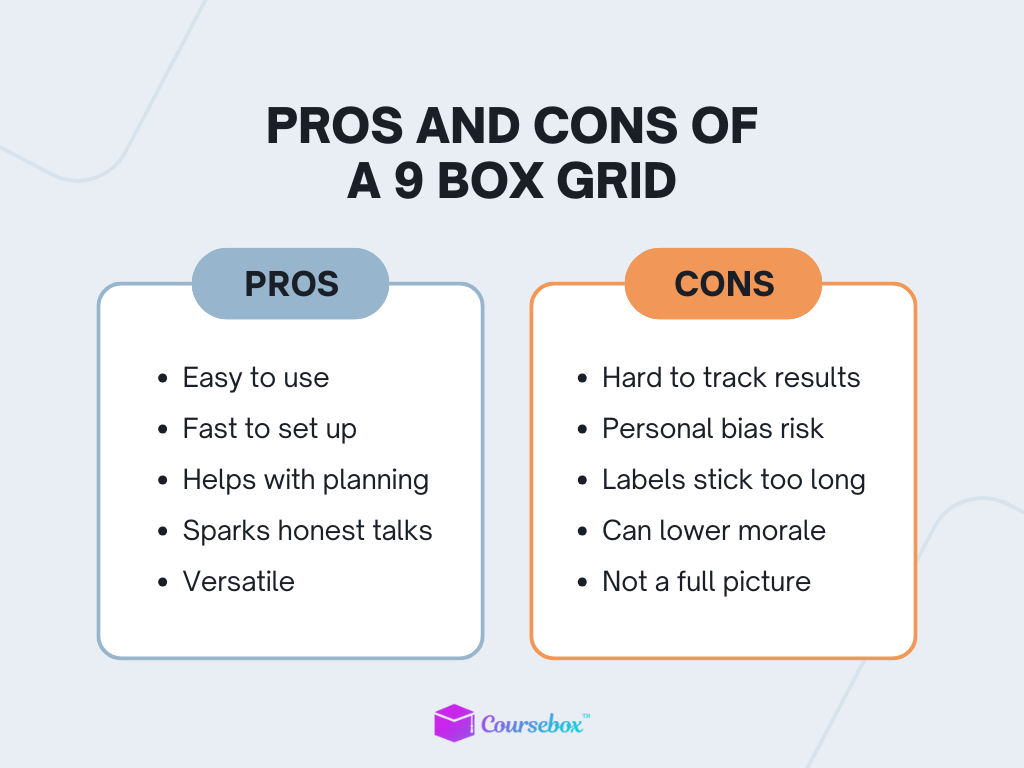
What are the limitations of the 9-Box Grid model?
The 9-Box isn't dangerous because of the model – it's dangerous because of how it's used.
- Bias – The most common failure mode.
Failure mode mechanism
- Halo effect, recency bias
- Management evaluates performance based on emotions, not data.
Consequences
- Talented people are underestimated.
- The average person gets a "boost in score".
- Forced Ranking – Distorting Reality
Failure mode mechanism
- There must be enough people in each square.
- Turn 9-Box into a forced ranking system.
Consequences
- Creating unfair competition
- Internal loss of motivation
- Succession data discrepancies
9-Box should not be used as a forced ranking system.
- Labeling Risk – the risk of "labeling people"
Failure mode mechanism
- Personnel labeled as "low potential"
- This label has not been updated.
Consequences
- Self-sabotage
- Violation of the principle of equitable development.
- Increased legal risk if used for exit purposes.
- Lack of data – turning 9-Box into a matter of intuition.
Failure mode mechanism
- There are no quantifiable KPIs.
- Lack of standardization between departments.
Consequences
- Performance does not reflect true value.
- The CFO cannot be tied to Operations & Cash Flow.
- Lack of calibration – a governance risk.
Failure mode mechanism
- 1. Manager self-assessment
- There is no peer review panel.
Consequences
- Inconsistent scoring
- Prone to complaints and disputes.
- Loss of internal trust
- Without follow-up, the 9-Box becomes just a "pretend slide".
Failure mode mechanism
- Once arranged, leave it there.
- Not tied to specific actions
Consequences
- No performance improvement
- Do not create a successor pipeline.
- Loss of HR credibility
Frequently Asked Questions about the 9-Box Grid Model (FAQ)
Below is a compilation of frequently asked questions about the 9-Box Grid model, along with detailed answers.
Is a 9-Box Grid suitable for small and medium-sized businesses?
Yes, if implemented appropriately to the organization's level of maturity.
- Small and medium-sized enterprises don't need complex matrices or overly detailed data.
- Minimum requirements:
- There is a clear evaluation cycle (6 months / 1 year)
- There is basic performance data (KPIs, work results).
- Recommended method:
- Use a 3-level rating scale (Low / Medium / High)
- Prioritize calibration among managers.
- Focus on the action plan after the 9-Box instead of "drawing a matrix for aesthetics".
For SMEs, the value of the 9-Box lies in the action, not in the sophistication of the framework.
How can we convert "Potential" data into payroll forecasting data in FP&A?
Potential is not directly included in the budget, but must be translated into a personnel scenario.
The standard method:
- Potential → readiness (level of readiness to take on a higher role)
- Develop scenario planning in teams:
- HiPo / Star: Promotion prospects, development programs, retention packages
- Core: Salary increase in line with market rates.
- Integrate these scenarios into the payroll forecasting model.
- Monitor Plan vs Actual to adjust assumptions.
CFOs don't "believe" in potential; CFOs believe in scenarios and probabilities.
What are the hidden costs of hiring a "medium-performing, low-potential" group compared to hiring new employees?
Don't compare based on emotions, but compare the total cost over the product's lifecycle. Compare both sides:
(1) Retention cost:
- Salary & Benefits
- Repeated training but no improvement.
- Hidden costs: opportunities for lost productivity and holding back the team.
(2) Replacement cost:
- Recruitment
- Onboarding
- Ramp-up time until performance is reached.
The comparison results are used to make a decision:
- Hold
- Adjust roles
- Or replace
How can we use Expense Management data to assess “compliance & performance” in the 9-box?
Expense data is a very good source of evidence for the Performance axis.
The following metrics can be used:
- Compliance rate (expenditure policy compliance)
- Violation/Exception Rate
- Cycle time for expenditure approval
- Budget variance by cost center
- Full Audit Trail
This data helps to:
- Evaluating operational discipline
- Reduce subjective evaluations.
- Adding a perspective on "cost management efficiency"
This data source is particularly well-suited for managerial roles.
What is the connection between the 9-box of Sales and DSO?
For sales, performance isn't just about sales figures, but about the quality of revenue generated.
- High-performing salespeople typically:
- Good pipeline management
- Effective collection coordination
- This helps:
- Reduce DSO
- Increase cash-in
- Improve working capital
By linking 9-Box to DSO, the CFO can clearly see who is generating "real money" revenue.
How should training ROI be measured to avoid "scattered training"?
Instead of measuring ROI across the entire training program, it's measured by 9-Box groups.
Recommended measurement framework: Benefit – Cost
- Benefit:
- Reduce errors
- Reduce cycle time
- Increase productivity
- Reduce exception rate
- Cost:
- Training costs
- Work interruption time
Investment priorities:
- HiPo / Star → High ROI
- Avoid spreading training too thin among groups that are unlikely to translate into results.
How many laps are needed for calibration, and who should participate?
It doesn't take many rounds, just the right people and the right method.
Minimum requirements:
- 1 formal calibration meeting
- Composition: HR, Line Manager, Senior Management/Level Executive Representative
Principle:
- Standardize criteria
- Based on the evidence pack
- There is moderation and a written decision.
Calibration is a mechanism for reducing governance bias and risks, not a mere formality.
How is a 9-box grid different from forced ranking?
- 9-Box:
- Grouping based on two axes: Performance × Potential
- Objectives: development, succession, resource allocation
- Forced ranking:
- Forced ranking by ratio
- It can easily lead to injustice and the loss of talented people.
Using 9-Box ranking increases labeling risk and disrupts internal fairness.
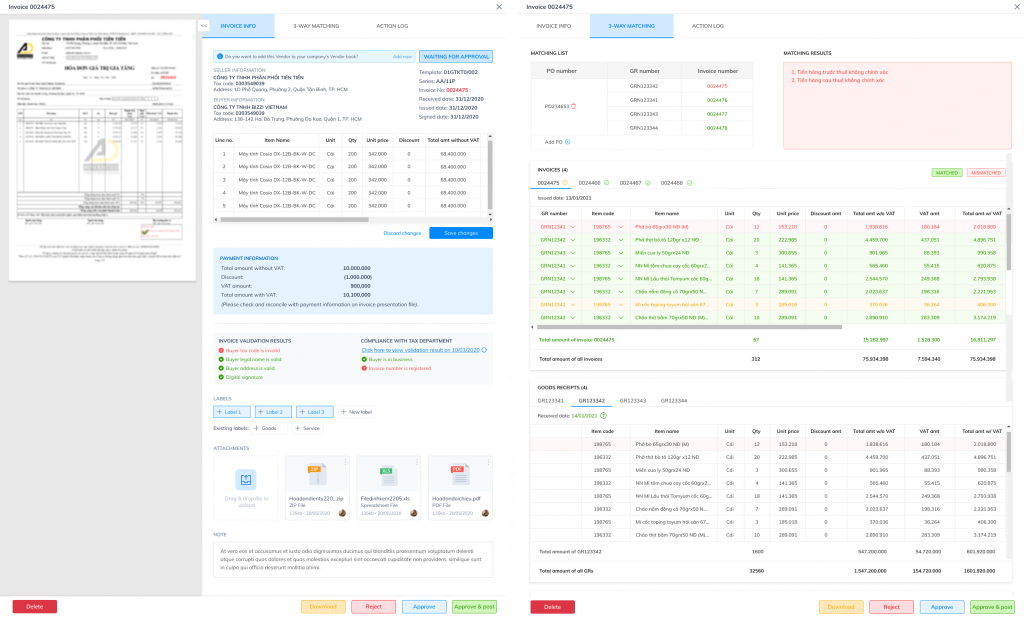
What support does Bizzi Bot/Expense/ARM offer to 9-box systems if businesses want to "quantify" performance?
These solutions provide real-time data to reduce subjectivity when stacking 9-Boxes:
- Bizzi Bot:
- Invoice processing quality and speed
- Error/exception rate
- Bizzi Expense:
- Data compliance
- Cycle time for expenditure approval
- Bizzi ARM:
- Data retrieval
- DSO by customer/related personnel
All of this creates evidence-based assessment for the Performance axis.

Conclude
The 9-Box Grid model is not a "human evaluation matrix," but rather a decision-making tool that helps businesses answer three core questions:
- Who is creating, holding, or leaking value?
- Where should resources (salaries, training, retention) be prioritized?
- Who will be the successors to protect future growth and cash flow?
When implemented correctly, the 9-Box model becomes a bridge between human resource strategy and financial strategy. When combined with solutions like Bizzi, businesses can:
- Quantifying performance with real operational data.
- Support calibration and reduce governance risks.
- Connecting 9-Box with Finance & FP&A
To receive personalized solutions tailored to your business, register here: https://bizzi.vn/dang-ky-dung-thu/