


In business and client meetings, having a tax invoice for meals is not just a procedural requirement, but also determines the validity of expenses, the possibility of tax deductions, and the risks involved in tax settlement. This article helps CFOs and the Finance and Accounting department understand correctly. Regulations regarding the issuance of invoices for food and beverages., identification The restaurant issues VAT invoices. and design effective cost control processes. Together. Bizzi Find out!
What does it mean for a restaurant to issue a tax invoice?
"The restaurant issues official invoices." is a restaurant/eatery capable of establishing valid electronic invoice give food and beverage services According to regulations, this helps businesses record legitimate expenses for tax settlement and deduction purposes.
In practice, "red invoice" is the common name for VAT invoice/electronic invoiceThe important point isn't the color of the receipt, but... validity of the document: the restaurant must have MST, has the right to publish electronic invoice (E-invoice) and issue invoices in accordance with regulations regarding timing and content.
Businesses also need to make a clear distinction:
- Bill/Receipt: Internal documents of the restaurant, which can be used to reconcile expenses, but no replacement The invoice is valid for accounting/deduction purposes (depending on the specific case being checked).
- Electronic billTax documents contain complete information about the seller, buyer, services, tax rate, etc., for declaration/reconciliation purposes.
From a CFO's perspective, having invoices isn't just about completing paperwork, but about ensuring accountability. accepted costsThis reduces the risk of expenses being disallowed and minimizes the effort required for explanations during the settlement process.
Comparison Table: Physical Bill vs. Electronic Food and Beverage Invoice
| Criteria | Bill/Receipt | Electronic food and beverage invoices |
| Purpose | Verify payment at the restaurant, reconcile internal expenses. | Valid tax documents for accounting, declaration, and reconciliation. |
| Legal value | Limitations, dependence on internal policies, and inspection requirements. | Furthermore, according to regulations on electronic invoices and invoice and document management. |
| Settlement capacity | Risk of being asked for additional information/explanations; difficulty maintaining a firm position without proper documentation. | Higher if the timing is right, with sufficient information about the buyer and seller, and the service details are accurate. |
| Tax risk | High: easily considered an ineligible document. | Lower if valid and matches the purpose of expenditure, accounting period, and payment documents. |
As soon as the HR department submits the invoice, Bizzi Bot can assist in extracting the data and checking fundamental points such as the tax identification number (MST), format, and basic information fields; then Bizzi Expense can attach the invoice to the correct expense to ensure traceability (who paid – what was paid for – which cost center – which invoice).
What is a tax invoice for food and what is it used for in a business?
What does it mean to get a tax invoice when eating out? That is the requirement for restaurants to set up Electronic invoice This is for meals provided to businesses for operational purposes, aiming to legitimize expenses, reduce the risk of disallowance during settlement, and increase transparency in cash flow.
Essentially, food expenses typically arise in three situations: river, internal meeting, collaborateWithout valid invoices (or with weak documentation), businesses may face common consequences:
- Costs are at risk of being disallowed. When settling accounts, this increases taxable income and increases corporate income tax liability.
- Tax deduction risk (if the invoice contains incorrect/invalid/outdated information).
- Increased administrative costs This is due to the need to process additional documents, explain the source of expenditure, and the purpose of the expenditure.
From a control perspective, "getting a tax invoice for meals" should be considered part of the policy. internal spending and control policiesIt's not just about "requesting invoices to complete the documentation."
Before going out to eat, businesses can request the creation of expense request On Bizzi Expense: purpose of expenditure, list of attendees/guests, cost center, budget/limit. When the invoice arrives, the system automatically assigns the purpose of expenditure and department, ensuring the record is "contextually relevant" for audit purposes.
Which category do restaurants that issue official tax invoices usually belong to?
Restaurants that issue VAT invoices Typically, these are registered F&B businesses or sole proprietorships. Electronic invoice, especially restaurant chains, hotels, or models with well-structured sales systems.
Rapid identification in real-world situations (sufficient for frontline use):
- The shop has a notice posted:Issue VAT invoices/electronic invoices".
- Employees can ask for and receive invoicing information (company name, tax identification number, email address for receiving invoices).
- The restaurant has a payment/reservation/sales system with a clear e-invoice issuance process.
The risks CFOs need to be concerned about are not just whether the restaurant is serving customers or not, but rather... Does the restaurant issue valid invoices?In particular, businesses should be wary of invoices with tax identification numbers (TINs). ceased operations, unusual seller information or invoices issued at the wrong time of service provision.
Bizzi Bot can assist in verifying supplier information based on received invoice data (comparing tax identification numbers and data consistency). From a cost control perspective, Bizzi Expense allows businesses to manage a list of "verified" suppliers, while also flagging new suppliers or those with unusual patterns (frequency/value) for accounting review before recording transactions.
Regulations regarding food and beverage invoices that businesses need to know.
Food bill is the invoice service, and the core principle is It must be prepared upon completion of service delivery.In cases where payment is collected before or during the provision of services, the invoice date is the date of payment.
For the purchasing business, the "compliant" aspect should be understood in two layers:
1) Right timing (the most common risk)
Invoice late Alternatively, "postponing" invoices to the next period can cause accounting discrepancies, increase risks when reconciling expenses on a monthly/quarterly basis, and weaken supporting documentation. Regulations regarding the timing of invoicing for services are clearly stated in official guidance sources.
Bizzi Expense allows you to set up rules to remind you to collect invoices by deadline (e.g., within 24–48 hours of the transaction) and alert you to invoices that are "late" compared to the date the expense was incurred, helping to reduce discrepancies in billing cycles and minimize processing time during closing.
2) Correct required content
At a minimum, the following information must be ensured: seller's information, buyer's information, name of food and beverage service, value, tax rate/tax amount (if any), total payment… in accordance with regulations on invoice and document management.
Bizzi Bot assists in extracting invoice data and detecting common errors (missing/incorrect buyer's tax identification number, incorrect company name, overly general content, incorrect tax calculation logic, etc.), thereby reducing the risk of "missing errors" when entering data manually.
In addition, regulations regarding electronic invoices originating from cash register This information is also important for businesses in the food and beverage service industry to keep updated when working with F&B suppliers.
Conditions for meal expenses to be considered reasonable expenses during the settlement process.
Food expenses It is generally accepted when serving business operations, provided there is a valid invoice, it complies with internal spending policies, and all relevant documentation is available.
To implement control using CFO logic (concise and easy to deploy), a four-factor framework can be used:
- Purpose: Receiving guests/internal meetings/business trips… related to business activities.
- Approve: Within the correct authority, within the correct budget, and within the correct cost center/department.
- BillValid, timely, and accurate buying and selling information.
- Payment documents & supporting documentsAccording to internal regulations (list of attendees, agenda for receiving guests/meetings, work decisions, etc., depending on the company).
Interpretation according to the "internal control formula":
Eligible expenses = Expenses incurred for the intended purpose × Legitimate invoices × Internal approvals
In operations, businesses often face risks such as "invoices exist but the purpose of the expenditure cannot be linked" or "the purpose exists but the documentation cannot be traced." Therefore, systematizing the process (requiring the creation of expenditure requests, linking purposes/cost centers, and tracking approvals) is the best way to reduce risks for the buyer.
Bizzi Expense allows you to configure entertainment spending limits by department/level, request approval based on thresholds, and track audit trails. When all records are centralized in one place (expenses + invoices + supporting documents), financial review and internal audits are easier, reducing reliance on "recalling" events after 1–2 months.
How do advances and reimbursements for food expenses affect a company's cash flow?
Advance payment - refund Uncontrolled food and beverage expenses can distort cash flow, increase outstanding advance payments, and create loopholes for fraudulent entertainment spending.
Two common problems CFOs face:
- Extended advance payments without settlementThis leads to an increase in internal receivables, making it difficult to control short-term cash flow.
- The invoice does not match the advance payment.Incorrect purpose, wrong timeframe, wrong target audience… leading to weak application or rejection of the application.
Therefore, controlling advances/reimbursements should not only involve collecting sufficient documentation, but should also be linked to cash flow management: knowing who is holding how much advance payment, how long it is overdue, and the status of the documentation.
Bizzi Expense records the status of advances and reimbursements for each employee/expense request, tracks reimbursement deadlines, and reconciles invoices with the advanced amount. This allows CFOs to see the "advance balance" in real time instead of waiting until the end of the month for a summary.
See more: Advance – Advance Refund: Improve the efficiency of managing business expenses and purchasing
Food bill fraud and how to control it from a CFO's perspective.
Food bill fraud This often stems from inactive suppliers, incorrect or fictitious invoices, posing a risk of tax arrears and penalties for the purchasing business.
Common risk indicators (enough for an accountant to quickly check):
- The supplier's tax identification number (MST) shows unusual activity (inactive/constantly changing information).
- The invoice does not match the time/location/organization hosting the guest.
- The service content is too generic, and the value is "out of sync" with the spending history.
- Repeated invoices from the same supplier with unusual frequency.
A quick 1-2 minute check before accounting is often far more effective than a "post-month audit": verifying the tax identification number (TIN), comparing invoice information, checking the logic of the date, purpose, and person requesting the expenditure, and comparing it to similar expenditure history.
Bizzi Bot assists in checking invoice data and flagging anomalies before accounting. More importantly, the system helps businesses view risks accordingly. supplier (vendor-level), thereby detecting recurring patterns and identifying high-risk NCCs to increase control levels.
Integrate food and beverage invoices into ERP/EPM systems to track expenses in real time.
Integrating food and beverage invoices into ERP/EPM helps CFOs track expenses by department/project, forecast budgets, and make quick decisions instead of waiting for end-of-period consolidation.
To achieve this, the data needs to be normalized according to at least the following fields:
- Cost center/department
- Project/Campaign
- Vendor/Supplier
- Purpose of expenditure (entertaining guests/meetings/business trips)
- Requester – Approver – Time of occurrence
The value of FP&A is clear: when dining expense data is updated accurately and quickly, budget variances are reflected sooner, short-term cash flow forecasts are more realistic, and decisions to tighten or loosen spending are more well-founded.
Bizzi Expense standardizes expense and invoice data by cost center/vendor/expenditure purpose, creating consistent input for synchronization with ERP/EPM. With clean and timely data in the system, FP&A can monitor budgets in near real-time instead of waiting for end-of-period aggregation.
B-Invoice Meet the issue of electronic invoices initiated from cash registers according to Circular 78, Decree 123
B-Invoice is a comprehensive electronic invoice solution for food service businesses such as restaurants, cafes, and eateries, supporting businesses to issue electronic invoices initiated from cash registers and Connect electronic invoice data to the system of the General Department of Taxation according to the provisions of Circular 78 and Decree 123.
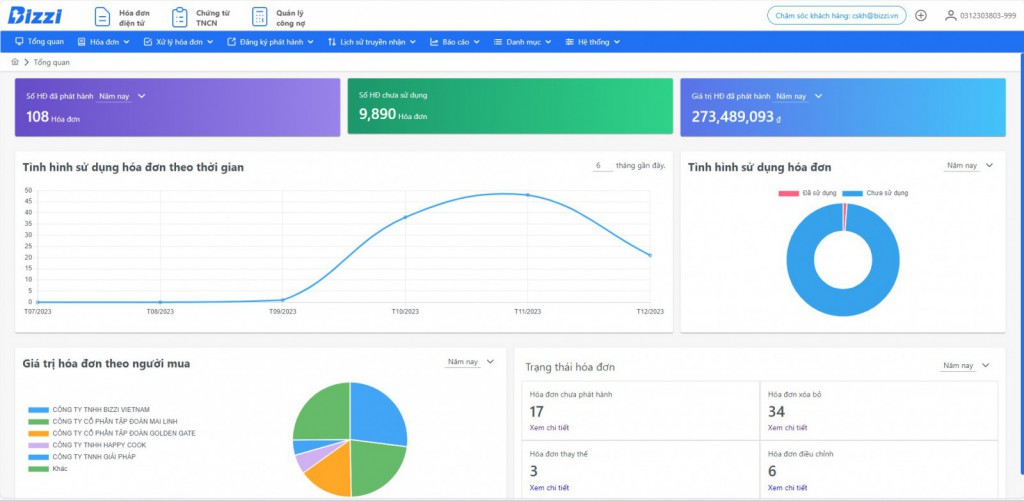
Issuing electronic invoices for food and beverage services initiated from the cash register not only helps businesses optimize costs but also saves time and effort for business owners in accounting and declaring with the Department. Tax.
- Easily connect data between electronic invoice software with POS machines and accounting software
- Fully meets all current circulars and decrees
- Look up invoices quickly, easily, and conveniently
- Ensure safety and security when issuing invoices
- Provide invoice templates according to regulations of the Tax Authority
- Dedicated, fast and professional support team from a reputable electronic invoice software provider
Frequently Asked Questions about Restaurants That Issue VAT Invoices (FAQ)
Is it mandatory to list each dish in detail on the bill?
It's not always mandatory to list every single item, but the bill should clearly detail the food and beverage services provided for explanation, avoiding overly vague descriptions that could pose a risk during inspections.
What should the business do if the restaurant refuses to issue an invoice?
From a compliance perspective, the lack of valid invoices weakens expense documentation and increases the risk of disallowance. Businesses should prioritize suppliers capable of issuing electronic invoices or modify their spending plans according to internal regulations.
Can small businesses issue electronic invoices?
Yes, if registered and meeting the requirements for electronic invoices; certain groups may be eligible to implement electronic invoices from cash registers according to the relevant roadmap/regulations.
Can a bill of sale replace a tax invoice?
Bills/receipts are helpful for verification but generally cannot replace valid invoices for tax declaration/deduction purposes as required by tax documentation.
Are late-issued meal bills accepted?
Late invoicing increases the risk of accounting period discrepancies and weak supporting documentation. The principle regarding the timing of invoicing for services is either upon completion of the service or upon receipt of payment (if payment is received before/during service provision).
At what cost level is it mandatory to obtain a receipt for food and drinks?
Regarding risk management, businesses should set internal thresholds: exceeding these thresholds should mandate electronic invoices and approvals, instead of relying solely on individual employee "habits."
When traveling abroad for business, how should I handle food and beverage bills?
Typically, this is handled according to the regulations on business travel expenses and valid documentation in the host country (including payment receipts, itinerary, and work assignment decision). The FP&A/accounting department needs to clearly define the minimum required documentation to avoid missing records.
How can I quickly find restaurants that issue VAT invoices?
The quickest way is to ask directly, "Do you issue electronic invoices for companies?" before making a reservation/ordering food; for frequent expenses, businesses should maintain a list of verified F&B suppliers.
Can invoices with incorrect tax identification number/company name be corrected?
Typically, erroneous invoices can be handled according to regulations (adjustment/replacement depending on the situation). Early detection is crucial to reduce processing costs and avoid impacting tax filing periods.
Conclude
For businesses, the important question is not "The restaurant issues VAT invoices. or not,” but rather “Is this expense fully documented for acceptance during settlement and is it subject to real-time monitoring?"Food expenses are often small but frequent, so if managed manually (requesting invoices later, lacking proper expense documentation, delayed reimbursement), the risks will accumulate into three major problems: expenses disallowed, accounting period deviation, and Cash flow distortion due to outstanding advances..
The standard CFO approach is to standardize the control chain: Request for expenditure → Approval → Expenditure incurred → Receipt of valid invoice → Reconciliation/Reimbursement → ReportingWhen this chain runs smoothly, businesses reduce tax risks while having clean data for FP&A to track budgets and make quick decisions. Bizzi, acting as a control system for the buyer, helps standardize documentation and track expenditures, reducing manual errors and increasing accountability when needed.
Follow Bizzi to quickly receive the latest information:
- Facebook: https://www.facebook.com/bizzivietnam
- Linkedin: https://www.linkedin.com/company/bizzi-vietnam/
- Youtube: https://www.youtube.com/@bizzivietnam