



What is a CFO? The Chief Financial Officer (CFO) is no longer just someone who "holds the money" or signs off on financial reports. In modern businesses, the CFO designs and operates the entire financial control system, from expenses and cash flow to risk and compliance, while providing reliable data for the CEO and senior management to make decisions.
This article helps you understand the true nature of the CFO role, how CFOs manage core financial processes, and how platforms like Bizzi support CFOs in transforming the Finance and Accounting department from a passive to an active control role.
What is a CFO and what are the responsibilities of a Chief Financial Officer in a business?
CFO (Chief Financial Officer) The Chief Financial Officer (CFO) is the person ultimately responsible for the entire financial system of a business. The CFO's role goes beyond simply preparing reports or ensuring the books are "up to standard"; it encompasses many other aspects. ultimate responsibility (accountability) This allows for better management of funds, risk control, and the transformation of financial data into strategic decisions for the CEO and Board of Directors.
In practice, the CFO doesn't "do the accounting for the accountant," but rather... Design and oversee financial mechanisms To ensure the business operates safely and efficiently, the first priority is... equipped – This includes financial regulations, approval authority, control flows, and audit trail principles. When governance is weak, the risk doesn't lie in individual transactions, but in the inability of the business to prove who is responsible for which financial decision when something goes wrong.
Alongside governance is Cash flow and liquidity managementCFOs must ensure that the business not only reports profits but also has sufficient cash at the right time to operate and grow. This is why CFOs cannot simply look at the P&L (Payment & Revenue) figures, but must closely monitor them. working capital through core indicators such as:
- Cash Conversion Cycle (CCC) = DSO + DIO − DPO, reflecting the speed of conversion from expenses to cash.
- Free Cash Flow (FCF) = Operating Cash Flow − CAPEXThis demonstrates the ability to generate real money after investing in maintaining and expanding operations.
In the array cost managementThe CFO's responsibility is not to "cut at all costs," but to establish... budget discipline and ensure that costs align with strategic objectives. This requires CFOs to see the relationship between budget, actual spending, and business results, rather than simply compiling figures after the accounting period.
Another inseparable pillar is financial risk management and complianceThe CFO is responsible for ensuring the business is ready for audits, tax inspections, and disclosure requirements. Here, audit trail It's not just a compliance requirement, but "proof of defense" for the CFO against legal risks and personal liability.
The major difference between the modern CFO concept and the traditional understanding lies in this: A CFO is not judged by how quickly reports are submitted, but by how well the financial system helps the business make the right decisions early on.The CFO is ultimately responsible for that system – from data input and processing procedures to the output information used for operations.
In this context, many CFOs choose to build an operational control layer alongside their ERP system to ensure financial data remains "alive" and trackable in real time. For example, Bizzi is often used as an execution platform where CFOs establish data standards and financial approval flows, and track expenses, invoices, and accounts payable in a centralized and consistent manner.
Once you understand who a CFO is and what their responsibilities are, it becomes clear what a CFO is. not the data compiler, who is the designer and responsible for the entire financial system. From here, the natural next question is: Where does the CFO stand within the corporate structure, and how do they differ from the CEO, Chief Accountant, or Financial Controller in terms of authority and responsibilities?
How do CFOs differ from CEOs, Chief Accountants, and Financial Controllers in terms of authority and responsibilities?
The core difference The difference between the CFO, CEO, Chief Accountant, and Financial Controller isn't about "who does what," but about... Who is ultimately responsible for the financial risks and the efficiency of the company's use of funds?The CFO is responsible for overall financial accountability; the remaining roles are primarily responsible for specific operational or compliance levels.
CFO and CEO: Financial Strategy vs. Overall Strategy
The CEO bears ultimate responsibility for overall business direction and results: growth, market share, organization, and culture. The CFO does not replace the CEO in strategic decision-making, but responsible for "transforming strategy into controllable numbers".
In other words, if the CEO decides to go in direction A, the CFO must be able to answer: should we go in that direction? How much will it cost, where are the cash flow risks, when will the danger threshold be reached, and what control mechanisms are needed?The CFO is responsible when the strategy is correct but cash flow is disrupted, the covenant is breached, or financial risks are not warned about in a timely manner.
CFO and Chief Accountant: Systems Management vs. Recording & Compliance
The chief accountant focuses on Recording transactions, preparing reports, and complying with standards – tax – accounting.The Chief Accountant's responsibilities typically end with ensuring that the data is "accurate, complete, and valid."
Meanwhile, the CFO is responsible. control system design To ensure those figures accurately reflect business reality and don't mask risks. If the reports are up to standard but the business still overspends, makes incorrect payments, or fails to foresee tax risks, the responsibility lies not with the Chief Accountant but with the CFO.
CFO and Financial Controller: Accountability vs. Operations Control
A Financial Controller typically oversees day-to-day financial operations: closing, reconciliation, and internal compliance checks. The Controller "ensures the system runs correctly."
The CFO is different: They will be held responsible if that system is insufficient to protect the business.The CFO determines the governance model, delegation of authority, approval thresholds, and what level of financial risk is acceptable or unacceptable. This is the difference between someone who "operates control" and someone who "is responsible for risk."
A quick comparison from a risk responsibility perspective.
| Role | Main responsibilities | Risk liability |
| CEO | Overall strategy, business results | Strategic risks |
| CFO | Financial performance, cash flow, control | Overall financial risk |
| Chief Accountant | Record, report, comply. | Risk of accounting errors |
| Financial Controller | Operational control, closing | Process risks |
Viewed through a lens RACI and Governance ModelThe CFO is usually... Accountable for key financial decisions, while the Chief Accountant and Controller are Healthy for each specific operation. Principle Segregation of Duties (SoD) It's designed not to "hinder operations," but so that the CFO can demonstrate that risks have been properly categorized and controlled.
In reality, the boundaries between these roles only become clear when the business has A transparent system for authorization, approval, and tracking.This is why many CFOs deploy platforms like Bizzi to establish role-based authority, automatically log control, and clarify who is responsible at each financial decision point.
Once the distinctions in authority and responsibility have been clearly defined, the next question becomes more practical: To fulfill that role effectively, what core functions within the business does a CFO need to operate?
What is the role of the CFO in corporate cost management and budget control?
In modern businesses, cost management is no longer about "seeing how much was spent at the end of the month," but rather... Design a mechanism so that money only leaves the business when it is under control.This responsibility rests with the CFO. At the system level, the CFO doesn't directly approve every single expenditure, but bears ultimate responsibility for it. Are all expenditures within the budget, for the right purpose, and do they create value?.
Essentially, the CFO's role in cost management revolves around a closed loop: Budgeting → Approval → Expenditure Monitoring → Comparison and WarningA budget is not just a planned number, but a “financial contract” between the CFO and the departments. When the budget is designed according to cost center, project or programIn this way, the CFO can assign spending responsibility to specific owners, instead of letting expenses become a "collective responsibility" with no one ultimately accountable.
The key lies in the relationship. Budget vs ActualThe CFO doesn't just look at total costs, but tracks them. cost variance To understand where spending is skewed and why. This skewness is often quantified using an index:
Variance (%) = (Actual − Budget) / Budget × 100%
But the numbers only really matter when the CFO can see them. deviations over time and cost structureA budget overrun of 5% at the beginning of the period can be a much greater risk signal than an overrun of 10% at the end of the period, as it indicates that spending momentum is forming. This is where many businesses fail: they discover the overspending when the budget is already exhausted.
Concept enter under management Therefore, it becomes an important metric for the CFO. Not the total cost, but... What percentage of spending falls within the standard control flow?There is a budget, approvals, and tracking data. These extraneous expenses – unexpected expenses, advances, expenses without purchase orders or without a cost center – are the source of losses and internal disputes.
The major difference between an active CFO and a passive CFO lies in control timeIf the CFO only takes control after costs have been incurred and recorded in the books, all measures taken will be reactive rather than proactive. Conversely, when control is implemented proactively... before the payment timeIn this system, the budget becomes a tool for management rather than a post-audit report. When an expenditure is about to exceed the budget, the system must immediately signal the CFO or management to decide: adjust the budget, postpone the expenditure, or stop it entirely.
In practice, this is very difficult to achieve if the budget is in Excel and expenses are incurred across multiple different systems. This is why many CFOs implement expense control platforms like Bizzi Expense as a solution. A layer of control before money leaves the business.Budgets are set by department or project, all spending requests are compared against the budget in real time, and overspending alerts appear as soon as a risk arises, instead of waiting until the reporting period.
When budgets are managed in this way, the CFO is not only "tightening spending," but also... Improve the quality of spending decisions.Departments understand financial constraints, management has data to prioritize resources, and the CFO has a vivid cost picture to connect with cash flow and forecasting. From this, cost management is no longer a purely accounting function, but becomes a core part of the CFO's financial executive role.
And that is why, Effective cost control is inseparable from invoice control and tax risk management. – where every expenditure needs to be verified, cross-checked, and tracked to ensure the business optimizes its spending while maintaining compliance.
How does a CFO manage electronic invoicing and tax risks to avoid errors and tax arrears?
In an environment of mandatory electronic invoicing and increasingly stringent tax audits, the risk for CFOs doesn't lie in "lack of invoices," but rather in... The invoices exist but are not legally valid, do not match the transaction, or do not prove the nature of the transaction.Therefore, invoice control for the CFO is not an administrative task, but a core part of financial risk management and compliance.
From a systems perspective, the CFO controls invoices through three main layers: Legal validity, professional correctness, and traceability in auditing..
First of all legal validityA valid invoice must not only be in the correct format, with the correct tax identification number and tax rate, but also be linked to a real transaction and approved by the appropriate authority. The CFO needs to ensure the business does not record or pay invoices that are "correct in form but incorrect in substance"—this is the source of the risk of tax audits and disallowed expenses during tax settlement.
The second layer of control – and the one that makes the biggest difference compared to traditional methods – is Business process reconciliation using 3-way matchingInstead of simply reviewing invoices in isolation, the CFO places invoices in relation to... Purchase Order (PO) and Goods/Service Receipt (GR)When these three pieces of data don't match in terms of price, quantity, delivery terms, or tax rate, the system must stop and request clarification before recording the expense or making the payment. This mechanism significantly reduces the risk of fraud, incorrect payments, and non-deductible expenses for CFOs.
The key point is that CFOs cannot – and should not – perform manual 3-way matching. With hundreds or thousands of invoices each month, manual methods only ensure "verification," not "quality." consistent controlTherefore, many CFOs are switching to the model. insurance risk scoringInvoices are classified by risk level based on criteria such as new supplier, history of discrepancies, large value, discrepancies from the purchase order, or tax rate differences. High-risk invoices require in-depth audits; standard invoices are processed quickly to avoid slowing down cash flow.
The third class is audit trail and audit palmFrom a CFO's perspective, a "safe" invoice is not just an invoice that is correct in the present, but an invoice that is safe. It can be resubmitted after 1–3 years. When tax authorities or auditors inquire, this requires the entire processing flow – from receiving invoices, reconciling, approving, to payment – to be fully documented: who processed it, when, and on what basis. Without an audit trail, the risk doesn't lie with the accountants, but ultimately returns to the CFO for responsibility.
In practice, to effectively operate these three layers of control, CFOs often need specialized automation platforms. For example, Bizzi is used as an operational invoice control layer: the system automatically collects and extracts invoice data, then performs a 3-way reconciliation with the Purchase Order (PO) and General Receipt (GR). Discrepancies are clearly flagged, allowing the CFO and finance team to focus on truly risky exceptions, rather than conducting a wide-ranging audit.
When invoices are controlled in this way, the CFO achieves two goals simultaneously: Reduce tax risks and expedite expense processing.Businesses no longer have to choose between "safety" and "speed," because the system has automated the repetitive checking process, allowing humans to focus on judgment and decision-making.
And from here, the role of the CFO continues to expand to address larger issues: cash flow and liabilitiesBecause even if the invoices are correct, if payments are collected late or made at the wrong time, financial risk still exists – and that's the next challenge CFOs must address.
How does a CFO manage accounts receivable and payable to optimize cash flow?
From a CFO's perspective, accounts receivable is not just a "list of customers who haven't paid" or "suppliers who haven't paid," but rather... direct leverage of corporate cash flow and liquidityEffective accounts receivable management means that the CFO has control over the situation. the timing of money inflows and outflowsInstead of just looking at the profit figures on the report.
In principle, the CFO approaches the accounts receivable problem through two main axes: credit policy and revenue and expenditure disciplineWith accounts receivable (AR), the CFO designs credit policies based on customer groups, sales channels, or risk levels, clearly defining payment deadlines, discount conditions, and the consequences of late payments. With accounts payable (AP), the CFO balances leveraging payment terms to maintain cash flow with preserving credibility and avoiding supply chain disruptions.
To manage these two axes quantitatively, the CFO cannot ignore core metrics. DSO (Days Sales Outstanding) This reflects the average number of days it takes for a business to collect payments from customers, while DPO (Days Payable Outstanding) It indicates how long it takes a business to pay its suppliers. When you put these two metrics in the picture... Cash Conversion Cycle (CCC)The CFO can clearly see where and for how long the business is "tying up" cash. A rapid increase in DSO or a sudden decrease in DPO are warning signs of cash flow pressure, even if revenue continues to increase.
However, the difference between a well-performing CFO and a slow-reacting CFO lies in how accounts receivable data is handled. If accounts receivable/payable (AR/AP) are only updated periodically, the CFO will always make decisions based on delayed data. Conversely, when accounts receivable are continuously reconciled, linked to actual invoice status and payment schedules, the CFO can proactively adjust credit policies, prioritize the collection of high-risk accounts, or renegotiate terms with suppliers to protect liquidity.
In reality, the biggest challenge doesn't lie in the DSO or DPO formula, but in transaction volume and data dispersionWith invoices issued from multiple systems, inconsistent payment statuses, and scattered customer communication histories, manual reconciliation is both slow and prone to errors. This is why CFOs are increasingly relying on automation to transform accounts receivable management from a post-audit task into an operational mechanism.
In this operational layer, Bizzi ARM acts as a debt management systemInstead of waiting until the end of the month, accounts receivable are automatically reconciled in real time, updating the aging of the debt and the collection status. Based on this data, the CFO can set up appropriate debt reminder scenarios based on the value of the receivable, the degree of overdue payment, or the customer group, helping the finance team focus on the accounts with the greatest impact on cash flow.
More importantly, when DSO is continuously monitored and linked to each credit decision, CFOs not only “collect money faster,” but also more accurate forecasts Future cash flow. This creates a direct link to FP&A and forecasting, where CFOs no longer view debt as historical data, but as a proactive variable in financial planning.
From this point on, accounts receivable management is no longer just an operational task for accountants, but becomes a professional responsibility. strategic tools This helps CFOs optimize the cash conversion cycle and maintain liquidity in all growth scenarios.
Why do CFOs need FP&A and EPM to connect actual data with forecasts?
In many businesses, ERP does one thing very well: Record the data that has occurred.But the CFO's problem rarely lies in the question "how much did we spend last month?", but rather in the question "given the current trajectory, what will the business be in terms of cash flow and risk over the next 3–6 months?". This gap is precisely why CFOs need FP&A and EPM.
In essence, FP&A (Financial Planning & Analysis) This function helps CFOs transform past accounting data (actuals) into decision-making information for the future. EPM (Enterprise Performance Management) It is a large-scale FP&A support system with the ability to plan, forecast, analyze variance, and simulate scenarios much more flexibly than ERP.
The key point that many businesses overlook is relationships. Plan – Actual – ForecastA plan is only valuable when continuously compared with actual data, and a forecast is only accurate when it reflects current operational momentum. ERP systems often stop at the "actual," while CFOs need an intermediate layer to provide answers: Where does this discrepancy come from? Is it structural or merely temporary? And if this trend continues, what will be the impact on cash flow and profits?
Therefore, rolling forecast Rolling forecasts have become a crucial tool for modern CFOs. Instead of creating a fixed budget once a year, CFOs continuously update their forecasts quarterly or monthly, based on the latest data. This is especially important in a context of fluctuating costs, unpredictable revenue, and high cash flow pressure. Rolling forecasts help CFOs avoid being "locked" into an outdated plan, allowing them to adjust decisions according to the unfolding reality.
Furthermore, scenario planning This allows CFOs to answer “if-then” questions that ERP systems weren’t designed to handle: if revenue decreases, if financial costs increase, if collection times are extended by 15 days, what impact will the business experience and where action needs to be taken? This is where FP&A and EPM shift the CFO from a reactive role to a proactive, steering one.
For FP&A and EPM to be effective, the prerequisite is: The actual data must be clean enough, fast enough, and consistent enough.In reality, many CFOs struggle because expense, invoice, and accounts receivable data is fragmented, slow to update, or does not accurately reflect the operational state. This is where platforms like Bizzi play a pivotal role: standardizing expense, invoice, and accounts receivable data before it is fed into analysis.
Once the actual data is controlled and updated in near real-time, the CFO can connect it to the EPM to analyze Plan vs. Actual, build rolling forecasts, and simulate scenarios directly on the same data platform. At this point, FP&A is no longer a "end-of-month Excel assignment," but becomes a real-world solution. living decision-making system, closely linked to the daily operations of the business.
In short, CFOs need FP&A and EPM not to replace ERP, but to... Extending the value of ERP data into the future.When actuals are well controlled and forecasts are continuously updated, the CFO truly has the ability to predict risks, allocate resources, and support the CEO in decision-making in a volatile environment. From here, digital transformation of the Finance department is no longer just a slogan, but becomes a real competitive advantage.
What competencies does a modern CFO need to lead financial transformation?
Modern CFOs are no longer judged solely on the accuracy of their reports or their ability to control short-term costs. The core competencies of a CFO today lie in: Design and operate an adaptable financial system., where data, processes, and technology are connected to facilitate fast and accurate decision-making.
First and foremost, a CFO needs competence. main end – This means the ability to view finance as a strategic tool, not a logistical support department. This is reflected in how the CFO participates in decisions about market expansion, investment, pricing structure, or business models, based on the impact on cash flow, risk, and long-term profitability. A good CFO doesn't just answer the question "how much does it cost?", but must answer "what does the business gain in return and where are the risks?".
Besides, data literacy This has become a mandatory competency. CFOs don't need to write code or build complex data models, but they must understand where the data comes from, how reliable it is, and how it's used in decision-making. When a business has multiple systems – ERP, CRM, banking, electronic invoicing – the CFO must have enough understanding to ask the right questions: Does this data reflect reality or is it just the result of an uncontrolled data entry process? This ability to "read data" helps CFOs distinguish between a visually appealing dashboard and a reliable one.
The third factor is automatic wardrobe – An automated mindset. Modern CFOs don't optimize the Finance department by increasing staff to handle the ever-growing workload, but rather by designing processes so that repetitive tasks are automated, while people focus on analysis and control. This mindset helps CFOs shift the Finance department from a reactive state (chasing invoices, accounts receivable, settlements) to a proactive state (detecting discrepancies, intervening early, forecasting).
In practice, the mindset of automation only proves valuable when supported by a sufficiently robust platform. Connecting operational processes and data.This is why many CFOs choose platforms like Bizzi not to “replace ERP,” but to add an execution layer: pre-expense cost control, automated invoice and accounts payable reconciliation, and real-time data for decision-making. When operational processes are standardized and automated at this layer, CFOs can rely on the data input for FP&A, EPM, and higher-level strategic decisions.
In summary, the modern CFO is a convergence of three competencies: Strategic finance, data insights, and automation thinking.Financial transformation doesn't begin with buying more software; it begins with CFOs redesigning how businesses manage money, risk, and information – and using technology like Bizzi to translate that design into daily operations.

Bizzi Expense: Elevating the Role of the Chief Financial Officer
Bizzi Expense is an advanced expense management solution that helps CFOs optimize financial management processes, improve efficiency and better control spending. With outstanding features, Bizzi Expense helps CFOs modernize expense management activities and focus on strategic goals.
Bizzi Expense's notable features include:
- Automate expense reporting: Bizzi Expense eliminates manual data entry, saving time and reducing errors. This feature allows CFOs to focus on strategic tasks instead of dealing with manual expense reports.
- Real-time spending visibility: Bizzi provides detailed spending tracking by category, department, or project in real time. CFOs can easily control spending and adjust budgets in a timely manner, helping to optimize financial performance.
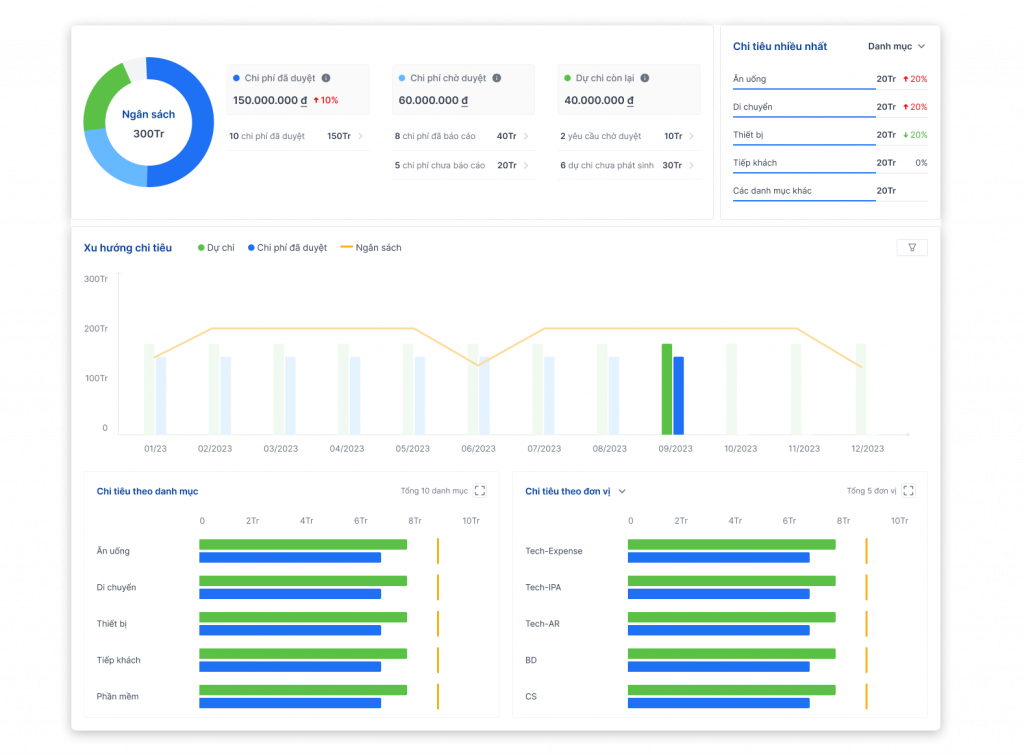
- Custom spending controls: With the ability to set spending policies and control rules, Bizzi Expense helps CFOs ensure spending stays within budget and company policies, while preventing overspending.
- Easy integration with accounting systems: Bizzi Expense integrates flexibly with existing accounting and financial management systems, helping to synchronize data and optimize accounting processes.
Bizzi Expense is the ideal tool to help CFOs manage costs effectively and provide management with timely data to make informed decisions.
Sign up for a free trial now at: https://bizzi.vn/dang-ky-dung-thu/
Frequently Asked Questions about CFOs
Do CFOs need CMA or CPA certifications?
While not mandatory, these certifications provide CFOs with a solid foundation in financial management and control.
What is the most important difference between a CFO and a chief accountant?
The CFO is ultimately responsible for risk and financial performance, not just for the accuracy of the data.
What KPIs does a CFO use to control costs?
Budget variance, spend under management, and cash conversion cycle are common metrics.
Do medium-sized businesses need a CFO?
Yes, especially when businesses begin to expand and financial risks increase rapidly.
Conclude
The role of the CFO has changed dramatically in the digital age. CFOs are no longer just managing costs and books; they now act as strategic advisors, helping to guide the development of the entire business.
Tools like Bizzi Expense have helped CFOs automate processes, provide real-time data, and improve financial efficiency. With these changes, CFOs can focus on long-term goals and become a key force in the sustainable development of the business.
Monitor Bizzi To quickly receive the latest information:
- Facebook: https://www.facebook.com/bizzivietnam
- Linkedin: https://www.linkedin.com/company/bizzi-vietnam/
- Youtube: https://www.youtube.com/@bizzivietnam