



Incorrectly issued electronic invoices must be processed according to the nature of the error, and should not be automatically "canceled and reissued" because they have not yet been sent to the customer or declared for tax purposes. Current handling procedures include notifying the error, issuing an adjustment invoice, or issuing a replacement invoice. Some types of invoices and transactions have specific regulations.
Before working with the software, accountants need to determine whether the invoice has been assigned a code or whether the data has been sent to the tax authorities, identify any errors, and verify whether the actual transaction has changed. Selecting the correct branch from the beginning helps avoid creating unnecessary additional documents and maintains a link between the original invoice and the processing record.
Can invoices that were issued incorrectly still be canceled according to the old instructions?
For invoices that have been assigned a code or invoices without a code that have had their data sent to the tax authority, Article 10 of Circular 91/2026/TT-BTC stipulates the handling method according to the type of error. The procedure for canceling an invoice in the old software documentation should not be used as a basis for processing a current invoice.
It's necessary to separate three tasks that are easily categorized as "cancellations": correcting an unreleased draft, processing an incorrectly issued invoice, and handling invoices when the transaction is subsequently terminated or goods are returned. The status in the software is for verification purposes only, not a substitute for determining the nature of the transaction.
For example, an invoice that has been issued with an incorrect buyer address but correct tax identification number and other essential details may fall under the notification branch and does not require a new invoice. If the tax identification number or amount is incorrect, the adjustment or replacement branch must be checked. If a customer returns goods after a correct transaction, this is a situation that arises after the invoice is issued and has its own handling procedure.
Choose how to handle the error and invoice type.
Compare both the incorrect content and the invoice type. The general rules for regular invoices should not be applied mechanically to invoices from cash registers, invoices related to registered assets, or data submitted in a summary table.
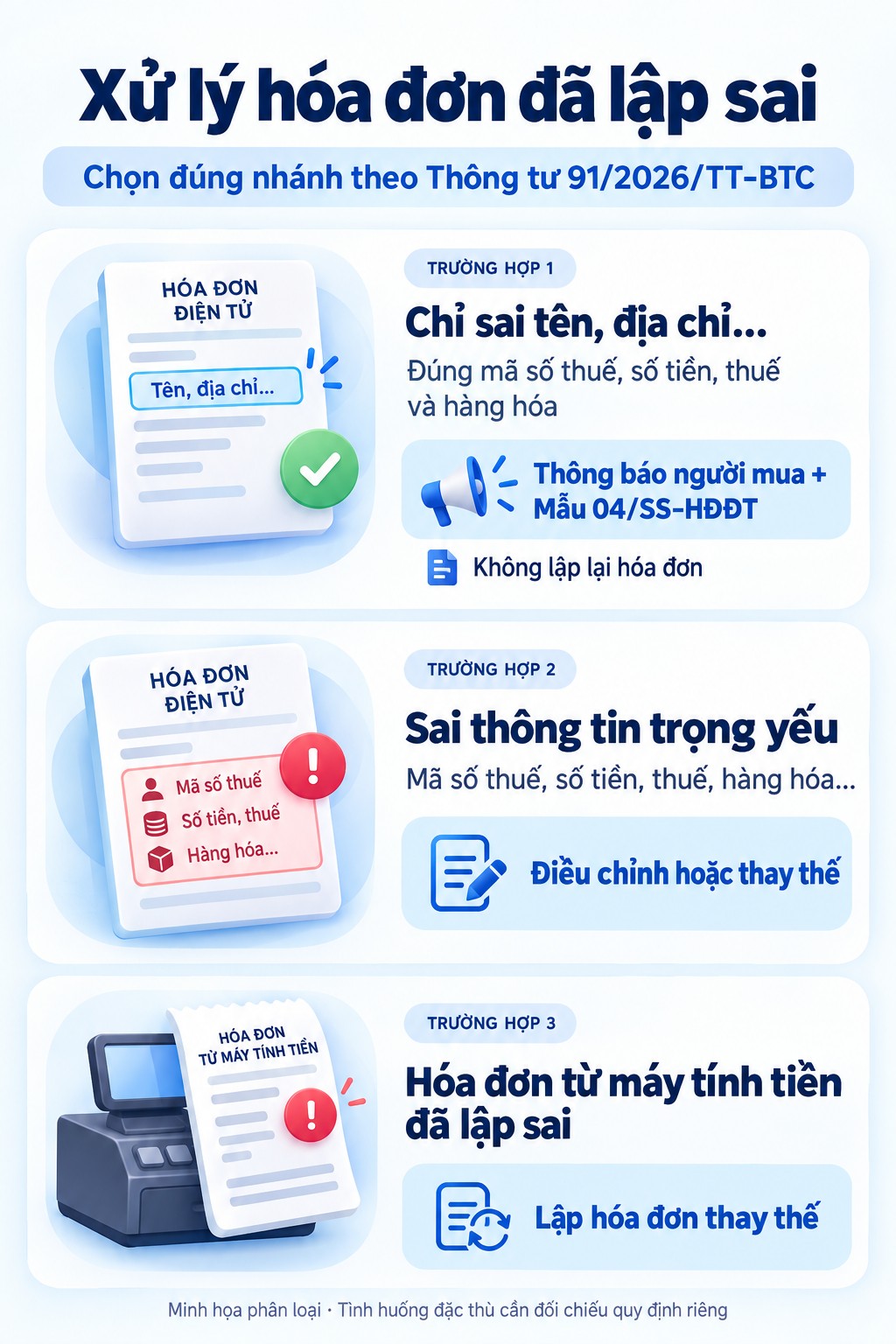
| Situation requiring inspection | Solution | Conditions that need to be maintained |
|---|---|---|
| Incorrect name, address, amount in words, or other content as per point a, clause 1 | Notify the buyer and send Form 04/SS-HĐĐT; do not reissue the invoice. | No errors in tax identification number, invoice amount, tax rate, tax amount, or goods. |
| Incorrect tax identification number, amount, tax rate, tax amount, goods, or mandatory content under point b, clause 1. | Adjustment or replacement options are available. | Check the invoice type, previous handling method, and records with the buyer. |
| The receipt from the cash register was incorrect. | Create a replacement invoice | Apply the specific branch at point c of clause 1; do not use the general selection rule without permission. |
| The invoice for the sale of assets requiring registration of ownership or use rights was incorrectly issued. | Create a replacement invoice | This is distinct from the case of returning registered property as per point c.2, clause 5. |
| The incorrect invoice was sent according to the Electronic Invoice Data Summary. | Submit the adjusted or replaced information on the summary table for subsequent periods. | Do not submit Form 04/SS-HĐĐT for the case specified in point d, clause 1. |
| The invoice is valid when issued, but then the customer returns the goods or terminates the service for which payment has already been received. | Compare the transaction processing branch arising in clause 5. | Return records, transaction termination, and the billing entity must be appropriate to the specific case. |
For draft invoices, invoices with errors, or invoices without codes that haven't been sent, it's necessary to check the logs and the actual status before making a decision. It shouldn't be assumed that an invoice not sent to the customer necessarily hasn't been assigned a code or that the data hasn't been transferred to the tax authorities.
6 steps to correct errors and check results
The process begins with checking the original invoice and ends with a traceable record. The button names may vary across different software programs, but the data, documents, and results to be checked must match the selected processing branch.
- Compare the original invoice with the transaction. Open the XML file, its representation, and the code or data transmission information. Compare it with the contract, order, delivery, acceptance, and buyer information. Clearly identify the incorrect field, the content being recorded, and the correct content. The desired result should be: correctly identifying the invoice and its cause, avoiding confusion between the incorrect invoice and subsequent transaction changes.
- Select the notification branch, adjust, or replace it. Using the classification table above, check invoices from the cash register, assets requiring registration, summary tables, and previous processing. The results should include: the basis for selection and the list of documents to be prepared; it is not assumed that all branches will send Form 04/SS-HĐĐT.
- Complete the paperwork with the buyer. If the case falls under the adjustment or replacement clause (b) of paragraph 1 and the buyer is an economic organization, other organization, business household, or individual business, a written agreement must be prepared clearly stating the incorrect content, except in cases where exemption is granted. For individual buyers, the seller must notify the buyer or post the notification on their website, if available. The required result is a written notification or evidence that is appropriate and addressed to the correct party.
- Prepare the documents according to the chosen method. The notification branch uses Form 04/SS-HĐĐT as specified in Appendix III of Circular 91. The adjustment or replacement branch creates an invoice with content and information referencing the original invoice as prescribed. Check the amount, increase or decrease mark, and buyer data before signing. The desired result should include: the correct document type, the correct link to the original invoice, and the content matching the transaction.
- Sign, send, and check the response. For adjustment or replacement invoices with a code, the seller submits them to the tax authority for code issuance before sending them to the buyer. For invoices without a code, the invoice is sent to the buyer and data is transmitted according to the applicable method. Regarding the notification branch in point a, clause 1, check the receipt notification Form 01/TB-SSĐT. The result should show: the data has been sent to the correct location and the response has been saved, not just a "Saved successfully" status.
- Verify the declarations and close the file for processing. Determine whether the invoice was initially incorrect or was adjusted due to a subsequent transaction; check the filing period and corresponding supplementary filing obligations. Keep the original invoice, new documents, agreements or notices, responses, and business documents in the same file. The desired outcome should allow the reviewer to trace the transaction back to each invoice and the reason for the correction.
Reading the tax identification number, invoice number, or status on a PDF document is not a substitute for verifying the original data. When it is necessary to compare information on a received or issued invoice, other methods can be used. Look up electronic invoices on the tax authority's system. Before processing, the search results must still be placed alongside the actual transaction record.
What are the differences between adjusting and replacing data?
Adjust the content to reflect the correction needed; replace the incorrect invoice with a new one containing the correct information. One should not choose an option based solely on the feeling that the error is "minor" or "major"; it is necessary to compare the type of error with the specific regulations.
Adjustments, whether upward or downward, must accurately reflect the difference.
Clause 6 of Article 10 requires that the value on adjustment invoices be recorded as a positive number for increases and a negative number for decreases, reflecting the actual situation. For example, suppose the invoice shows a pre-tax value of 20 million VND, but the correct value is 18 million VND: the adjusted decrease of 2 million VND should be recorded as a negative number. The tax amount needs to be processed according to the tax rate and the actual nature of the transaction, not just the total payment.
Adjustment invoices must include reference information to the original invoice as per point b.1, clause 1. After preparation, the difference must be checked and linked to the original document; do not confuse recording a negative number with deleting the old invoice from the file.
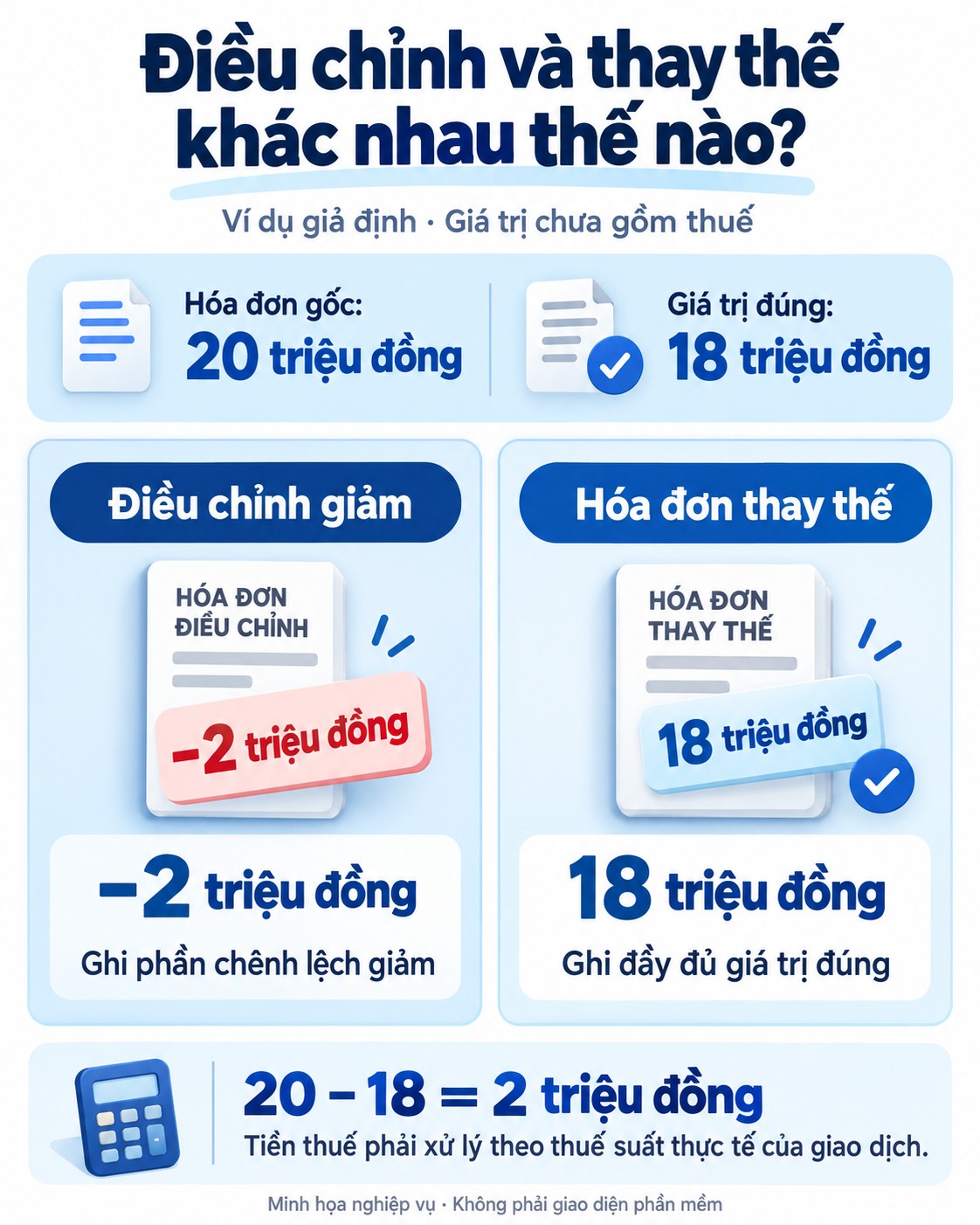
The replacement invoice must contain all the correct information.
Using the same example above, the replacement invoice shows the correct value of 18 million VND along with other invoice details as prescribed. The replacement invoice should not be recorded as a document reducing the invoice by 2 million VND. The reference information must clearly indicate the replacement invoice, which the seller then signs and sends, either with or without a code.
For valid invoices without a sample number, invoice symbol, or invoice number, Clause 6 of Article 10 stipulates that if an invoice is incorrect, the seller may only issue an adjustment invoice. If there are multiple incorrect invoices with the same information for the same buyer in the same month, all conditions must be checked before issuing an adjustment or replacement invoice accompanied by a Statement of Invoices Form 01/BK-ĐCTT.
When processing multiple documents, a reconciliation table should be created showing the original invoices, the type of error, the proposed solution, and the new invoice number. Each line should indicate the correct value, the difference, and supporting documentation for verification by both the preparer and the recipient.
When are Form 04/SS-HĐĐT and the agreement document used?
Notification to the tax authorities and the written agreement between the seller and the buyer are two documents with different functions. Do not use a “cancellation record” in an old document to substitute for all current obligations.
Not all errors require submitting Form 04/SS-HĐĐT.
In the section at point a, clause 1, Article 10, the seller notifies the buyer, does not reissue the invoice, and sends Form 04/SS-HĐĐT under Appendix III. Before sending, it is necessary to check the taxpayer, the relevant invoice, and the reason for the notification; use the current form on the system instead of copying notification images from 2018 or old forms.
The tax management information system automatically notifies this branch of receipt using Form 01/TB-SSĐT. If the tax authority discovers an incorrect invoice, the review notification using Form 01/TB-RSĐT is a request for the seller to check and correct the issue. These two responses do not mean that the tax authority has authorized the "cancellation" operation. For incorrect invoices that have already been submitted as a summary, point d, clause 1 has a separate processing mechanism and does not send Form 04/SS-HĐĐT like the regular notification branch.
The agreement should clearly state the fault; it shouldn't always be a default for both parties to digitally sign.
A written agreement, when necessary, helps both parties determine the correct invoice and correct any errors in its content. The framework below is a suggestion for preparing business documentation, not a legally mandated template applicable to all transactions.
| Information | Content that needs clarification |
|---|---|
| Both parties and the certifying party | Information about the seller and buyer; authority to certify the transaction. |
| Related invoices | Invoice form number, symbol, number and date; related list if processing multiple invoices. |
| Incorrect content and correct content | Specify the error field, the value being displayed, and the basis for determining the correct content. |
| Treatment options | Adjust or replace documents in accordance with regulations; reference information and responsibilities for sending and receiving documents. |
| Attached documents | Contracts, delivery notes, acceptance certificates, return documents, or other necessary verification documents. |
Circular 91 requires the retention of the agreement document and its presentation upon request by the competent authority; a general rule that all documents must have digital signatures from both parties should not be arbitrarily assumed. The form and method of confirmation must be appropriate to the requirements applicable to the document, transaction, and system being used.
Sellers are exempt from preparing written agreements in the cases mentioned in point b, clause 1: transferring data via summary tables, transferring detailed transaction information databases via detailed information tables, and buying and selling goods on e-commerce platforms or other digital platforms. This exemption from written agreements is within the scope of the regulations and does not include exemption from invoice processing or the retention of transaction documents.
Does returning goods or terminating services require canceling the invoice?
Transactions that change after an invoice has been correctly prepared must be distinguished from errors in the original invoice. Clause 5 of Article 10 provides specific guidance on cases of returns, refunds, discounts, settlements, and termination of transactions where payment has been received in advance.
When the buyer returns all or part of the goods, including exchanging goods that change their value, the seller issues an adjustment invoice in accordance with point c.1, clause 5. An exception is when the parties agree that the buyer will issue a return invoice; in this case, the buyer issues the invoice to the seller, and both parties fulfill their tax obligations as prescribed. Both parties must retain records and documents related to the return of goods for presentation upon request.
For example, suppose a customer receives all the goods as per the invoice, but then returns some due to a change in needs. A return record needs to be created and verified, the quantity and value returned must be determined, and the invoice processed according to the return procedure. It should not be recorded as if the seller entered the wrong quantity on the original invoice if the initial transaction was correct.
For assets that require registration but have already been registered in the buyer's name, point c.2 of clause 5 has a specific rule: when returning goods in accordance with relevant laws, if the buyer is an entity using electronic invoices, the buyer must issue a return invoice. The procedure of replacing the invoice issued incorrectly is not applicable.
When a seller has issued an invoice for payment received before providing services, or for real estate, infrastructure, or houses for sale or transfer, and then the transaction is canceled or terminated and part of the service is cancelled, it is necessary to refer to point c.4, clause 5 to adjust the issued invoice. In cases where an invoice is mistakenly issued for a transaction that never occurred, it must be reviewed separately with the records and the tax authorities; it cannot be assumed that it can be deleted or adjusted to zero in all cases.
What information needs to be checked regarding declared invoices and risk assessment documents?
Whether or not a declaration has been filed is not the only criterion for deciding whether to "cancel" or amend it. First, it's necessary to classify whether the invoice was initially incorrect or if the transaction was altered later, then determine the appropriate handling method and corresponding declaration obligations.
Clause 6 of Article 10 specifically stipulates that adjustment invoices under Clause 5 must be declared by the seller in the period in which the adjustment invoice is issued, and by the buyer in the period in which the adjustment invoice is received. This clause should not be extended to a general rule that all adjustment or replacement invoices due to errors must be declared in the current period without requiring supplementary declaration verification.
Accountants need to review the declared tax amounts, relevant periods, adjustment or replacement documents, inspection or audit status, and applicable tax management regulations. If errors affect the amount of tax payable or the file has already been concluded by a competent authority, it is advisable to check with the tax department before submitting the file. Avoid having the seller and buyer use two sets of inconsistent documents.
- The original invoice and processing documents are clearly linked and are not recorded as two separate transactions.
- The accuracy of the information is verified by actual transactions and documentation.
- The agreement or buyer notice has been saved if applicable.
- Data transmission responses, code issuance, or message reception have been checked.
- The reviewer confirms the filing period and any supplementary filings as needed.
The penalty cannot be determined solely from the action name "canceling the invoice." The actual act, type of document, party involved, time, and circumstances of the case must be considered. A single penalty table for "failure to create a cancellation record" or "failure to send Form 04/SS" cannot be used to conclude that all cases constitute the same violation. When assessing sanctions, the currently effective penalty document and the specific case file must be compared.
Frequently Asked Questions When Handling Errors in Electronic Invoices
Can invoices that haven't been sent to the buyer be canceled automatically?
Decisions cannot be made solely based on the customer delivery status. Invoices may have been assigned a code or may not have sent data to the tax authorities. When falling under the scope of Clause 1, Article 10, the handling should be based on the nature of the error and the type of invoice. Error drafts or issued invoices must be checked separately against the actual log.
Is the processing complete once Form 04/SS-HĐĐT has been submitted?
It's too early to draw a general conclusion. We need to verify that the correct branch used form 04/SS, that the data and reasons are correct, that a response has been received, and that the buyer has been notified. The adjustment or replacement branch requires a new invoice and corresponding documents; sending form 04/SS cannot replace these tasks.
How do you correct errors on invoices issued on a transaction-by-transaction basis?
Clause 7 of Article 10 stipulates that in cases requiring adjustment or replacement, organizations, households, or individuals engaged in business activities shall submit Application Form 06/DN-PSDT to the tax authority to obtain adjusted or replacement invoices. Tax obligations and revenue from the increased difference in revenue must be checked according to tax management regulations.
Is it possible to delete the original invoice after issuing a replacement invoice?
The original invoice, its connection to the replacement document, and the processing record must be retained for traceability. It's important to understand that "replace" means the right to delete the transaction history or discard documentation proving the error. Before confirming a deletion in the software, verify the correct data type and the impact on the records.