


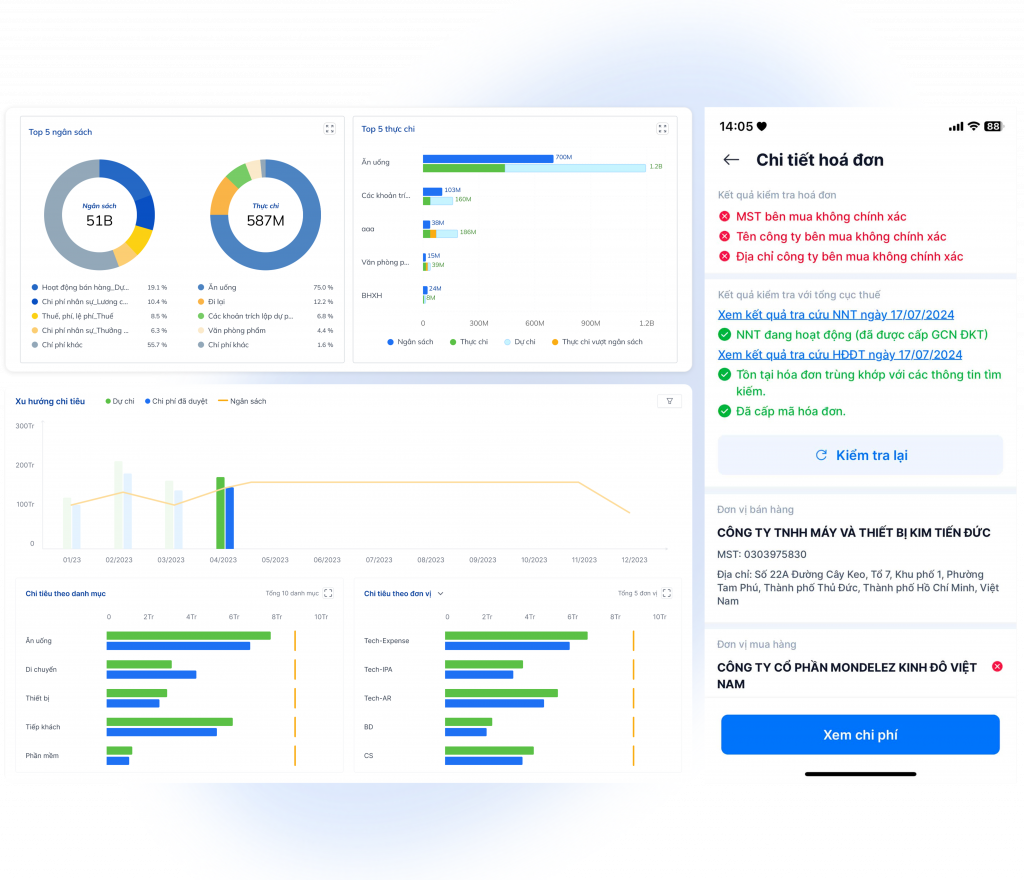
In a constantly changing environment, Dashboards are no longer a “nice to have” but a vital capability for modern CFOs. Those who own real-time data will make faster, more accurate decisions and lead the business through the volatility.
In other words, the CFO dashboard isn't a pretty tool to look at, but a survival tool. Join Bizzi as we delve deeper into the essence of what a CFO dashboard is in the following article.
Why do CFOs need dashboards to survive in a volatile financial environment?
Today's CFOs no longer focus solely on closing the books, controlling operations, and ensuring compliance; they must become data architects and growth strategists.
But the reality is that financial data is scattered in too many places:
ERP • Accounting software • Banking • Sales • Accounts receivable • Electronic invoices • Expense
Without a “visual data center,” CFOs face:
- Waiting for manual reports → missing the opportunity to make quick decisions
- Explain the discrepancies caused by dirty and fragmented data.
- The forecast is based on inaccurate assumptions.
- A passive rather than proactive response to market fluctuations.

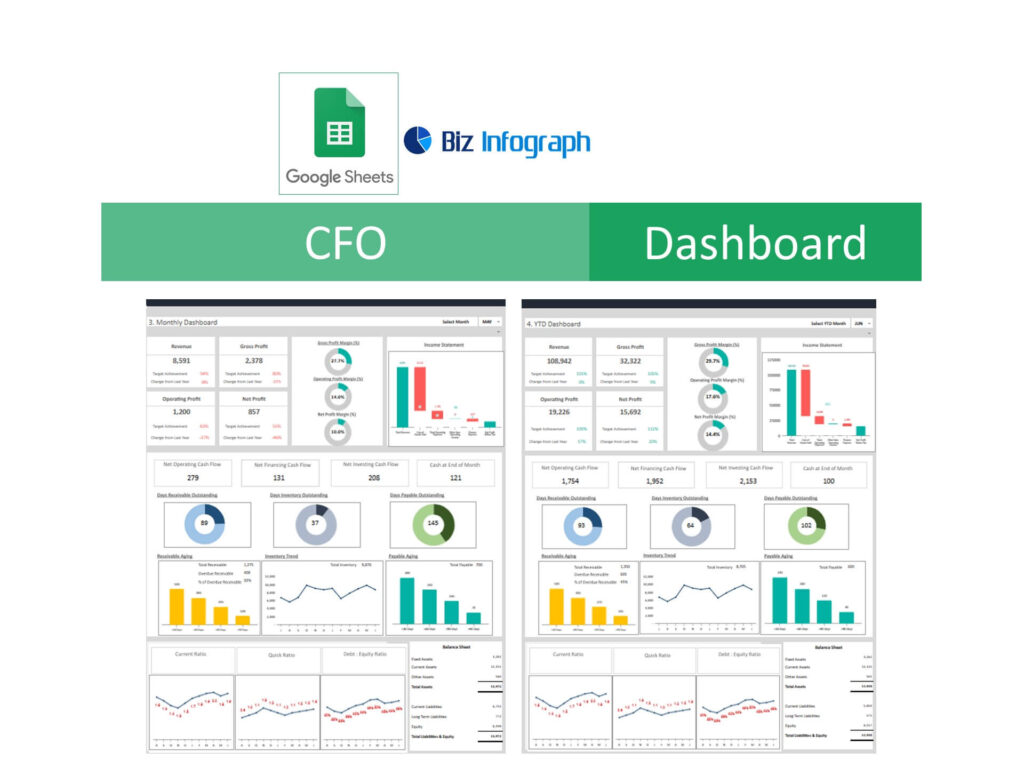
The question arises regarding the emergence of the CFO dashboard. What is a CFO dashboard and why is it important? Like an airplane cockpit, a financial dashboard allows for a real-time overview of the company's health:
- Cash flow & cash runway
- Cost-effectiveness & ROI by channel
- Accounts receivable and accounts payable
- Budget status & forecast
- Operational KPI – profit by product / customer
From there, the CFO has a database to make quick, accurate, and data-backed decisions, not based on emotions.
What is a CFO dashboard?
CFO Dashboard is a centralized financial dashboard that displays key performance indicators (KPIs) that help CFOs monitor the financial health of the business in real time, including:
- Cash flow & Cash runway
- Cost control
- Financial activities: AP – AR – Closing
- Profit & business efficiency
- Risk & Compliance (Compliance & Audit)
- Budget vs. Actual
1. What is the core function of a CFO dashboard?
The core function of a CFO dashboard is to provide a comprehensive, visual, and real-time overview of the company's financial situation. This allows the CFO to monitor, analyze, and make strategic decisions quickly and accurately. Specifically:
- Consolidate data from multiple systems.
- Data normalization and visualization.
- Forecasting and scenario simulation.
- Real-time risk alerts.
2. What is the difference between a regular Excel report and a CFO Dashboard?
Compared to traditional methods, the CFO dashboard has many outstanding advantages such as:
| Excel | CFO Dashboard |
| Handmade, prone to errors. | Automatically, from the data API |
| Slow, late update | Real-time / near real-time |
| Difficult to drill down | Drilldown: from overview → details of each invoice |
| Description only | Predictable and alertable |
5 types of CFO dashboards based on business objectives
There is no one-size-fits-all dashboard for every business. Each stage of growth will require a different type of dashboard focus.
1. Financial Health Dashboard – Overall Financial Health
Helps CFOs get a complete picture of business performance and financial strength of the enterprise.
- Revenue – Gross Profit – Net Profit
- EBITDA – ROE – ROA
- Cash flow from operating activities
- Profit by department / product / project
- Profit margin by customer segment
Objective: To answer the question, "Is the business creating sustainable value?"

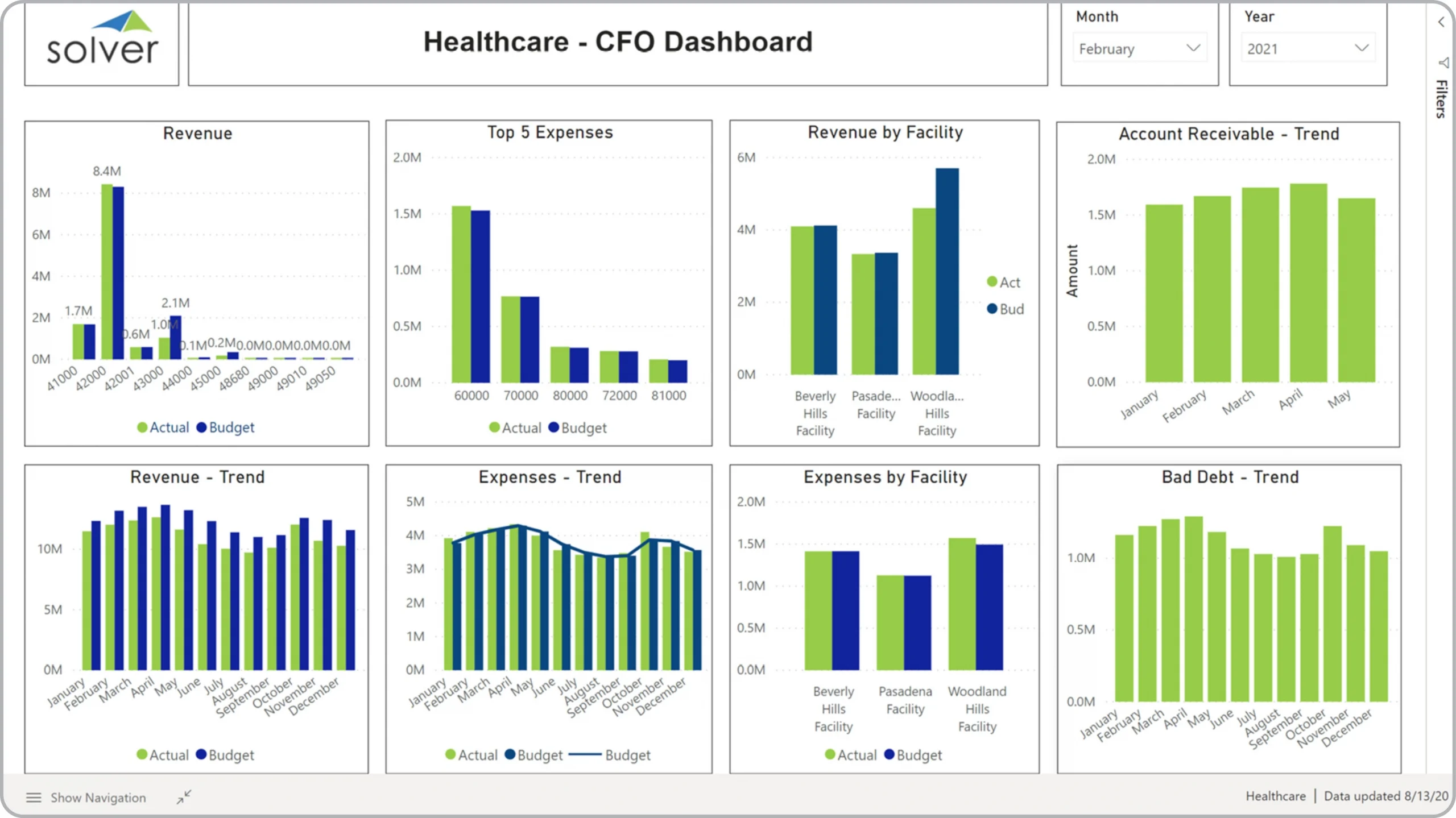
2. Cashflow & Liquidity Dashboard
For the phase where businesses prioritize survival and liquidity control.
- Cash on hand – Available credit
- Cash runway (how long will the business survive at the current burn rate)
- Cash flow forecast 30/60/90 days
- Cash Conversion Cycle (CCC) = DSO + DIO – DPO
- Ability to meet debt obligations
Objective: Always know when you're short on money before it happens.
3. Cost & Spend Control Dashboard
Focus on optimizing costs, reducing leakage and improving investment efficiency.
- Actual vs Budget
- OPEX / CAPEX
- Cost per invoice – Cost per transaction
- AP aging / Overdue payments
- Vendor compliance & performance
Goal: From blind cutting to data-driven optimization.

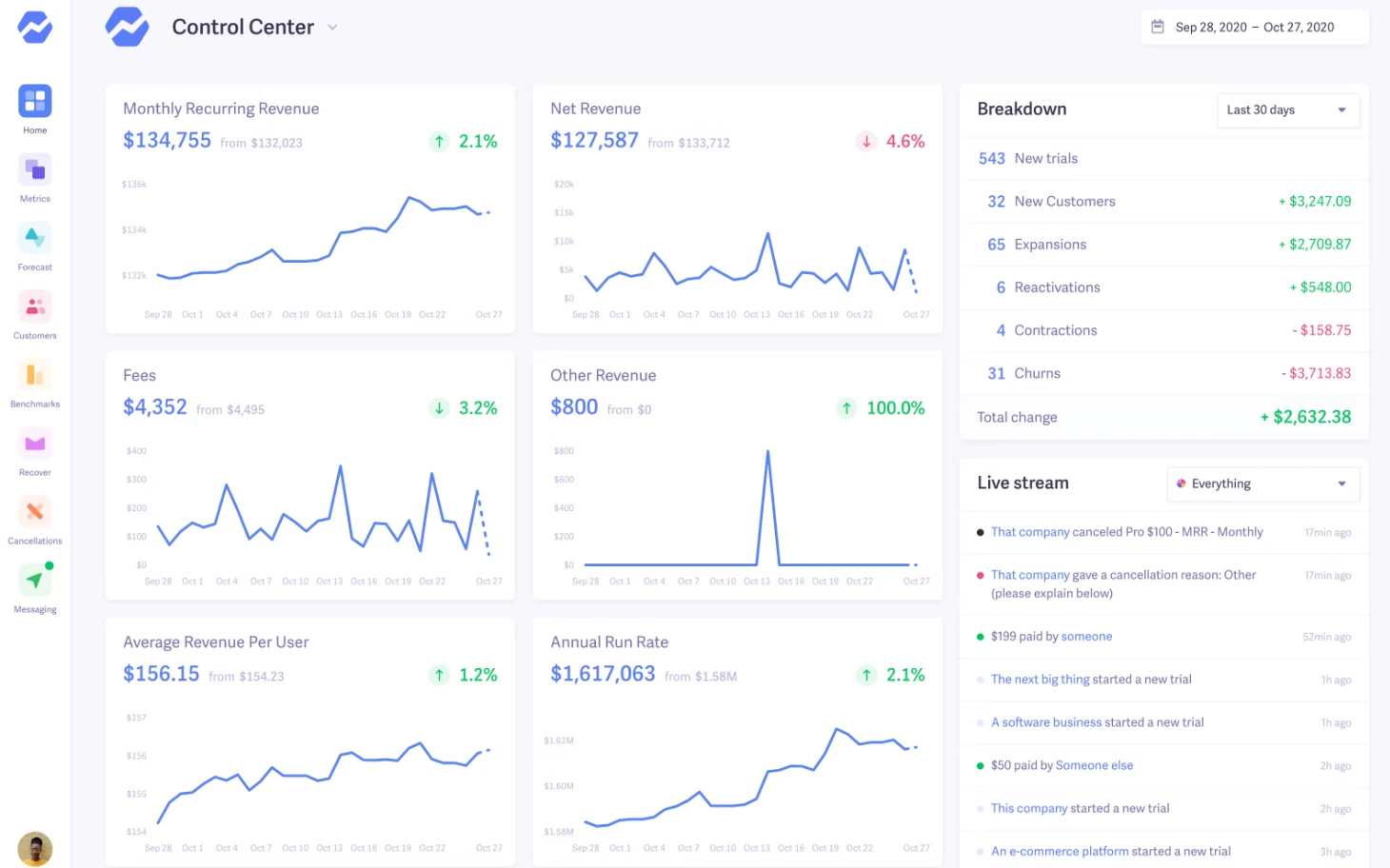
4. FP&A Dashboard (Planning – Forecasting – Decision Making)
The ability to plan for and simulate the future.
- Budget vs Actual vs Forecast
- Scenario Planning (best/worst/average scenario)
- 12-Month Rolling Forecast
- Variance Analysis & Root causes
- Break-even analysis
Goal: Be proactive strategically rather than reactive.
5. AP/AR Operations Dashboard
Reduce cash flow bottlenecks and increase the likelihood of timely collection and payment.
- DSO – DPO
- AR aging / AP aging
- First Pass Match Rate (AP automation accuracy)
- Exception rate (rate of errors and invoices requiring manual processing)
- Payment performance
Objective: Shorten the cash cycle, accelerate revenue collection, and optimize expenditure.

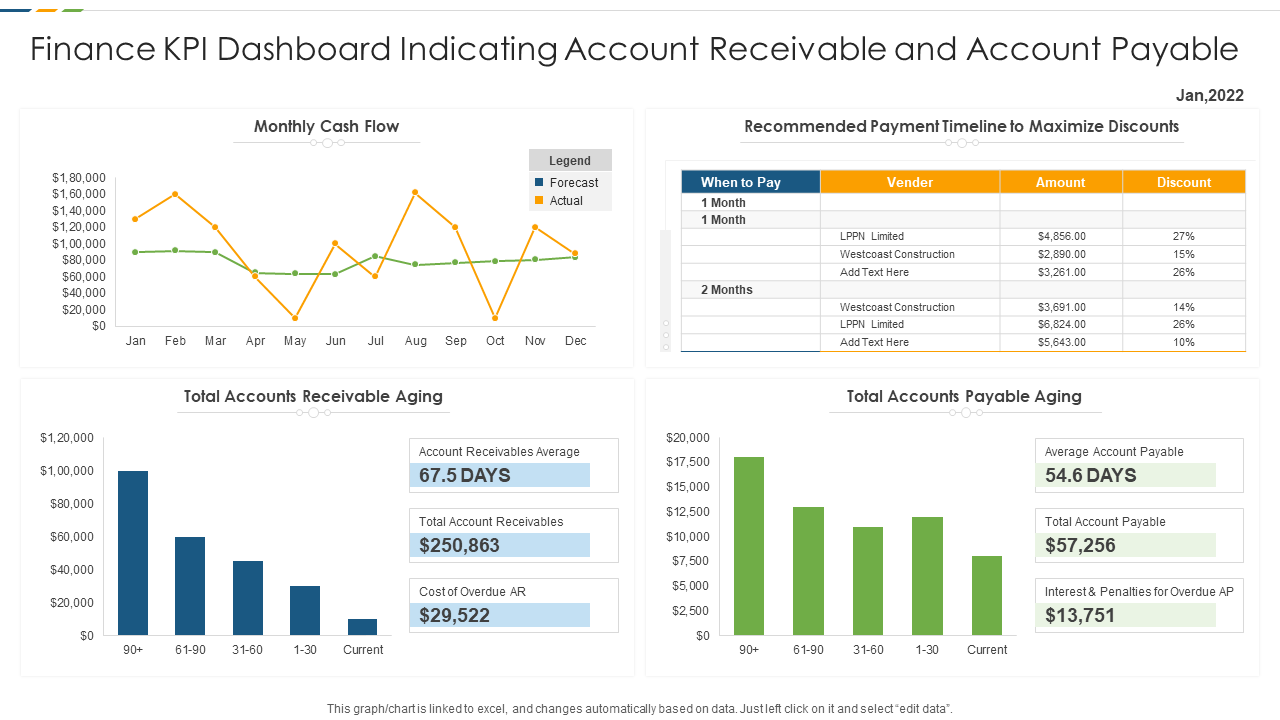
What are the most important Key Performance Indicators (KPIs) in a CFO Dashboard?
The CFO dashboard serves as a platform for continuous measurement and improvement. Therefore, the CFO dashboard will have specific performance indicators and metrics.
1. Cashflow KPIs
| Index | Meaning |
| Operating Cashflow | Measure the cash flow generated from core business operations. |
| Net Cashflow | Net cash flow after calculating all income and expenses |
| Burn Rate | Monthly spending rate is especially important for startups. |
| Cash Conversion Cycle (CCC) | Conversion rate from inventory → revenue → cash |
Target: Help the CFO know When is a business about to run out of cash? To take proactive action.
2. KPIs for Costs & Expense Control
| Index | Meaning |
| Fabric breakdown | Operating cost structure, identifying waste areas |
| Cost per invoice (CPI) | Cost of processing 1 input invoice — automation optimization index |
| Cost overrun alerts | Budget overrun warning by department / project |
| Actual vs Budget | Measuring deviations and budget discipline |
Target: No arbitrary cuts., which optimizes spending with data.
3. Performance & Profitability KPIs
| Index | Meaning |
| EBITDA Margin | Measuring core earnings quality |
| Net Profit Margin | Net profit margin on revenue |
| Revenue Growth | Revenue growth rate by period |
| Gross Margin | Operational efficiency and product pricing |
Target: Evaluate How do businesses create value? and Is the profit margin sustainable?.
4. KPIs for Accounts Receivable/Payable
| Index | Meaning |
| DSO – Days Sales Outstanding | Average number of days to collect payment |
| DPO – Days Payable Outstanding | Average number of payment days |
| AR/AP Aging | Debt collection and payment age structure |
| Percentage Overdue | Delinquency rate affects cashflow |
Target: Accelerate collection – optimize payment to improve cash flow.
5. Compliance & Risk KPIs
| Index | Meaning |
| Invoice compliance rate | First-time valid invoice rate |
| Vendor risk score | Supplier risk level (legal – financial – SLA) |
| Tax compliance status | Tax compliance status by period |
| Audit readiness | Audit readiness, document preparation time |
Target: Reduce tax penalty & audit risks, increase transparency and financial reputation.
Technical requirements for CFO Dashboard to function properly
CFO Dashboard is not a problem of “drawing beautiful charts”, but a problem of data infrastructure + automation + standardized management. Only then will the dashboard become the basis for strategic decision making, not a decorative screen.
1. Data source to connect (Single Source of Truth)
For the dashboard to accurately reflect financial health, data must be automatically synchronized from multiple systems:
- ERP (SAP / Oracle / Odoo / Bravo / Misa / Fast…)
- Bank
- Electronic bill
- AP/AR system
- CRM & sales system
- Bizzi Expense & Bizzi IPA
If data is only entered manually, dashboards will always be slow and inaccurate.
2. Data Governance
Data Standardization & Synchronization requirements for CFO Dashboard are extremely important, as this dashboard aggregates information from many different systems (ERP, CRM, sales system, etc.). Inconsistent or inaccurate data will lead to misleading reports and wrong business decisions.
- Mapping according to accounting and tax standards
- Standardize cost data (department / cost center / project / region)
- Eliminate duplicate transactions, fake invoices, and errors
- Automatic data classification rules (rules engine)
Without normalization, data is beautiful but unreliable.
3. BI & Visualization Layer
Popular technologies:
- Power BI
- Looker Studio
- Tableau
- Bizzi Dashboard (ready connected e-invoice, banking, AP/AR, Expense)
BI is only strong when clean input data – standard – realtime.
What are the mistakes that cause failure when using CFO Dashboard?
Dashboards are only as good as the data. BI can't save dirty data — automation and standardization can.
1. Dirty data from ERP
- Wrong item code, wrong accounting account, missing cost mapping
- Duplicate or missing data
Consequence: Dashboard looks nice but make wrong decisions, loss of trust in data.
2. No Data Governance
- No standardization of cost center, department, project
- No data control & authorization process
Consequence: Unexplained variance, figures skewed between departments.
3. AP is not automated
- Invoices are slow to enter, manually entered, and contain many errors.
- Approval time is long
Consequence: Cashflow forecast is wrong, difficult to forecast capital needs.
4. No Audit Trail
- No data edit tracking, no change tracking
Consequence: Difficult to audit, tax risks, untraceable errors.
5. Asynchronous Multi-branch
- Branches record revenues and expenditures according to their own standards, data is not unified.
Consequence: The summary report is incorrect and does not accurately reflect the financial situation.
6. Not checking Invoice Compliance
- Error, duplicate, invalid invoices still enter the system
Consequence: CFOs make decisions based on dirty data, increasing the risk of tax penalties and fraud.
Bizzi – Financial automation layer helps CFO Dashboard update real-time and no more errors
CFO Dashboard is only accurate when the input data is clean – complete – synchronized. However, most businesses encounter the following situation:
- Disparate data across multiple systems
- Incorrect/late/duplicate invoices cause data discrepancies
- Manual AP → incorrect cashflow forecast
- Lack of cost standardization & audit trail
Instead of trying to “prettify” dirty data on the dashboard, businesses need a layer of filtering – cleaning – standardizing data before it is put into BI. Or in other words, when the data is clean, the Dashboard is accurate.
Bizzi – Trợ lý tài chính đắc lực, “sàng lọc” dữ liệu tự động và thông minh giúp CFO ra quyết định real-time, không sai lệch! With support from Bizz in automating & standardizing data before entering BI, dashboard becomes a real-time decision-making tool, no longer misleading.
Bizzi supports CFO Dashboard through the following aspects:
Bizzi IPA (Invoice Processing Automation) – Clean invoice data from input
- Automatically download – extract – check – compare invoices
- Verify suppliers, eliminate risky/duplicate/wrong invoices
- Synchronize data Invoice → ERP → Dashboard
- Automatic document compliance check
CFOs have real-time, accurate, transparent cost data right from the source.
Bizzi Expense / Travel – Kiểm soát chi tiêu & ngân sách chuẩn
Function:
- Control spending before - during - after.
- Over budget warning, internal policy check.
- Tracking & audit trail according to tax standards.
Benefit:
- Ensure spending compliance.
- Reduce internal fraud, increase transparency.
- Assist CFO and FP&A in tracking and reporting accurate expenses.
Bizzi Integration – Standardized multi-system connection
- ERP – accounting – eInvoice – banking – AP/AR integration
- Enterprise-standard API
- Multi-branch synchronization
- Full audit trail & transparent authorization
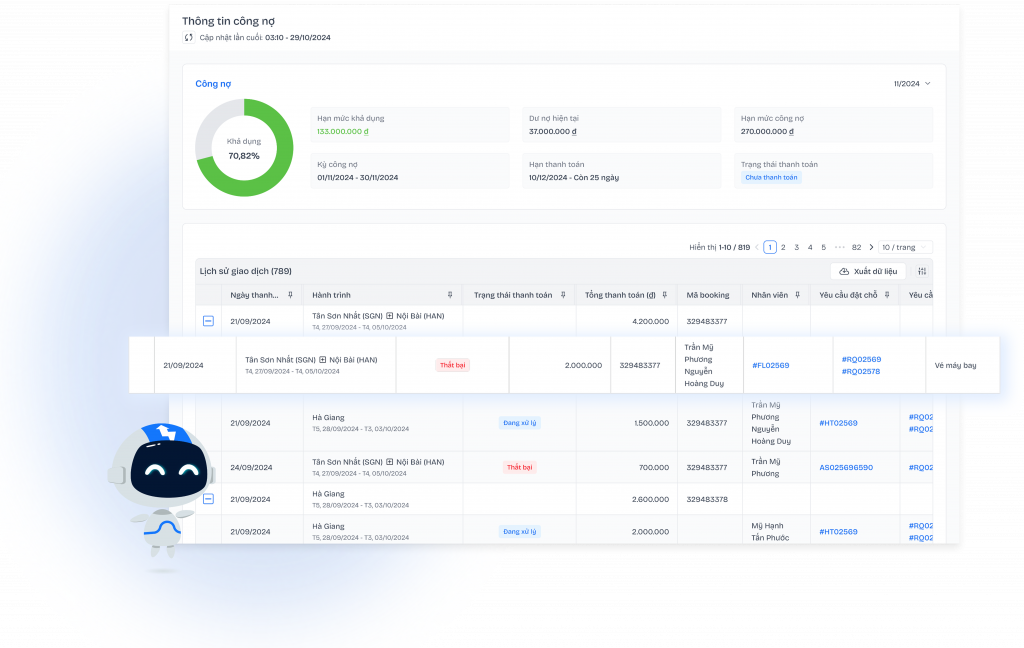
In short, Bizzi's solution helps source data layer automation, cung cấp “nguyên liệu sạch” và kịp thời cho CFO Dashboard, từ đó nâng cao vai trò của CFO từ người quản lý truyền thống thành một nhà lãnh đạo chiến lược dựa trên dữ liệu.

What are the frequently asked questions about CFO Dashboard?
Below is the FAQ section – Frequently Asked Questions about CFO Dashboard.
What KPIs does the CFO Dashboard include?
Commonly used index groups:
- Revenue, gross profit, net profit
- Operating Cashflow, cash conversion cycle (DSO – DPO – DIO)
- Actual vs Budget
- Cost per Invoice, Cost per Expense
- EBITDA, departmental expense ratio
- Forecast/Scenario Planning
Depending on the business model, KPIs will be designed according to management goals.
How does the CFO Dashboard get data from ERP?
Through:
- API integrates directly with ERP/Accounting
- Synchronize data in real time or periodically (hourly/daily)
- Bizzi Integration Layer helps standardize data before pushing it to Dashboard
Should I use Power BI or Excel to make a CFO Dashboard?
- Excel is suitable for small businesses, data changes little
- Power BI / BI Tools are suitable for businesses that need real-time & big data
- In fact, many businesses still use Excel in the early stages and gradually upgrade to BI.
How is CFO Dashboard different from Accounting Dashboard?
| Accounting Dashboard | CFO Dashboard |
| Recording the past | Future forecasting & analysis |
| Exactly as prescribed | Cost-effective & efficient |
| Finalized data | Real-time actuals & forecasting |
| Compliance | Business operations |
How to avoid dirty data causing Dashboard errors?
- Standardize master data (vendor, GL, cost center...)
- Automate invoice & claim processing to avoid manual entry
- Clear budget & workflow control
- Use Bizzi IPA (Invoice Processing Automation) to "clean up the data" before uploading it to the ERP system.
Does the dashboard help with cost control?
Yes. CFO Dashboard supports:
- Monitor Actual vs Budget real-time
- Over budget warning
- Identify areas of unusual expenses.
- Measuring budget efficiency by department
Do SMEs need a CFO Dashboard?
The smaller the more needed because:
- Quick decisions – limited resources
- Avoid cost leakage & increase cash flow efficiency
- No need to wait for slow reports from multiple departments
Can Bizzi be linked to ERP?
Have. Bizzi Integration Layer Supports standard connectivity with most ERP/Accounting/eInvoice/Banking systems; becoming “single source of truth” for Dashboard.
- SAP, Oracle, Microsoft Dynamics 365
- Bravo, FAST, Misa
- Electronic bills & banking
Conclude
A CFO dashboard is not just for viewing numbers, but for making quick, accurate, data-backed decisions. Bizzi aims for this goal.Single Source of Truth” – a single and reliable source of data for businesses.
Hopefully, through this analysis of the nature of the CFO dashboard, leaders will gain a more comprehensive perspective on financial performance and understand the importance of clean data in their businesses. To optimize costs and cash flow and make quick decisions, leaders need to base their decisions on accurate data, not on intuition.
CFO Dashboard is the foundation for continuous measurement and improvement. If you want to demo CFO Dashboard real-time on sample data, register here or chat directly to get advice from Bizzi's team of experts!