


In the digital age, financial data needs to be not only accurate but also... "There is evidence"For the CFO, the worry doesn't stop at accounting errors; it lies in the core question: Who edited the data? When was it edited? Is there any evidence to prove it? When tax inspectors or independent auditors get involved, the ability to retrieve the history of system operations becomes crucial for protecting the business.
That's when the concept What is an audit trail? It is no longer purely academic, but has become a mandatory foundation for internal control. This article by Bizzi will provide an in-depth analysis of the role of... audit trail in software In finance and accounting, this mechanism helps ensure data integrity, enhance legal compliance, and support CFOs in building a transparent operating system ready for any audit through automation.
What is an audit trail and what is its core role in financial data management?
In the digital age, the question "what is an audit trail?" is no longer a purely technical IT issue but has become a strategic focus for CFOs.
An audit trail is an electronic log that records the entire chronological sequence of activities affecting records, transactions, or events within a system. In other words, it's evidence that answers three questions: Who performed the action? What action was taken? When was it performed? And how did the data change?
Essentially, the audit trail is the "black box" of the financial system. When reporting discrepancies, internal fraud, or disputes with tax authorities occur, it serves as the last line of defense protecting data integrity.
Without an audit trail in the software, CFOs face three major risks:
- It is impossible to determine responsibility when the data is manipulated.
- The authenticity of the electronic document could not be proven.
- The financial statements have lost credibility in the eyes of independent auditors and the board of directors.
A standard audit trail must ensure immutability. This means that logs are automatically recorded by the system and are read-only. No individual, including the IT administrator, is allowed to modify or delete traces in the core database. This is a crucial factor in determining the level of audit readiness of a business.
The four mandatory components of an Audit Trail record according to the ALCOA+ standard.
To assess whether the audit trail in the software meets the standards, the CFO can compare it to the ALCOA+ principles for data integrity.
A standard record must include:
- User ID – Uniquely identify the person performing the operation.
- Action Type – Type of action (create, edit, delete, approve, etc.).
- Homestamp – The timestamp is accurate to the second.
- Original vs New Value – Values before and after the change.
From an auditing perspective, this is not just technical information but legal evidence. When an invoice's unit price is adjusted, the system must record both the old and new values. If it only records "edited" but doesn't save the details of the change, that audit trail is virtually worthless.
One often overlooked issue is "log fatigue"—systems recording too much non-essential data, making actual tracing difficult. CFOs need an intelligent log filtering mechanism that focuses on transactions affecting cash, assets, and tax obligations.
Regulations on audit traces according to the Accounting Law and Decree 123/2020/ND-CP
In Vietnam, the requirement for audit trails in software is not just a recommendation but is integral to the legal framework.
According to the 2015 Accounting Law, electronic documents must ensure integrity and accessibility when needed. At the same time, Decree 123/2020/ND-CP The requirement is that electronic invoices must be stored in their original format and include a history of transmission and receipt.
If a business cannot prove that its invoices have never been illegally altered, there is a high risk of having its legitimate expenses disallowed during tax settlement.
Furthermore, the storage of logs containing personal information is also related to Decree 13/2023/ND-CP. This requires a balance between financial transparency and personal data protection.
How does Audit Trail prevent fraud in the Procure-to-Pay process?
In the Procure-to-Pay (P2P) cycle, the audit trail in the software acts as a surveillance camera monitoring the entire transaction lifecycle: from purchase request, approval, delivery, to payment.
CFOs are often concerned about the following behaviors:
- Making fictitious payments to "familiar" suppliers.
- Increase the purchase price compared to the contract.
- An individual both creates a proposal and approves it themselves (violating the Segregation of Duties – SOD).
When every operation is logged, collusion becomes much more difficult. The system can detect unusual behavioral patterns such as approvals outside of business hours, value modifications right before payment, or numerous small, repeated transactions below control limits.
With Bizzi Bot, every invoice passing through the system is recorded throughout its entire lifecycle: the time the email was received, the time the data was extracted, the 3-way reconciliation result (Invoice – Purchase Order – GRN), and the final approver. CFOs can access this entire history in seconds, instead of searching through paper records.
Optimize storage costs and system performance when running Audit Trail.
A common misconception is that the more logs, the better. In reality, if not properly designed, audit trails in software can increase infrastructure costs and impact ERP performance.
The total cost of ownership (TCO) of an Audit Trail includes storage costs, maintenance costs, and the impact on system speed. The optimal strategy is to tier the data:
- Current operational data is stored on a high-performance system.
- "Cold" data, which serves legal obligations for 10 years, is stored on a low-cost cloud platform.
Some advanced systems adopt a "blockchain-lite" model, ensuring logs are undeletable while optimizing storage space. This approach helps businesses achieve immutability without inflating their IT budget.
Real-time budget control through approval logs on Bizzi Expense
In employee cost management, Audit Trail becomes a tool for real-time budget control. On Bizzi Expense, from the moment an employee receives an invoice, the system records the timestamp, equipment details, etc. When a manager approves or rejects the invoice, the reason and time are both saved. If budget adjustments are made, the entire change history is also displayed.
This helps the CFO:
- Significantly reduces post-inspection time.
- Quickly identify the reasons for budget overruns.
- Provide proof of the reasonableness of your expenses when the tax authorities request an explanation.
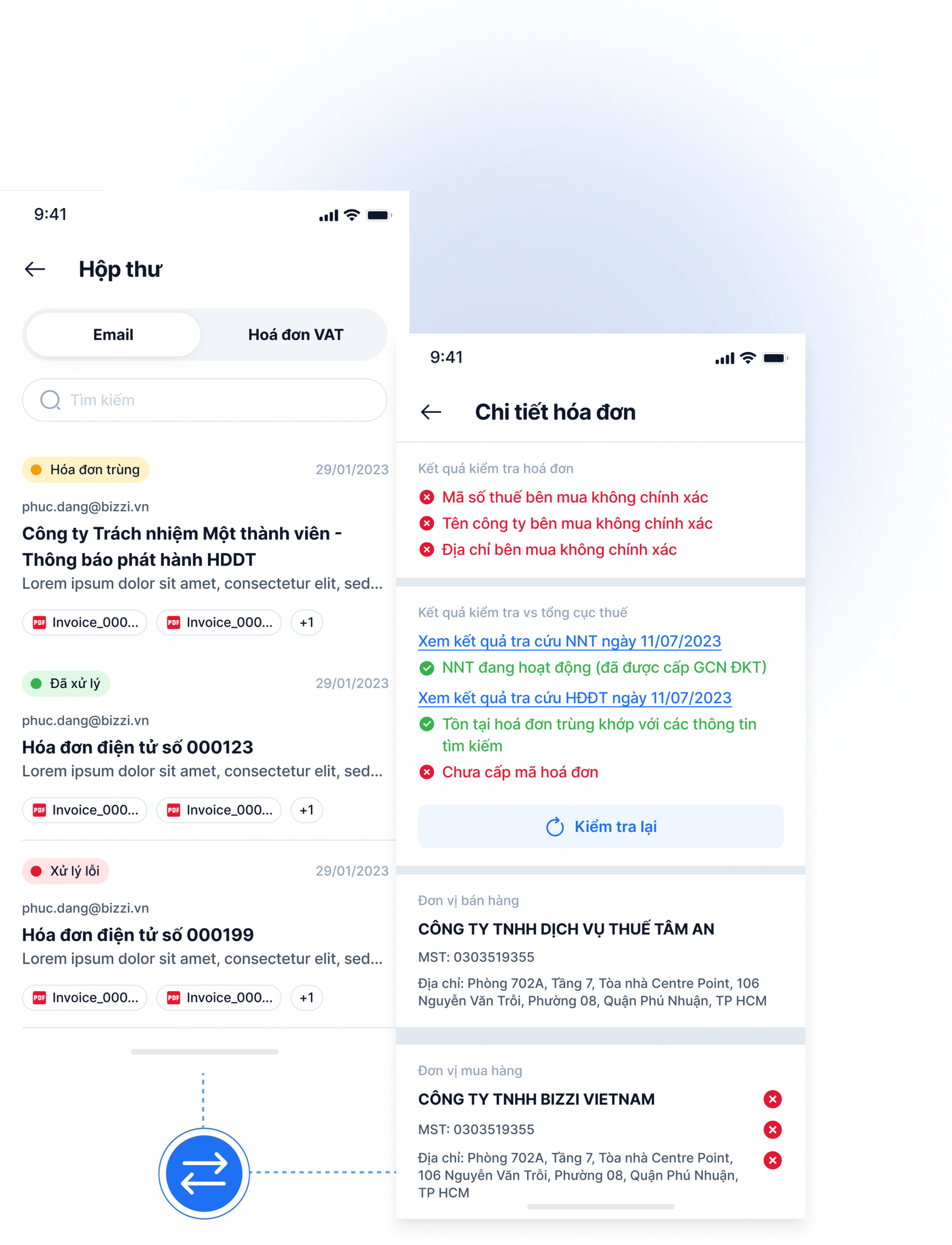
Audit Trail Reliability Comparison: When Do Robots Outperform Humans?
Manual audit trails using Excel or paper records always carry the risk of being altered or retroactively recorded. Excel does not automatically save old values when data changes, so it almost never meets audit requirements. Conversely, audit trail in automated software like Bizzi or ERP:
- Real-time recording.
- The log cannot be edited.
- Allows one-click searching.
- They have higher legal value in an electronic document environment.
This difference is not just a matter of convenience, but a matter of risk management.
Comparison Table: Manual vs. Automated Audit Trail
| Criteria | Manual Audit Trail (Excel/Paper) | Automated Audit Trail (Bizzi/ERP) |
| Invariance | Easily edited, deleted, or had lines inserted. | Immutable |
| Recording time | Slow, retroactive recording possible. | Real-time |
| Access costs | Very high (must search through records) | Low (1-click search) |
| Legal reliability | Low, easily rejected. | High (electronic document standard) |
| Fraud risk | Tall (easy to get along with) | Very low (System's rigid logic) |
Frequently Asked Questions about Audit Trail and Financial Risk Management (FAQ)
1. Can an IT administrator delete or edit an Audit Trail?
In principle, regarding internal control, if the system allows the IT Admin to delete logs, then that system is considered to be in violation of internal control regulations. Failed to meet audit trail standards in the software.A proper audit trail must ensure accuracy. Immutability – Once data is recorded, it cannot be edited or deleted without leaving a secondary trace.
In the standard model, even an IT Admin only has the following rights:
- Log retrieval
- User authorization
- System configuration
But No permissions to edit core logs in the financial database.If a business uses software that allows IT to "interfere with the backend," the CFO needs to reassess immediately because the legal risks are enormous when tax inspectors or independent auditors request tracing.
With standard SaaS platforms like Bizzi, access is separated according to certain principles. Segregation of Duties (SOD)Logs are stored at a separate system layer, ensuring their non-repudiation.
2. Will the audit trail slow down the ERP system or accounting software?
It's possible, if the design isn't architecturally sound.
Many legacy systems log directly to the same database that processes business transactions, leading to:
- Increase data capacity quickly
- Slow query
- Database lock when logging
The modern solution is to separate the logging layer and the business logic processing layer using microservices or message queue architecture. This allows logging to be done in parallel without affecting core performance.
This is why CFOs conduct research. audit trail in softwareYou need to ask the supplier for clarification on:
- Log storage methods
- Retrieval speed when logs are older than 5 years
- Backup and disaster recovery mechanisms
Without careful assessment, total cost of infrastructure (TCO) can increase significantly after 3–5 years of operation.
3. How long must a business retain the audit trail?
According to Vietnamese Accounting Law, accounting documents and related records must be retained for a minimum of 10 years. This includes:
- Electronic bill
- Approval history
- Traces of editing
- Data transmission and reception information
In practice, during tax audits, the tax authorities not only require PDF invoice files but also other documents. transaction processing historyIf a business cannot demonstrate the data lifecycle, the expense may be disallowed.
Therefore, when answering the question What is an audit trail?The CFO needs to understand that it's not just internal logs, but... vital legal evidence within the 10-year lifespan of the document.
4. Is Excel considered to have an Audit Trail?
No. Excel can enable Track Changes, but:
- It may be turned off.
- The original file can be edited.
- System-independent timestamps are not guaranteed.
- Immutability is not guaranteed.
Therefore, Excel does not meet the requirements of an audit trail in audit-standard software. In a fraud-prone environment, using Excel as a "journal" is almost ineffective.
If a business continues to manage expenses or accounts payable on Excel, the CFO is putting themselves in a very difficult position to defend in the event of disputes or audits.
5. How can fraud and system errors be distinguished through an Audit Trail?
Audit Trail allows CFOs to analyze behavior patterns.
Fraud typically has the following characteristics:
- Work outside of working hours
- Change the value multiple times before approval.
- A user performing multiple roles (violating SOD)
- Edit data close to the closing date.
Conversely, system errors typically include:
- There is a recurring technical error code.
- Affects many users simultaneously.
- Issues arise as a result of software updates.
Without a detailed audit trail, it is nearly impossible for a CFO to conduct a root cause analysis. This is why understanding what an audit trail is is not just a technical question, but a question of corporate risk management.
6. How does an Audit Trail help when there's a tax audit or Big4 audit team?
In practice, when inspection teams come to work, they usually request:
- List of input invoices
- Approval history
- Proof of comparison between Purchase Order – GRN – Invoice
- Edit the log if any changes are made.
If a business has to spend 3–5 days searching through paper records, the risk level is considered high. Conversely, with a system like Bizzi Archive, the CFO can retrieve the entire invoice lifecycle in minutes, including:
- Timestamp receives invoices
- 3D comparison results
- Who approves it, and when?
- Is there any editing required?
The ability to quickly and fully retrieve information is key to helping businesses reduce the risk of expense disallowance.
7. How much does it cost to implement an Audit Trail?
If you build a custom system from scratch, the cost is very high because you have to:
- Database log design
- Security
- Regular backups
- SOD authorization
- Long-term storage
However, with the SaaS model that integrates audit trail into the software, the cost is usually included in the licensing package, which is much lower than:
- Tax penalty 20%
- Corporate income tax arrears collection
- Internal fraud losses
- Loss of credibility with investors.
CFOs should view audit trail costs from the perspective of an “insurance premium”—a premium for financial transparency.
8. Can an audit trail replace traditional internal controls?
Not entirely. Audit trail is a recording tool, while internal control is a preventative mechanism. These two elements complement each other.
However, in a digitized environment, if a business relies solely on paper processes without automated audit trails, it will still have control gaps. Robots don't replace humans, but they eliminate the possibility of "forgetting to log" or "retroactive logging."
Therefore, in a financial digital transformation strategy, what is an audit trail must be considered within the bigger picture: Automation – Transparency – Compliance – Profit Protection.

Conclusion: Audit Trail – The foundation of financial transparency and trust.
Understand correctly What is an audit trail? This helps CFOs see that this is not just a secondary feature of the software, but a cornerstone of risk management. In a digitized and electronic invoicing environment, transparency is no longer based on personal trust but on evidence-based data.
A system without an audit trail in its standard software will always have a "blind spot" of responsibility. Conversely, when the audit trail is automated, immutable, and instantly traceable, businesses can:
- Reduce internal fraud.
- Increase the reliability of financial reporting.
- Be proactive in the face of tax inspections and audits.
- Optimizing long-term operating costs.
Bizzi doesn't just provide logging tools; it builds a financial management ecosystem with a traceable system from invoices and expense approvals to ERP synchronization. In the context of increasingly complex data risks, Audit Trail is the "armor" protecting a company's financial trust – and Bizzi is the platform that helps CFOs activate that armor automatically and sustainably.
Register here to receive one-on-one consultations and personalized solutions tailored specifically to your business: https://bizzi.vn/dang-ky-dung-thu/