


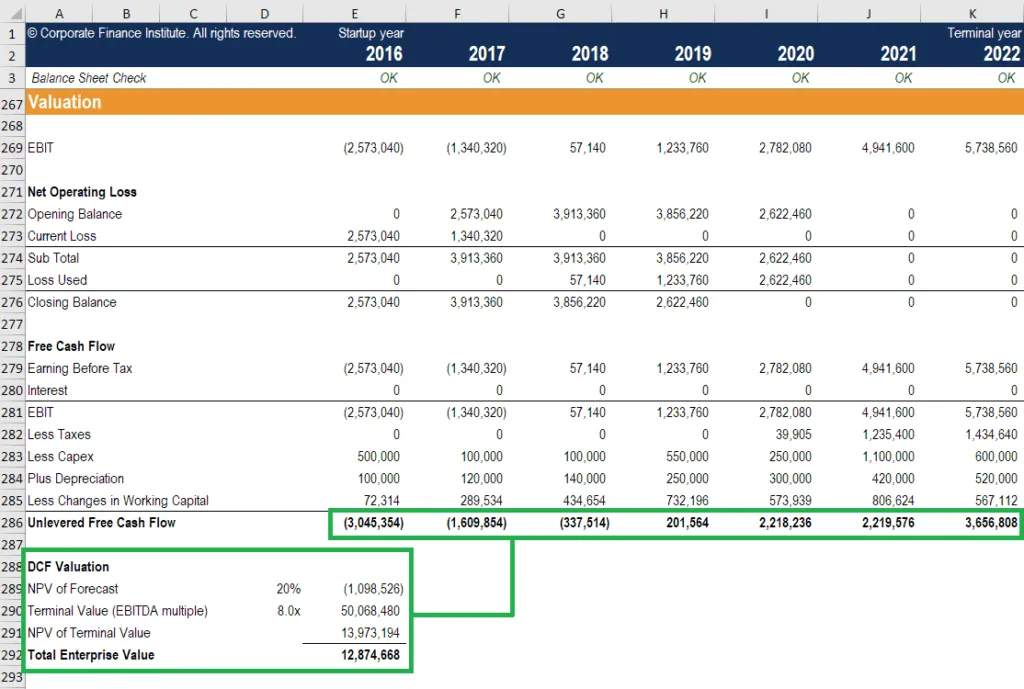
What is discounted cash flow? This is the conversion pricing method. projected future cash flows about present value by one discount rate It reflects the risks and costs of capital. In other words, What is discounted cash flow? If that's not the way to answer the question: How much is the asset/project worth in real cash that could be earned in the future, after deducting time and risk?
In reality, many investment decisions are fundamentally flawed not because the CFO miscalculated the formula, but because they used the wrong type of cash flow, made subjective assumptions, or because the cost-debt-cash flow data was not clean enough. In such cases, discounted cash flow method (DCF) is just a nice-looking but unreliable Excel file.
This article will help you understand What is discounted cash flow?, discounted cash flow to the presentThis includes how to build a DCF model according to CFO standards, and the mistakes that "kill" the credibility of DCF when incorporated into investment/M&A/digital transformation decisions.
1. What is discounted cash flow (DCF) and what is its financial nature?
What is discounted cash flow? Essentially, DCF is a valuation method based on converting projected future cash flows to their present value using a discount rate that reflects risk and the cost of capital. From a financial management perspective, DCF is not just a "PV formula," but a way to force organizations to answer difficult questions: where do the cash flows come from, when do they arrive, what is the probability of achieving them, and what is the "cost of capital" the business must pay to receive those cash flows?
Why do CFOs prioritize DCF over just looking at profit?
From a more in-depth perspective, net income is often distorted by non-cash transactions such as depreciation, provisions, or the recognition of fictitious revenue.
What makes DCF particularly suitable for CFOs is that it requires businesses to incorporate "operating realities" into their financial models. Accounting profits may be high, but cash flow may remain weak due to prolonged debt, inflated inventory, or increased CapEx that doesn't translate into cash generation capacity.
Therefore, when people ask What is discounted cash flow?The answer shouldn't stop at "discounted cash flow," but should emphasize the management significance: it's cash flow that can be verified by operational systems and data discipline, brought to the present to compare with the cost of capital, thereby determining whether the project creates economic value.
One crucial point often overlooked in articles is that DCF (Direct Cost of Delivery) is often flawed not by mathematics, but by an inconsistency between its "operational narrative" and its assumptions. A business that assumes strong growth but lacks production capacity, a sales pipeline, or the ability to collect payments on time will find its DCF becomes a storytelling tool rather than a decision-making tool.


2) The formula for discounting cash flows to the present and how to correctly understand "r" from a CFO's perspective.
The core of DCF lies in discounted cash flow to the present:
PV = FV / (1 + r)^n
In this formula, PV is the present value, FV is the future value (or cash flow in year t), r is the discount rate, and n is the number of periods. This formula reflects the “time value of money”: a dollar received today is worth more than a dollar received in the future due to the possibility of reinvestment, inflation, and risk.
However, the practical issue isn't whether the CFO remembers the formula, but rather how the CFO chooses "r" correctly. Here, r shouldn't be a "reasonable" number to model a beautiful valuation. r is a statement about the level of risk and opportunity cost of capital. When r is chosen subjectively, the business is inadvertently doing something dangerous: turning r into an adjustment knob to achieve the desired result, thereby losing the independence of the analysis.
At the decision-making level, CFOs should view r as a “risk filter” reflecting capital structure, cash flow stability, and operational control quality. A business with good data discipline, tight cost control, timely collection of payments, and efficient working capital management typically has a lower level of risk. This not only improves actual cash flow but also indirectly impacts the cost of capital (e.g., lower interest rates), making the DCF model “better” in a reasonable way, rather than due to manipulation.
3. What types of cash flows are used in the DCF model?
A common mistake is using after-tax profit for discounts. Meanwhile, professional CFOs understand that DCF is all about cash, and to apply it effectively. discounted cash flow method Yes, you have to choose the right type of cash flow that suits the subject being valued.
Unfinanced free cash flow (UFCF)
This is the actual amount of cash a business generates before paying interest on loans, and it is used to determine the overall value of the business (Enterprise Value).
Free Cash Flow to Firm (FCFF / Unlevered Free Cash Flow – UFCF)
UFCF is typically used to value the entire business (regardless of debt structure):
Common ways to write CFO logic:
UFCF = EBIT × (1 − Tax) + Depreciation & Amortization − CapEx − ΔWorking Capital
Note to the CFO: Don't be mistaken. EBITDA with cashEBITDA has not yet deducted CapEx and does not reflect changes in working capital (accounts payable, inventory).
2) Free Cash Flow to Equity (FCFE)
Use this when you are setting a price. equity (equity) and debt structure dependency models.
Why is DCF often inaccurate in Vietnamese businesses?
Many competitors simply assume that projected cash flow is "clean." In reality, projected cash flow is often "noisy" by:
- Hidden costs: These are small expenses, but they add up to a large sum.
- Outstanding debts: Revenue is recorded, but the money doesn't go into the pockets.
- Expense fraud: Fake invoices inflate output costs without justification.
The key point here: EBITDA is just "profitability before expenses," not cash. A business might report good EBITDA but still be "short on cash" if its CapEx is large or its working capital is heavily drained by accounts receivable and inventory. This is why many DCFs look great but the projects still lack cash to proceed.
If the objective is to value equity, especially when debt structure is a key variable, the CFO will consider it. FCFEIn that case, the corresponding discount rate is usually the cost of equity. In other words, the problem is not just about... What is discounted cash flow?Instead, it's about "which cash flow is discounted," and "which discount rate" to use, to avoid misinterpreting the frame of reference.
4. How does the time value of money affect DCF?
The discount rate (r) is the "filter" that brings future money to the present. This rate is influenced by three factors: Inflation, Risk, and Opportunity Cost.
- Inflationary: It reduces purchasing power. For example, in Vietnam in 2025-2026, the target inflation rate typically fluctuates between 4-4.5%, directly impacting the value of the currency.
- Risk: The riskier a project is (such as investing in new technology or a new market), the higher the discount rate should be.
- Opportunity cost: If the company invests in this project, it loses the opportunity to deposit savings or invest in other projects.
5. Discount Rate and WACC
In business, the most common discount rate is WACC (Weighted Average Cost of Capital)It represents the cost that a business pays to creditors and shareholders for using their capital.
WACC formula:
WACC = (E/V) × Re + (D/V) × Rd × (1 − T)
In there:
- E/V: Equity ratio
- D/V: debt ratio
- Re: Cost of Equity
- Rd: interest rate on debt
- T: tax rate (tax shield of interest expense)
A key point for CFOs to note is that WACC is the most "sensitive" variable in DCF, and often where the model is "smoothed." Just a few percentage point changes in WACC can significantly alter PV and, especially, Terminal Value. Therefore, a so-called "CFO-standard" DCF model typically goes beyond simply calculating WACC; it also explains why that WACC is reasonable in the context of industry risk, firm risk, and cash flow stability.
At the operational level, there's an often-underestimated link: the quality of cost control, debt management, and data transparency can affect how banks/investors perceive risk, thereby impacting Rd and Re. That is, "data cleaning" not only serves reporting purposes but also indirectly impacts the cost of capital, and ultimately the valuation outcome. discounted cash flow method.
6. The step-by-step DCF calculation process: Where technology "rescues" data.
A standard DCF model doesn't start with Excel, but with how a business defines its drivers. Cash flow projections can't simply be "revenue increases X% annually," but must answer questions about the source of revenue growth, the reasons for profit margin changes, which capacity expansions CapEx will support, and how working capital will fluctuate according to payment terms.
Technically, DCF typically consists of two phases: a forecast period (1–5 years or 5–10 years depending on the industry) and a terminal value. During the forecast period, you calculate the cash flow (UFCF/FCFF or FCFE) annually and apply it. discounted cash flow to the present to convert it to PV. Then you add the PV of the Terminal Value to get the total value.
In the Terminal Value section, many models look good but are weak because TV accounts for too large a proportion of the total EV. When Terminal Value is dominant, valuation almost becomes a "long-term assumption" rather than a reflection of current operations. In reality, the CFO should ask the opposite question: if simply changing g or multiple causes a significant increase in EV, the model is lacking "anchoring" from operational data.
To implement a standard DCF model, the CFO goes through the following steps:
- Cash flow projections (1-5 years): Projected cash inflows and outflows are based on the business plan.
- Calculate the Ending Value: The company's value after the forecasting period.
- Discount to present value: Apply WACC to each year.
Step 1: Determine the forecast period.
The usual practice is to use Terminal Value every 5–10 years, depending on the industry (stable or volatile).
Step 2: Project Cash Flows (UFCF/FCFF)
Projections should not only include revenue and expenses, but also:
- CapEx
- Working Capital (AR, AP, inventory)
- Tax
Step 3: Discount to present value
Annual PV = CF_t / (1 + WACC)^t
Step 4: Terminal Value (TV)
Two common methods:
- Gordon Assessment: TV = CF_(t+1) / (WACC − g)
- Multiple ExitTV = EBITDA × Multiple (be careful as it's easy to "make up multiple")
Step 5: Summarize the Enterprise Value
EV = ΣPV(CF_t) + PV(TV)
7. How does DCF differ from NPV and IRR? When should a CFO prioritize DCF?
A helpful way to understand it: DCF is the present value framework; NPV and IRR are indicators used for decision-making. NPV indicates how much absolute value the project generates after deducting the initial investment. IRR indicates the internal rate of return, but IRR can be misleading when a project has multiple cash flows or when comparing it to projects of different scales.
In the context of CFO decision-making, NPV is often the "backbone" because it directly answers how much value the project adds to the business. IRR should be used as a supplementary indicator, and even more so when the project has a complex cash flow profile or a different scale of investment.
CFOs are typically ranked before these three key metrics. Understand the relationships between them:
- DCF: It serves as the basis for calculating intrinsic value.
- NPV (Net Present Value): The result of DCF minus the initial investment.
- IRR (Internal Rate of Return): Indicate how much profit the project generates per year (%). The IRR can be misleading if cash flows are uneven or project sizes vary significantly.
How to use the CFO correctly?
- NPVThis is a priority when you need to decide "to do or not to do" and compare the absolute added value.
- IRRUse as a supplementary indicator, with particular caution when:
- Cash flow changes sign multiple times.
- The project has different scales (high IRR but low NPV).
8. Why are DCFs often inaccurate in Vietnamese businesses: errors in data and control discipline?
In many businesses, the problem isn't a lack of knowledge. What is discounted cash flow?However, the input data is not "clean" enough to make DCF a reliable tool. Projected cash flows are often distorted by hidden costs, long-term liabilities, and data lags, causing CFOs to inadvertently discount the "past" instead of the future.
Below are three typical mistakes and how to fix them, according to CFO thinking.
Invoice fraud and "fictitious expenses" lead to FCF being siphoned off.
In the case of invoice fraud or "fictitious expenses," the model is skewed in two ways: free cash flow is reduced because cash-out is real but the value received is disproportionate, and EBIT/EBITDA and taxes are distorted, causing the underlying FCF to be flawed.
It's worth noting that these indicators sometimes lie not in the formula but in "data behavior": vaguely described services that are difficult to verify, high frequency of invoice adjustments, or unusual changes in information by the provider.
Signs that CFOs should be aware of (add to the control checklist before running DCF):
- Opex increased but could not be linked to the operational drivers (headcount, output, leads, customers).
- Proportion Adjustment invoice/delete high, or NCC changes information unusually.
- The service description is too general ("other services", "total fees"), making it difficult to verify.
Bizzi Solution:
- Bizzi Bot Supports verification and standardization of invoice input: automatically reads and compares information, identifies risk signals according to control rules/logic (supplier information, validity, anomalies in value/frequency), helping businesses reduce the probability of "fictitious expenses" appearing in the books.
- Verify the supplier. (MST/status) and flag risky suppliers so that the CFO has visibility before the data goes into the valuation model.


Manual data entry and data delays cause CFOs to discount "the past".
Another systemic flaw is data lag. DCF is a forecasting model, but forecasts are only effective when anchored to sufficiently recent actual data. When businesses close their books late, data entry is sporadic, or they rely too heavily on manual Excel spreadsheets, CFOs can easily base today's valuation on last month's data. The consequence is a driver-biased forecast, out-of-date working capital, and sensitivity analysis becoming a false sense of control.
Bizzi Solution:
- Automate the invoice and expense processing flow. This helps to update input data (costs, payment obligations, document status) faster, reducing reliance on manual data entry.
- CFOs/FP&A professionals can use standardized data to refresh key DCF drivers such as: Opex run-rate, CapEx actual expenditure, and working capital trends over the period.
Lack of reconciliation results in revenue appearing good on paper, but the money is tied up in accounts receivable.
Finally, there's the issue of cash conversion. You might project good revenue growth, but cash flow remains poor if accounts receivable grow faster than revenue, overdue debts arise, or DSO (Demand and Sale) drags on due to document disputes. In that case, EBITDA looks good, but the money is tied up in debt, ΔWorking Capital is constantly draining cash, and Terminal Value is inflated due to unrealistic cash conversion assumptions.
A DCF model can project good revenue growth, but FCF is still bad. If:
- Accounts receivable are increasing faster than revenue.
- overdue debts arise.
- or DSO delays due to invoice/document disputes.
This is a very common mistake: Valuation based on P&L rather than cash reality.The CFO will see:
- Good EBITDA but poor cash conversion.
- ΔNWC is consistently negative (money is being drawn into working capital).
- Terminal Value is inflated due to the unrealistic assumption of "cash conversion."
- 3-way matching (Invoice – Purchase Order – Retail Price) This helps ensure that all expenditures have clear transactional documentation: what was purchased, what was received, and what the invoice was for. This provides FCF protection in two layers:
- Block fraudulent/incorrect payments (unreasonable cash-out reduction)
- Reduce the frequency due to discrepancies in documents (indirectly improving processing speed and data reliability)
- Bizzi ARM (Accounts Receivable Management) helps CFOs track aging debts, send debt reminders, and prioritize collection based on risk level, thereby improving performance. cash conversion and reduce volatility of ΔNWC.
"Real-time FP&A" in the context of DCF: Understanding it correctly for proper use.
Points to clarify: DCF is still a periodic (monthly/quarterly/yearly) model. "Real-time" here doesn't mean the CFO has to run DCF every day, but rather:
- Input data (expenses, invoices, accounts payable) is updated quickly.
- FP&A can refresh run-rate and transmission timely,
- Therefore, the DCF model reflects the "current reality" rather than a 1–3 month lag.
Bizzi (positioned correctly):
- Bizzi plays a role operational financial data control layer (invoice/expense/AP-AR hygiene), helps FP&A obtain sufficiently clean data to:
- Reduce forecast error,
- Run scenarios faster.
- This makes DCF a reliable decision-making tool in decisions such as investment, M&A, changes in payment terms, and optimizing working capital.
9. Conclusion: What does a CFO need to make DCF a truly effective tool?
What is discounted cash flow? It will no longer be an academic question if businesses view DCF as a mirror reflecting operational quality: cost management, accounts receivable, working capital, and data discipline. When the data foundation is clean enough and the assumptions are sufficiently disciplined, What is discounted cash flow? At this point, it becomes a powerful tool: helping CFOs to assess, compare scenarios, and make investment decisions with clearly "quantified" risk levels.
To achieve that, businesses need to:
- Digitize all input: Convert paper invoices into digital data (Bizzi Bot).
- Real-time cost control: Eliminate waste charges (Bizzi Expense).
- Smart debt management: Optimizing working capital (Bizzi ARM).
Once the data foundation is solid, discounted cash flow will no longer be a dry mathematical formula, but rather... "A mirror reflecting a prosperous future" of the business.
Are you ready to standardize your financial data to build the most accurate DCF valuation model? Let Bizzi accompany CFOs on this data digitization journey.
To receive personalized solutions tailored specifically to your business, register here: https://bizzi.vn/dang-ky-dung-thu/