



In a rapidly changing market, escalating costs and increasingly looming financial risks, many CFOs are beginning to ask: “Is simply cutting costs or optimizing current processes enough to keep the business safe and growing?”
The answer is Are not. The world's leading businesses are moving to a new model called Finance Transformation — a journey that helps the Finance department move from a “recording – controlling” role to a “forecasting – leading strategy” role.
In Vietnam, this trend is strongly driven by financial automation platforms such as Bizzi and systems EPM new generation like Sactona (Japan) – solutions exclusively distributed by Bizzi. These tools enable faster planning, more accurate forecasting, and real-time data-driven decision making.
Join Bizzi to learn what Finance Transformation is in the article below!
I. Why are CFOs talking about Finance Transformation?
In just the last few years, the role of the CFO has changed faster than it did even a decade ago. Whereas in the past, the CFO focused primarily on cost control and ensure compliance, they now face a new set of pressures:
1. Pressure to make decisions faster and more accurately
Businesses need to react daily, even hourly. Strategic questions like:
- “How much does increased inventory affect cash flow?”
- “If interest rates increase by 1%, how will EBITDA change?”
- “How does price adjustment affect channel profit margins?”
…can't wait until the end of the month to reply.
Finance Transformation become the foundation for CFOs to have correct - sufficient - timely data for these decisions.
2. The explosion of data and the complexity of financial processes
The business is operating with:
- many branches
- multiple sales channels
- multiple systems (ERP, accounting, CRM, POS, banking…)
- many types of transactions every day
Without automated systems and a unified data architecture, reporting and forecasting lags will continue to grow.
Finance Transformation helps to completely solve the “data bottleneck” problem.
3. CFOs don't just protect profits – they create growth
Businesses expect the Finance department to:
- help optimize costs while still expanding the market
- predict risks before they occur
- provide insights for CEOs to make strategic decisions
- support M&A, IPO, international expansion
This requires CFOs to transform from “numbers keeper” to “value architect.”
4. Technology is completely changing the role of finance
Invoice automation, debt reconciliation robots, AI forecasting, real-time smart reporting… make the old operating model (Excel + manual reporting) no longer suitable.
Bizzi and Sactona are two of the clearest examples of technology helping the Vietnamese Finance department:
- 70–90% manual operation reduction
- reduce errors
- increase response speed
- Bring strategic data to your dashboard in real time
5. The question every CFO must face
So Finance Transformation becomes the center of every CFO meeting:
- “How to reduce closing from 10 days to 3 days?”
- “How can FP&A forecast accurately without spending weeks collecting data?”
- “How to transform the Finance department into a truly value-creating department?”
Finance Transformation is the answer.

II. What is Finance Transformation?
After understanding why Finance Transformation has become a strategic priority for CFOs, the next question is: What is Finance Transformation?
Is this just a technology project, an optimization process, or a comprehensive change in people - data - systems?
In fact, Finance Transformation is a journey to change the operating model of the Finance department, aiming to achieve three major goals:
- Automate manual tasks
- Standardize data and increase transparency
- Provide strategic insights to support CEO decision making
Finance Transformation is more than just installing new software. It is a long-term strategy, including technology, people, processes and new operational thinking.
1. What is the definition of Finance Transformation?
Finance Transformation is a comprehensive restructuring of how the Finance department operates – from reporting, planning, forecasting to performance analysis and measurement – with the support of modern technology, data and governance models.
Finance Transformation helps the Finance department transform from:
| Traditional finance | Transformed Finance |
| Recording & Reporting | Simulation, forecasting & strategic direction |
| Manual Excel | Real-time automation & dashboards |
| Discrete process | End-to-end integration process |
| Waiting for end of month data | Real-time data |
| Control | Strategic leadership |
2. The three core pillars of Finance Transformation
Process Transformation – Financial Process Reengineering
Processes such as:
- Record-to-Report
- Procure-to-Pay
- Order-to-Cash
- Planning – forecasting – budgeting (FP&A cycle)
… is restructured to:
- Eliminate manual operations
- Standardize the process
- Speed up closing
- Ensuring transparency and internal control
Technology Transformation – Technology as the foundation
Include:
- RPA: automate repetitive tasks
- AI/ML: forecast revenue, cash flow, costs
- Cloud ERP: standardize core data
- EPM (Enterprise Performance Management): planning – forecasting – performance reporting
Vietnamese businesses are moving from “Excel + discrete systems” to “unified data architecture”, with the support of platforms such as:
- Bizzi Automation Platform → P2P, R2R automation
- Sactona EPM → FP&A, planning, budgeting, rolling forecast
People & Culture Transformation – New thinking & skills
Finance Transformation requires drastic change:
- Accountant: from data input → control & analysis
- FP&A: from data synthesis → modeling & forecasting
- Finance: from recognition → strategic partnership
Target: Finance becomes a “business enabler”, not a cost center.
III. Benefits of Finance Transformation
Finance Transformation delivers value in both directions:
- Operational efficiency
- Strategic capability
Here is an in-depth analysis for each interest group:
1. Planning & Forecasting Excellence
Finance Transformation helps businesses move from static planning luxurious dynamic planning with real-time data.
1.1 More accurate forecasts
Thanks to the combination of:
- Centralized data (ERP/EPM)
- Advanced forecasting models (rolling forecast, driver-based planning)
- Scenario planning
→ Forecast accuracy increases significantly, especially in volatile factors such as raw material costs, interest rates, and market demand.
Real life example: FP&A can propose 3 revenue scenarios (base, best, worst) and update continuously based on weekly sales data, instead of waiting for the end of the quarter.
1.2 Make decisions faster
Finance Transformation eliminates slow reporting cycles because:
- No more manual Excel summarization
- Reports are automatically updated when input data changes.
- CFO has a real-time financial dashboard to monitor indicators: cash flow, working capital, profitability
Result: CFOs don't have to wait until the "monthly closing date" to know the situation. Decisions are made. during the day, Not in the month.
1.3 Increase Agility
Forecast models can be rerun in minutes when there is a change:
- Changing markets
- Exchange rate changes
- Change in cost of goods assumption
- Ad hoc budget adjustments
→ Organizations become more agile, pivot faster, and reduce the risk of making decisions based on emotions.
2. Working Capital Optimization
Working capital is the “blood” of a business. Finance Transformation helps optimize in three ways: process – data – control
2.1 Real-time debt control
When the system is connected:
- Customer Accounts Receivable (AR) is always updated instantly
- Accounts Payable (AP) closely monitors payment due dates
- Cash flow forecast by week/month
Benefit: Early detection of problem debts, prioritizing collection, limiting bad debts.
2.2 Reduce DSO/DPO
Ask for a favor:
- Automate payment reconciliation
- Smart debt reminder process
- Debt aging & payment risk analysis
Businesses often record:
- DSO decreased by 10–25% after standardizing the process
- DPO optimized according to payment strategy – avoid paying too early or late and causing penalties
2.3 Effective cash flow balancing
The finance department can:
- 13-week rolling cashflow forecast
- Optimize inventory (high inventory → capital tied up)
- Adjusting credit policy
- Tight control of CAPEX against budget
When cash flow becomes transparent and forecasted accurately → businesses reduce the need for short-term loans and optimize capital costs.
3. Shareholder Value Enhancement
When finances operate better, the impact on the overall performance of the business is clear.
3.1 Improved profit margin
Businesses improve profit margins thanks to:
- Optimize operating costs
- Detect abnormal costs (non-standard costs, duplicate costs)
- Reducing waste in P2P
- Optimize cost of goods sold and logistics costs based on data
3.2 More transparent data for investors
Finance Transformation creates:
- Standardized data set
- Transparent reporting
- Ability to drill down to individual data lines
This helps:
- IPO is more favorable
- Raising capital is easier
- Increase shareholder & BOD confidence
3.3 Improved ROI through operational optimization
Businesses reduce costs in many aspects:
- Reduced labor costs due to automation
- Reduced audit costs due to clean data
- Reduced operating costs due to elimination of discrete systems
- Reduce error cost (error cost, compliance cost)
Finance Transformation ROI is often recorded in 12–18 months, especially when deployed in combination:
- Automation (P2P, R2R, Expense)
- EPM (planning, forecasting, analysis)
4. Increase compliance & reduce risk (Governance, Risk & Compliance)
Not just a cost saver — Finance Transformation is also a “firewall” that protects your business.
4.1 Reduce fraud and loss
Ask for a favor:
- 3-way automatic reconciliation
- Check invoices according to standards
- Multi-level approval mechanism
- Role-based access control
→ Risk of invoice fraud, incorrect payments, or duplicate payments is reduced to 70–90%.
4.2 Standardize data according to Vietnamese regulations
Include:
- Standardize electronic invoice data
- Standardize financial reporting formats according to regulations
- Comply with 10-year retention requirements
- Standardize reconciliation process according to auditing standards
When financial data is standardized → internal and independent audits work faster, with fewer errors detected.
4.3 Strong support for internal audit and independent audit
Finance Transformation offers:
- Complete, continuous, traceable data
- Clear audit trail
- Risk monitoring dashboard
- Standardized reporting form according to IFRS/VAS
Reduce audit preparation time by 40–60% — a key benefit for large or multi-subsidiary enterprises.

IV. Finance Transformation Roadmap (Roadmap for CFOs)
Finance Transformation cannot be implemented in a “jump-into-technology” manner. To be successful, CFOs need a controlled, sequential roadmap—from understanding the current state to measuring ROI. Here’s how: 5 important stages that most CFOs/FP&As in Vietnam apply when building a financial transformation strategy.
1. Current State Assessment
Target: Identify where the business stands — systems, processes, data, people.
A sustainable Finance Transformation program always starts with “internal strength review”, including 4 layers:
1.1 Check the level of automation
- How many accounting and financial processes are still done manually?
- Are P2P, O2C, R2R dependent on data entry staff?
- What percentage of work can be RPA'd immediately?
1.2 Assess data fragmentation
- Is ERP unified or does each department use its own tool?
- How many data sources are used in financial statements?
- Does COA, master data standardization exist?
1.3 Measuring Excel Dependency
Common CFO questions:
- “If the Excel file crashes tomorrow, can the FP&A department run the forecast?”
- “How many Excel files are 'single point of failure'?”
1.4 Identify bottlenecks in closing and reporting
- Closing takes 7 days, 10 days, or 20 days?
- How many hours does a bank reconciliation take?
- Is the management report "file-generating", with a different version for each department?
Why is it important? Failure to properly assess the current situation → technology deployment only “automates chaos”.
2. Building a new financial vision (Future-State Vision)
After understanding the “starting point,” the CFO needs to determine the “destination.”
This is the strategic phase, which involves the future operating model of the Finance department.
2.1 The strategic role of the CFO
In the digital age, the CFO is not just a “bookkeeper”, but:
- Growth model designer
- The creator of competitive advantage with data
- Strategic partner of CEO and Board of Directors
2.2 Goals of Finance Transformation
The new vision must be linked to three core elements:
- Speed: Fast reporting, fast forecasting, fast response.
- Transparent: A single source of truth.
- Agility: Enterprises promptly pivot according to the market, simulating many scenarios.
3. Priority Quick Wins (3–6 months)
Here is the secret to create momentum and early proof of effectiveness help CFOs easily convince the board of directors.
3.1 Expense Automation
- Standardize expense approval
- Control spending according to real-time budget
- Reduce 70–80% of consolidation & settlement time
3.2 Invoice reconciliation – PO – GR (3-Way Matching)
One of the biggest Quick Win points in Vietnamese enterprises:
- Eliminate duplicate invoice errors
- Prevent expense fraud
- Automating the most labor-intensive step in P2P
3.3 Reduce closing time
Thanks to R2R automation:
- Automatic reconciliation
- Pull data directly from the system
- Report results by day/week
4. Investing in EPM/FP&A (Strategic Phase)
Once the business has a foundation of automation and clean data, the CFO can upgrade to a higher value level: analysis – planning – forecasting.
4.1 Connecting planning – forecasting – reality
EPM helps create a single system to manage:
- Budget
- Forecast
- Actual
- Variance analysis
All follow driver-based and rolling forecast model.
4.2 Budgeting Automation
No more sending dozens of Excel files back and forth → but:
- Centralized budget process
- Standardize COA and drivers
- Approve budget by workflow
- Automatically updated when assumptions change
4.3 Rolling forecast in real time
The biggest weakness of Vietnamese enterprises: "There are forecasts but no one can update them."
EPM solves this by:
- Automatically pull actual data
- Allows FP&A to update drivers in minutes
- Run forecasts quarterly, monthly, even weekly
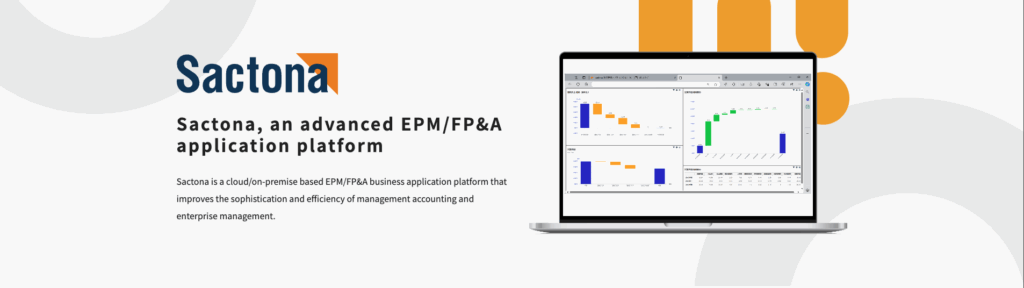
4.4 Why is Sactona EPM suitable?
Sactona – Japanese EPM solution exclusively distributed by Bizzi – is suitable for Vietnamese enterprises thanks to:
- Familiar Excel interface
- IT independent (Finance can operate itself)
- Fast deployment 2–3 months
- Lower cost 40–60% compared to traditional EPM
→ This is the stage where businesses begin to transition from "manual finance" to Modern FP&A.
5. Measure ROI (Measure & Improve)
Finance Transformation must be accompanied by specific metrics.
5.1 The most important KPIs
| KPI Group | Measurement index | Meaning |
| Closing Speed | Closing time | Measure R2R efficiency |
| Reporting Speed | Report preparation time | Measure analytical ability |
| Cost Savings | Financial costs reduced by % | Measuring operational efficiency |
| Data Quality | Data errors reduced by % | Measure the level of standardization |
| Decision Cycle | Decision making speed | Measuring organizational agility |
5.2 Why is it important?
Without KPIs → CFOs cannot demonstrate the value of Finance Transformation.
With KPIs → CFOs can:
- Investment Persuasion Phase 2–3
- Demonstrate clear ROI
- Optimizing resources for the Finance department
- Transparency with the Board of Directors and investors
V. Common challenges and how to avoid them in Finance Transformation
Finance Transformation brings clear benefits, but the journey is not simple. Especially in Vietnam, many businesses face barriers related to data, people and technology models. Understanding these challenges will help CFOs develop a suitable roadmap, avoid wasting resources and optimize transformation efficiency.
1. Distributed, asynchronous data
This is the most common problem. Financial and accounting data is in ERP, purchasing data is in another system, sales data is in CRM, and planning data is in dozens of Excel files.
Consequences:
- Slow, inconsistent analysis
- Reports must be manually reconciled
- FP&A cannot run accurate forecasts
Proposed solution:
- Deployment Cloud ERP as a centralized data platform
- Standardization master data (COA, vendor list, customer list, product list…)
- Building data according to the “single source of truth” model
2. Focusing too much on technology and forgetting the operational factor
Many businesses think that Finance Transformation = buying new software. This is the biggest mistake that leads to failure.
Golden ratio in FT: ➡️ 40% process – 40% people – 20% technology
If the process is not streamlined or the staff is not retrained, any solution becomes “automation chaos”.
Proposed solution:
- Optimize processes before automation
- Target Operating Model Design
- Training staff on analytics and data-driven mindset
3. High cost and implementation time
Traditional ERP/EPM solutions typically:
- 12–18 month deployment
- High cost
- Highly dependent on IT team
This is a big barrier for Vietnamese businesses.
Proposed solution:
- Platform priority light – flexible – low code – fast deployment
- For example, automation and EPM toolkit deployed by Bizzi & Sactona in Vietnam (2–3 months duration)
- Apply the “start small – scale fast” strategy
4. Dependence on IT, lack of initiative from Finance department
Common mindset barrier: “Anything related to the system is IT's job.”
Consequences:
- Finance has no control over the process
- Any changes must wait for IT to fix.
- Forecast and reporting speed is slow
Proposed solution:
- Choose a solution to Self-operating Finance
- User-friendly interface (e.g. Excel-based like Sactona EPM)
- Minimize programming needs
VI. Bizzi: Platform to promote Finance Transformation in Vietnam
For Finance Transformation to be successful, businesses need a technology ecosystem that is strong enough to automate operations, standardize data, and create a foundation for in-depth analysis. Bizzi is providing two important pieces of the puzzle for Vietnamese businesses: Bizzi Automation Platform (operation optimization) and Sactona EPM (FP&A support & financial planning).
1. Bizzi Automation Platform – Automate financial operations
Bizzi focuses on eliminating repetitive tasks in P2P, R2R and expense management – the biggest bottlenecks in Finance.
Bizzi Bot (IPA + 3-way matching)
- Automatically check invoice validity
- Compare with PO & GR according to 3-way matching standard
- Reduce the risk of errors and fraud in purchasing and payment
- Save hours of manual processing and reconciliation
Bizzi Expense
- Real-time budget cost management
- Standardize the spending approval process
- Control overspending, reduce unusual costs
- Support businesses in establishing transparent spending policies
Bizzi ARM (Account Receivable Management)
- Track customer debt
- Automatic debt reminders according to risk level
- Reduce DSO, speed up collection
- Improving Operating Cash Flow
B-invoice
- Issuing, storing and reconciling electronic invoices
- Fully comply with state regulations
- Direct connection to accounting processes
Bizzi Automation Platform helps businesses streamline financial operations, creating a clean data foundation - an important premise before moving on to analysis and planning.
2. Sactona EPM – The analytical and planning brain for CFOs
Sactona is a Japanese EPM solution, exclusively distributed by Bizzi in Vietnam. This is a unified FP&A platform for businesses that want to move to a higher level of financial maturity.
Core strengths
- Integrate the entire FP&A cycle: budget – forecast – report – analysis
- Familiar Excel interface: easy to use, easy to deploy
- No programming required: Finance self-configures, reducing IT dependency
- Fast deployment (2–3 months): suitable for Vietnamese business context
- More cost-effective than 40–60%
International case study
Corporations such as Panasonic, Monex Group, Fujifilm… apply Sactona to:
- Shorten forecast time 5.5 days
- Improve forecast accuracy
- Increased agility in scenario analysis
- Standardize management reporting systems throughout the organization
VII. New vision of CFO in the era of Finance Transformation
The modern CFO has shifted his role from “financial overseer” to “strategic leader.” In many progressive organizations, the CFO is seen as:
- Chief Future Officer – the person who forecasts and shapes the financial future
- Chief Value Officer – business value optimizer
- Chief Decision Partner – strategic companion to the CEO
Three core competencies CFOs need to develop
1. Real-time Insight – The ability to understand data instantly
CFOs no longer wait for month-end reports. Data must always be “analysis-ready.”
2. Lean Financial Operations
Processes must be automated as much as possible to reduce costs and increase speed.
3. Strategic Scenario Planning – Strategic Modeling
CFOs must be able to run multiple scenarios: exchange rate changes, interest rate fluctuations, cost of goods sold changes… and make decisions on the fly.
The Foundational Pair That Drives CFO Performance
- Bizzi: automate and standardize operational data
- Sactona: analysis – planning – forecasting
This combination creates “financial intelligence” – smart financial model for Vietnamese businesses.
VIII. Conclusion
The article has provided full information about what Finance Transformation is. It can be understood that Finance Transformation is not a short-term technology project and should not be seen as a "new trend". This is a long-term journey, where businesses continuously upgrade financial capacity, standardize data and optimize processes to adapt to the changing speed of the market. When the finance department operates effectively, information is reflected accurately and promptly, businesses will have a stronger competitive advantage, especially in the context of an increasingly complex digital economy.
To start this journey, CFOs do not need large projects or excessive investments. The key is to start with small but impactful steps: standardizing data, streamlining processes, eliminating manual tasks, and implementing appropriate automation solutions. Once the foundation is solid, businesses can upgrade to FP&A/EPM tools to create a systematic strategic planning, forecasting, and analysis system.
Bizzi and Sactona bring a practical approach to Vietnamese businesses: faster, less IT-dependent and more cost-effective than traditional EPM models. By combining operational automation (Bizzi) and a financial planning, forecasting and analysis platform (Sactona), businesses can build a smart, flexible financial system capable of making decisions based on real-time data.
Finance Transformation is therefore not a destination, but a capability that businesses must continuously maintain. Businesses that start earlier, adapt faster and operate based on better data will have a sustainable competitive advantage in the years to come.