


Financial fraud, invoice discrepancies, and budget misappropriation are not just accounting problems, but existential risks for businesses. A weak internal control system puts CFOs in a management "blind spot," leading to serious legal consequences and significant cash flow losses.
This article by Bizzi not only clarifies what internal control is according to the COSO standard, but also provides a roadmap for transitioning from manual to automated controls. Bizzi helps businesses build a strong "financial shield," ensuring compliance and optimizing operations in the digital age.
What is an internal control system?
Before developing processes or implementing technology, CFOs need to clearly understand what internal control systems are from a strategic management perspective. Internal control is a system of policies, processes, and procedures established by management to ensure three objectives: operational efficiency, reliability, and performance. financial report and compliance with the law. For the CFO, this is the "operating system" for managing financial risk.
Distinguishing between “Control” and “Inspection”
A common mistake is to equate "control" with "check".
- Verification is an action that occurs after a transaction has been completed.
- Control is an ongoing process designed to prevent errors at their source.
If a company focuses solely on auditing, it may only discover wrongdoing after damage has already occurred. In contrast, an effective internal control system shifts the focus to preventative control, mitigating the risk of internal fraud and material misstatements in financial reporting.
From a CFO's perspective, "dirty" data leads to poor decisions. Even a few percent discrepancies in P&L figures can distort budget allocation, investment, and cash flow management strategies.
Understanding what an internal control system is is fundamental to protecting a company's financial integrity.
The three core objectives of internal control according to the COS framework.
According to the COSO framework, an internal control system focuses on three strategic pillars.
1. Operational efficiency
It's not just about being "right," but also about being "optimal." Operational efficiency (%) = (Actual results / Resources used) x 100. Many Vietnamese businesses focus excessively on compliance procedures, leading to cumbersome control mechanisms. When control costs increase faster than the value of risks prevented, the system becomes a burden.
2. Reliability of financial reports
The CFO is directly responsible for the accuracy of financial statements. If the internal control system is weak, errors in input data will distort management reports, affecting the decisions of the Board of Directors and investors.
3. Comply with the law.
Trong bối cảnh tuân thủ quy định về hóa đơn điện tử theo Decree 123/2020/ND-CP và các nội dung sửa đổi, bổ sung tại Decree 70/2025/ND-CP, cùng với yêu cầu quản lý thuế ngày càng chặt chẽ, chi phí không tuân thủ (Cost of Non-compliance) có thể lớn hơn nhiều lần chi phí đầu tư xây dựng hệ thống kiểm soát.
Các rủi ro không còn dừng ở sai sót chứng từ mà mở rộng sang việc sử dụng hóa đơn không hợp lệ, sai thời điểm lập – kê khai, hoặc dữ liệu không đồng nhất với hệ thống của cơ quan thuế, từ đó dẫn đến nguy cơ bị loại chi phí, truy thu và xử phạt hành chính.
Điểm khác biệt ở đây là: hệ thống kiểm soát nội bộ không nên chỉ phục vụ “tuân thủ”, mà cần được thiết kế như một công cụ quản trị chủ động — vừa đảm bảo đáp ứng đầy đủ quy định pháp lý, vừa nâng cao hiệu quả vận hành. Khi được tích hợp vào hệ thống tự động, các quy tắc kiểm soát không chỉ giúp giảm thiểu rủi ro mà còn tối ưu quy trình xử lý, rút ngắn thời gian và cải thiện độ chính xác trong toàn bộ chu trình tài chính.
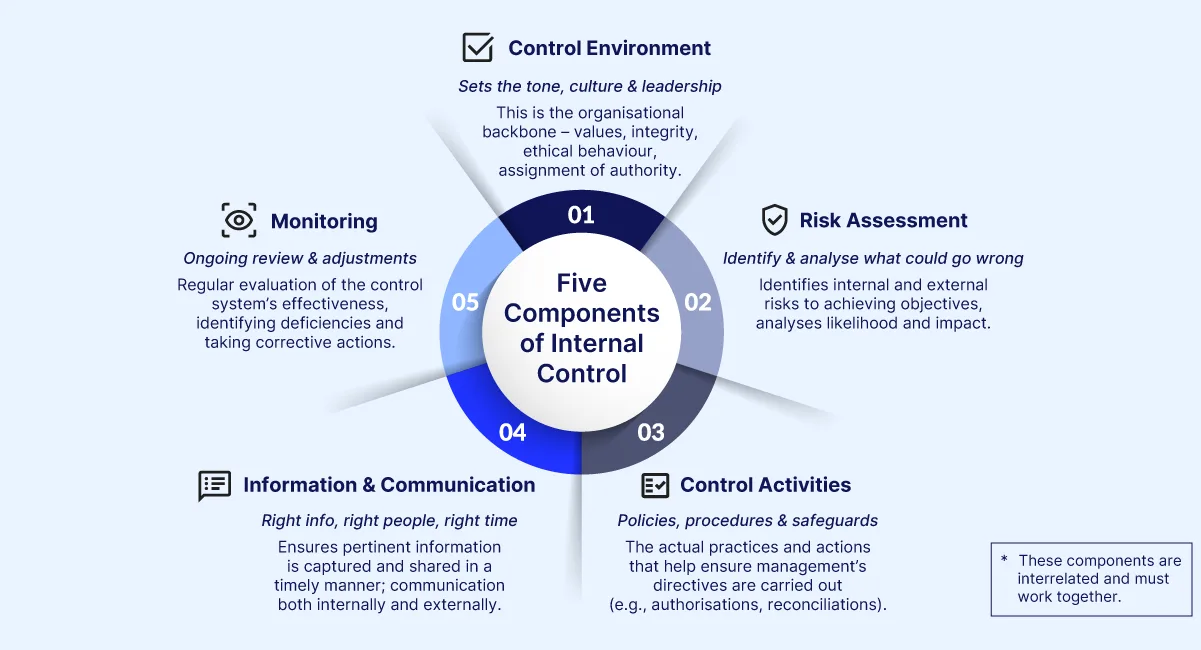
5 Components of an International Standard Internal Control System
A complete internal control system includes:
- Controlled environment
- Risk assessment
- Control activities
- Information & Communication
- Monitor
A break in any link will disable the entire system.
Segregation of Duties (SoD)
A core principle in internal control procedures is to prevent any single individual from both creating and approving payment orders and recording them in accounting.
If the Statement of Documents (SoD) is not tightly established, the risk of collusion increases significantly.
Risk Score = Impact x Likelihood.
CFOs need to quantify risk rather than rely on intuition.
In addition to hard controls, businesses also need soft controls such as a culture of ethics and transparency. This is a point that many documents overlook.
With Bizzi Expense:
- Pre-configured multi-level approval flow
- The system automatically checks permissions before approval.
- CFO manages the LOA matrix transparently on mobile.
As a result, internal control processes no longer depend on memory or personal goodwill.
Internal control procedures for the P2P purchasing cycle.
The Procure-to-Pay cycle is the highest-risk area for business cash flow. P2P internal control processes ensure that all cash disbursement transactions are genuine, at the correct price and quantity, through a 3-way matching mechanism.
Key checkpoints
- Purchase request
- Purchase Order (PO)
- Goods Receipt Note (GRN)
- Bill
- Pay
Common risks include fraudulent invoices, fictitious suppliers, and invalid electronic invoices. Bizzi Bot provides support for:
- Automatically check the supplier's tax identification number (MST) status.
- Implement 3-way matching between Invoices – Purchase Orders – GRNs in real time.
- Only invoices matching the code 100% will be processed for payment.
Instead of detecting violations after the money has left the account, the internal control system shifts to a preventative mechanism.
Optimize compliance costs with the Lean Internal Control model.
More procedures don't necessarily mean greater security. Lean Internal Control focuses on eliminating non-value-adding steps and automating repetitive checkpoints.
ROI of Automation = (Manual cost savings + Reduced risk value) / Investment cost
Comparison table for CFOs:
| Criteria | Manual control | Automatic control |
| Reconciliation speed | 3–5 minutes per invoice | 10–30 seconds per receipt |
| Error rate | 3–5% | <0.1% |
| Audit Trail | Easily overwritten | Trace 100% |
| Scalability | Dependence on personnel | Unlimited |
Sactona (EPM) helps CFOs perform continuous monitoring instead of waiting for end-of-month reports.
What are some common questions about internal control systems? (FAQ)
Below is a section answering questions related to internal control systems.
Do small businesses need an internal control system?
Yes. However, for a small-scale operation, focus on basic SoD (State of Deposit) and cash control. A complex system isn't necessary, but it's crucial to ensure no single individual controls the entire revenue and expenditure cycle.
How can I automatically detect potentially tax-risk invoices?
Bizzi Bot can verify the validity of digital signatures, the status of provider tax codes, and reconcile data in real time, reducing reliance on manual verification.
What is the difference between Internal Audit and Internal Control?
Internal control is a daily operational process. Internal auditing is an independent assessment of the effectiveness of that system.
How can we prevent fraud related to travel expenses?
Use Bizzi Expense to allow employees to photograph invoices at the time of transaction. The system automatically checks budget limits and alerts you if you exceed them.
Should Excel be used for internal control processes?
Not recommended as businesses grow. Excel lacks audit trails, data is easily manipulated, and access control is difficult.
What are the CFO's responsibilities when the control system fails?
The CFO is accountable to the Board of Directors for the integrity of financial statements and the protection of company assets. A weak internal control system not only causes financial losses but also damages personal reputation.

Conclude
Understanding what internal controls are not only helps businesses comply, but also protects them. cash flow and improve the quality of strategic decision-making. A modern internal control system must shift from a manual to an automated model, from detection control to prevention control.
In the context of increasing tax risks, insider fraud, and pressure for transparency, CFOs need a technology-integrated internal control process capable of continuous monitoring and full data traceability. Bizzi acts as a "financial shield," helping businesses digitize, automate reconciliation, and sustainably protect their financial integrity. Investing in internal control systems is not just an operating cost, but a long-term strategy for preserving business value.
Register here to receive a one-on-one consultation on solutions tailored to your business: https://bizzi.vn/dang-ky-dung-thu/