



Are you managing a multi-point retail chain but constantly worried that POS revenue and actual bank deposits never match? Manually reconciling thousands of transactions daily in Excel not only creates operational bottlenecks but also hides the risk of revenue leakage silently eroding profits.
This article by Bizzi will redefine the essence. What is reconciliation? Under the guidance of modern financial management principles, it also provides automation solutions to help CFOs control data integrity and ensure accurate cash flow down to the last penny.
What is reconciliation in the modern financial management model?
Before discussing technology or processes, the CFO needs to understand the underlying principles. What is reconciliation?It's not simply a comparison of two sets of data, but rather an internal control mechanism that protects corporate profits.
Financial reconciliation is a mandatory internal control process aimed at verifying the consistency of data between independent systems such as POS, ERP, banks, or e-commerce platforms. In the digital age, reconciliation is not just about "matching" but also a protective mechanism. Values IntegrityThis ensures that all transactions are recorded correctly and completely, and are converted into actual cash flow on the financial statements.
Break free from the "get it done by the end of the month" mindset.
The old way of thinking views reconciliation as simply closing the books at the end of the period. However, from a CFO's perspective, reconciliation is an activity. Continuous Monitoring – Continuous monitoring is essential to detect discrepancies as soon as they arise. If businesses wait until the end of the month to check, they may have lost hundreds of millions of dong without being able to trace the losses.
The three levels of standard reconciliation include:
- At the level Transactional LevelThe system must match each invoice with the actual payment transaction.
- At the level Balance LevelTo match the total revenue and balance between General Ledger (GL) and the bank statement, it is necessary to reconcile the total revenue and balance.
- At the level Process LevelBusinesses must control the entire "Goods Out - Money In" journey, ensuring there are no breaks in the operational process.
The biggest difference between Accounting Reconciliation and Operational Reconciliation lies in their objectives. While accounting aims only to "beautify the books," operational reconciliation is a "profit shield," directly protecting the real cash flow.
With a multi-point retail chain, implementation Reconciliation of store chain revenue Manually handling this is nearly impossible. Businesses are forced to switch to Automated Reconciliation to process highly complex multi-channel data.
Understanding the true nature of the situation is the first step, but what keeps CFOs awake at night are the funds that silently disappear, undetectable by manual processes.

Why is "Revenue Leakage" the biggest risk when skipping reconciliation?
In the modern retail environment, losses no longer come solely from cash. They stem from system errors, hidden fees, and technical discrepancies. Revenue leakage is when a business loses 1–51 TP3T of profit due to errors in the revenue recognition and collection process. Common causes include fluctuating MDR fees, e-commerce platform fees, successful POS transactions that are not credited, or refund fraud.
"Illusory Profits - Real Losses": A Dangerous Financial Trap
The POS system reported revenue of 10 billion, but only 9.5 billion actually arrived in the bank. Where did the 500 million difference come from? If no action is taken... POS and bank reconciliationThe CFO only sees accounting profit and not actual cash flow.
The formula for controlling net cash flow needs to be closely monitored:
Net Cash Flow = Gross Revenue (POS) – (MDR Fees + Platform Fees + Returns/Refunds)
The "leakage" often occurs in fees deducted before payment or transactions being permanently suspended. Technical discrepancies such as Net Settlement and Timing Difference, if left unchecked, will silently erode profit margins. Bizzi allows setting extremely small discrepancy alert thresholds, enabling the detection of discrepancies as small as 0.1% that Excel struggles to identify. This represents a shift from manual checks to proactive financial control.
Retail Chain Revenue Reconciliation Process
For retail chains,Review of store chain revenue It's not just an accounting problem, but also a data systems problem. The standard process consists of four steps: aggregating POS data across the entire chain, verifying bank deposits, automatically matching electronic payments, and analyzing exceptions. The goal is to ensure that every sales invoice has a corresponding cash flow.
Challenges to the supply chain model
Fragmented data and information delays make real-time control impossible for headquarters. The modern management principle is "Exception-based Management," focusing on handling only erroneous transactions instead of scrutinizing every single line.
For cash payments, the Z-Report must be matched against the Deposit Slip. For electronic payments, this is mandatory. POS and bank reconciliation Based on the Auth Code or Ref ID instead of just the amount of money.
Data Flow Diagram
POS (Revenue) + Bank (Cash In) → Bizzi Reconciliation Engine → Result: Matched / Unmatched → ERP.
Bizzi Bot automatically collects Z-Reports from POS systems such as iPOS, KiotViet, and Sapo, and automatically downloads bank statements for matching overnight. This allows accountants to handle exceptions instead of processing all the data.
Techniques for handling discrepancies in POS and banking reconciliation.
If cash is a matter of honesty, then electronic payments are a matter of technology. POS and bank reconciliation requires handling Net Settlement and Timing Difference. It's necessary to separate MDR fees and use transaction codes as the primary key to ensure accurate order matching.
Net Settlement and Timing T+X
The POS system recorded 1,000,000 VND, but the bank reported 980,000 VND due to deducted fees. If the 20,000 VND is not accounted for as financial expense, the accounts payable will be permanently skewed.
For T+3 transactions, a "Cash in Transit" account is required for monitoring. The Bizzi system has the ability to "Unbundle" Batch Payments, automatically breaking down a total payment into individual transactions to match the POS.
The result is a reduction in manual operations and an increase in the transparency of cash flow.
Optimize the P2P process with 3-Way Matching (PO – GRN – Invoice)
If Reconciliation of store chain revenue To protect the revenue, the Procure-to-Pay (P2P) process acts as a "control valve" for the cost. Modern CFOs cannot simply focus on whether enough money is coming in, but must also ensure that money is spent correctly, sufficiently, and legitimately. 3-Way Matching is the gold standard for achieving this.
What is 3-Way Matching and why is it considered a "Cost Control Standard"?
3-Way Matching is a mechanism for comparing three core documents, including:
- Purchase Order (PO) – Approved Purchase Order
- Goods Receipt Note (GRN) – Receipt confirming receipt of goods
- Invoice – Invoice from the supplier
Payment is only made when all three elements—quantity, unit price, and terms—match. This mechanism ensures that businesses do not pay for goods not received, do not make incorrect payments, and are not issued fraudulent invoices.
From the CFO's perspective, this is not just an accounting process, but a layer. Internal Control This helps protect profit margins and ensures compliance during audits.
Risks of not implementing 3-Way Matching
Many rapidly expanding chain businesses often skip this step due to operational pressures. However, failing to implement 3-Way Matching can lead to three major groups of risks:
First of all over-billingThe supplier may issue an invoice for a higher price than the agreed-upon unit price. If the accountant relies solely on the invoice without comparing it to the purchase order (PO), this difference will directly increase the cost of goods sold (COGS).
Secondly Quantity VarianceThe actual quantity received is less than what is stated on the invoice, but full payment is still made. In a chain store model with hundreds of delivery points, this discrepancy can accumulate to hundreds of millions of dong per year.
Thirdly, there is risk. Fake Invoice Or the invoice may lack a valid purchase order (PO). This is a common weakness in organizations that have not standardized their P2P processes.
If revenue leakage is a leak at the output, then a lack of 3-way matching is a leak at the input.
Formulas for controlling Price Variance and Quantity Variance
To measure the financial impact, the CFO needs to monitor:
- Price Variance = (Invoice Price – Purchase Order Price) × Quantity
- Quantity Variance = (Quantity on Invoice – Quantity of GRN) × Unit Price on Purchase Order
These two indicators directly reflect the degree of profit erosion. Without an automated warning system, small deviations would be overlooked as "insignificant," but accumulating over time would distort Gross Margin.
The link between Order-to-Cash and Procure-to-Pay: A closed loop of control.
The key point that many businesses miss is: reconciliation doesn't just exist at the revenue level.
When businesses perform well POS and bank reconciliation While P2P trading is controlled at the output end, lax control at the input end still erodes profits.
A strong financial system must form a circle: Revenue management and accurate reconciliation → Full cash flow → Tightly controlled costs → Protected net profit.
This is the model. Closed-loop Financial Control which the CFO aims for.
3-Way Matching in the context of retail chains
For F&B or retail chains, the specific characteristics are:
- Many stores place orders in a decentralized manner.
- High frequency of goods delivery
- Diverse suppliers
- Thin profit margins
Without a centralized system, manually checking purchase orders (POs), gross receipts (GRNs), and invoices would create a major bottleneck and easily lead to omissions.
In practice, many businesses only conduct random checks instead of rigorously monitoring transactions. This inadvertently creates a "dark area" where errors can occur.
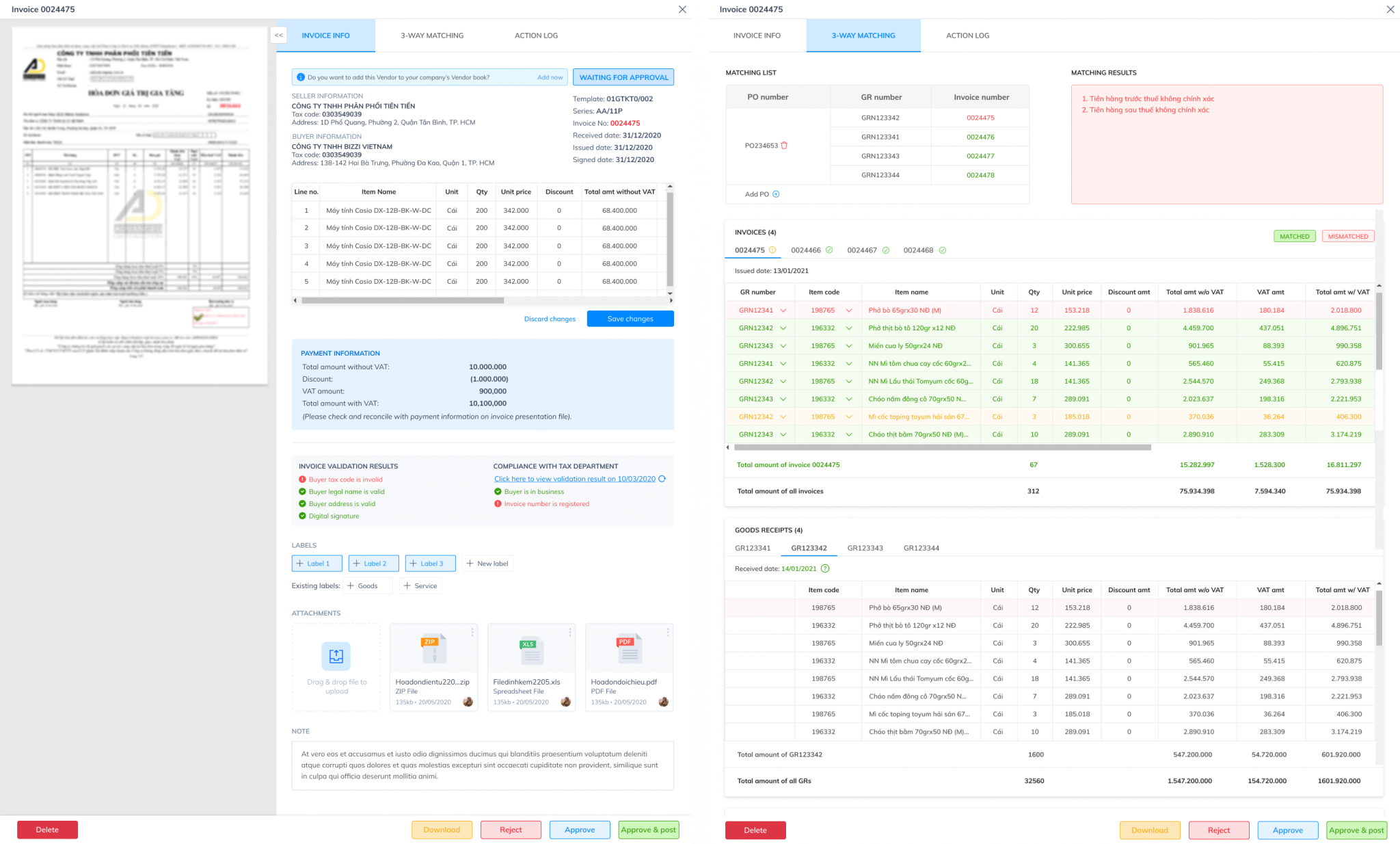
Automation applications in 3-Way Matching with Bizzi
Technological solutions play a crucial role in transforming 3-Way Matching from a theoretical process into a practical control mechanism.
Bizzi Procurement allows:
- Automatically record approved purchase orders.
- Connect GRN data from the warehouse system.
- Read and extract invoice data using AI.
When the system detects discrepancies between the invoice price and the purchase order, or a mismatch between the quantity and the gross receipt, it will issue a warning immediately before payment is processed. This helps CFOs shift from "detecting after the loss" to "preventing before payment."
Especially when combined with the system Reconciliation of store chain revenueThis allows businesses to create synergy between input and output control, ensuring that both cash inflows and outflows are automatically monitored.
From Cost Control to Profit Margin Protection
In a competitive retail environment, increasing revenue can be difficult, but losing profit due to cost discrepancies is very easy to happen.
Therefore, 3-Way Matching is not an “auxiliary process” but a core part of the financial strategy. When automated and integrated into the overall reconciliation system, businesses not only reduce the risk of fraud but also enhance the reliability of their financial reporting.
For the CFO, this represents a shift from accounting management to strategic financial management – where every transaction, from sales invoices to purchase invoices, is controlled by data and technology instead of intuition and Excel.
From Excel to AI: A Comparison Table of Digital Transformation Effectiveness
Converting from Excel to an automated system helps shorten the closing time for 80% and provides real-time reporting.
Manual reconciliation is often slow, prone to errors, and difficult to scale as the number of stores increases. In contrast, automated systems like Bizzi generate Single Source of Truth, automatically break down MDR costs, and guarantee 99.91% accuracy.
The ROI of the system lies not only in the software cost, but also in preventing revenue loss – a figure that can be much larger than the technology investment cost.
| Criteria | Manual reconciliation (Excel) | Automated verification (Bizzi AI) |
| Speed | Delayed (T+N days), wait until the end of the month. | Real-time / T+0 |
| Accuracy | Prone to errors (data entry, formulas) | Exactly 99.9% |
| Processing Fee (MDR) | Often overlooked or accounted for collectively. | Automatically break down each transaction. |
| Scalability | Chaos ensued when opening another store. | Scalable |
| Data | Fragmented, disjointed (Silos) | Concentration (Single Source of Truth) |
Frequently Asked Questions about Revenue Reconciliation & Compliance (FAQ)
Revenue reconciliation and compliance is a process that ensures actual revenue matches accounting records, and complies with tax regulations (VAT, corporate income tax) and invoicing requirements. The FAQ focuses on: recording unearned revenue (Account 3387), invoice issuance timing, tax collection from business households, and checking for risks of discrepancies between actual revenue and tax.
Frequently Asked Questions (FAQ) regarding Revenue Reconciliation and Compliance:
How do reconciliation discrepancies affect tax reporting?
Discrepancies between POS terminals and bank statements can lead to underreporting of taxable revenue for VAT or corporate income tax purposes. If tax authorities discover these discrepancies and the business cannot provide an explanation, the risk of tax assessment and penalties is very high.
Index DSO What does this have to do with reconciliation?
Delayed reconciliation increases DSO because accounts payable are not confirmed in a timely manner. Reconciliation of store chain revenue When executed quickly and accurately, cash flow is released sooner, improving working capital.
How do I reconcile my account with the e-commerce platform?
Platforms often have complex fee structures including fixed fees, processing fees, and shipping support fees. A system capable of reading specific APIs or files is needed to accurately break down net revenue, rather than simply looking at the total amount transferred.
Conclusion: Reconciliation is the "profit shield" of the modern CFO.
So What is reconciliation? In the context of a multi-channel business, it's no longer about matching numbers, but about strategies for controlling revenue and protecting real cash flow.
With retail chains, Reconciliation of store chain revenue and POS and bank reconciliation It must be done automatically, continuously, and at the system level. Only then will the CFO truly see the real cash flow picture, instead of just accounting profits on paper.
Bizzi is not just a reconciliation tool, but also a financial automation platform that helps businesses build "Closed-loop Financial Control"—a closed-loop control system from revenue to expenses. In a competitive environment with increasingly thin profit margins, controlling every dollar of revenue is a sustainable strategic advantage.
To receive personalized solutions tailored to your business, schedule an appointment here: https://bizzi.vn/dang-ky-dung-thu/