


A high ROE isn't necessarily a positive sign. A business might achieve an ROE of 20% through efficient sales, but it could also achieve it through excessive debt. To avoid the "performance illusion," CFOs need a tool to uncover the true nature behind these numbers. DuPont model This analytical framework helps transform the ROE metric from a dry, abstract ratio into a strategic action roadmap.
This article by Bizzi will provide an in-depth analysis of the DuPont 3-step and 5-step models, and guide you on how to optimize each variable from a modern management perspective.
What is the DuPont model in modern financial management?
Before implementing the formula, the CFO needs to understand the management principles behind it. DuPont model It's not just a multiplication of three variables, but a system of thinking about how to generate returns on equity.
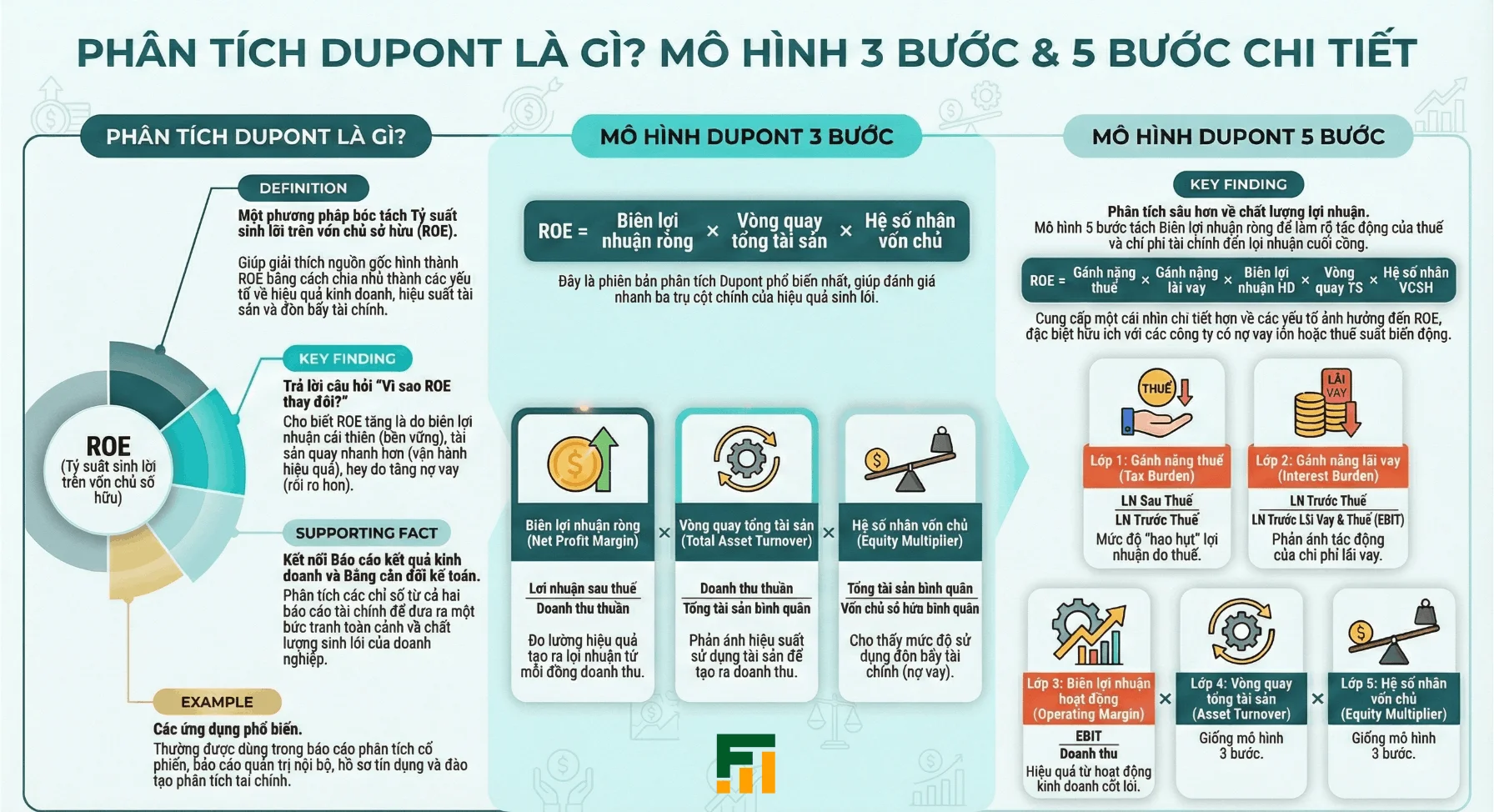
DuPont Analysis is a technical financial analysis framework used to assess a company's profitability by analyzing its Return on Equity (ROE). This model indicates that ROE is driven by three main financial levers: operational efficiency (Net Profit Margin), asset utilization efficiency (Asset Turnover), and financial leverage (Equity Multiplier).
The basic formula of DuPont model: ROE = (Net Income / Sales) × (Sales / Assets) × (Assets / Equity)
The key lies in the mindset: never evaluate ROE as a standalone number.
A ROE of 20% can be a good sign if it comes from high profit margins and a fast asset turnover. However, if that 20% is due to excessive financial leverage, the business is facing serious liquidity risks.
The true value of DuPont model For a CFO, this means transforming static financial reports into actionable maps. When shareholders ask, "How will we achieve growth next year?", the CFO can provide specific answers: increasing sales prices to improve profit margins, accelerating cash collection to increase asset turnover, or restructuring capital to optimize leverage.
One less-discussed point is the trade-off. Increasing profit margins often slows asset turnover because selling at high prices can slow down production. CFOs must find a balance between "selling high" and "selling quickly." This is where the depth of management lies. DuPont model bring about.
To apply it correctly, we need to clearly distinguish between the two versions of this model in order to break down the layers. hidden costs.
Comparison of the 3-Step and 5-Step DuPont Models (Formulas & Applications)
Understanding the formula is a necessary condition. Choosing the right version for analysis is the sufficient condition. DuPont model It exists in two levels: 3 steps and 5 steps.
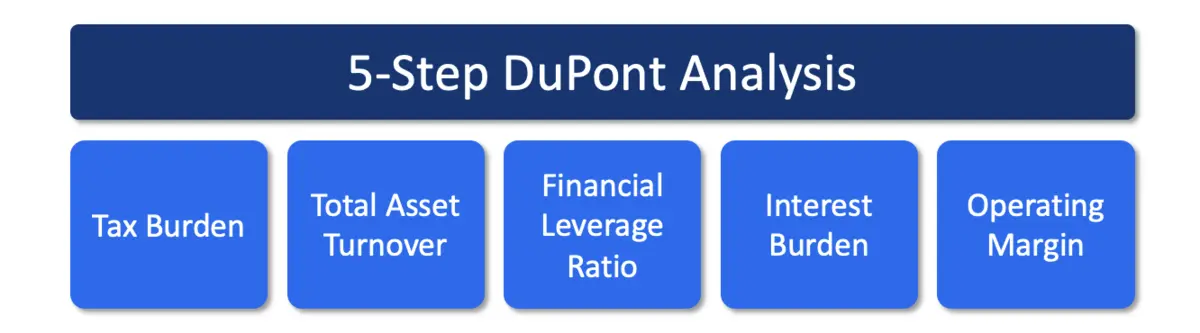
The DuPont 3-step model is suitable for a quick assessment of overall operational efficiency. The DuPont 5-step model adds two more factors, Tax Burden and Interest Burden, helping CFOs determine whether profit erosion is due to core business operations or financial structure and tax policies.
DuPont 3-step
ROE = (Net Income / Sales) × (Sales / Assets) × (Assets / Equity)
This version focuses on operations and leverage. However, it doesn't clearly distinguish between profits affected by taxes and interest expenses.
DuPont 5-step
ROE = (Net Income / EBT) × (EBT / EBIT) × (EBIT / Sales) × (Sales / Assets) × (Assets / Equity)
Where: Tax Burden = Net Income / EBT; Interest Burden = EBT / EBIT
Using only three steps, CFOs might confuse "poor business performance" with "excessive interest expenses." DuPont's five-step system allows for the detection of financial vulnerabilities stemming from non-operating expenses.
For example, a business might have good EBITDA but low ROE. When applying... DuPont 5-step modelA CFO might find a low Tax Burden due to many non-deductible expenses, or a low Interest Burden due to excessive debt.
Understanding the formula is a necessary condition. The sufficient condition for optimizing these variables is that the input data must be clean and real-time.
Optimizing Net Profit Margin: Controlling Costs & Tax Risks
In the structure of DuPont modelNet profit margin is the variable that best reflects operational quality.
Net profit margin reflects the ability to convert revenue into actual profit. To optimize it, the CFO must tightly control operating costs and tax expenses, especially the risk of invalid invoices.
Net Income = Revenue − (COGS + Opex + Interest + Tax)
Profit margins are eroded not only by rising cost of goods sold but also by uncontrolled administrative expenses and non-deductible costs. These are “hidden costs” that many businesses overlook.
Data entry errors, fake invoices, and incomplete documentation can lead to tax authorities disallowing expenses, increasing tax payable, and directly reducing net income. DuPont model.
Automating invoice processing with Bizzi helps reduce data entry personnel costs and improve compliance control through 3-way matching (PO – GRN – Invoice). When all expenses are valid and controlled according to the approval matrix, the Tax Burden in DuPont's 5-step process will be naturally optimized.
Besides carefully managing every penny of profit, businesses need to accelerate the rate of capital turnover.
Improving Asset Turnover: Working Capital Optimization Strategies
In DuPont modelAsset turnover reflects the ability to generate revenue per dollar of assets. To increase asset turnover without selling off fixed assets, CFOs need to focus on working capital, especially shortening the timeframe. DSO (Days Sales Outstanding).
Asset Turnover = Revenue / Total Assets
Accounts receivable typically account for a large proportion of total assets. High levels of outstanding debt tie up assets, reducing the efficiency of capital utilization.
The key difference in the modern approach is connectivity. DuPont model With the Order-to-Cash process, instead of just "selling more," CFOs need to "collect money faster."
Bizzi's accounts receivable management solution enables real-time reconciliation of accounts receivable and automatic debt reminders. With faster cash flow, businesses can reinvest and increase revenue without increasing asset size. The result is a higher Sales/Assets ratio. DuPont model Sustainable improvement.
Managing Financial Leverage: Making Decisions from Real-Time Data
Financial leverage is the most powerful variable amplifying ROE in DuPont model.
Equity Multiplier = Total Assets / Total Equity
Leverage is a double-edged sword. When business is going well, it amplifies profits. When the market declines, it increases the risk of bankruptcy.
The problem is that traditional financial reports are often indicators of the past. CFOs need consolidated, real-time data to decide whether to borrow more or raise capital.
Implementing an EPM system, integrated with the Bizzi data platform, automatically consolidates data from subsidiaries, eliminates insider trading, and forecasts cash flow. With a real-time dashboard of capital structure, CFOs can determine safe leverage levels instead of relying on lagging data.
The "Paper Profit" Trap: Why DuPont Needs to Include Open Cash Flow (OCF)?
Umbrella DuPont model Although very powerful, it is still based on accrual accounting.
A business may record revenue but not yet receive the money. If ROE is high but OCF remains negative for an extended period, this is a warning sign.
CFOs should always compare DuPont analysis results with the cash flow statement. Bizzi's 3-way matching feature helps verify that purchase and sale transactions are genuine, limiting the risk of recording fictitious revenue or expenses.
DuPont is a powerful tool, but it shouldn't be "mythologized."
Businesses applying EPM Optimizing management reports
In reality, when technology supports analysis, financial efficiency improves significantly. An electronics manufacturing company has shortened its monthly forecasting time from 7 days to 5.5 days and reduced the number of reporting forms by 75% thanks to the implementation of an EPM system.
Below is a detailed analysis of each variable in the DuPont 5-step process.
Pre-transformation context: The issue wasn't about profit, but about the speed of decision-making.
As a multinational corporation with hundreds of subsidiaries, electronics manufacturers face three major challenges:
- Financial data is dispersed by region.
- The consolidation cycle and forecast are expected to be prolonged.
- It is difficult to monitor performance on a unit-by-unit basis.
When data consolidation takes almost a week, decisions about selling prices, inventory, cost of capital, etc., are all "past" in nature. This directly affects three components of the system. DuPont model:
- Profit margin (EBIT/Sales)
- Asset Turnover Ratio (Sales/Assets)
- Financial leverage (Assets/Equity)
In other words, the problem isn't low ROE—but rather not knowing what is causing the ROE to change.
Impact on Operating Margin
Before implementing EPM:
- Operating costs are allocated slowly.
- Not tracking budget discrepancies in real-time.
- Slow response to fluctuations in raw material costs.
This causes EBIT to fluctuate but is not controlled in a timely manner.
After deployment:
When the EPM system allows:
- Compare actual vs. real-time forecast
- Drill-down by product/region
- Automated variance analysis
The finance committee may:
- Adjust selling prices faster.
- Reducing Opex is ineffective.
- Reallocate marketing budget
Impact of DuPont: More stable EBIT/Sales → Sustainable improvement in profit margins instead of short-term spikes.
Impact on Asset Turnover
For businesses manufacturing electronic products, fixed assets (factories, machinery) and inventory account for a large proportion of their assets.
Previous bottleneck
- Suboptimal inventory levels by region.
- The demand forecast was inaccurate.
- Long planning cycles lead to production being out of sync with the market.
When forecasts take 7 days and rely on fragmented Excel files, production adjustments lag behind demand fluctuations.
After EPM standardization
- Forecast rolling continuously
- Connecting financial and operational plans.
- Reduce the number of forms 75% → eliminate duplicate data
Result:
- Reduce excess inventory.
- Increase inventory turnover rate
- Reduce "frozen" assets
DuPont's impact: Sales/Assets increased due to optimized working capital and production assets.
Impact on Financial Leverage (Equity Multiplier)
In conglomerates with multiple subsidiaries, leverage management often lacks transparency:
- The subsidiary company took out separate loans.
- It's difficult to see the overall capital structure.
- The entire group failed to optimize interest expense.
After automatic data merging:
- The finance board can see the debt structure in real time.
- Compare ROIC per unit with cost of capital.
- Reallocate capital to higher-performing units.
Impact of DuPont: Assets/Equity are being strategically optimized instead of increasing debt across the board.
If you apply the DuPont 5-step method – A deeper perspective
ROE = Tax Burden × Interest Burden × EBIT Margin × Asset Turnover × Equity Multiplier
The most obvious benefits are:
(1) Interest Burden (EBT/EBIT)
When interest rate data is consolidated and the scenario is simulated:
- The corporation may restructure its debt.
- Negotiate better interest rates.
- Reduce financial costs.
(2) Tax Burden (Net Income/EBT)
Standardization systems help to:
- Reduce compliance errors.
- Optimizing the tax structure across regions.
These are two variables that the 3-step DuPont method cannot clearly see.
Most importantly: Speed of decision-making = Competitive advantage
Reducing the forecast period from 7 days to 5.5 days may seem like a small amount. But for a global corporation:
- A 1–2 day faster turnaround can help adjust production before market changes.
- It's possible to lock in raw material prices before raising them.
- Production of the low-margin product line may be discontinued sooner.
In a thin profit margin environment, decision speed directly impacts:
- EBIT
- Inventory
- Cash flow
This means it affects the entire DuPont model.
Strategic lessons learned for CFOs
- ROE cannot be improved by “a single lever”
Simply increasing debt to boost ROE is not enough.
- Data systems determine the quality of DuPont analysis.
If the data is incorrect or outdated → analysis is incorrect → decisions are incorrect.
- EPM is not a reporting tool, but a tool for optimizing ROE.
When:
- Profit margins are tracked in real time.
- Assets are turned over more quickly.
- Capital structure is transparently controlled.
ROE improved in a sustainable manner, not due to increased financial risk.
Extended perspective: If not implemented EPM So what?
If electronics manufacturers continue to maintain a fragmented system:
- Slow Forecast
- High inventory
- It is difficult to optimize interest rates.
- Decision-making based on lagging data.
In the DuPont model, this leads to:
- EBIT Margin Volatility
- Asset Turnover decreases
- Equity Multiplier increases risk.
The return on equity (ROE) may remain high, but the quality of the ROE is low.
Digital transformation in finance doesn't just make reporting faster. It directly impacts every variable in the DuPont model:
- Improve profit margins by controlling variance.
- Increase asset turnover through optimized planning.
- Leverage management based on consolidated data.
Most importantly: DuPont is only strong when the input data is strong.
Frequently Asked Questions about the DuPont Model (FAQ)
The DuPont model is a financial analysis tool that breaks down the ROE (Return on Equity) into three components: Net Profit Margin (operational efficiency), Asset Turnover (asset utilization efficiency), and Financial Leverage (capital structure). It helps investors accurately identify the sources of sustainable profit. Frequently Asked Questions (FAQ) about the DuPont Model:
What are the main differences between the 3-step and 5-step DuPont?
DuPont's five-step process further separates the tax burden and interest burden to provide a more detailed assessment of the source of ROE.
What is a good asset turnover ratio?
It varies depending on the industry. Retail typically has a high ratio above 2.0, while real estate usually has a ratio below 0.5 due to large fixed assets.
How can we improve net profit margins without increasing selling prices?
Focus on reducing Opex and compliance costs by automating expense and invoice processing.
Can the DuPont model be applied to loss-making businesses?
Yes. It helps identify whether losses are stemming from negative profit margins, low turnover, or interest burdens.
Conclusion: From the DuPont Formula to Financial Data Infrastructure
DuPont model It's not just a financial formula. It's a framework that helps CFOs answer three strategic questions: Are we making money well? Are we using our assets efficiently? Is our capital structure safe?
However, to accurately analyze each variable in the DuPont model, businesses need clean, complete, and real-time data. Discrepancies in expense recording, accounts payable, or data consolidation can distort the entire analysis.
Bizzi, along with its financial automation and EPM ecosystem, serves as a platform to standardize input data, optimize P2P and O2C processes, control compliance, and consolidate reporting. When data is transparent and real-time, DuPont model It will no longer be a theoretical exercise, but will become a strategic management tool that helps businesses optimize ROE sustainably.
Register here to schedule a consultation with an expert to find the right solution for your business: https://bizzi.vn/dat-lich-demo/