



Job year-end exchange rate differential assessment This is not just a purely accounting practice, but also directly affects the integrity of financial statements and corporate income tax risks. Discrepancies in determining closing exchange rates or classifying currency items can distort P&L ratios, impacting board decision-making. This article provides... Guidelines for assessing year-end exchange rate differences In-depth training based on Circular 200, integrating risk management thinking and modern Record-to-Report (R2R) process automation solutions.
The nature of evaluating end-of-period exchange rate differences.
According to Circular 200/2014/TT-BTC, Assessing end-of-period exchange rate differences This is the process of updating the value of monetary items denominated in foreign currencies according to the actual exchange rate on the date of the financial statement. The goal is to accurately reflect the value of assets and liabilities as of December 31st, thereby determining... Year-end revaluation exchange rate difference or unrealized losses.
CFOs need to distinguish between two core concepts:
- Realized exchange rate differences: arise upon payment or debt collection during the period.
- Unrealized exchange rate differences: arise when year-end exchange rate differential assessment for the remaining balance.
If not done correctly How to assess exchange rate differences at the end of the periodFurthermore, the financial statements would violate the principle of fair and true representation. More importantly, EBITDA and EPS could be distorted, misrepresenting the company's valuation in the eyes of investors.
From a management perspective, exchange rate fluctuations are a market risk. A year-end review helps CFOs measure the actual level of FX exposure still visible on the balance sheet.
Monetary items that require year-end exchange rate revaluation.
According to Circular 200, businesses only need to implement year-end exchange rate differential assessment This applies to monetary items only, not non-monetary items.
Popular accounts that need to be reassessed include:
- 1112 – Foreign currency cash
- 1122 – Foreign currency bank deposits
- 131 – Accounts receivable in foreign currency
- 331 – Amounts payable to foreign currency suppliers
A point of confusion is the use of "prepayments to the seller" or "prepayments from the buyer." If this is a guarantee for contract performance and not a purely monetary payment, then it does not fall under this category. Assessing end-of-period exchange rate differences.
Below is a quick reference table for settlement purposes:
| Account | Item type | Is there a review? | Applicable exchange rate |
| 1112 | Cash | Have | Buying rate |
| 1122 | Deposits | Have | Buying rate |
| 131 | Accounts Receivable | Have | Buying rate |
| 331 | Payable | Have | Selling rate |
| 152/156 | Inventory | Are not | Not applicable |
| 211 | Fixed assets | Are not | Not applicable |
In practice, reviewing foreign currency balances is often time-consuming if a company has many subsidiaries. When using Bizzi ARM/AP, foreign currency accounts payable data is categorized from the outset, streamlining the process. year-end exchange rate differential assessment Reduce manual processing volume by 80–90%.
The actual exchange rate used to revalue foreign currency balances.
According to Circular 200, the exchange rate used to assess year-end exchange rate differences is the buying or selling rate of the commercial bank where the enterprise regularly conducts transactions on December 31st.
Applicable principles:
- Assets (Debit) → use the buying rate
- Credit → use the selling exchange rate
Calculation formula: Revaluation value = Original currency balance x Exchange rate on December 31st
A common risk is using the State Bank's "central exchange rate" instead of the actual buying/selling rate of the transacting bank. This can lead auditors to require a complete readjustment of the end-of-period exchange rate difference valuation entries.
Bizzi Bot automatically collects the closing exchange rate on December 31st from the business bank, saves electronic evidence (Audit Trail), and synchronizes the data. ERP softwareThis is especially important when a business has hundreds of subsidiary units.
See more content about Principles for determining exchange rates
Accounting for year-end exchange rate gains and losses from revaluation.
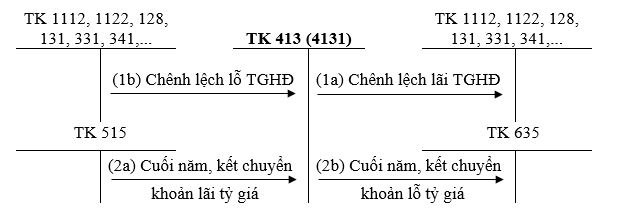
The year-end exchange rate difference assessment is carried out through account 413 – Exchange Rate Differences.
Formula for determining the difference: FX Difference=Balance×(Closing Rate−Book Rate)
Examples of exchange rate differences:
- The company still owes $100,000.
- Book exchange rate: 23,500
- Exchange rate on December 31st: 24,000
- Difference: 100,000 × (24,000 – 23,500) = 50,000,000 VND
This is an unrealized exchange rate loss and is recorded in account 413. At the end of the year, the profit/loss balance will be transferred to account 515 or 635.
A key point for CFOs to note: year-end exchange rate gains from revaluation do not generate actual cash flow but still affect after-tax profit. On the Cash Flow Statement (indirect method), this amount must be adjusted when determining cash flow from operating activities.
EPM Performance management solutions can automate year-end closing entries and separate realized and unrealized profit/loss on the management dashboard.

Distinguishing between exchange rate differences in accounting and tax settlement.
The major difference between accounting and taxation lies in how unrealized gains and losses are handled.
According to corporate income tax regulations:
- Exchange rate losses from the revaluation of liabilities are deductible expenses.
- Exchange rate gains from the revaluation of cash and receivables are not included in taxable income.
This creates a temporary difference and gives rise to deferred income tax. If the CFO fails to reconcile accounting profit and taxable income, the business may:
- Overpayment of taxes due to failure to exclude unrealized interest.
- Subject to retroactive tax collection due to incorrect recording of deductible losses.
FAQ – Frequently Asked Questions about Exchange Rate Differences
The section below expands on common real-world scenarios that arise when year-end exchange rate differential assessment and analysis from the CFO's perspective – where the focus is not only on accurate accounting but also on managing tax risks, cash flow, and consolidated reporting.
1. Is it possible to offset gains and losses due to exchange rate differences during revaluation?
Yes. According to Circular 200, when implementing Assessing end-of-period exchange rate differencesBusinesses record profits/losses in account 4131 – Exchange rate differences from year-end revaluation. At the time of preparing the annual financial statements, accountants offset the debit and credit balances of account 4131 before transferring them to account 515 (financial revenue) or 635 (financial expenses).
However, CFOs need to be aware of two layers of control:
- Firstly, the offsetting is only carried out within a certain scope. unrealized difference Amounts arising from the year-end revaluation cannot be offset against differences realized during the period.
- Secondly, although accounting offsets apply, unrealized profits may need to be excluded during corporate income tax settlement. Without separate tracking, businesses can easily make mistakes when preparing the B4 adjustment appendix.
In terms of management, the CFO should require the R2R system to automatically separate realized and unrealized profit/loss instead of manually compiling them in Excel – this is a common mistake many businesses make. Guidelines for assessing year-end exchange rate differences.
2. Which exchange rate, the buying or selling rate, is used for accounts receivable?
Accounts receivable are assets, so the following should be applied. buying rate of the commercial bank where the business regularly conducts transactions as of December 31st. The accounting logic is as follows: when a business has the right to receive foreign currency, if it converts it to VND, it will sell that foreign currency to the bank. Therefore, using the buying exchange rate is consistent with the principle of prudence.
A common mistake is that accountants use the wrong selling exchange rate for all items. The consequence is that assets are recorded at higher prices than they actually are, creating an artificial increase in profits. year-end exchange rate differential assessment.
For corporations with multiple banks involved in transactions, the CFO needs to implement a policy to select a single, unified reference bank to avoid audit risks related to consistency.
3. Do deposits denominated in foreign currency need to be revalued?
The answer depends on the nature of the item. If the deposit is intended to secure the performance of a contract and will be deducted from the value of the property or goods in the future, this is non-monetary itemsAccording to Circular 200, this is not implemented. Assessing end-of-period exchange rate differences for this item.
Conversely, if the deposit is actually a recoverable deposit or escrow in a specific foreign currency, it is a monetary item and must be revalued.
In practice, misclassifying the nature of a deposit during a tax audit is a common mistake. CFOs should require accountants to retain the original contract and payment terms to prove the nature of the deposit when audited by the tax authorities.
4. Is a monthly reassessment of the exchange rate mandatory?
Not mandatory under Vietnamese accounting regulations. Businesses are only required to comply. year-end exchange rate differential assessment when preparing the annual financial statements.
However, for businesses with significant foreign currency debt or USD loans, the CFO should take proactive steps. Assessing end-of-period exchange rate differences on a monthly or quarterly basis to control profit fluctuations and bank covenants. In particular, if EBITDA and EPS are strongly affected by exchange rate fluctuations, regular monitoring helps management make more accurate forecasts instead of being "shocked" at the end of the year.

5. Are exchange rate losses from revaluation eligible for dividend distribution?
No. Magnetic hole Year-end revaluation exchange rate difference or unrealized losses reduce undistributed after-tax profits.
According to the Enterprise Law, only realized profits, after allocating sufficient funds, can be distributed as dividends. Distributing dividends based on profits that already include unrealized profits carries the risk of violating the law.
This is why CFOs need to clearly analyze the “quality of earnings”—that is, whether profits come from operating activities or from exchange rate fluctuations.
6. How can I automatically get exchange rates for 500 subsidiary companies?
For a conglomerate, manually collecting exchange rates poses a significant internal control risk.
The solution is to use an EPM or RPA system to:
- Automatically retrieve closing exchange rates from the bank's website.
- Retain audit trail evidence.
- Synchronize with SAP/Oracle ERP
- Normalize data for consolidated reports.
As a result, the process How to assess exchange rate differences at the end of the period This is implemented consistently across the system, significantly reducing the risk of discrepancies when consolidating financial statements.
7. What documents are needed when re-evaluating exchange rates?
To ensure legal compliance during implementation. year-end exchange rate differential assessmentBusinesses need to be fully prepared:
- First, a detailed statement of the original currency balance for each account (1112, 1122, 131, 331…).
- Secondly, the bank's exchange rate announcement as of December 31st (printed from the website with the access date).
- Third, the accounting voucher records the revaluation and transfer entries.
- Fourth, a reconciliation statement between accounting profit and taxable income if there is a difference requiring adjustment.
CFOs should standardize this checklist in the R2R process to ensure that each accounting period has sufficient supporting documentation for tax audits or inspections.
Conclusion: From accounting practices to proactive exchange rate risk management
Year-end exchange rate differential assessment It's not just a closing procedure, but a tool for measuring exchange rate risk and protecting the integrity of financial reporting. Proper implementation is crucial. How to assess exchange rate differences at the end of the period According to Circular 200, this helps businesses:
- Accurately reflect the value of the asset and
- Avoid misrepresenting earnings and EPS.
- Minimize corporate income tax risks.
- Increase transparency before audits.
However, for businesses with numerous foreign exchange transactions, manual processing is almost no longer suitable. Integrating automated R2R, exchange rate collection, debt classification, and journal entry transfer through the Bizzi ecosystem helps CFOs shift from "passive recording" to "active exchange rate risk management."
In an environment of increasingly volatile exchange rates, technology is no longer an option—it's a necessity—for securing sustainable profits.
To receive personalized advice and try out Bizzi's features, book an appointment here: https://bizzi.vn/dang-ky-dung-thu/