


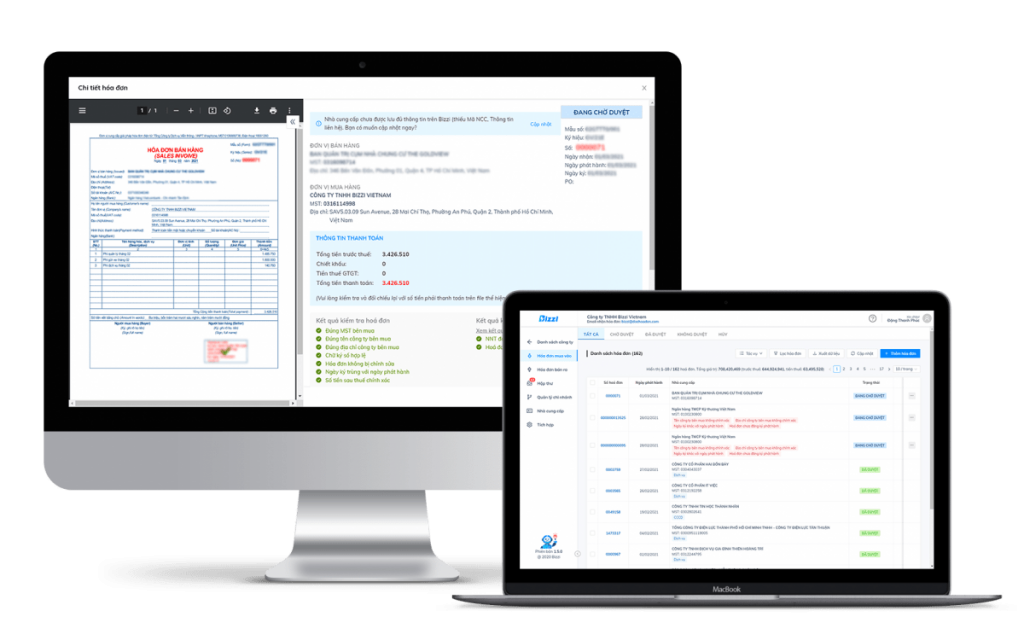
In the context of financial digital transformation, manual invoice processing is becoming a bottleneck that erodes business profits through hidden costs and compliance risks. It's not just about "reading images to translate text" like traditional OCR tools; Input invoice processing software next generation AI & RPA accounting This is reshaping the entire Accounts Payable (AP) process.
This article provides a process design. Automate input invoice processing Following the "Zero-touch" model, CFOs can control expense data, prevent fraud, and optimize business cash flow.
What is automated invoice processing software in the AI era?
Before discussing financial benefits, CFOs need to understand the nature of the technology. Not every invoice digitization solution is true AP Automation.
Input invoice processing software Automated is a solution integrating AI, Computer Vision (OCR), and RPA to automatically collect and extract detailed data for each product line, check legal validity, perform 3-Way Matching, and synchronize accounting entries to the ERP system without manual intervention. This is the foundation for the strategy. Automate input invoice processing According to the Zero-touch model.
The evolution of invoice processing technology
Automated invoice processing is not just a technological solution, but also a strategy that helps businesses improve operational efficiency and minimize financial risks. Applying AI to this process automates steps from collecting and verifying invoice data to reconciliation, shortening processing time, reducing manual errors, and increasing accuracy. Simultaneously, standardized and real-time data support businesses in improving cost management, tracking cash flow, and making more effective financial decisions.
- Generation 1 – Template-based OCR forced businesses to create templates for each supplier. If a supplier changed the layout, the system would crash and require reconfiguration.
- Generation 2 – Cognitive Capture, like Bizzi, uses Machine Learning to understand semantics, independent of fixed patterns. The system recognizes that "Total Amount," "Amount Due," or "Total Amount Due" are all the same data entity.
The core difference lies in its ability to understand table structures, identify line items, and learn from historical data. This transforms the software from a data entry tool into a "Digital Workforce"—a digital workforce operating 24/7/365.
Bizzi handles a variety of formats: XML, PDF, scanned images, digitized paper invoices, and even foreign invoices. This is a strength that many domestic solutions, which only focus on looking up invoices from tax authorities, cannot meet.
However, technology is merely a tool. The real reason CFOs invest lies in the hidden costs concealed within manual processes.
Why are manual processes creating “Invisible Costs”?Hidden costs)?
The accounting department may be running smoothly, but that doesn't mean the process is optimized. Manual processes create three major cost groups: personnel costs for repetitive tasks, costs of errors leading to tax penalties or incorrect payments, and opportunity costs from losing the right to early payment discounts.
Formula for calculating the cost of processing an invoice
The cost of processing an invoice. = [(Total personnel costs (salaries, bonuses) + System/software costs + Process costs (office supplies, storage))]/Number of invoices.
- Personnel costs (Salary/time): Time spent by employees entering, approving, and verifying data.
- System/Software Costs: Costs for renting electronic invoicing software and storage.
- Process costs: printing costs, shipping costs (if any), and costs for handling errors and mistakes.
According to research by Ardent Partners, the cost of manual processing ranges from $2–10 per invoice. For a business processing 50,000 invoices per year, this is a significant expense.
The "Data Re-keying Error" is a common cause. Entering a single digit incorrectly in the tax identification number (MST) or total amount can cause discrepancies in accounting records and waste hours on reconciliation at the end of the month.
Furthermore, there is a tax risk when businesses fail to verify the operational status of suppliers at the time of tax declaration, leading to the recording of invoices from businesses that have absconded. Bizzi has helped retail chains like GS25 and Guardian reduce processing time and bring costs down to below VND 2,000 per invoice.
To eliminate these costs, businesses need a standardized process based on the zero-touch model.
The 5-step process for handling "Zero-touch" invoices.
Automation is not just about installing software, but about redesigning the entire AP process.
Step 1: Multi-channel Ingestion
Instead of waiting to receive invoices via email or manually downloading them, the system automatically scans data from multiple sources: directly connecting to the General Department of Taxation's portal to download XML, automatically reading emails via IMAP/POP3, and receiving screenshots from the mobile app.
All invoices are collected into a centralized data repository – Single Source of Truth. This ensures no omissions and no duplications.
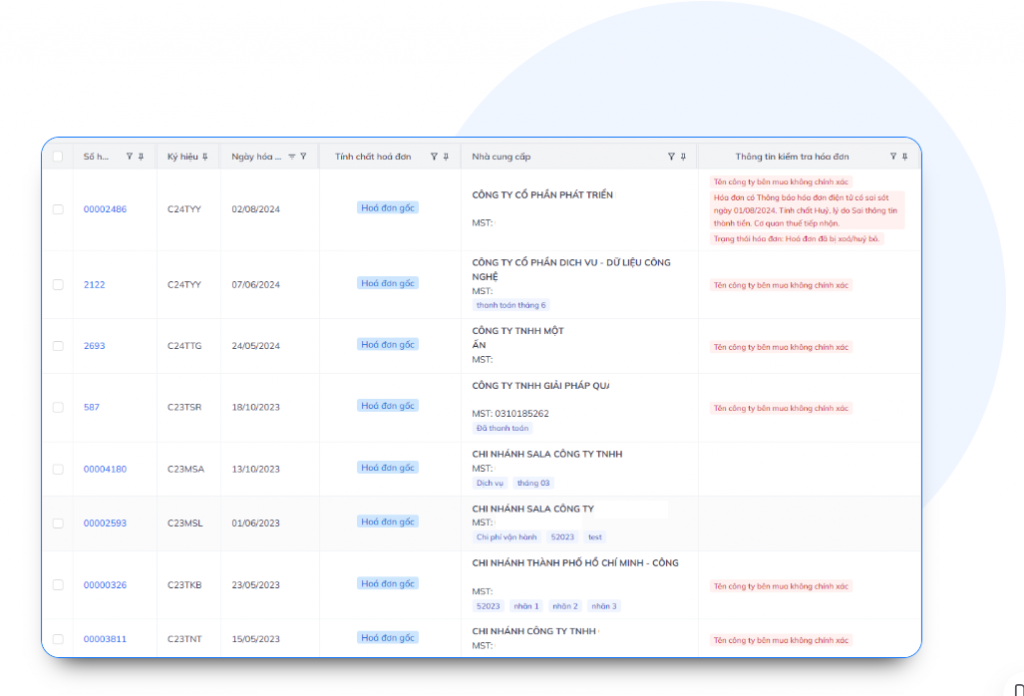
Step 2: Line-item Extraction
Unlike basic OCR that only reads the header, Bizzi's AI extracts each line item, including SKU, quantity, unit price, and unit of measurement.
Table Extraction AI technology preserves the table structure and maps supplier product codes to internal ERP codes. This is especially important for logistics invoices with multiple expense lines or supermarket invoices that are dozens of pages long.
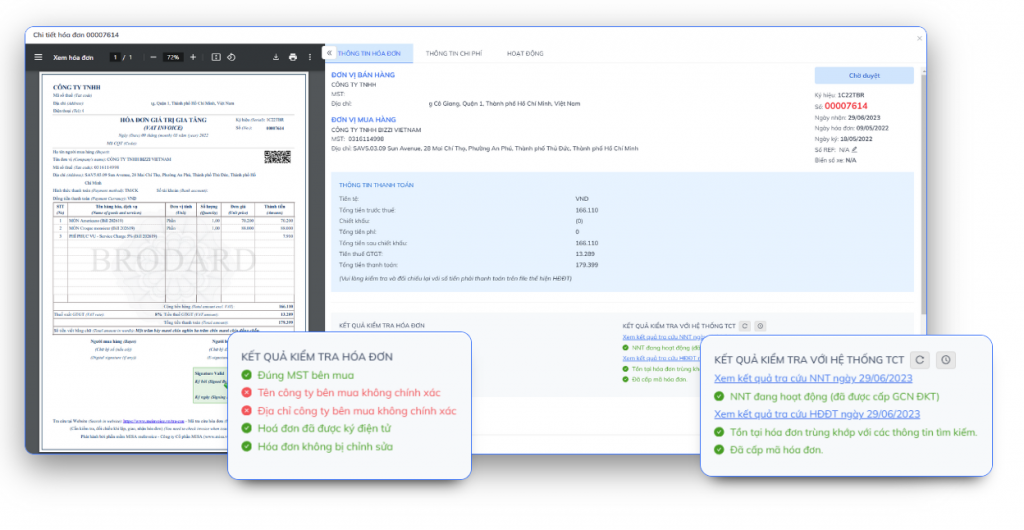
Step 3: Automated Validation
In less than 5 seconds, the system performs over 20 verification steps: digital signature authentication, checking business status via tax API, duplication checking, and arithmetic calculations.
Automating this step virtually eliminates the risk of fraudulent or duplicate invoices.
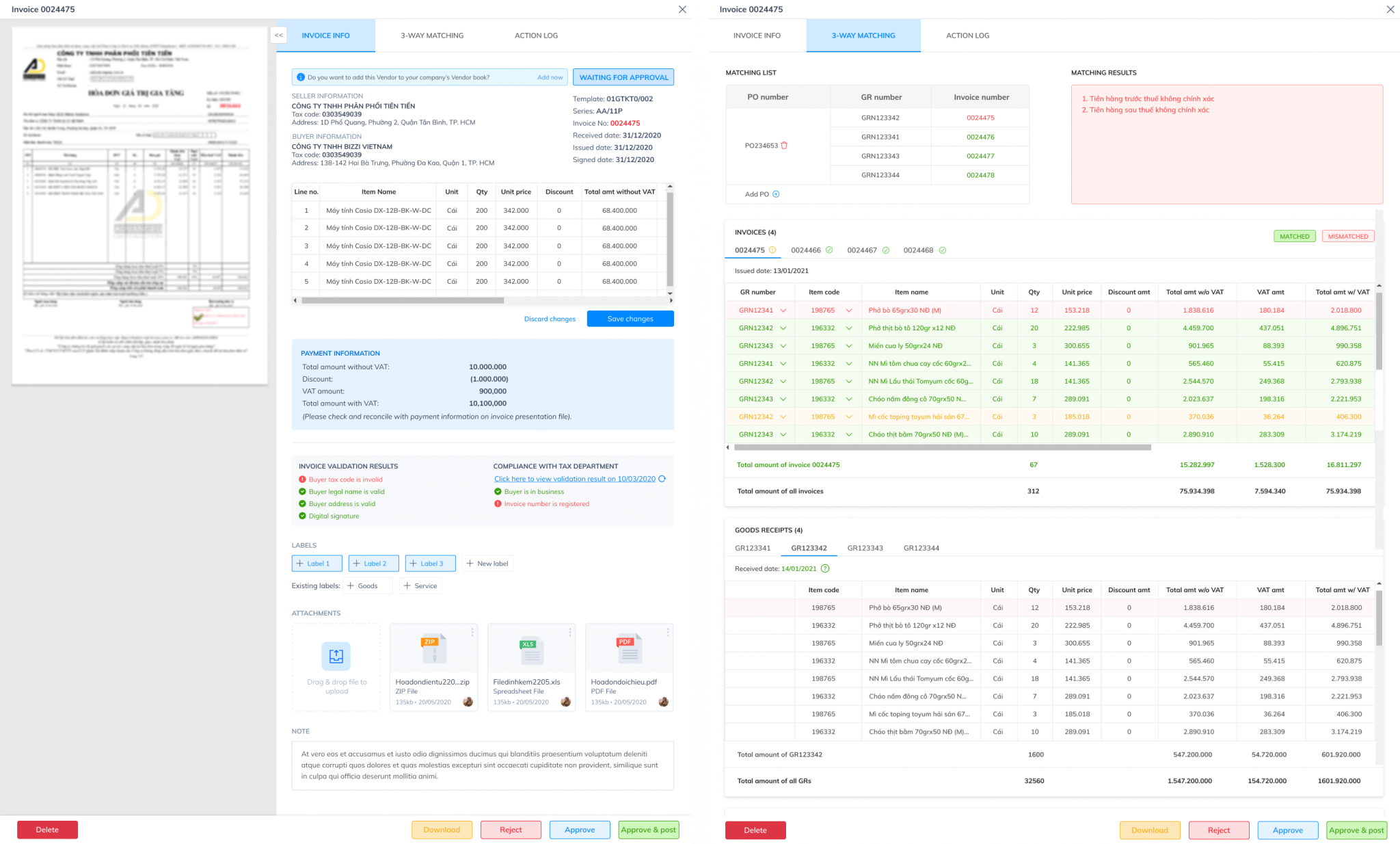
Step 4: 3-Way Matching (Automatic 3D matching)
The automated Invoice-PO-GRN (3-Way Matching) system operates on the principle of comparing three documents: Invoice, Purchase Order (PO), and Goods Receipt (GRN) to ensure consistency in supplier information, items, quantity, and value. The system automatically checks quantities and prices (allowing for a margin of error) to approve payments automatically, minimizing the risk of fraud and manual errors.
Automatic 3-way matching logic:
- Verification: The system compares the supplier code, product code (Item Code/SKU), and purchase order number between three documents.
- Quantity Matching: The quantity on the invoice must not exceed the quantity on the goods receipt note (GRN), and the GRN must not exceed the purchase order quantity (PO).
- Amount/Price Matching: The unit price and total amount on the invoice must match the purchase order (PO). If there is a discrepancy, the system will check if it falls within the pre-configured tolerance limits (e.g., a small difference due to shipping costs).
- Exception Handling:
- Match: Automatic payment approval.
- Partial Match: Automatically generates a discrepancy report, pauses payment, and sends an alert to the accounting department for processing.
If a discrepancy exceeding the tolerance threshold (e.g., ±10,000 VND) is detected, the system will automatically send an alert to the Purchasing department for processing. This mechanism transforms the software from a data entry tool into a true Internal Control system.
Step 5: ERP Integration & Posting
After passing 3-Way Matching, the journal entry is automatically generated and pushed to SAP, Oracle, NetSuite, MISA, or Fast via API. Accountants only need to review and post. The time spent closing the books at the end of the month is significantly shortened.
Comparison: Manual Process vs. Bizzi Automation
| Criteria | Handmade | Bizzi Automation |
| Speed | 5–10 minutes per invoice | <1 minute/invoice |
| Estimated cost | 50,000–200,000 VND | Reduce 80% |
| Error rate | 1–3% | <0.1% |
| Search capability | Find files manually | Search in seconds |
Bizzi is faster than the 90%, drastically reduces costs, and virtually eliminates data entry errors.
Zero-touch process flowchart
Input (Email/Tax/Scan)
→ Bizzi AI Core (Extraction + Validation)
→ 3-Way Matching Engine (Check PO/GRN)
→ Output (ERP/Accounting Software)
This process allows CFOs to see the entire invoice journey in real time.
Criteria for selecting AP Automation software for large enterprises
Before deployment Automate input invoice processingBusinesses need to evaluate the system from a strategic perspective, not just from an operational accounting standpoint. For organizations with tens of thousands of invoices each month, choosing the wrong solution can create more "technical debt" instead of optimizing the process.
1. Deep ERP Integration – A Crucial Factor
For large businesses running SAP, Oracle, NetSuite, or custom ERP systems, AP Automation software cannot be allowed to function as a "data island."
The CFO needs to ask these questions:
- Does the system integrate via a bidirectional API or is it just for exporting/importing files?
- Is there an automatic creation of Journal Entry with the correct account structure, Cost Center, and Project Code?
- Does it support multi-entity, multi-ledger, and multi-currency?
One Input invoice processing software Enterprise-grade systems require real-time data synchronization to avoid discrepancies between AP systems and General Ledger.
If integration is limited to CSV uploads, businesses will revert to manual reconciliation at the end of the month — something AP Automation should have eliminated.
2. Cognitive AI vs. Template-Based OCR (Self-Learning AI Technology)
Many marketing solutions are AI-powered but still rely on fixed templates. For businesses with thousands of vendors, manually configuring templates is impractical.
The CFO should evaluate based on technical criteria:
- Does the system learn automatically when new invoice templates appear?
- Is it possible to accurately separate line items on a multi-page invoice?
- Is there automatic mapping of supplier SKUs to internal SKUs?
In strategy Automate input invoice processingThe key factor determining ROI lies in the ability to process 90% invoices without human intervention. If the rate of manual corrections is high, hidden costs will follow.
Bizzi uses Cognitive Data Capture, which allows the system to understand semantics rather than just reading characters. This is especially important for F&B, retail, or logistics businesses with complex invoice structures.
3. Scalability & Performance Under Load
Large businesses are seasonal. For example:
- Retail sales boomed in Q4.
- FMCG prices surge during Tet holiday.
- Construction companies have a peak period for acceptance testing.
The CFO needs to check:
- Can the system process thousands of invoices per day without crashing?
- Is there a clear SLA regarding uptime?
- Does cloud architecture have auto-scaling?
An underloaded system can lead to slow payment approvals, impacting supplier relationships and cash flow.
4. Security & Compliance Standards
Invoice data contains sensitive financial information: purchase price, trade terms, tax identification number, and bank account details.
The administrator needs to verify:
- Is it ISO 27001 certified?
- Is the data end-to-end encrypted?
- Is there role-based access control?
- Is there an audit trail to support the audit?
One input invoice processing software For large businesses, it is essential to ensure the ability to retrieve the entire invoice processing history when requested by internal auditors or tax inspectors.
Bizzi is ISO 27001 certified and provides a detailed access control mechanism, ensuring that only authorized personnel can approve or edit data.
5. Internal Control Capabilities: 3-Way Matching & Exception Workflow
Internal control through 3-Way Matching (3-party reconciliation: Order - Warehouse Receipt - Invoice) ensures accurate payment, prevents fraud and errors by confirming that goods have been ordered, received, and are priced correctly.The Exception Workflow process handles discrepancies (price, quantity) for approval or rejection, increasing transparency and efficiency.
AP Automation is more than just automated data entry. The real value lies in the internal control layer.
The CFO should check:
- Is there automatic 3-way matching between Invoice – Purchase Order – Gross Receipt?
- Are tolerance limits set for each type of goods?
- Is there a clear workflow for handling exceptions?
Exception Workflow
When the three documents don't match (for example, the price on the invoice is higher than the purchase order, or there's a shortage of goods), the system will trigger an Exception Workflow.
- Error classification: Automatically detects discrepancies (quantity, price, spelling errors, etc.).
- Approval: Forward to the appropriate authority (purchasing manager, chief accountant) for approval of the difference (if accepted) or rejection.
- Solution: Contact the supplier to adjust the invoice (Credit Note) or update the warehouse receipt.
Without 3-Way Matching, the software would only offer "faster data entry," not full functionality. Automate input invoice processing true meaning The combination of 3-Way Matching and Exception Workflow helps businesses automate AP processes, minimize risks, and enhance transparency.
6. Total Cost of Ownership (TCO) & Actual ROI
To assess whether an automation project is truly worth investing in, businesses need to consider the following: TCO (Total Cost of Ownership) Instead of just looking at license costs or initial deployment costs, the analysis should also be considered. ROI of the automation project It is also an important factor in determining the effectiveness of an investment in the long term.
In reality, many projects fail because businesses only calculate tangible costs and ignore other factors. indirect costs such as training time, process changes, system operation, as well as opportunity cost when resources are dispersed or deployed inefficiently.
The CFO shouldn't just look at licensing fees, but must consider the total cost of ownership. They need to ask for clarification:
- Are there any customization fees?
- Are there separate ERP integration fees?
- Are there any additional charges for exceeding the invoice limit?
A good solution should help reduce processing costs by at least 70–80% and improve accounting department productivity. Bizzi often helps clients reduce processing costs to below 2,000 VND/invoice, thanks to its high automation rate and virtually eliminate data entry errors.
7. Expanding financial ecosystem
For large businesses, AP Automation should not be a standalone system.
The CFO should consider:
- Is it connected to an Expense Management system?
- Is Supply Chain Finance available?
- Is there a bank connection for automatic payment?
A well-scalable platform helps businesses build a closed-loop financial system, from Procure-to-Pay to Cash Management.
Bizzi positions itself as more than just... input invoice processing softwareIt is also a deeply integrated financial automation platform with bank reconciliation and expense management.
The choice input invoice processing software It needs to be based on deep integration with existing ERP systems, self-learning AI technology, ISO 27001 security standards, scalability, and a supporting financial ecosystem.
Bizzi is ISO 27001 certified, integrates with many major ERP systems, and ensures the ability to process thousands of invoices per day without interruption.
Frequently Asked Questions about Invoice Processing Automation
Can the software handle specialized invoices such as those related to logistics or airline tickets?
Yes. Bizzi's AI is trained with many complex invoice templates, capable of breaking down details of each line item for logistics fees, fuel surcharges, or airport taxes. Therefore, businesses don't need to configure separate templates for each type of invoice.
What happens if the invoice differs from the purchase order (PO)?
The invoice will be kept in a "Pending" state, and the system will send a notification with the reason for the discrepancy to the person in charge. Only when the discrepancy is resolved or an exception is approved will the system allow payment to be recorded.
How long is invoice data stored?
According to Vietnamese accounting law, the retention period is 10 years. Bizzi stores records on a secure cloud platform, allowing for retrieval in seconds when needed for audits or inspections.
Conclusion: AP Automation is the next-generation financial control platform for CFOs.
In the context of increasing profit margin pressure and increasingly stringent compliance requirements, Automate input invoice processing This is no longer just a simple operational optimization initiative. It's a cost control and cash flow protection strategy at the system level.
One Input invoice processing software Achieving enterprise standards will help businesses:
- Standardize the AP process using the Zero-touch model.
- Deep integration with ERP to eliminate manual reconciliation.
- Establishing internal control layers through 3-Way Matching
- Minimize data entry fraud and errors.
- Shorten the bookkeeping cycle and improve reporting reliability.
More importantly, AP Automation helps CFOs shift their role from "post-verification" to "pre-proactive prevention." When invoice data is checked, reconciled, and accounted for automatically in real time, businesses not only save costs but also increase their ability to accurately forecast cash flow.
In this strategy, Bizzi is not simply a input invoice processing softwareFurthermore, it is designed as a "Digital Workforce" for the Finance and Accounting department. The Bizzi platform combines AI self-learning, RPA, and an automated 3-Way Matching mechanism to ensure 90% invoices are processed contactlessly (Zero-touch), while maintaining a tight layer of internal control before funds leave the business account.
Unlike standalone OCR tools, Bizzi acts as an intelligent middleware layer between the vendor, tax authority, ERP system, and bank, creating a closed financial ecosystem. This is especially important for large-scale businesses where transaction volumes are high and financial risks accumulate exponentially.
For the CFO, investing in Automate input invoice processing It's not a technological decision, but a strategic one about risk management and optimizing long-term cash flow. And choosing a platform like Bizzi – where automation is coupled with internal controls and scalability – is a solid step towards building a modern, transparent, and growth-ready financial system.
To experience Bizzi's features and solutions firsthand, book an appointment here: https://bizzi.vn/dat-lich-demo/