



A debt confirmation statement is a document that records the outstanding balance of receivables, payables, or payment obligations at a specific point in time. Bizzi provides Word templates for businesses and individuals, and guides you on how to choose templates based on customer and supplier accounts receivable, year-end, amounts to be committed for payment, or amounts already paid.
The article also clarifies the differences between debt confirmation, debt reconciliation, and audit confirmation letters; the information fields to fill in; how to check balances; the process of submitting, signing, and archiving documents; how to handle discrepancies; a checklist before signing; and the next steps to track aging, DSO, payments, and debt collection on a centralized management system.
Select and download a debt confirmation form template.
Choose a template based on the subject and purpose of use. A Word file is suitable for editing content and signing; an Excel spreadsheet, if available, should be used as an appendix detailing the invoice and payment, not as a replacement for the signed document between the parties.
| Sample | Suitable when | Format | Download template |
|---|---|---|---|
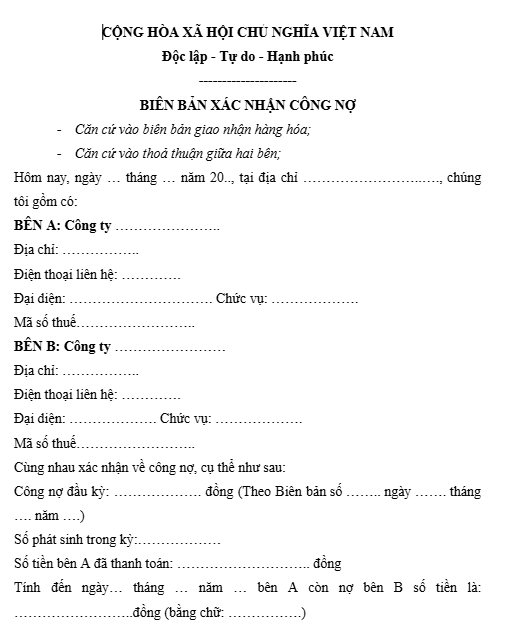
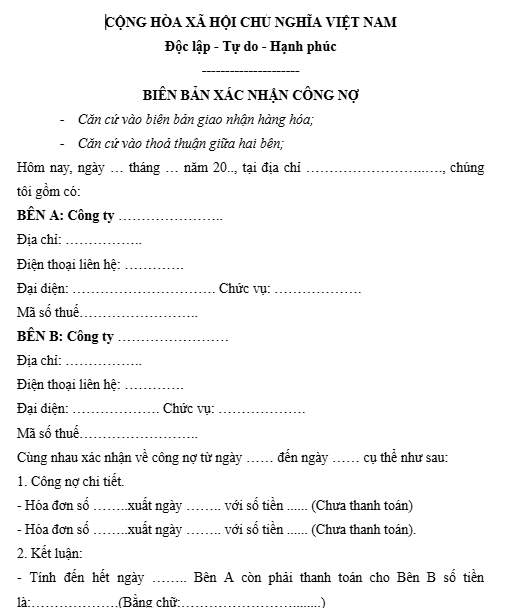
| Business debt confirmation form | Businesses need to confirm accounts receivable or payable with customers and suppliers. | Word (.doc) | Download business template |
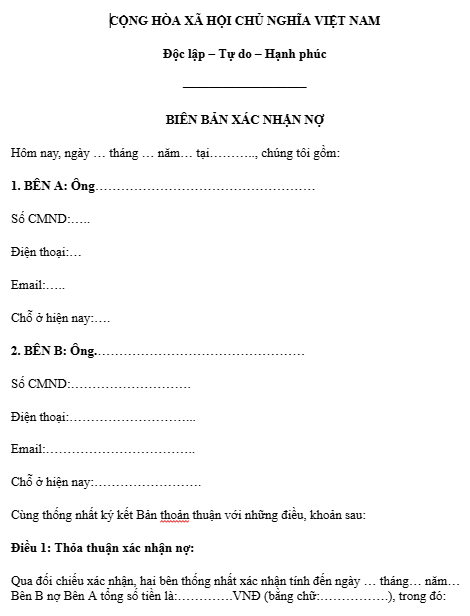
| Personal debt confirmation form | The debt must involve at least one individual party and must clearly state their identification and the basis for the debt. | Word (.doc) | Download personal template |
What is a debt confirmation document?
A debt confirmation document is a written record of the parties' agreement on a receivable, payable, or payment obligation at a specific time. It typically includes the basis for the debt, the amount paid, the remaining balance, the payment deadline, and the confirmation of the parties involved.
Minutes of meeting may be part of documentation proving the status of accounts receivable. The usefulness of the document depends on its content, signatory, signing authority, and accompanying transaction documents; therefore, downloaded templates should not be considered automatically suitable for all cases.
Distinguish between debt confirmation, debt reconciliation, and confirmation letter.
These documents all relate to balances but serve different purposes. Choosing the wrong document can lead to the two parties failing to resolve the discrepancies or not providing the correct evidence for audit purposes.
| Document | Purpose | When should it be used? | Required output |
|---|---|---|---|
| Debt confirmation minutes | Record the balance or payment obligation that has been confirmed by the parties. | After the figures have been verified, at the end of the period or when debt confirmation is needed. | Amount, closing date, basis, deadline, and signature. |
| Debt reconciliation minutes | Compare the detailed data between the two sides and identify the differences. | Before confirmation or when the accounts payable records of both parties do not match. | Table of variations, differences, causes, and agreed-upon figures. |
| Letter confirming outstanding debt | Request a direct response from one party regarding the balance stated in the letter. | Commonly encountered in audit procedures or third-party confirmations. | Provide feedback to agree, disagree, or point out discrepancies. |
| Payment confirmation slip | The payment obligation has been acknowledged as fulfilled. | After the debtor has paid in full and confirmation is needed that there is no outstanding balance. | Amount received, date received, and status completed. |
When you need to compare the details of each invoice and make payments before signing, please refer to the following: debt reconciliation form Instead of using the confirmation form immediately.
Select a template based on each debt case.
A single template is unlikely to simultaneously handle accounts payable to customers, suppliers, individuals, amounts paid, and amounts requiring repayment. Maintain the core structure but adjust the information fields to suit the specific situation.
Confirm customer accounts receivable
For accounts receivable. Include contract number, invoice number, amount collected, amount due, due date, and contact person.
Confirmation of accounts payable
Used when a business confirms its obligations to a supplier. It requires comparing invoices, goods or services received, and payments made.
Year-end debt confirmation
Finalize the balances on the closing date. A detailed breakdown and a deadline for responding to discrepancies should be attached before finalizing the report.
Confirmation of debt and commitment to payment
In addition to the balance, the payment schedule, method, responsibilities in case of late payment, and the authorized person making the commitment should be recorded.
Confirmation of full payment
Clearly state the amount received, the date of receipt, the basis for payment, and confirm that you are no longer obligated within the scope of the transaction.
Confirmation of personal debt
Accurate identification information, contact address, basis for the debt, amount in numbers and words, and payment deadline are required.
What information should a debt confirmation document include?
An easily verifiable memorandum should allow the reader to answer four questions: who is confirming, where the debt originated, how the balance is calculated, and what the parties will do next.
- Text information: Document name, record number, date, and location of creation.
- Information of the parties: Name, tax identification number or identifying information, address, representative and position.
- Basis for origin: Contracts, appendices, invoices, delivery notes, acceptance certificates, or related agreements.
- Deadline: The date the balance is determined and the data period is reconciled.
- Details of the amount: Beginning balance, increases, decreases, payments, and remaining balance.
- Status of obligation: Outstanding debt, partially paid, fully paid, or outstanding balance.
- Payment terms and methods: This applies when there is an outstanding balance to be paid.
- Differing opinions: Instructions on how to record outstanding balances and the deadline for submitting supporting documents.
- Confirm: Signatures, full names, titles, and seals or forms of confirmation consistent with the parties' records.
- Number of copies and archives: Number of copies, the party responsible for archiving, and a list of attached appendices.
How to check your balance before filling out the form.
Before preparing the report, accountants should recalculate the balances from the original data instead of simply copying the ending balances from a tracking sheet. The verification formula needs to be consistent with how the business records transactions.
Example test
Company A has opening receivables of VND 80 million, new invoices totaling VND 120 million, customer payments of VND 150 million, and a downward adjustment of VND 10 million. The projected balance at the confirmation date is VND 40 million. Before recording in the minutes, the accountant needs to verify that the payment has been correctly matched to the invoice and that the adjustment has supporting documentation.
The process of confirming outstanding debts between businesses and partners.
An efficient process begins with data cleaning, only creating confirmation documents after identifying discrepancies. This reduces the exchange cycle and avoids signing off on unverified balances.
-
Select closing date and range.
Identify the customer, supplier, contract, accounting period, and type of balance that needs confirmation.
-
Compile original data
Collect contracts, invoices, delivery notes, acceptance certificates, receipts, payment orders, bank statements, and adjustment documents.
-
Compare and classify the differences.
Differences in timing, missing documents, unmatched payments, returned goods, discounts, or disputed items.
-
Prepare and submit the minutes.
Record the agreed-upon number, attach a detailed table, state the recipient, and specify the response deadline.
-
Handling feedback
Note the agreement or difference; do not adjust the ledger based solely on unsubstantiated feedback.
-
Sign, save, and track
Keep records of transactions along with transaction files; update payment schedules, send debt reminders, or plan for handling outstanding debts.
To standardize the aggregation, verification, approval, and monitoring process, businesses can refer to the following: debt management process.
How do you handle discrepancies in accounts receivable figures?
When two parties disagree on the balance, the first goal is not to sign a memorandum in time, but to identify the transaction that caused the discrepancy. Each group of causes requires a different type of evidence.
| Common causes | How to check | How to reflect this in the record |
|---|---|---|
| Payment has been transferred but not yet recorded. | Compare the bank statement, the date of the transaction, the details of the transfer, and the amount awaiting reconciliation. | Mark the item as pending verification; supplement the documentation before making any adjustments. |
| Missing or duplicate invoices | Compare invoice numbers, dates, values, contracts, and invoice receipt data. | Create a list of missing/duplicate documents and agree on the correct accounting entries for processing them. |
| Returns, discounts, or adjustments | Check the return record, discount agreement, and adjustment documents. | Only reduce the balance when there is a valid reason. |
| Different recording times | Compare the delivery date, acceptance date, invoice date, and closing date. | Specify the timing and period for which the discrepancies will be recorded. |
| The amount in dispute | Identify the missing values, obligations, and documents. | Separate the agreed-upon portion from the unresolved portion; do not record them together as the confirmed balance. |
Checklist before signing the debt confirmation document.
The checklist below helps reduce data errors and document errors before submitting them to the authorized person for signing.
- The closing date of accounts payable matches the detailed statement and the accounting period.
- The legal name, tax identification number, address, and representative are recorded correctly.
- Each invoice or transaction has a basis for verification.
- The payments have been correctly matched to the customer, contract, or invoice.
- The amount in numbers and the amount in words do not contradict each other.
- The agreed-upon parts and the remaining discrepancies are clearly separated.
- The terms, methods, and payment schedule are feasible if there are outstanding debts.
- The signatory has the qualifications or authority appropriate to the company's records.
- The appendix is numbered, referenced, and kept together with the minutes.
- There is a point of contact to track feedback and update the status after submission.
After confirming the balance: how to track and collect outstanding debts?
The debt confirmation document only finalizes the balance at a specific point in time. After both parties sign, the Finance Team still needs to monitor due invoices, paid amounts, amounts awaiting reconciliation, and unfulfilled commitments.
With centralized data by customer, contract, and invoice, businesses can move from manual confirmation to a continuous management process: updating balances, classifying aging debts, tracking DSOs, and prioritizing receivables.
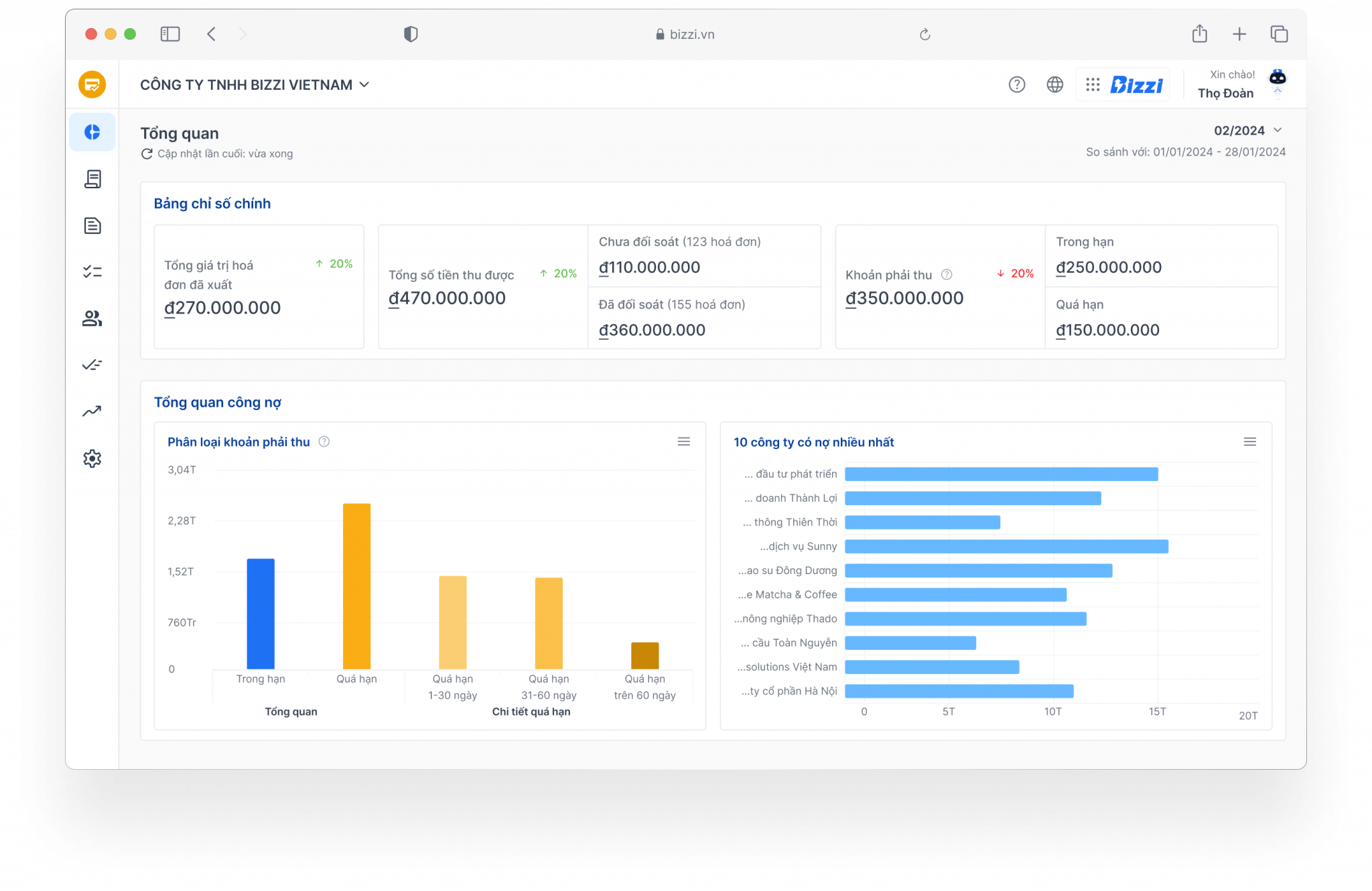
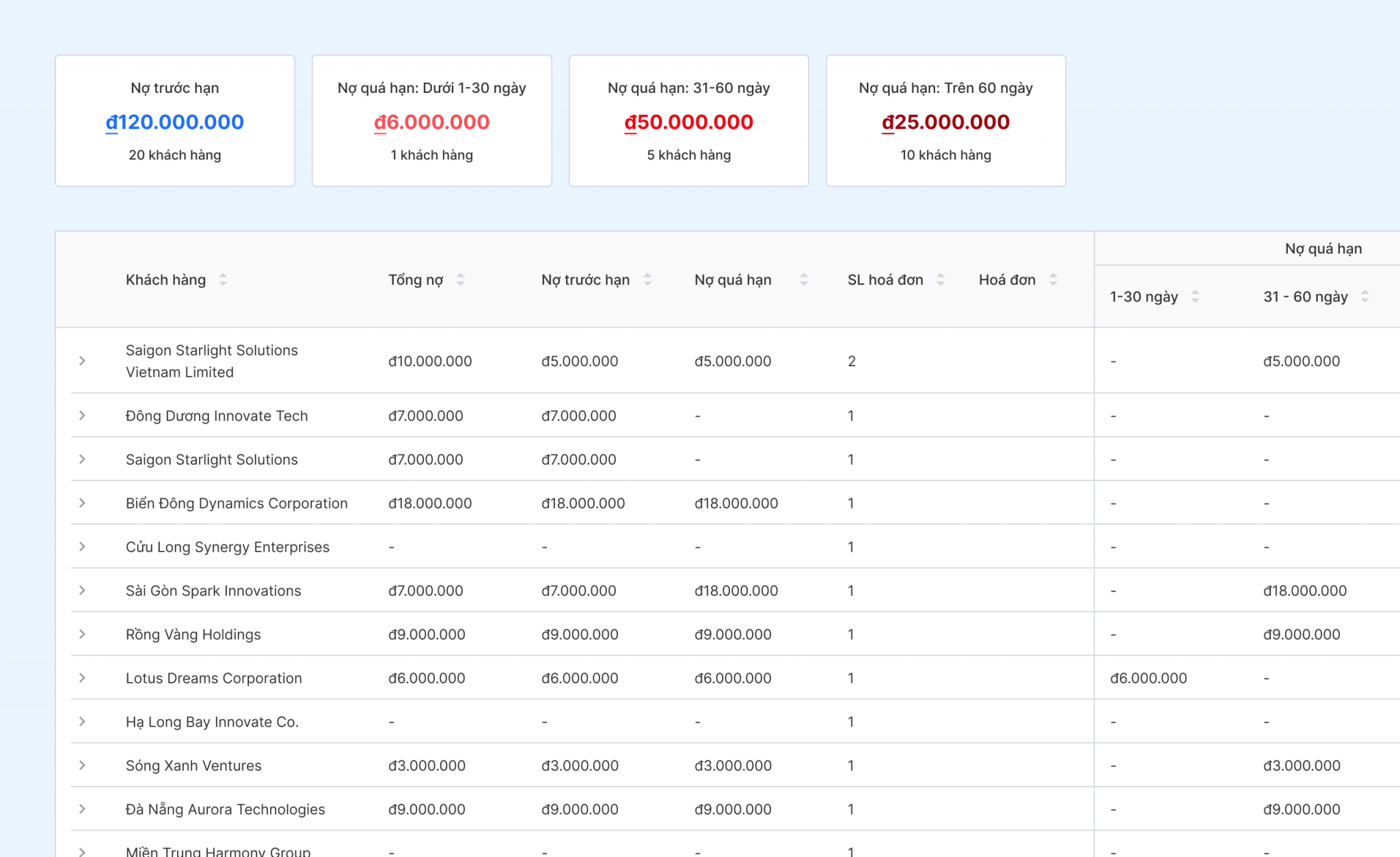
According to the solutions page, Bizzi ARM supports managing accounts receivable by invoice, contract, and customer; tracking DSOs, reporting aging of accounts receivable; managing pending payments and reconciling with bank statements.
Centralized debt management with Bizzi ARM
Track invoices, contracts, customers, aging accounts receivable, DSOs, and pending payments on a single system.
Frequently Asked Questions about Debt Confirmation Memorandums
The answers below clarify common situations encountered when selecting samples, filling in data, and signing off on them.
Is it mandatory for a debt confirmation document to follow a fixed template?
Businesses should design content based on actual transactions, ensuring correct identification of parties, basis for the transaction, closing date, amount, payment status, and confirmation. The downloadable template is a starting point and does not replace a thorough review of the specific documents.
What are the differences between a Word and an Excel file for a debt confirmation form?
Word is suitable for drafting signed confirmation documents. Excel is suitable for creating detailed tables of multiple invoices, payments, and remaining balances. When dealing with large amounts of data, a Word document can be used as the main document, and the finalized Excel or PDF spreadsheet can be attached.
Does a debt acknowledgment document need to be signed by both parties?
To demonstrate mutual confirmation by all parties, the document should be authenticated by the relevant parties. The credentials and authority of the signatories should be verified against company records, contracts, or authorizations applicable to the transaction.
Should we use a confirmation report or a reconciliation report at the end of the year?
If the figures have not been compared in detail, do so first. After processing or clearly separating the differences, prepare a statement confirming the balances at the closing date. The two documents may be used consecutively but should not be considered as one.
What should you do if the customer doesn't respond to your debt confirmation?
Businesses should retain proof of submissions, verify the correct contact, follow up within the specified timeframe, and use appropriate communication channels. Simultaneously, they should review internal transaction records and categorize unanswered accounts to continue monitoring or processing them according to established accounts receivable management procedures.
If all debts have been paid off, should I still use a balance confirmation form?
Avoid using the phrase "still owed" if the obligation has been fulfilled. Use a written confirmation or receipt stating the amount received, the date of receipt, and the extent of the completed obligation.
Does the auditor's debt confirmation letter match the minutes of the meeting between the two businesses?
Not exactly the same. An audit confirmation letter is typically designed for the interviewee to respond directly to balances or terms. A memorandum between the two businesses usually records the results of a reconciliation or agreement reached between the two parties.
Points to remember before using the template
A debt confirmation form is only valuable when the data is verified, the documents are selected for the correct purpose, and the signatory has the appropriate authority. Start with a detailed transaction table, handle discrepancies, then finalize the balance and track payment obligations after signing.