


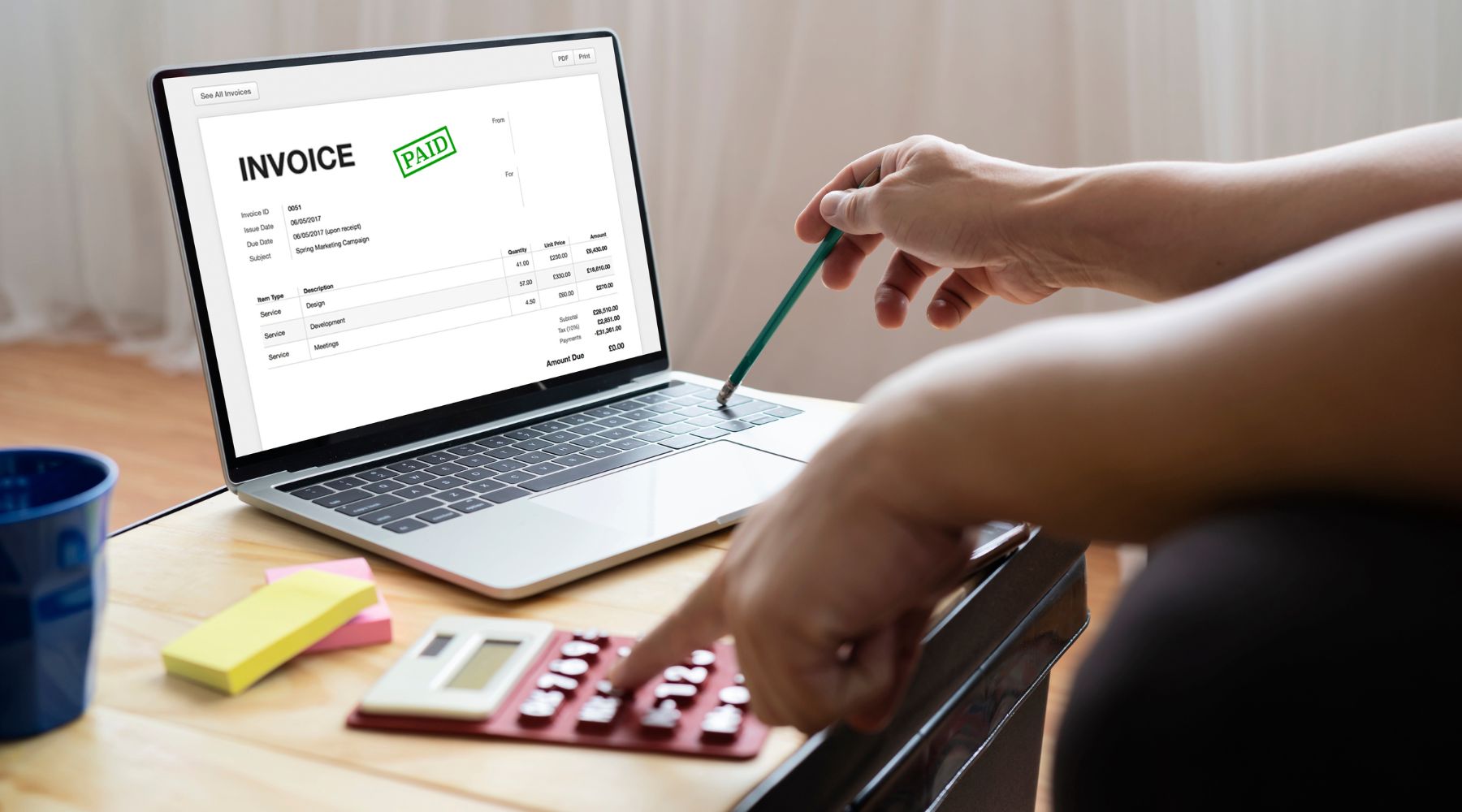
How much hidden cost are you incurring on manual document verification? Receiving invoices from "phantom companies" by mistake, or issuing invoices when inventory is in deficit, not only leads to tax penalties but also depletes your business's working capital.
This article by Bizzi will address that bottleneck by providing CFOs and Chief Accountants with an internationally standardized process for managing incoming and outgoing invoices, applying automation to eliminate risks and accelerate cash flow.
How do input and output invoices impact the capital turnover cycle?
Input invoice Accounts Payable (AP) and Accounts Receivable (AR) are not just accounting documents, but represent the "velocity of cash flow" within a business. Input invoices represent cash outflows, while output invoices represent cash outflows. output invoice This determines the cash flow. By effectively managing input and output invoices, CFOs can extend payment terms to suppliers and shorten collection times from customers, thereby optimizing the Cash Conversion Cycle (CCC).
The core issue lies not just in "accurate recording," but in the speed of matching between documents and cash flow. Slow matching means capital is tied up, reducing the efficiency of working capital utilization. This is why managing input and output invoices becomes a crucial financial leverage rather than just an accounting operation.
What legal framework must businesses comply with to protect deductible expenses?
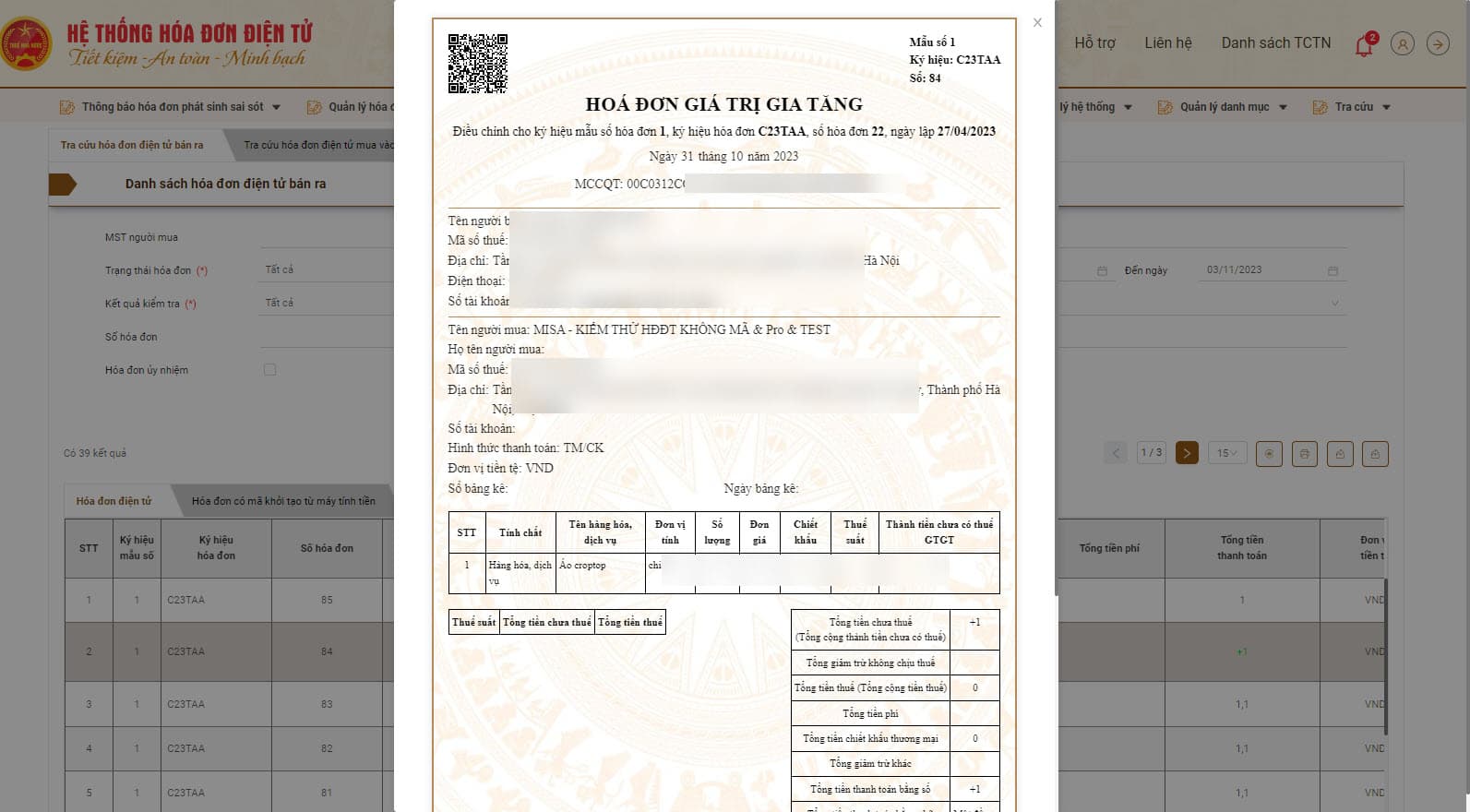
For invoices to be considered valid and deductible for tax purposes, businesses must comply with multiple layers of legal regulations. Crucially, electronic invoices must exist in XML format as stipulated in Decree 70/2025/ND-CP and guided by Circular 32/2025/TT-BTC. This data must be stored intact for at least 10 years, and transactions of 5 million VND or more must be settled through a bank to be eligible for tax deduction.
Checklist for Mastering Input and Output Invoices
An effective input-output invoice management system should operate in a closed five-step process, rather than as a series of disconnected operations:
1. Extract invoice data from emails without typing.
Manual data entry creates significant hidden costs and risks of errors. When using OCR/AI, entire invoices from email or data portals are automatically extracted and standardized into a single source of truth. This not only saves time but also reduces VAT losses due to incorrect or omitted data entry.
2. 3D verification to block fraudulent payments
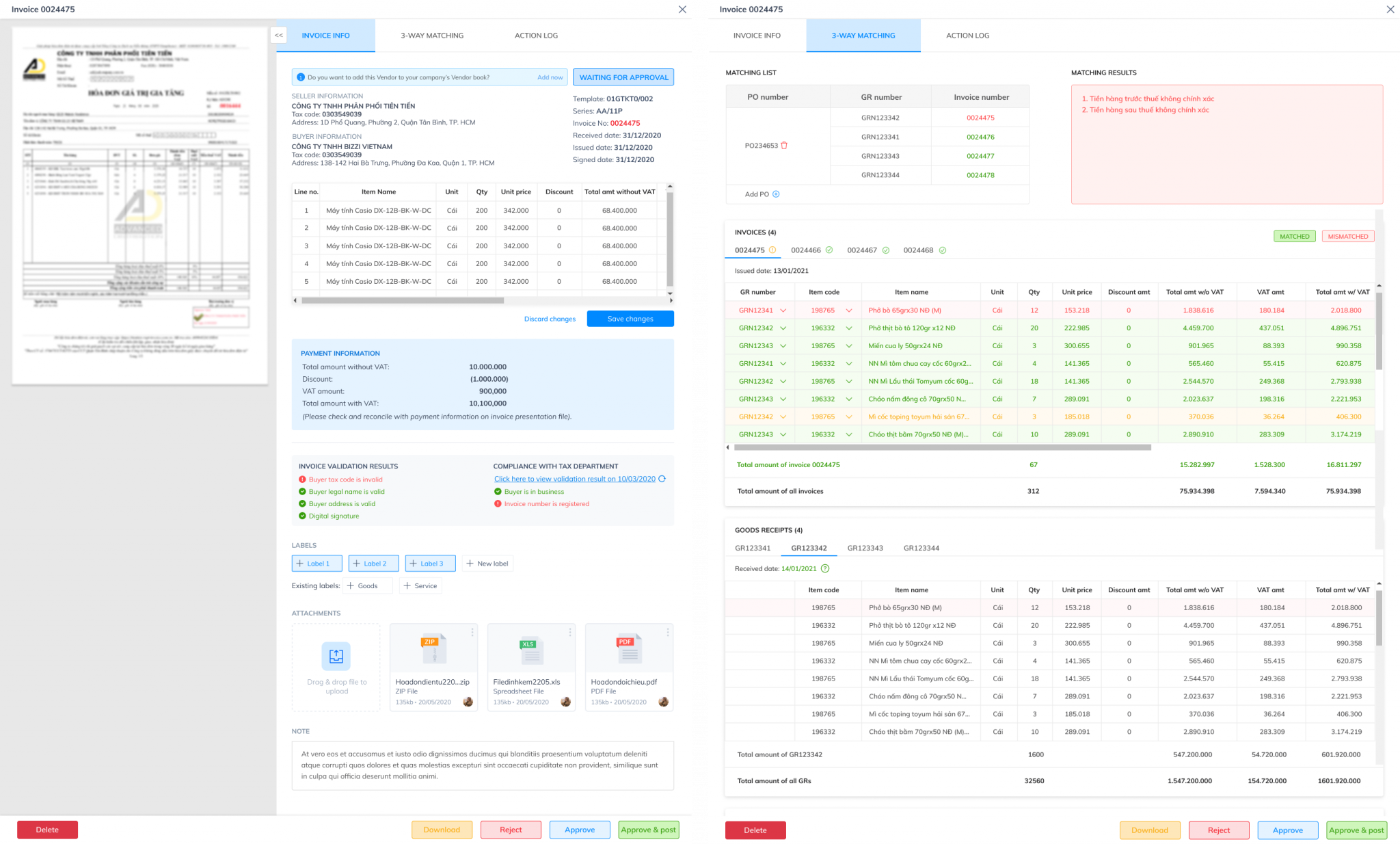
The three-way reconciliation mechanism (Invoice – Purchase Order – GRN) is the most important control layer in the Procure-to-Pay process. The system automatically matches quantities and unit prices at the line-item level, ensuring that businesses only pay for goods actually received. Discrepancies are detected before money leaves the account.
3. Review the supplier's tax identification number status.
Paying businesses that have ceased operations can lead to serious tax risks. Therefore, the system needs to check the tax identification number status in real time to block risky invoices before accounting for them.
4. Manage outgoing invoices to reduce DSO.
Outgoing invoices should be linked to the order-to-cash collection process. When businesses implement an automated debt reminder and aging tracking system, Number of days to collect payments (DSO) The timeframe was significantly shortened, which helped improve cash flow.
5. Synchronize data with ERP.
Once verified, invoice data is automatically pushed into the ERP system to generate ledger entries (GL Posting). This shortens closing time and provides timely financial reports to management.
Table: Risk Comparison Matrix – Manual vs. Automation
| Criteria | Handmade | Automation |
| Processing time | 10–15 minutes per invoice | <10 seconds |
| Data entry error | High | Almost 0 |
| 3D verification | Handmade | Automatic |
| Tax audit | Manual search | Real-time API |
| Storage | Fragmentation | Cloud 10 years |
What price do businesses pay when tax inspectors discover fictitious inventory?
A fictitious inventory loss occurs when a business has issued outgoing invoices but has not received incoming invoices or recorded corresponding inventory entries. If discovered by a tax audit, the business may face penalties. Input VAT type, upward adjustment of taxable revenue, collection of corporate income tax, and penalties for violations.This also distorts financial statements and actual cash flow.
Currently, the data electronic invoice XML file It is automatically cross-referenced across the entire system. The tax authority uses it:
- Match the timestamps between input and output invoices.
- Matching purchase and sale chains by tax identification number.
- Detecting inventory discrepancies by industry (retail and FMCG are very easy to detect).
If the "sell first - buy later" pattern appears, the system will put the business under inspection. Specific financial consequences (RISK):
- Input VAT type → Loss of tax deduction rights
- Collection of Corporate Income Tax (CIT) due to invalid expenses
- Fines and late payment penalties according to regulations
- Revenue breakdown if suspected of fraudulent export
It can be quickly visualized using a formula:
- Tax loss = VAT disallowed + (Disallowed expenses × Corporate income tax rate)
- Total loss = Tax arrears + Penalties + Opportunity cost of capital
Example: An invoice worth 1 billion VND was rejected. Direct damages: 300 million (excluding penalties)
- VAT 10% = 100 million is not deductible.
- Corporate income tax under Article 20% on disallowed expenses = 200 million VND
To avoid negative inventory, CFOs need to design controls in a targeted manner. “pre-control” (before recording) Instead of post-audit processing:
- Revenue cannot be recorded without supporting documentation for inventory receipts or a clear provisional pricing mechanism.
- Apply Three-way reconciliation (PO–GR–Invoice) Make it a mandatory condition before recording.
- Set up a rule to receive alerts when inventory drops below 0.
- Standardize the process for handling late invoices.
What are common questions that chief accountants and CFOs have when digitizing electronic invoicing management?
Chief accountants and CFOs often have questions about Legal aspects, data security risks, deployment costs, system integration capabilities (ERP/accounting), and the process for handling erroneous invoices. When digitizing electronic invoice management, they are concerned with how to automate processes, minimize manual errors, and ensure compliance with tax regulations.
Below are the common question categories:
How can we ensure that suppliers issue invoices on time?
Businesses should include SLA (Security Level Agreement) in contracts, requiring invoices to be issued within 24–48 hours of acceptance. This helps avoid inventory discrepancies and data inaccuracies.
What should I do if I've already paid the supplier but they disappear?
It is necessary to prepare complete documentation including contracts, payment receipts, and delivery records to prove the transaction was genuine, thereby protecting the legitimacy of the expense.
How do I manage invoices from multiple branches?
An effective solution is to use cloud-based workflow automation to centralize approvals and synchronize data with the ERP system via APIs.
What is the difference between two-way and three-way reconciliation?
Two-way verification only matches invoices and orders, while three-way verification adds warehouse receipts. This is the most important layer of control to prevent fraud and incorrect payments.
Conclude
Managing incoming and outgoing invoices is no longer a simple accounting task, but a system for controlling cash flow and financial risks at the CFO level. When operated manually, businesses face three major problems: data errors, tax risks, and stagnant cash flow.
The solution lies in building an end-to-end automation process, from data extraction and three-way reconciliation to compliance checks and ERP synchronization. This transforms invoices from mere documents into reliable data sources for financial decision-making. This allows CFOs not only to "close the books faster" but also... Close the loopholes that cause losses and optimize working capital in a sustainable way..
To receive advice on effective corporate financial management solutions, schedule an appointment with Bizzi here: https://bizzi.vn/dat-lich-demo/