



Business travel expenses are not only costs for work trips but also an important part of corporate cost management. Optimizing the business expense process. This involves standardizing the entire workflow of requests, approvals, service bookings, advances, invoicing, settlement, and reconciliation, enabling businesses to control costs before, during, and after a trip. When the process is tightly designed and operates on centralized data, businesses can reduce manual errors, enhance transparency, and help CFOs monitor budgets and cost efficiency in real time.
What does optimizing the business expense process mean?
Optimizing the business expense process involves redesigning how businesses propose, approve, spend, document, settle, and report business expenses to reduce manual operations and increase control throughout the entire lifecycle of a business trip.
In reality, business travel expenses include not only airfare, train tickets, or hotel accommodations, but also many other incidental expenses such as taxi fares, meals, accommodation allowances, conference fees, baggage fees, entertainment expenses, or other expenses directly related to work. Each expense needs to be managed according to internal regulations, budget, and valid documentation to meet management requirements and facilitate accounting, auditing, and settlement processes.
Many businesses still believe that optimizing business travel expenses simply means cutting the travel budget. However, this approach only addresses the "how much to spend" aspect and fails to tackle the "how to spend" question. An optimized business travel expense process needs to ensure that all expenses are:
- The right person is allowed to do it.
- In line with the purpose of the work.
- In accordance with internal policies and standards.
- The budget has been allocated correctly.
- The documentation is correct and fully traceable for inspection or post-audit purposes.
To achieve this, businesses should view the business expense process under three mutually reinforcing layers of control instead of focusing solely on the final settlement step.
Policy layer – Standardizing policies and standards
This is the foundation of the entire process. Businesses need to build it. Sample regulations on travel expenses The regulations should clearly define the applicable subjects, conditions for business trips, reimbursable expenses, limits based on rank or location, advance payment and reimbursement deadlines, and exceptions. The clearer the policy, the lower the likelihood of disputes or subjective approvals.
Download the document: Regulations on travel expenses according to Circular 99/2025/TT-BTC at This
Workflow layer – Standardizing operational processes
The process should cover all steps from creating work requests, budget review, approval, booking flights and hotels, advances or spending limits, document collection, to settlement and reconciliation. Each step needs to clearly define the responsible person, required data, and control points to minimize errors.
System layer – Digitizing the expense management process
Even when businesses have comprehensive policies and procedures in place, managing data using email, Excel spreadsheets, or paper documents still results in fragmented and difficult-to-control information. Therefore, many businesses are switching to using platforms. business cost management capable:
- Establish rules and spending limits.
- Create and approve proposals via web or mobile.
- Collect and verify invoices using OCR.
- Track budgets by department or cost center.
- Automated document reconciliation, payment processing, and reporting.
- Provides dashboards that help Finance Managers and CFOs track cost trends in real time.
Three classes Policy – Workflow – System These two elements are not interchangeable but need to be implemented synchronously. Policies help define what businesses are allowed to spend, processes ensure consistent execution of steps, and systems automate and track all data to enhance control and retrieval when needed.
Why are manual expense tracking processes prone to delays and difficult to control?
Manual expense tracking processes are often slow because expense data is scattered across emails, Excel spreadsheets, paper invoices, bookings, statements, and approvals via chat or verbal communication. When each step is processed using a different tool, it becomes difficult for businesses to track the status of each expense and reconcile data during the final settlement process.
Initially, manual processes may be sufficient for small businesses. However, as the number of business trips increases, multiple departments incur expenses, or the business expands to multiple branches, manual data entry, verification, and reconciliation will quickly become a bottleneck.
| Bottleneck | Consequences for employees | Consequences for Finance |
| Browse through email/chat | Browsing status unknown | Difficult to trace responsibility |
| The employee advances money from their own pocket. | Personal cash flow pressure | Extended reimbursement |
| Lost invoice | Claim returned | Accountants spend time checking. |
| Booking does not match requirements. | Expenditures outside of established policies are likely to occur. | Difficult to verify |
| Manual data entry | Late complaint submission | Accounting errors |
| No dashboard | The actual cost is unknown. | CFOs only see data after the period. |
It's worth noting that most of these problems don't stem from employees intentionally violating regulations, but rather from a lack of coordination between steps in the process. A work request approved via email is difficult to reconcile with bookings, invoices, or advances later on. Similarly, when documents are sent through multiple channels, accountants spend a lot of time compiling them before they can finalize the accounts.
As a result, businesses not only lose additional resources but also struggle to track budgets in real time. CFOs often only see the full cost picture after accounting completes the end-of-period summary, causing a delay in budget control and adjustment compared to actual operations.
What steps should a standard expense reimbursement process include?
A standardized business expense reimbursement process should cover the period before, during, and after the trip, rather than just processing it when employees submit documentation. Designing the process to encompass the entire lifecycle of a business trip helps businesses control their budget from the outset, reduce the risk of incurring expenses outside of established policies, and shorten the settlement time.
The reference process may include the following 7 steps:
- Create a work request
Employees prepare work requests with complete information about the purpose of the trip, duration, location, department, cost center, project (if any), and estimated budget. This serves as the basis for management to assess the necessity of the trip and prepare financial resources. - Review policies and budgets.
The finance or budget verification system checks whether the request complies with regulations on travel expenses, limits based on rank, expense type, work route, and the remaining budget of the department or project. Controlling expenses before they are incurred helps limit budget overruns or policy violations. - Approve the work request.
Requests are processed through approval levels based on role, value, or risk level. In cases of expenses exceeding the standard budget or cost overruns, an exceptional approval process and full documentation are required for future reconciliation. - Book tickets, hotels, or related services.
Bookings for flights, hotels, or other travel services must adhere strictly to the approved terms. Bookings should be cross-checked with the business requirements to avoid incurring expenses beyond the approved scope. - Advance payments, settlements, or spending limits.
Businesses can choose to disburse advances, make direct payments, or provide appropriate spending limits. The goal is to reduce the need for employees to borrow personal funds while maintaining control before the money is used. - Collect invoices, receipts, and work reports.
After the trip, employees are required to submit invoices, receipts, payment documents, expense statements, and work reports (if required by regulations) within the specified timeframe. This forms the basis for reimbursement and expense recording. - Settlement, reconciliation, accounting, and reporting.
The accountant verifies the work request, advance payments, bookings, actual documents, and incurred amounts to process reimbursements or additional payments, then records and updates the data in the management report.
Summary of business expense procedures
| Step | Person in charge | Data/Documents | Checkpoint |
| Create a work request | Staff | Purpose of the mission, time, location, cost center, estimated budget. | Complete and accurate information |
| Review policies and budgets. | Finance/Admin or System | Regulations on travel expenses, budget, and norms. | Check your remaining budget and limits. |
| Approve the request | Direct Manager, Finance, Exception Approval | Request for work, budget information | Approved according to the approved route, leaving a trace of the approval. |
| Book tickets, hotels | Support staff or department | Booking, service confirmation | The booking matches the approved requirements. |
| Advance payment or settlement | Finance/Accounting | Advance payment request, payment order | Disbursement will only be made when all conditions are met. |
| Collect documents | Staff | Invoices, receipts, statements, work reports | On time, with complete documentation. |
| Settlement and reporting | Accounting/Finance | Settlement documents, payment vouchers | Complete and update management reports. |
A standardized process following these steps not only reduces processing time for staff and the finance department but also creates a foundation for businesses to apply deeper layers of control such as budget overrun alerts, automated invoice verification, data reconciliation, and cost analysis by department or project. This also serves as a prerequisite for digitizing the entire business expense process on a unified platform.

Key control points at each step of the expense tracking process.
Optimizing the business expense process within enterprises. It's not just about designing the processing steps, but also about clearly defining control points at each stage to prevent out-of-plan costs, budget overruns, or insufficient basis for settlement. When each step has clear verification criteria, businesses will significantly reduce the risk of errors and limit the volume of exception processing later on.
| Step | Risk | Checkpoint |
| Create a work request | The purpose of the work is unclear, or there is a lack of project or departmental information. | It is mandatory to declare the purpose, location, time, department, project/cost center, and estimated budget. |
| Review request | Approval without budget review or exceeding allocated limits. | Review remaining budget, travel expense policy, and warnings before approval. |
| Book tickets/rooms | Bookings that do not meet standards or unexpected issues arise. | Compare the booking with the approved business trip request, check the ticket class, hotel, and length of stay. |
| Advance | Advances exceeding actual needs or duplicate disbursements. | Apply credit limits based on rank, length of service, and location; check open advance payments. |
| Record the invoice. | Invoices with incorrect information, missing documents, or duplicates. | Verify the validity of the invoice, compare it with the booking, and issue a warning about duplicate invoices. |
| Settlement | Delayed reimbursement, missing documentation, and lengthy reconciliation processes. | Establish a document submission SLAs, specify reimbursement deadlines, and define exception handling procedures. |
| Report | No unusual cost trends were detected. | Dashboard by department, work route, project, expense category, and budget. |
1. Control right from the task request creation stage.
Many budget overruns stem from poorly worded travel requests. Simply stating "meeting with a client" or "business trip to Hanoi" without clearly defining the objective, duration, project, and estimated budget makes it difficult for the finance department to assess the necessity of the trip.
A job application form should include at least:
- Purpose of the business trip.
- Time and place.
- Relevant department or project.
- Cost center.
- Estimated costs.
- Advance payment required (if any).
As a result, all subsequent expenses have a basis for comparison.
2. Budget control before approval.
This is the class pre-inspection This is the most important aspect of the business expense process.
Before management approves, businesses should check the following simultaneously:
- How much budget is left for the department or project?.
- Is the expenditure within the prescribed limits?.
- Does the employee have any outstanding advances that haven't been settled?.
- Was the trip part of an approved plan or an unplanned event?.
If budget overruns or exceeding limits are detected, the system should issue a warning and request higher-level approval instead of leaving it to the accountant to handle during final settlement.
3. Compare bookings with work requirements.
Once approved, booking flights, hotels, or transportation also needs to be monitored.
Businesses should ensure:
- Bookings were made for the correct business trip route.
- The ticket class complies with the regulations.
- The length of stay matches the schedule.
- No additional services will be added beyond the scope of what has been approved.
Matching bookings with work requirements helps limit unplanned expenses and reduce disputes during settlement.
4. Control of advances
If a company uses a system of advance payments for business expenses, the advance payment should be tracked as an amount awaiting settlement.
Checkpoints typically include:
- Advance payment limits are based on rank or length of service.
- No new advances will be granted until the previous one has been repaid (except in approved exceptional cases).
- Monitor the repayment deadline right from the time of disbursement.
- Link the advance payment to the approved work request.
As a result, Finance can better control cash flow and limit prolonged outstanding advances.
5. Check invoices and supporting documents immediately upon receipt.
Waiting until the end of the month to review documents often causes accountants to waste more processing time and increases the risk of missing records.
Businesses should check documents immediately when employees submit them in order to:
- The invoice was found to be missing information.
- Check for duplicate invoices.
- Compare this with the approved expenditure.
- Verify when the expense was incurred.
- Please supplement your application promptly if any documents are missing.
Digitizing documents immediately after a trip also helps reduce the risk of losing paper invoices.
6. Establish SLAs for reimbursement and settlement.
An effective process is not just about regulations. must reimburse, and also stipulates When will the reimbursement be processed?.
Businesses should clearly define:
- The deadline for submitting documents is after the end of the business trip.
- Timeframe for Finance to process the application.
- Payment schedule for any excess expenses (if approved).
- Procedure for handling cases where documents are missing or exceed the prescribed limits.
These SLA metrics help reduce backlogs and shorten settlement cycles.
7. Track expenses using dashboards instead of end-of-period reports.
After settlement, business trip expense data should be compiled into management reports so that the CFO and Finance Manager can track spending trends.
Common analytical dimensions include:
- Costs by department.
- Project-based costs.
- Expenses based on business trip.
- Costs per employee.
- Expenses categorized by item (airfare, hotel, taxi, allowances, etc.).
- Budget usage by period.
Instead of just looking at the total expenses at the end of the month, a near-real-time dashboard helps businesses detect unusual expenses early and adjust their budgets in a timely manner.
When control points are established throughout the entire process, from request creation to reporting, the expense tracking process will no longer rely on accounting "post-audit" but will become a proactive control system. On a digital platform like Bizzi Travel & Expense, These control points can be configured into spending policies, budgets, approval flows, invoice checks, and real-time dashboards, helping Finance reduce manual operations while increasing cost control throughout the entire business trip lifecycle.
How to optimize advances, reimbursements, and settlements of business expenses.
Advances and reimbursements should be designed as a cash flow control mechanism, not just a post-trip payment procedure. When regulations regarding advances, settlements, and reconciliation are standardized from the outset, businesses can reduce outstanding advances, minimize missing documentation, and ensure that business travel expenses are recorded in the correct accounting period.
1. Clearly define the conditions for receiving an advance payment.
Not every business trip requires an advance payment. Businesses should specify the circumstances under which advances are permitted to avoid unnecessary upfront payments.
Conditions for receiving an advance payment usually include:
- The work request has been approved by the competent authority.
- The estimated costs are in accordance with the regulations on travel expenses.
- These include expenses that need to be paid in advance, such as airfare, hotels, transportation, or project implementation costs.
- There are no more overdue advances that have not been repaid (or require exceptional approval).
Clearly defining the conditions from the outset helps Finance better control the flow of funds and reduces instances of providing advance funding without actual expenditure.
2. Establish advance payment limits for each group of recipients.
Instead of applying a single advance payment limit for the entire company, limits should be established based on the level of risk and characteristics of each business trip.
Common criteria include:
| Criteria | Example application | Note on control |
| Rank | Employees, managers, leaders | Appropriate to the authority and job requirements. |
| Area of work | Within the province, inter-provincial, international | Adjusted according to actual costs in each region. |
| length of service | 1 day, several days, long term | The limit increases with trip duration. |
| Cost Type | Travel, accommodation, allowances | Only provide an advance payment for the amount that is truly necessary. |
| Department/Project | Sales, implementation, engineering… | Aligned with the budget of the cost center or project. |
Setting spending limits helps businesses both facilitate employees' work and prevent them from overspending beyond actual needs.
3. Clearly define the repayment deadline.
One of the reasons why advances are often delayed for extended periods is the lack of specific regulations regarding settlement deadlines.
Businesses should establish the following regulations:
- The repayment period begins from the date the business trip ends.
- Deadline for submitting reimbursement applications.
- Procedure for handling late submissions.
- A reminder mechanism for outstanding payments.
Establishing Service Level Agreements (SLAs) for reimbursements allows Finance to proactively monitor settlement progress, preventing the accumulation of documents at the end of the month or accounting period.
4. Handling discrepancies between advance payments and actual expenses.
After the employee completes their business trip, the accountant needs to compare the amount advanced with the actual expenses incurred to determine the difference.
| Situation | How to handle it |
| Pay exactly the amount of the advance payment. | Close the advance payment and record the expense. |
| The amount spent was less than the advance payment. | The staff member returned the remaining amount. |
| Spend more than the advance payment. | Additional payment will be made if the expense is eligible and approved. |
| Expenditures exceeding the budget | Processing will only be done if an exception is approved according to regulations. |
| Missing documents | Requests for additional information or processing will be handled according to internal policy. |
A standardized process helps reduce disputes between employees and the finance department, while ensuring transparency in expense management.
5. Establish an exception approval mechanism.
In practice, some business trips may incur costs exceeding the budget due to schedule changes, price fluctuations, or special client requirements.
Businesses should clearly define the following:
- What cases are considered exceptions?.
- Who has the authority to approve it?.
- Additional documentation is required.
- Conditions for the expenditure to still be settled.
As a result, the business maintains operational flexibility while ensuring that any overspending is justified and fully documented.
6. No new advances will be granted until the previous advance has been repaid.
This is one of the most effective control mechanisms for limiting the accumulation of long-term advances.
Businesses can stipulate:
- Employees with overdue advances will be temporarily unable to create new advance requests.
- Exceptional cases require approval from management or the Finance Manager.
- The system automatically alerts you when it detects an outstanding advance payment.
This measure helps reduce the amount of capital tied up in loans while also improving employee compliance with the reimbursement process.
7. Link the advance payment to the approved work request.
Advance payments should be directly linked to the work request, project, or cost center, rather than existing as a standalone transaction.
This helps businesses:
- Track expenses for each business trip.
- Verify the budget's usage even before disbursing funds.
- Quick reconciliation between work requests, advances, documents, and final settlement.
- Assist in generating expense reports by department, project, or work route.
Among modern expense management solutions such as Bizzi Travel & Expense, Advance payments can be linked to work requests, spending policies, budgets, and approval processes all on the same platform. This allows Finance to track advance payment status in real time, while significantly reducing manual reconciliation when employees repay advances.
What documents are needed for the business trip expense settlement?
The expense settlement file must include all necessary supporting documents, including approvals, supporting invoices, expense statements, and confirmations from the competent authority. A complete set of documents not only helps accountants process settlements more quickly but also provides a basis for the business to explain its position during audits, inspections, or post-audits.
In practice, the list of documents can be adjusted according to internal travel expense regulations, and must also comply with current regulations on accounting, taxation, and electronic invoicing.
Checklist for travel expense settlement documents
| File group | Documents should be included. | Purpose |
| Based on the work | The work request or proposal has been approved. | Provide evidence for the purpose and scope of the business trip. |
| Cost estimate | Estimate or request for advance payment | Compare with actual costs |
| Moving documents | Flight tickets, train/bus tickets, hotel bookings, service confirmations | Proof of expenses incurred |
| Bill | Electronic invoice or valid supporting document as prescribed. | To be used as a basis for accounting and tax purposes when eligible. |
| Pay | Receipts, bank statements, payment documents (if any) | Confirm the actual payment. |
| Settlement | Business trip expense statement | Summarize all the expenses of the trip. |
| Work report | Report on the results of the business trip (if required by regulations) | Demonstrate the results of the work performed. |
| Payment/Reimbursement | Request for payment or reimbursement | Complete the settlement process. |
| Approve | Confirmation from management, accountant, or finance department. | Close the file and record the expense. |
Some things to note when preparing settlement documents.
To minimize the risk of documents being rejected or delays in the settlement process, businesses should note the following:
- Prepare the necessary documents during your business trip instead of waiting until the trip is over.
- Compare the information between the work request, advance payment, invoices, and expense statements before submitting.
- Adhere to the repayment deadlines as stipulated in internal regulations to avoid incurring overdue advance payments.
- For expenses subject to documentation requirements or payment methods as stipulated by current laws, businesses should carefully review them to ensure sufficient basis for accounting and tax declaration.
Digitizing the document collection process also significantly reduces the workload for Finance. Instead of receiving paper invoices from various sources, businesses can use tools to capture and upload documents via mobile applications, automatically verify invoice information, and link documents to specific work requests and advance payments. As a result, settlement records are centralized on a single platform, making reconciliation, auditing, and retrieval convenient when needed.
What KPIs help Finance Managers and CFOs track the effectiveness of expense reporting?
A CFO needs to know not only the total cost of business trips, but also where those costs are coming from, why they are exceeding the budget, and whether the processing procedures are slow. Only by properly monitoring operational KPIs can businesses assess the effectiveness of their expense tracking processes and identify bottlenecks affecting cash flow, budgets, and the productivity of their finance team.
Instead of simply compiling expenses at the end of the month, Finance Managers should build a real-time tracking system to measure the entire lifecycle of a business trip: from proposal, approval, service booking, expense generation to settlement and reporting.
| KPI | Management significance |
| Timeframe for reviewing work requests | Measure operating speed before the trip, identify bottlenecks in the approval process. |
| The rate of requests exceeding the policy. | Measure the level of compliance with regulations on travel expenses among departments and employees. |
| Off-budget expenditure ratio | Assess the quality of planning and budget control before any expenditures are made. |
| Settlement time after the trip | Measure the processing performance of Finance and the speed of completing expense claim files. |
| Percentage of files with missing or incorrect documents | Evaluating the quality of incoming documents reduces the time spent on supplementing paperwork and minimizes risks during post-audits. |
| Business trip expenses by department/project | Assists in budget control, analyzing spending trends, and optimizing resource allocation. |
| The booking rate matches the job requirements. | Measure the effectiveness of the control between the approved request and the actual service delivered. |
| Rates for ticket refunds, cancellations, or changes. | Monitor unexpected expenses to adjust travel policies and ticket bookings. |
From a financial management perspective, these KPIs should not be tracked individually but rather combined to comprehensively reflect process efficiency. For example, short approval times but high overspending rates may indicate that the process prioritizes speed over control. Conversely, a high percentage of complete documents but lengthy settlement times may reflect problems in the final reconciliation or approval stages.
For these metrics to be meaningful, data must be linked throughout, from work requests, budgets, bookings, invoices, payments, to final settlements. When all information is centralized on a single system, CFOs can monitor dashboards by department, project, work route, or expense type, thereby making decisions to adjust policies and budgets based on data rather than intuition.
When should businesses digitize their business expense processing?
Businesses should digitize when business expenses become unmanageable using Excel spreadsheets, emails, and fragmented documents. As the number of business trips increases, manual processes not only slow down processing times but also lead to scattered data, making reconciliation difficult and limiting the ability to control the budget in real time.
Initially, many businesses could manage business expenses using Excel spreadsheets combined with email or shared spreadsheets. However, as the size of the workforce, the number of projects, or the number of business locations expanded, this method revealed many limitations: difficulty in tracking approval status, lost documents, lengthy settlement processes, and CFOs only seeing expenses after the accounting period had ended.
Some signs that indicate it's time for a business to move to a digital process include:
- Many employees travel for business each month, resulting in a large volume of requests and documentation.
- Businesses with multiple departments, projects, branches, or cost centers need to track their own budgets.
- Accountants spend a lot of time checking invoices, reconciling bookings, and compiling settlement documents.
- Employees often have to borrow money from their own pockets before being reimbursed.
- The approval process still relies on email, text messages, or paper documents, making it difficult to trace the processing history.
- Without real-time tracking of the operational budget, budget overruns are only detected after expenses have already been incurred.
- Bookings, invoices, and payment requests are not linked, making reconciliation time-consuming.
- CFOs need dashboards to track cost trends by department, project, or work route, but the data is currently scattered across multiple systems.
When encountering these signs, digitization is not just about shortening processing time. More importantly, businesses can standardize the entire process from business trip requests, budget control, approval, advance management, invoice collection to settlement and reporting on a single data stream. This significantly reduces manual operations in the Finance department while improving cost control before, during, and after each business trip.
How does Bizzi Travel & Expense optimize the business expense process?
Bizzi Travel & Expense helps transform the business expense process from fragmented handling to a digitized flow connecting business requests, policies, budgets, bookings, invoices, payments, and reports. https://bizzi.vn/dat-lich-demo/. Instead of managing each step across multiple tools, businesses can configure the process according to internal policies and track the entire lifecycle of a business trip on a single platform.
| Process requirements | Bizzi Travel & Expense support |
| Create a work request | Create proposals and work plans on the system with complete information about purpose, schedule, departments, and cost center. |
| Policy control | Establish regulations for travel expenses based on department, rank, limits, and expense categories. |
| Budget control | A warning about budget overruns or depletion will be displayed immediately upon creating a work request. |
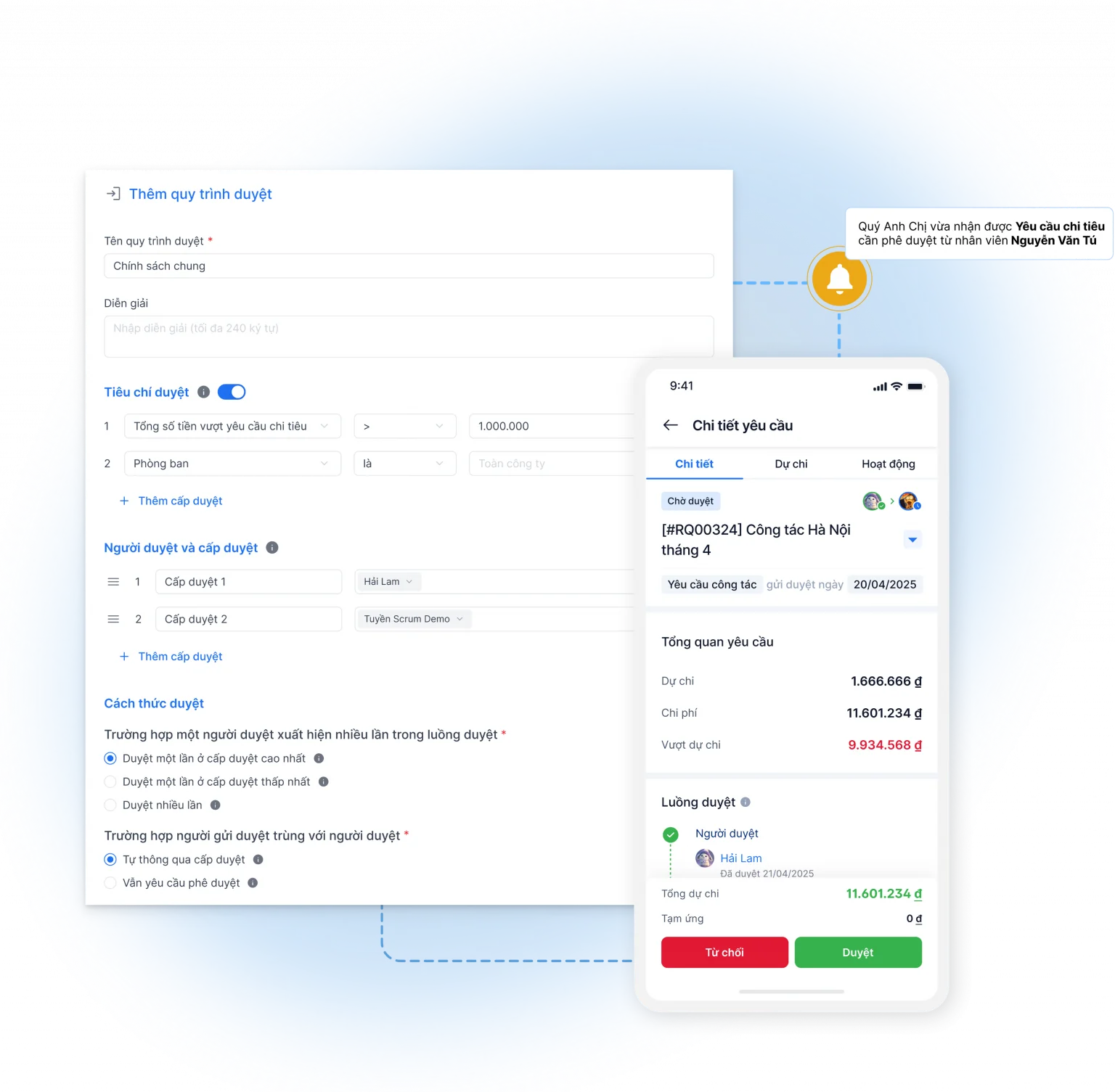
| Approve | Automated approval flow based on multiple criteria, with support for mobile app approval. |
| Book tickets | We help you find suitable flights based on policies, limits, flight times, airlines, and class of service. |
| Record the expense. | Create expense requests, scan receipts, collect electronic invoices, and store records centrally. |
| Check the invoice | Automatically collect and verify input invoices, helping to reduce errors and duplicate documents. |
| Reconciliation | Compare bookings with work requirements, and reconcile costs by employee, department, or project. |
| Report | The dashboard analyzes business trip expenses, ticket refund/cancellation/change status, spending trends, and budget utilization. |
Bizzi Travel & Expense's strengths lie not only in the digitization of individual business processes but also in its ability to connect all data throughout the entire process. When an employee creates a business trip request, the system can simultaneously check policies, budgets, and approved routes for compatibility. During the business trip, incurred expenses are updated along with invoices and supporting documents. After the trip, data is reconciled with bookings, advances, and payments to facilitate faster settlement.
For CFOs and Finance Managers, centralizing all data on a single platform enhances real-time cost monitoring, early detection of budget overruns, and the creation of management reports by department, project, or work route. It also provides a foundation for businesses to shift from administrative expense management to data-driven expenditure management.
Checklist for optimizing business travel expense procedures.
An optimized expense tracking process requires adequate policies, approval flows, documentation, reconciliation, and management reporting. Before investing in tools or Expense and travel expense management software for businesses, Businesses should review whether their current processes meet basic control requirements.
Implementation checklist
- □ There are regulations regarding travel expenses based on rank, department, or group of personnel.
- □ There are spending limits based on the type of expense and the location of work.
- □ Budgets are allocated by cost center or project.
- □ There is an approval process in place before any business trip takes place.
- □ There are clear regulations regarding advances, reimbursements, and settlement deadlines.
- □ There is a list of required supporting documents for each type of expense.
- □ There is a warning mechanism in place for exceeding the budget or policy limits.
- □ There is a process for collecting and verifying electronic invoices.
- □ There is a reconciliation process between the booking, the work request, and the actual costs.
- □ There is a dashboard to track travel expenses by department, project, route, and time.
If a business doesn't meet many of the criteria in the checklist above, standardizing policies and digitizing processes will significantly reduce processing time, while also improving budget control and the quality of data for management.
FAQ on optimizing business expense processes in enterprises
What are the steps involved in the business expense reimbursement process?
Typically, the travel expense process consists of 7 steps: creating a travel request, checking policies and budget, approval, booking services, advance payment or settlement, collecting documentation, and final settlement/reconciliation after the trip.
Do travel expenses need prior approval?
Businesses should require prior approval for most business trips to control the purpose, budget, and spending limits from the outset. This also helps reduce instances of unauthorized spending.
How should the regulations regarding advance payments for business travel expenses be structured?
Internal regulations should clearly specify the conditions for receiving advances, limits based on rank or geographical area, repayment deadlines, required documents, and circumstances under which new advances will not be granted if there are outstanding overdue funds.
What documents are needed for settling travel expenses?
The documentation typically includes the approved work request, advance payment request (if any), tickets or bookings, valid invoices, expense statements, payment vouchers, work reports (if required by regulations), and final settlement approval.
How can we control travel expenses that exceed the budget?
Businesses should establish budgets by department or project, review budgets before approval, and clearly define the process for approving exceptions for expenditures exceeding limits.
When should you use expense management software?
As the number of business trips increases, documentation becomes fragmented, approvals rely on email or Excel spreadsheets, and finance departments spend a lot of time on reconciliation, businesses should consider digitizing their processes to improve control and data retrieval.
How is Bizzi Travel & Expense different from managing your business using Excel?
Excel primarily supports data recording, while Bizzi Travel & Expense connects the entire process from business requests, policies, budgets, approvals, service bookings, collection, and Automated input invoice verification, This allows businesses to streamline accounting processes and access analytical dashboards. As a result, they reduce manual operations, increase control, and obtain real-time management data.
Conclude
Optimizing the expense reimbursement process not only helps businesses shorten processing time but also enhances budget control, reduces the risk of missing documentation, and improves transparency in financial management. An effective process needs to be designed comprehensively, from regulations, limits, approvals, advances, invoice collection, settlement, to management reporting, rather than focusing solely on the final payment stage.
For businesses with numerous business trips, multiple departments, or projects, digitizing the entire process ensures seamless data connectivity and readiness for reconciliation, auditing, and decision-making. Bizzi Travel & Expense is a solution that helps businesses standardize business travel expense processes on a unified platform, from managing business trip requests, setting policies and budgets, multi-level approvals, managing advances, collecting invoices, to settlement and expense analysis dashboards. This allows Finance Managers and CFOs to monitor business travel expenses in real time, while improving operational efficiency and long-term financial management.
Register here to receive consultation and experience solutions from Bizzi: https://bizzi.vn/dat-lich-demo/