



Most current corporate financial regulations remain dormant in drawers, creating significant gaps in actual cost control and tax risk assessment. For CFOs, the challenge isn't writing the regulations, but ensuring all personnel adhere to the standards without slowing down operations.
This article by Bizzi not only provides a sample corporate financial regulations based on the latest legal standards, but also guides you on how to "embed" the rules into an automation system. This allows businesses to shift from manual post-auditing to real-time compliance control, safeguarding cash flow and optimizing sustainable profits.
What are corporate financial regulations?
Corporate financial regulations are a system of internal rules that concretize legal regulations into the management of capital, assets, revenue, and expenses. This is the highest legal framework for CFOs to manage cash flow and control financial risks.
In essence, financial regulations of the enterprise This is completely different from accounting procedures. While accounting procedures guide how to record and account for transactions, a company's financial regulations are a miniature "constitution," defining who has the right to decide on spending, within what limits, and under what conditions. This also serves as a basis for tax authorities to accept expenses as legitimate. An expense with complete invoices but not included in the company's financial regulations or exceeding the approved authority may be disallowed during tax settlement.
Lack of corporate financial regulations means reckless spending, capital insecurity, and increased tax risks. Therefore, for CFOs, establishing Latest sample company financial regulations It's not just a legal requirement, but a foundation of governance.
The core contents of a sample company financial regulations.
A standard corporate financial regulations template includes five components: capital and asset management; revenue management – Costs; profit distribution; accounting and auditing procedures; and financial approval authority.
In reality, many websites only provide Sample financial regulations for a joint-stock company. In the form of a reference document. However, what the CFO needs is not a "template," but a logical structure for effective operation. A modern corporate financial policy must address the working capital problem. The basic formula:

If regulations do not clearly specify inventory limits, customer credit limits, or supplier payment cycles, businesses will experience cash flow erosion even if accounting profits remain positive.
Most importantly, it's crucial to establish a "matrix of authority" that is appropriate to the scale. This is where one Sample corporate financial regulations The 2026 standard needs updating.
Regulations on capital management and asset preservation for enterprises.
Capital management regulations focus on the principles of mobilizing, using, and investing capital to ensure solvency. Asset preservation includes provisions, depreciation, and periodic inventory.
From a CFO's perspective, capital preservation is not just about legal compliance, but also a survival strategy. The company's financial regulations need to clearly stipulate:
- Principles of fixed asset investment
- Asset liquidation process
- Provision for risk
- Periodic inventory and discrepancy handling
Without these provisions, the risk of asset loss and internal fraud increases significantly. corporate finance regulations Strict financial oversight will help businesses accurately reflect asset values and avoid the "illusion of profits."
Develop a spending approval matrix in the financial regulations.
An approval matrix is a hierarchical table of authority for deciding on spending based on transaction value and expense type.
In reality, if every small expense had to be signed by the CEO or CFO, the business would fall into a "bottleneck." Therefore, in Latest sample company financial regulationsIt needs to be clearly defined:
- Limit-based access control
- Or budget-based delegation of authority.
The new trend is "Dynamic Approval" – changing the approver based on the actual budget situation.
Comparing methods of enforcing regulations:
| Criteria | Handmade | Executed by Bizzi |
| Approval speed | 2–5 days | 30 seconds – 2 hours |
| Control of quotas | Post-audit | Pre-audit |
| Invoice compliance | Probability testing | Automatic 100% |
| CFO data | End-of-month report | Real-time Dashboard |
| Storage | Paper documents | Digitization 10 Years |
When the approval matrix is set up directly on Bizzi Expense, the system automatically routes spending requests to the correct authority level. CFOs can approve anytime on mobile while still ensuring compliance with 100%. financial regulations of the enterprise.
A three-tiered reconciliation mechanism for invoice compliance control.
3-way matching checks the agreement between the Purchase Order (PO), Gross Receipt (GRN), and Invoice.
The formula for controlling deviations:
Variance=Invoice Amount−(PO Quantity×Unit Price)
If this mechanism is not applied in corporate finance regulationsBusinesses can pay for goods not received or for invoices that have been inflated in price.
Bizzi Bot automatically collects invoices, extracts data, and performs reconciliation using AI. Accountants only handle exceptions, reducing post-audit time. This represents a shift from "regulations on paper" to actual control.
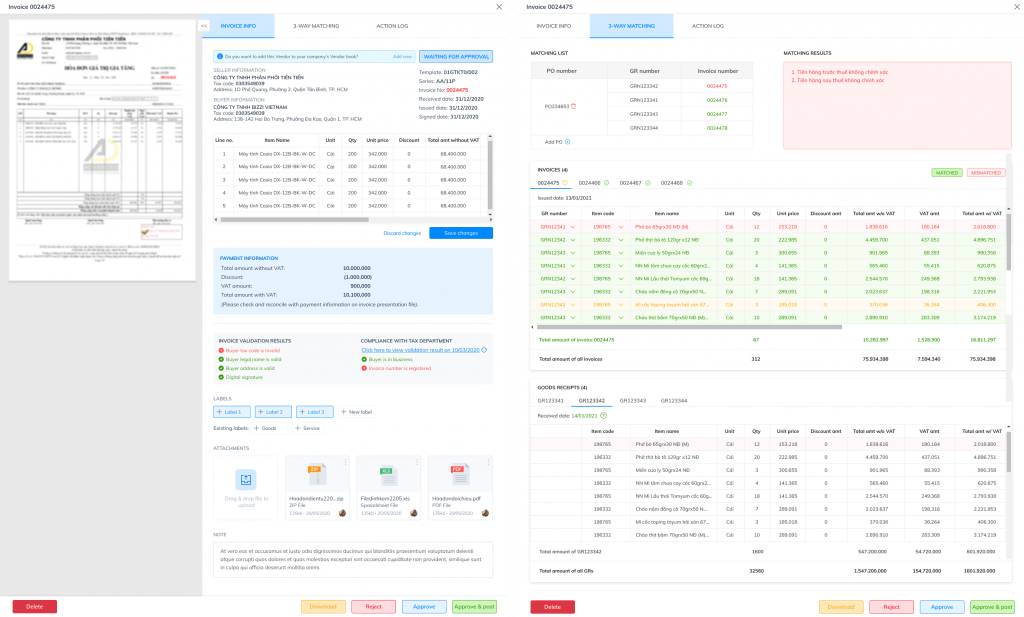
How to integrate financial regulations into an ERP management system.
Integrating regulations into ERP involves converting written terms and conditions into "Business Rules" within the system. CFOs need to choose a solution with flexible API integration capabilities so that invoice data is synchronized in real-time with SAP, Oracle, or internal ERP systems.
Instead of waiting for an audit to detect errors, the system will automatically block the offending transaction right from the initiation stage. Sample corporate financial regulations By being digitized into a rule-based system, compliance no longer depends on human memory.
What are the frequently asked questions about corporate financial regulations? (FAQ)
The above questions show that corporate finance regulations It's not just an internal document, but a foundation for modern financial management. Sample corporate financial regulations The 2026 standard must:
- In accordance with current law
- Protecting costs during audits
- Cash flow and accounts receivable control
- Executed automatically on the system
When regulations are digitized and integrated into operational processes, businesses not only comply with the law but also improve capital efficiency and optimize sustainable profits.
Are financial regulations mandatory for newly established companies?
According to the 2020 Enterprise Law, businesses are not required to submit their financial regulations to the regulatory authority immediately upon establishment. However, this does not mean that businesses are allowed to operate without such regulations.
In fact, during tax audits or inspections, authorities will require businesses to prove the reasonableness of their expenses. Without the company's financial regulations as a basis for determining spending limits, approval authority, and expenditure standards, the risk of expenses being disallowed is very high.
For the CFO, financial regulations are not administrative procedures but tools to protect after-tax profits. Issuing a model corporate financial regulation framework from day one helps establish financial discipline before the organization expands and cash flow becomes complex.
Who has the authority to issue financial regulations for joint-stock companies?
For joint-stock companies, the authority to issue company financial regulations usually rests with the Board of Directors, based on the company's charter and internal delegation of authority.
According to the 2020 Enterprise Law, the Board of Directors has the right to decide on the financial strategy, profit distribution plan, and risk management mechanism. The CFO or Chief Accountant proposes the professional content, but the final approval rests with the Board of Directors.
In practice, a sample financial regulations for a joint-stock company should clearly state:
- Authority of the General Meeting of Shareholders
- Authority of the Board of Directors
- Authority of the General Director
- Financial authorization mechanism
Without clear delegation of authority, businesses may find themselves making financial decisions beyond their jurisdiction, leading to internal disputes or individual legal liability.
How do I update to the latest 2026 corporate financial regulations template?
To ensure Latest sample company financial regulations To be in line with 2026, CFOs need to periodically review legal changes related to:
- Accounting Law 2015
- Corporate Income Tax Law
- Decree 123/2020/ND-CP
In particular, regulations regarding electronic invoices, digital data storage, and accountability are becoming increasingly stringent. If corporate finance regulations Without timely updates, businesses may violate regulations without realizing it.
The update process should consist of three steps:
(1) New legal impact assessment
(2) Comparison with current regulations
(3) Issuing an amended appendix to the Board of Directors' decision
The update is not only for compliance but also helps optimize the governance structure as the business grows in size.
What regulations should financial guidelines include regarding the management of electronic invoices?
In the context of the mandatory application of electronic invoices according to Decree 123/2020/ND-CP, financial regulations of the enterprise The following content needs to be added:
- Invoice acceptance process
- Verify validity (tax identification number, supplier operating status)
- Compare the three layers (PO – GRN – Invoice)
- Minimum storage period: 10 years
- Data access permissions
Without clear regulations, businesses may pay invoices from risky suppliers, leading to disallowed expenses and subsequent tax arrears.
For CFOs, invoice management is not just an accounting task but also involves controlling cash flow and legal risks. By integrating regulations into an automated system, inaccurate invoices will be flagged before payment.
Why should businesses use software like Bizzi to enforce regulations?
One corporate finance regulations Even meticulously drafted documents can be overlooked if executed manually. Emails, Excel files, and paper signatures do not guarantee absolute compliance.
Common risks include:
- Approval exceeding budget limits due to lack of budget review.
- Payment required before all documents are complete.
- Lack of audit trail
Bizzi acts as a “regulation enforcement system,” translating regulations into rule-based control. Once the approval matrix is implemented, all spending requests are automatically routed and budgeted in real time.
For the CFO, this represents a shift from post-audit to pre-audit — protecting cash flow before money leaves the account.
On what basis should spending limits in regulations be established?
Limits company financial regulations It needs to be based on:
- Spending history for the last 12 months
- The annual budget has been approved.
- Actual cash flow capacity
CFOs typically analyze:
Working Capital=Current Assets−Current Liabilities
If spending limits exceed working capital capacity, businesses will have to borrow short-term to cover the costs, increasing financing expenses. Therefore, when developing a plan... Sample corporate financial regulationsThe limit is not just a management figure, but must be linked to cash flow strategy and capital structure.
Will financial regulations help reduce bad debt?
Yes, if a comprehensive debt management mechanism is designed.
One financial regulations of the enterprise Effectiveness needs to be regulated:
- Credit limits by customer group
- Standard payment terms
- Conditions for suspending service when the deadline has passed.
CFOs typically monitor the following metrics:

If DSO increases significantly without a warning mechanism in place, the risk of cash flow imbalance is very high. By combining regulations with an automated debt management system like Bizzi's ARM module, businesses can control credit limits and schedule debt reminders, reducing reliance on manual operations.
Conclusion: From legal documents to automated control systems
One corporate finance regulations Goodness isn't about length, but about execution. In the context of 2026, where data and speed dictate competition, CFOs can no longer rely on manual approvals and fragmented post-audits. Construction Latest sample company financial regulations This is just the first step. The real value lies in digitizing the approval matrix, automating invoice reconciliation, integrating ERP, and providing a real-time dashboard.
Bizzi helps transform financial regulations of the enterprise From a static document to a dynamic control system: pre-auditing instead of post-auditing, clean data instead of end-of-period editing, and automated compliance instead of human dependence. For the modern CFO, this is not just a technological solution, but a strategy to preserve cash flow, optimize profits, and build a sustainable long-term governance foundation.
To receive personalized solutions for your business, sign up for a consultation here: https://bizzi.vn/dang-ky-dung-thu/