



From July 1st, 2025, regulations on cashless payments will change, with the mandatory transfer limit reduced to VND 5 million. This has led many CFOs to question: what are cashless payment documents and how can we build a cashless payment process that is both tax-compliant and optimizes cash flow?
This article by Bizzi will provide a comprehensive analysis of the new legal framework and strategies for automating the Payment Audit process, helping CFOs both comply with regulations and optimize cash flow.
What are non-cash payment documents according to the new regulations?
Understanding what constitutes a non-cash payment document is a prerequisite for avoiding the disallowance of expenses during tax settlement.
Non-cash payment documents are electronic documents or data proving that a payment transaction was made through a bank or payment intermediary instead of using cash, and are a mandatory condition for deducting input VAT for invoices of 5 million VND or more. Decree 181/2025/ND-CP.
Previously, according to Decree 123 and its guiding documents, the threshold for bank payments eligible for VAT deduction was 20 million VND. With Decree 181/2025/ND-CP, this threshold is expected to decrease to 5 million VND, significantly expanding the scope of mandatory non-cash payment documentation.
From a CFO's perspective, this isn't just about VAT or corporate income tax requirements. It's the foundation of the Audit Trail – a complete audit trail from electronic invoices → payment documents → bank statements. Each transaction leaves a "Digital Footprint" that can be cross-referenced by the tax authorities through bank data.
The key point to emphasize is that a valid document is not just a payment order form, but a collection of digital data including account information, transaction time, transfer details, and a matching with the invoice.
The "validity" and "storage" of digital documents have become core issues. In the digital age, storing fragmented files on email or personal computers no longer meets internal control standards. Documents need to be logically linked to electronic invoices and accounting records.
When a business has thousands of invoices exceeding 5 million VND per month, manual verification becomes nearly impossible. In this case, solutions like Bizzi Bot can automatically read the invoice XML data, identify the payment method, and immediately alert if an invoice exceeds the threshold but shows "Cash".
Understanding the definition correctly is just the first step. The bigger question is: why did the government tighten the quota to such a low level?
See more content about Contactless payment
Why has the bank payment limit been reduced to 5 million VND?
This change is not purely technical but reflects a trend toward data-driven tax administration.
Reducing the threshold to 5 million VND aims to promote cashless payments across the economy and enhance tax monitoring through banking data, thereby curbing tax evasion through small but frequent transactions.
The trend toward increased cash flow transparency and tax control using Big Data has made bank statements a crucial data source. The risk formula can be viewed simply:
Total Risk Exposure = Trading Volume (5–20 million) × Manual Error Rate.
When the number of transactions increases sharply, if cash reconciliation is still done manually, compliance risk will increase exponentially. Tax authorities can absolutely use AI to scan bank data and compare it with electronic invoices.
Businesses that fail to establish a proper cashless payment process face the risk of having expenses disallowed en masse.
To comply, businesses need to clearly understand the valid payment methods under the new regulations.
11 Valid Non-Cash Payment Methods (Updated 2026)
To comply with regulations on cashless payments, CFOs need to thoroughly understand each valid payment method and the accompanying documentation requirements. A deep understanding of the nature of each method helps in designing the correct cashless payment process, reducing the risk of expense disallowances.
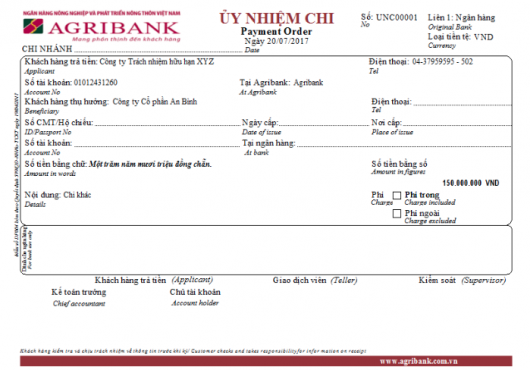
1. Payment Order (UNC)
Payment authorization is the most common form of payment. non-cash payment methodsThe company creates a money transfer order from its company account to the supplier's account at the bank.
To be considered non-cash payment voucherThe UNC (Unclear Documentation Center) must clearly show the sender's information, the recipient's information, the amount, and the payment details, matching the invoice.
2. Checks (including certified checks)
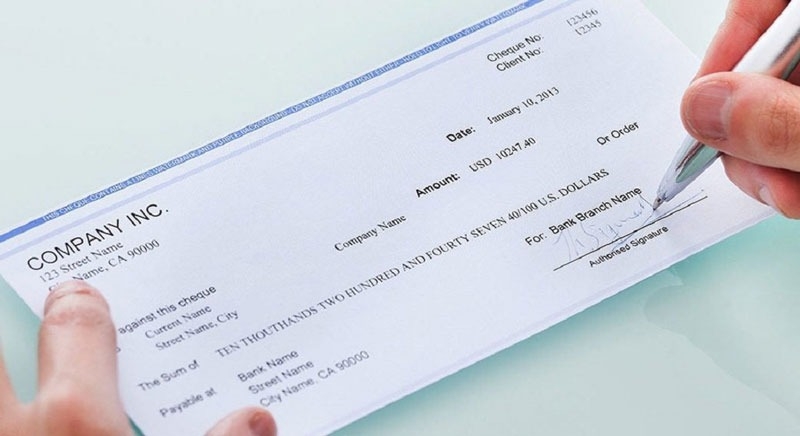
A check is a payment instrument issued or confirmed by a bank, allowing the beneficiary to receive money from the payer's account.
Certified checks offer a higher level of security because the bank guarantees payment. Businesses need to retain the original or certified copy along with their bank statement to ensure its validity. Regulations on cashless payments.
3. Payment by corporate bank card
This includes debit and credit cards issued in the company's name. This is a suitable method for business expenses, online purchases, or international service payments.
Credit card statements and VAT invoices are the minimum documents required to prove the nature of a non-cash payment in this case.
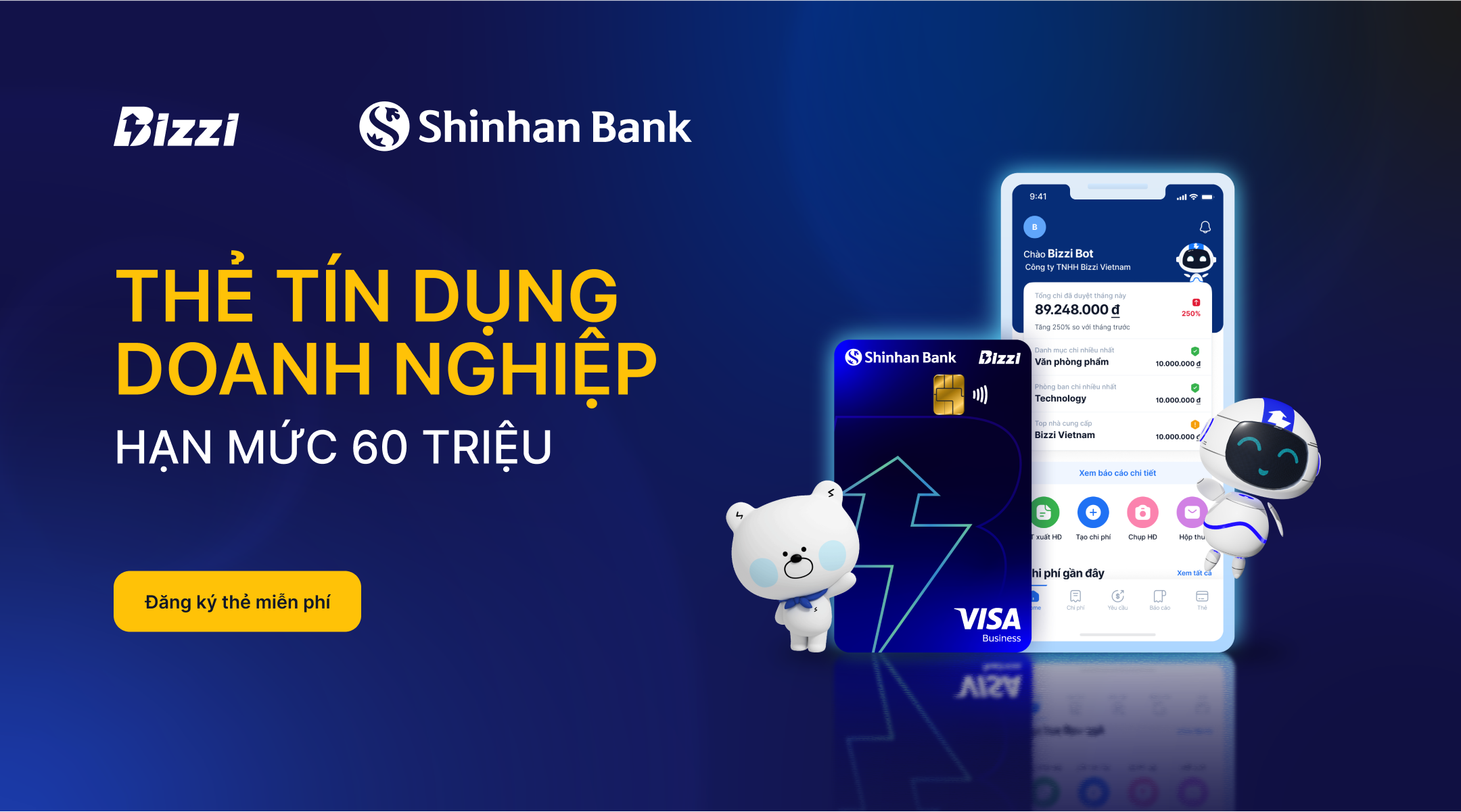
Bizzi Card This is a corporate credit card developed by Bizzi in collaboration with banking partners, directly integrated with the Bizzi Expense expense management platform, helping businesses both pay for expenses and control their budgets on a single system.
The goal of the solution
Bizzi Card is designed to solve a common problem faced by CFOs and accounting departments:
- It is difficult to control business spending by department or project.
- The advance payment and reimbursement process is complex.
- Lack of real-time spending data.
By integrating business cards with its expense management platform, Bizzi helps businesses optimize cash flow and increase transparency in spending.
Outstanding features
- Pay business expenses with a credit card for operations, services, advertising, SaaS, etc.
- Integrates directly with the Bizzi Expense expense management system to track and control spending.
- Managing budgets by department, project, or personnel helps CFOs maintain tighter control over costs.
- Automating expense data makes it easier for accountants to reconcile and manage cash flow.
Benefits for business
- Increase working capital through credit card payments.
- Increase transparency in business spending, reduce losses and off-book expenses.
- Save time on cost management and reconciliation thanks to automatically recorded data.
- Optimizing cash flow and budget management for businesses.
Special offers and privileges
Businesses using the Bizzi Card can receive benefits such as:
- A Bizzi Expense expense management account is included with the card.
- Get a discount when using other solutions on the Bizzi platform such as electronic invoicing or debt management.
- Earn reward points for eligible spending transactions.
In summary, Bizzi Card is a solution combining a business credit card and a cost management platform, helping businesses make flexible payments, control budgets in real time, and automate expense management processes.
4. Business e-wallets
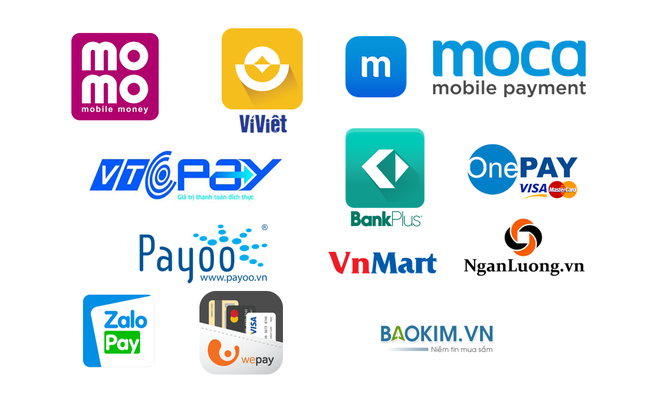
E-wallets registered under a business entity are accepted if the transaction history and identifying information are traceable.
The CFO needs to ensure the wallet is linked to the company bank account and that all electronic transaction reports are properly stored for compliance. Regulations on cashless payments.
5. Letter of Credit (L/C)
Letters of Credit (L/C) are commonly used in import and export transactions. The bank commits to paying the seller when all necessary documentation is provided.
This is a highly controlled method that reduces international payment risks and meets standards. non-cash payment voucher in large commercial transactions.
6. Clearing/Offset of Accounts Receivable/Payable
The two parties have a buyer-seller relationship and can offset their payment obligations instead of actually transferring money.
To be valid, a contract, a debt reconciliation statement, and an offsetting statement are required. If the documentation is incomplete, the tax authorities may not recognize it. non-cash payment voucher.
7. Barter
A transaction involving the exchange of goods or services of equivalent value that does not generate cash flow.
Businesses must issue complete invoices for both directions of transactions and have a contract specifying the payment method. This is still considered one of the requirements. non-cash payment methods If the documentation is complete.
8. Offsetting loan debt
In cases where a business has both a loan and payment obligations to the same partner, the two parties can offset the debts.
The required documents include the loan agreement, reconciliation statement, and offsetting statement. Without these documents, the transaction may not be processed. Regulations on cashless payments.
9. Payment processing via a third party.
Businesses can authorize a third party to make payments on their behalf under a trust agreement.
However, a clear authorization contract and documentation of money transfer from the authorized party's account to the beneficiary's account are required. This is a point that tax authorities often scrutinize closely during audits. Cashless payment process.
10. Payment will be made through a third-party bank as specified in the contract.
In some international or corporate transactions, contracts may stipulate payment into a third-party account.
The condition is that the contract must clearly state the terms and be supported by bank documents proving the transparent flow of funds. The CFO needs to exercise tight control to avoid risks related to transfer pricing or related-party transactions.
11. Non-cash payment instruments approved by the State Bank of Vietnam.
This includes new payment methods as regulated by the State Bank of Vietnam in each phase, such as licensed digital payment platforms or intermediary solutions.
Businesses need to regularly monitor legal updates to ensure these tools meet standards. non-cash payment voucher according to current regulations.
It is important to note that depositing cash directly into the seller's account is NOT considered a non-cash payment.
From an operational perspective, the emergence of corporate e-wallets and virtual cards is expanding the scope of digital payments. For businesses with employees who travel frequently, integrating corporate card management through a platform like Bizzi Expense helps ensure that all transactions have electronic documentation linked to corresponding invoices.
However, with the surge in transactions due to the 5 million VND limit, operational pressure will be the biggest challenge.
Operational challenges when document volume increases 300%
When limits are reduced, the volume of transactions requiring bank reconciliation increases sharply.
The new regulations could increase the number of transactions requiring reconciliation by 300–400%, raising processing costs and extending closing times if businesses continue to perform the process manually.
Cost of Processing = (Number of invoices > 5 million) × Reconciliation time × Accountant's salary/minute.
On average, an accountant spends 5–10 minutes manually matching a transaction. With thousands of transactions, businesses may need to add 2–3 FTEs just to process reconciliations. The solution is to automatically download bank statements via API, connecting to an accounts receivable management system like Bizzi ARM to track cash flow in real time, instead of waiting until the end of the month.
Besides volume pressure, another risk is the practice of splitting invoices into smaller amounts.
Risks of Splitting Invoices and Penalties
Splitting invoices into smaller amounts under 5 million VND to avoid bank payments is a high-risk practice that can result in expense disallowance, tax assessment, and administrative penalties if tax authorities discover that the total value of purchases from a single supplier on a given day exceeds the limit.
The tax authorities can total sales by tax identification number (TIN) for the day. If a CFO only reviews each invoice individually, they won't see the overall picture.
The system features Vendor Consolidation, which automatically accumulates invoice values throughout the day and alerts you when a threshold is exceeded, removing the "Blind Spot". Bizzi Bot can detect duplicate supplier invoices and send alerts before payment.
The ultimate solution lies in standardizing the 3-Way Matching process.
Procedure 3-Way Matching automation
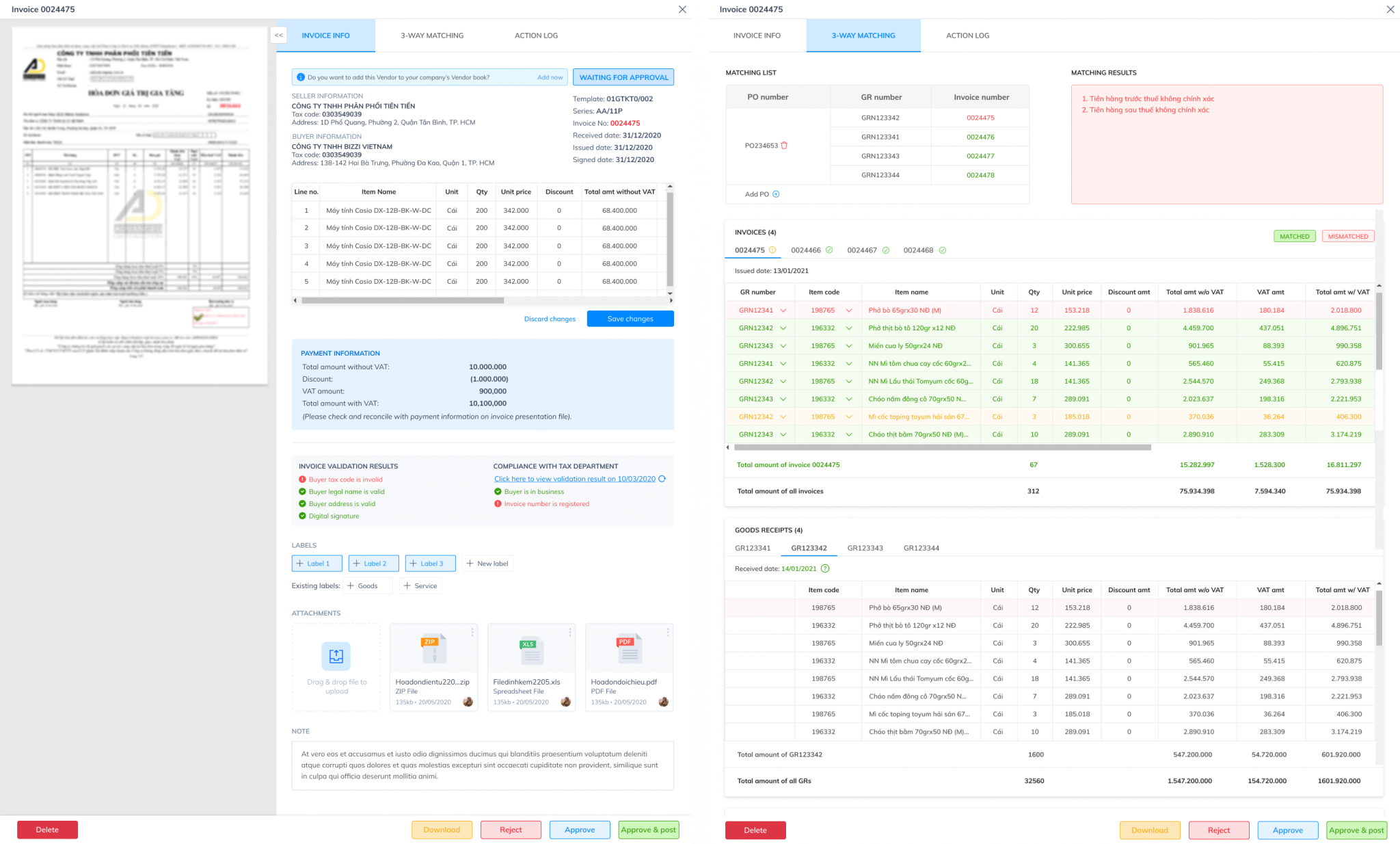
When it comes to cashless payment processThe CFO standard is pre-expenditure control. An automated three-way reconciliation process uses RPA technology to match data between Purchase Order (PO), Invoice, and Payment, ensuring that expenditures are valid before money leaves the account.
The standard procedure includes: comparing the Purchase Order (PO) with the Invoice for price and quantity; comparing the Invoice with the Gross Receipt (GRN); and finally, comparing the Payment with the Invoice for the amount and beneficiary account.
The major difference lies in pre-payment control. Systems like Bizzi allow for automatic invoice extraction, matching with purchase orders (POs) on the ERP system, and only creating payment orders when the data is accurate. CFOs can approve multiple orders with a single click, while simultaneously optimizing DPOs and controlling cash flow.
However, in reality, there are always exceptions that require proper handling of the documentation.
Instructions for processing documents in special cases.
Certain specialized transactions, such as debt offsetting or deferred payment purchases, require complete documentation to meet the requirements. Regulations on cashless payments.
For example, with debt offsetting, a business contract, a debt reconciliation statement, and a debt clearing minutes are required. For purchases made on credit exceeding 5 million VND, the contract must clearly state the payment deadline to avoid tax disallowance before payment is made.
Storing these contracts and documents in a fragmented manner increases the risk during settlement. Digital storage systems like Bizzi Docs allow contracts, invoices, and payment documents to be linked in a unified file, enabling retrieval in seconds.
Frequently Asked Questions (FAQ) regarding payment document regulations
If I make multiple purchases under 5 million VND in a single day, do I need to transfer the money?
Yes, if the total value for the day with the same supplier exceeds 5 million VND.
Is it valid to deposit cash into the seller's account?
No. You must transfer the payment from a company account to a company account or use another cashless payment method.
Is it permissible to pay using the Director's personal credit card and then have the company reimburse the difference?
Yes, but it requires a Financial Regulations document, an Authorization Decision, and a card statement to accompany the reimbursement application. Solutions like Bizzi Expense help manage reimbursements transparently.
What are non-cash payment documents in the case of e-wallets?
These are electronic transaction statements and payment confirmation data from the business wallet, which can be retrieved and compared with invoices.
Conclusion: Digital transformation is key to complying with Decree 181.
New regulations regarding non-cash payment voucher It's not just about changing the number from 20 million to 5 million. This is a major shift towards data-driven tax governance.
If a business continues to operate manually, tax risks, personnel costs, and closing times will increase faster than revenue. Conversely, standardization offers a different perspective. cashless payment processBy integrating 3-Way Matching and automated bank reconciliation, CFOs can transform compliance pressure into a competitive advantage.
Don't wait until July 1, 2025 to take action. Automation with Bizzi Bot and Bizzi Expense not only helps meet the right demands Regulations on cashless paymentsFurthermore, it builds a robust internal control system, optimizes cash flow, and reduces operating costs in the long term.
Digital transformation today is tax risk insurance for tomorrow. Register here to schedule a 1:1 consultation with Bizzi's team of experts: https://bizzi.vn/dat-lich-demo/