


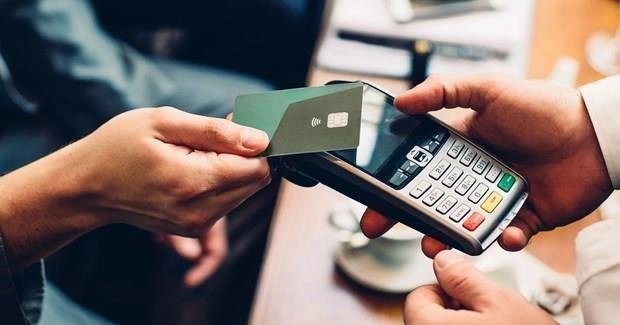
Non-cash payment documents are proof that a business has paid for goods or services through methods such as bank transfers, cards, e-wallets, QR codes, payment intermediaries, or other valid forms without using cash. From July 1st, 2025, according to new VAT regulations, non-cash payment documents for amounts of 5 million VND or more will become an important condition for businesses to deduct input VAT for many goods and services purchase transactions, except for certain specific cases as stipulated.
Therefore, correctly understanding regulations, identifying valid documents, and building effective control processes are no longer solely the responsibility of tax accountants but have become crucial management requirements for the entire enterprise.
What is a non-cash payment voucher?
Non-cash payment documents are electronic documents or data that prove a payment has been made through non-cash methods.
Simply put, this is proof that money has been transferred from the payer to the payee through the financial system, banks, or legally recognized payment intermediaries.
Many businesses still don't fully understand this concept. Many accountants believe that non-cash payment documents are simply payment orders or bank debit notes. In reality, the scope of these documents is much broader.
Depending on the payment method, the supporting documents may include:
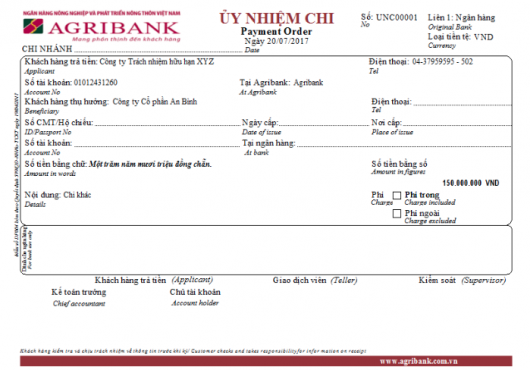
- Payment authorization.
- Money order.
- Debit notice.
- Bank statement.
- Credit card statement.
- Card transaction receipt.
- Electronic wallet voucher.
- Confirm QR payment.
- Minutes of debt offsetting.
- Authorized payment documents.
- Electronic transaction data.
The most important thing is that the documentation must prove:
- The money has actually been paid.
- The payer and the payee.
- Payment value.
- Payment time.
- The connection to invoices, contracts, or economic transactions that arise.
In reality, the value of a non-cash payment document lies not in the document itself, but in its ability to connect with:
- Input invoices.
- Contract.
- Purchase Order (PO).
- Warehouse receipt.
- Acceptance documents.
- Payment requested.
- Expense file.
Having understood that non-cash payment documents are evidence of cash flow, the next question is why this type of document will become particularly important for businesses from July 1, 2025.
Why are non-cash payment documents important from July 1, 2025?
From July 1st, 2025, non-cash payment documents will become one of the important conditions for businesses to deduct input VAT on purchased goods and services, except for specific cases as stipulated.
This is a change that will have a significant impact on a company's accounting, tax, and cost management practices.
Previously, many businesses focused primarily on: collect input invoices. Meanwhile, payment documents are usually only reviewed during tax settlement or when clarification is required by regulatory authorities.
From a management perspective, this approach is no longer appropriate.
Comparison before and after July 1, 2025
| Criteria | Before July 1, 2025 | From July 1, 2025 |
| Value of Goods/Services | From 20 million VND or more | From 5 million VND or more |
| Focus of the application | Invoices and accounting documents | The invoice must match the non-cash payment document. |
| Transaction control | Less attention is paid to payment documentation for small transactions. | Strictly control consistency between invoices and payment documents. |
| Main risks | Missing invoice or purchase record. | Lack of connection between invoices and cash flow. |
| Accounting responsibilities | Collect supporting documents after payment. | Control and approve documents before making payments. |
| Management objectives | Complete your tax return. | Ensuring the legality of cash flow and tax accountability. |
The impact of this change extends beyond just VAT declarations.
Businesses also face many new demands:
- Increase transparency in cash flow.
- Increase transaction traceability.
- Reduce the risk of expense fraud.
- Standardize the payment process.
- Increase the capacity to respond to tax audits and inspections.
This means businesses need to shift their mindset. “"Keep the receipt after the payment is made"” luxurious “"Control before, during, and after spending"”.
Valid types of non-cash payment documents
Non-cash payment documents can arise from various payment methods as long as the non-cash transaction can be proven and can be matched with relevant records.
Summary table of common document types
| Document group | For example | Please check. |
| Bank transfer | Payment authorization form, debit note, bank statement | Check account, amount, and payment date. |
| Bank card | Card statements, POS receipts | Related to the user and purpose of spending. |
| e-wallet | Transaction receipts, payment history | Proof of affiliated with the business |
| QR Code | Confirm transaction, transaction code | Save all reconciliation data. |
| Payment gateway | Transaction ID, receipt | Compare with the invoice. |
| Offsetting debts | Reconciliation record, offsetting record | It has a complete legal basis. |
| Authorized payment | Power of attorney, payment documents | Prove the relationship between the parties. |
| Deferred payment, installment payments | Contract, payment schedule, and installment documents. | Track each payment in full. |
One point to note is that businesses should not keep only a single document.
For example:
- Invoice for advertising services.
- Credit card statement.
- Payment requested.
- Budget approval.
When stored together, these documents form a complete record that helps prove the transaction.
Conditions for payment documents to be accepted when deducting VAT.
Not all electronic payment documents are automatically accepted. The value of the document depends on its ability to prove a real economic transaction.
Checklist of important conditions:
✓ We have a valid invoice.
✓ There is proof of non-cash payment.
✓ The payment details match the invoice.
✓ The recipient of the money matches the transaction.
✓ Relevant purchase or expense records are available.
✓ The business purpose can be demonstrated.
✓ Delivery or acceptance documents are available when required.
✓ There is documentation to explain cases of payment made on behalf of someone else or through an individual.
✓ A debt offsetting agreement will be provided if applicable.
✓ Centralized and complete record keeping.
Real life example
An employee uses a card to pay for business travel airfare. If the company only keeps electronic invoices, that's not enough. A complete set of records should include:
- Airline tickets.
- Electronic invoices.
- Card transactions.
- Job assignment decision.
- Payment requested.
- Approve the expenses.
Only when all the records are linked together can the expenditure be easily accounted for.
See more content about: Top 4 sample business trip payment request forms
Common mistakes when saving cashless payment documents.
Much of the risk doesn't stem from a business's failure to implement electronic payments, but rather from disjointed document management. Common mistakes include:
Only keep the invoice, not the payment receipt.
This is the most common mistake.
The transfer details are too vague.
For example:
- “"Pay"”
- “"Spend money"”
- “"CK"”
These details make comparison difficult.
Payment via personal account
Without clear internal regulations and supporting documentation, businesses may face risks during the tax settlement process.
Failure to retain sufficient payment documents on multiple occasions.
An invoice may be paid in multiple installments. Accountants need to keep complete records of each transaction.
Offsetting debts but without documentation.
The lack of reconciliation statements or offsetting agreements poses a significant risk.
Do not link transactions to the spender.
The business doesn't know:
- Who said that?
- What did the money go towards?
- Which budget will the expenditure follow?.
The documents are only collected when it's time for final settlement.
This is the reason for lost documents and lengthy processing times.
Procedures for controlling non-cash payment documents in businesses.
Businesses should manage payment documents as part of an overall expense control process, rather than processing them individually after the transaction is complete.
Step 1: Create a payment request or purchase request.
All expenditures should begin with a request for documentation.
Step 2: Check your budget and limits.
Ensure that the expenditure stays within the approved budget.
Step 3: Pre-expenditure approval
Reduce the risk of unexpected expenses.
Step 4: Make a cashless payment.
It can be done via:
- Transfer.
- Business cards.
- QR.
- Electronic wallet.
- Another valid method.
Step 5: Gather the documents
Include:
- Bill.
- Receipt.
- Bank statement.
- Transaction documents.
Step 6: Reconciliation
Comparison between:
- Bill.
- Pay.
- The spender.
- Contract.
Step 7: Save the file centrally.
Ensure accessibility.
Step 8: Monitor accounts receivable and payment status
- Payment has been made.
- Partial payment.
- Unpaid.
Step 9: Prepare the report
Serve:
- Accountant.
- Tax.
- Auditing.
- Budget management.
How does Bizzi help manage cashless spending and payment vouchers?
As transaction volumes increase, managing documents using Excel or manual storage makes businesses vulnerable to data loss, difficult to control, and resource-intensive.
Record centralized spending transactions.
Bizzi Expense helps record all spending transactions. of employees on a centralized platform.
Each transaction is linked to:
- For staff use.
- Time of occurrence.
- Supplier.
- Purpose of expenditure.
Set spending limits and policies.
Businesses can:
- Set spending limits based on your card.
- Departmental management.
- Project-based management.
- Track your budget in real time.
Online approval and approval history saving
The entire process is digitized:
- Request for payment.
- Advance payment.
- Refund.
- Approve.
The approval history is fully tracked for auditing purposes.
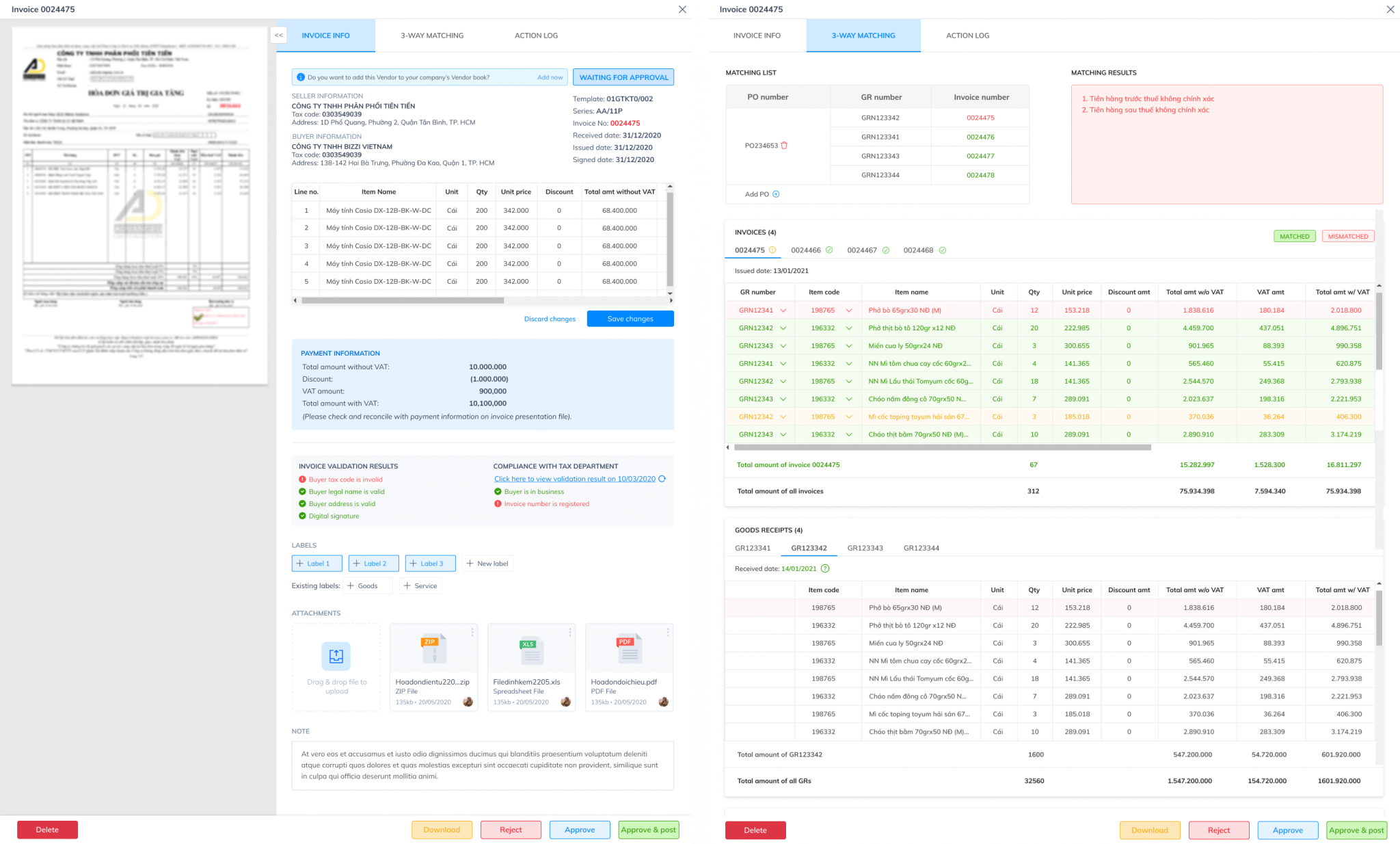
Automated invoice collection and reconciliation
Bizzi Expense supports:
- Collect the invoices.
- Processing invoice data.
- Transaction reconciliation.
- Attach the supporting documents to the invoice.
This significantly reduces the time accountants spend on manual checks.
Expenditure reports and data for audit purposes.
Businesses can track:
- Costs per employee.
- Costs by department.
- Cost varies by supplier.
- Budget situation.
As a result, payment documents are no longer separate files but become management data that can be exploited and analyzed.
What should businesses prepare for before the new regulations come into effect?
Instead of waiting until the tax authorities request an explanation, businesses should standardize their processes now.
The actions that should be taken include:
- Review internal payment policies.
- Limit cash payments.
- Standardize the content of bank transfers.
- The regulations clearly define the use of personal cards.
- Standardize debt offsetting records.
- Train staff on document archiving.
- Connect invoices to payment transactions.
- Implement a centralized expenditure management tool.
- Use business cards to increase control.
If a business has numerous expenses related to business trips, marketing, office supplies, or departmental spending, adopting a platform like Bizzi Expense can help standardize the entire process from approval to document archiving.
Frequently Asked Questions about Non-Cash Payment Documents
What is a non-cash payment voucher?
It is a document or electronic data proving that a business has made a payment using a non-cash method.
From July 1st, 2025, will invoices under 20 million VND require cashless payment?
Businesses need to monitor and comply with the current regulations of the 2024 Value Added Tax Law and related guiding documents. This is a major factor affecting the conditions for VAT deduction.
Is a payment order considered a non-cash payment document?
Yes. This is one of the most common types of documents.
Are bank statements accepted?
It can be used as part of a payment verification package.
What are the risks of paying company expenses with a personal credit card?
The risk lies in the lack of documentation proving the purpose of the spending and its connection to business activities.
Is offsetting debts considered a non-cash payment?
It may be considered if appropriate documentation, agreements, and records are available.
How should the payment receipts be kept when there are multiple payments?
Businesses should keep complete records of each payment and link them to the same invoice or contract.
What should be done if there is a lack of documentation for non-cash payments?
It is necessary to review the possibility of supplementing the application, cross-check with the bank, and prepare explanations based on the actual situation.
Does expense management software help save payment receipts?
Yes. Modern expense management platforms can store, reconcile, and retrieve documents centrally.
What support does Bizzi Expense provide in managing cashless payment documents?
Bizzi Expense supports transaction recording, limit management, online approval, invoice collection, document reconciliation, and report generation for accounting, auditing, and tax purposes.
Conclude
Non-cash payment documents are not just an accounting record requirement but are becoming a crucial element in a company's financial management and tax compliance. When the new regulations take effect on July 1, 2025, businesses need to shift from a mindset of retaining documents after each transaction to building a comprehensive control process from expense request, approval, payment, invoice collection to reconciliation and archiving.
Manual document management may meet the needs of small-scale businesses, but as the number of transactions increases, businesses face the risk of lost records, difficulty retrieving data, and lengthy explanations during audits or tax inspections. This is where digital solutions for expense management and cashless payments come into play.
Bizzi Expense, combined with business cards, helps businesses control the entire spending lifecycle on a unified platform: from setting limits, online approval, real-time transaction recording, invoice collection, document reconciliation to budget reporting and tracking for accounting, auditing, and tax purposes.
Sign up for a Bizzi demo today to experience our centralized cashless expense and payment voucher management solution, helping businesses reduce tax risks, improve budget control, and optimize financial and accounting operational efficiency.
Digital transformation today is tax risk insurance for tomorrow. Register here to schedule a 1:1 consultation with Bizzi's team of experts: https://bizzi.vn/dat-lich-demo/