



In many businesses, cost control often only begins when invoices are sent to the accounting department or when employees complete reimbursement procedures. However, by then, the expense has already been incurred, and the business is almost powerless to prevent it if errors are discovered. The only thing that can be done is to check the documents, adjust the accounting entries, or handle cases of policy violations.
That's also why more and more businesses are shifting from a post-audit to a pre-audit approach to expenses – that is, controlling spending before it occurs. Instead of only verifying after the money has been spent, businesses establish layers of control from the moment a need arises for purchases, business trips, advances, or payment requests. These layers of control include: corporate spending policy, spending limits, budgets, and procedures for approving expenses before they are incurred.
For CFOs and finance teams, pre-auditing is more than just an approval process. It's a management method that helps businesses proactively protect their budgets, improve cash flow forecasting, and significantly reduce the amount of error handling required during post-auditing. So, what is pre-auditing of expenses, how does it differ from post-auditing, and where should businesses begin implementing it?
What is cost pre-auditing?
Pre-expense audits are a mechanism for controlling expenditures before they are made or paid, ensuring that all expenses comply with the company's spending policy, approved budget, spending limits, and approval authority.
In other words, instead of allowing employees to make payments first and then submit the documents for accounting verification, the company will verify the validity of the expenditure from the moment the need arises. Only when all the conditions stipulated in internal regulations are met will the expenditure be permitted.
This is one of the crucial control layers of modern financial management, especially for large businesses with many departments or those that frequently incur expenses for business trips, internal procurement, client entertainment, advances, and payments to suppliers.
See more documents about Regulations on the management of travel expenses at This
When does pre-auditing take place?
Many businesses understand pre-payment verification as simply a "request for approval" step before payment. In reality, pre-payment verification can occur at various points in the lifecycle of an expenditure, including:
- Before making a purchase or booking a service.
- Before booking flights and hotels for a business trip.
- Before requesting an advance payment.
- Before using a business card for payment.
- Before signing a contract with a supplier.
- Before issuing the payment order.
The common feature of these stages is The business still has the option to decide whether or not to make the expenditure.. This is the core difference between pre-audit and post-audit.
What factors are controlled by pre-audit?
An effective pre-audit process not only considers the amount of money to be spent but also evaluates many other factors to determine whether the expenditure is appropriate.
| Control factors | Purpose |
| Purpose of spending | Determine whether the expenditure is related to business operations. |
| Cost Type | Apply the correct policy to each expense category. |
| Budget | Check the remaining expenses within the allocated budget. |
| Spending limit | Verify whether the person making the request has exceeded their spending authority. |
| Approver | Ensure that expenditures are approved by the appropriate authority. |
| Expected documents | Assess the ability to meet documentation requirements after they arise. |
By simultaneously checking multiple conditions, businesses not only limit overspending but also reduce the risk of incurring expenses that may not qualify for accounting or tax deductions later on.
Examples of cost pre-auditing in practice.
Suppose a salesperson needs to travel to Da Nang for three days to meet with a client. Before booking flights and hotels, the salesperson creates a business trip proposal on the system with an estimated total cost of 12 million VND.
At this stage, the pre-verification process will automatically or semi-automatically verify:
- Has this task been included in the Sales Department's budget plan?.
- Are the estimated costs within the travel allowance limits based on the employee's rank?.
- Does the direct manager or budget owner need to approve it?.
- Does this expense fall under the category of expenses eligible for reimbursement according to the company's business travel expense policy?.
If all conditions are met, the employee proceeds to book the service or receive an advance payment. Conversely, if the expenditure exceeds the limit or there is no budget allocated, the system will request additional information or forward the request to a higher approval level.
This process helps businesses prevent risks from the outset, rather than discovering them only after the invoice has been sent to the finance department.
Pre-auditing is not about "tightening spending".“
A common misconception is that pre-auditing complicates workflows and slows down operations. However, the goal of pre-auditing is not to reject every expenditure or require every transaction to go through multiple levels of approval.
Instead, pre-approval aims at Empowering controlled spending. Small, recurring, and low-risk expenditures may be approved automatically or controlled through limits. Conversely, large, off-budget, or high-impact expenditures will be subject to a stricter approval process.
This approach helps businesses maintain operational flexibility while ensuring all expenses are transparent and aligned with financial goals.
Having understood that pre-auditing is a layer of control that takes place before expenses are incurred, the next question is whether a business can apply only pre-auditing and ignore post-auditing. To answer this, it is necessary to clearly distinguish the roles of these two control methods in financial management.
How does pre-auditing of costs differ from post-auditing of costs?
Pre-auditing helps prevent inappropriate expenditures before they occur, while post-auditing focuses on verifying the validity of expenditures after transactions have been completed. These two methods are not interchangeable but complement each other to form a system. comprehensive cost control.
Many businesses still dedicate a significant portion of their resources to post-auditing: accountants check invoices, compare documents, review validity, and only then record expenses. This approach meets accounting and compliance requirements, but it has a major drawback: The money has been spent..
If budget overspending, policy violations, or a lack of accountability are discovered, it is very difficult for businesses to recover or reverse the decision. This means that post-audits primarily focus on detection and remediation, rather than risk prevention.
Conversely, pre-auditing brings control points up earlier, as soon as employees generate spending needs or commit to purchases. This allows businesses to prevent inappropriate spending before it impacts budgets and cash flow.
Comparison of pre-audit and post-audit of costs
| Criteria | Pre-audit of costs | Post-audit of costs |
| Control time | Before expenses are incurred or before payment is made. | After the expense has been incurred |
| Target | Preventing misuse of policies, exceeding limits, and exceeding budgets. | Checking documents, accounting entries, and correcting errors. |
| Participants | Staff, Direct Manager, Budget Owner, Finance | Accounting, Finance, Internal Control |
| Main tool | Spending policies, limits, budgets, and workflow approvals. | Invoices, receipts, expense reports, reconciliation statements |
| Value delivered | Prevent risks before money is spent. | Ensure the accuracy of financial records and reports. |
| Risks if there is a shortage. | Off-budget spending, exceeding budget, lack of transparency. | Outstanding errors, difficulty in recovering costs, increased processing volume at the end of the period. |
Businesses should not choose between pre-audit and post-audit.
A common mistake is viewing pre-auditing as a complete substitute for post-auditing. In reality, these two methods serve different objectives within the same internal control system.
The cost control process can be envisioned as consisting of several layers:
- Spending policy Regulations specify which expenses are permitted.
- Pre-audit Verify whether the expenditure complies with policy and budget regulations.
- Pay This should only be done after all necessary control steps have been completed.
- Post-audit Reviewing documents, accounting entries, and assessing compliance levels after the transaction is completed.
This multi-layered approach helps businesses reduce the likelihood of errors from the outset, while still ensuring the transparency and completeness of financial records.
For the CFO, the greatest value of pre-auditing lies not in reducing the workload of accountants, but in its ability to... Shifting the control point from post-trade to pre-trade. In that case, businesses not only record expenses more accurately but also proactively manage their budgets, limit unplanned expenditures, and improve their ability to forecast cash flow.
However, pre-auditing is only truly effective when businesses have a clear understanding of it. Why is it important to control spending before it happens?, Instead of viewing it as an administrative procedure, in the next section we will analyze the value that pre-auditing brings from the perspective of the CFO and financial manager.
Why do CFOs need to control spending before it happens?
CFOs need to control spending before it happens because most financial risks don't start with invoices or end-of-period reports, but rather emerge from the moment the business commits to making an expenditure. Pre-auditing shifts the focus from "detecting errors" to "preventing risks," thereby protecting the budget, improving cash flow, and enhancing financial management efficiency.
In many businesses, the finance department only becomes aware of an expenditure when an employee submits a payment request or reimbursement application. By then, goods have already been purchased, services used, or contracts signed. Even if the expenditure exceeds the budget or violates policy, it is very difficult for the business to change its decision because the payment obligation has already been established.
This is the difference between transaction control and control spending commitments (spend commitment). A business may maintain very accurate accounting records but still lose control of its budget if all spending decisions are made before the Finance department gets involved.

For the CFO, pre-auditing not only helps reduce accounting errors but also creates visibility This applies to upcoming expenses. This is especially important in the context of businesses with many departments, numerous projects, or rapid growth rates.
1. Prevent unauthorized expenditures from the outset.
One common reason businesses lose budget is employees incurring expenses not covered by internal regulations, such as:
- The hotel booking exceeded the standard requirements for the business trip.
- We received more guests than the approved limit.
- Purchasing SaaS software that is not on the list of permitted applications.
- The purchase of office supplies from an unapproved supplier.
If only post-auditing is used, accountants can only detect discrepancies after the transaction is complete. In that case, the business faces two suboptimal options:
- Refusing to pay can easily lead to conflicts with staff or suppliers.
- Accept payment even if the expense does not comply with policy.
Meanwhile, pre-approval allows the system or approver to determine from the outset whether the expenditure meets internal regulations. Any non-compliant proposals are adjusted before the business incurs financial obligations.
2. Keep spending within the approved budget.
A budget is not just a financial plan at the beginning of the year, but also a tool that helps businesses allocate resources according to their business strategy. However, a budget is only truly meaningful if every expenditure is compared against the remaining budget before implementation.
For example, the Marketing department was allocated a budget of 2 billion VND for its Q3 campaign. After two months of implementation, the department had used 1.85 billion VND. If another 300 million VND KOL booking is approved without checking the remaining budget, the total expenditure will exceed the approved plan.
Pre-auditing helps detect this situation right at the time the expenditure request is created. At that point, the business can:
- Adjust the scale of the expenditure.
- Transfer budget from another category.
- We are requesting additional approval from the management team.
- Or postpone the expense if it's not absolutely necessary.
The important thing is The CFO has the authority to make decisions independently., instead of just noting that the budget had been exceeded.
3. Improve cash flow forecasting capabilities.
For CFOs, one of the biggest challenges isn't knowing how much the business has spent, but knowing... How much will businesses have to spend in the coming period?.
If based solely on payments made, the cash flow statement always reflects the past. Meanwhile, many actual expenses have been committed but have not yet appeared on the books, for example:
- The service contract has been signed, but the payment due date has not yet arrived.
- The business trip has been approved but has not yet taken place.
- The purchase order has been confirmed with the supplier.
- The advance payment request is awaiting disbursement.
Thanks to pre-auditing, the CFO can monitor both committed costs and expenses incurred, This allows for more accurate forecasting of cash needs and proactive development of cash flow plans.
4. Standardize spending authority across departments.
In many rapidly growing businesses, approval authority is often formed based on experience or agreements between departments. This leads to situations where the same expense is applied differently by each department.
For example:
- The Sales Department requires the Department Head to approve all business trip expenses.
- The Marketing department only needs to make decisions independently if the budget is under 10 million VND.
- The Operations Department sends the information directly to the CFO.
The lack of standardized procedures makes the process opaque and difficult to control as businesses scale up.
Pre-auditing helps standardize spending decisions through Approval Matrix, in which decision-making power is determined based on criteria such as:
- The value of the expenditure.
- Type of expense.
- Department.
- Cost Center.
- Remaining budget.
- Level of risk.
As a result, businesses reduce their reliance on individual decisions and build consistent operational processes.
5. Reduce the post-audit workload for the Finance Department.
In businesses without pre-auditing, accountants often have to deal with many situations such as:
- The invoice contains incorrect information.
- Missing documentation.
- Expenditures exceeding budget.
- The refund application is missing documents.
- The person responsible for the budget has not been identified.
These issues lead to extended closing times, increased interdepartmental communication, and delays in financial reporting.
When businesses implement pre-auditing, most critical conditions are verified before expenses are incurred. This allows the Finance department to focus on higher-value activities such as cost analysis, budget forecasting, and advising management, rather than spending time dealing with administrative errors.
Not all expenditures require multi-level approval.
A common misconception is that pre-approval means every expenditure request must go through multiple rounds of approval. In reality, if poorly designed, this process can slow down business operations and place an additional burden on management.
Instead of applying a single process to all transactions, businesses should categorize expenses by risk level.
| Type of expenditure | Appropriate control mechanisms |
| Low, repeatable, and consistent cost. | Control through quotas or automatic approvals |
| Spending within the budget but exceeding the allocated amount. | Approval by management or Budget Owner |
| Off-budget expenditures | Requires additional approval from the competent authority. |
| New supplier or long-term contract | Combine Finance, Procurement, and Legal (if applicable) |
| Emergency expenditure | Fast-track approval process with mandatory post-approval review. |
A risk-based approach helps businesses strike a balance between control and operating speed. Instead of tightening all spending, businesses are only increasing control over transactions that are likely to significantly impact budgets or compliance.
For pre-approval to be effective, businesses cannot rely solely on the approval process. The foundation of the entire system is... spending policy – The document clearly specifies which expenses are permitted, who is authorized to spend them, how much can be spent, and under what conditions. This also forms the basis for establishing limits, approval workflows, and automating expense control.
What should a corporate spending policy include?
An effective spending policy needs to clearly define what expenses are permitted, who is authorized to spend, the applicable limits, approval conditions, and the required documentation. This forms the foundation for businesses to implement expense pre-auditing in a consistent and transparent manner.
Many businesses have issued internal spending regulations but still face inconsistent approval processes across departments. The reason is often not a lack of regulations, but rather that the policies exist only in written form and have not been translated into specific operational procedures.
An effective spending policy needs to answer five core questions:
- What expenses are you talking about?
- Who is allowed to spend the money?
- What is the maximum amount that can be spent?
- Who has the authority to approve it?
- What documents are needed?
If any of these questions are not clearly defined, it will be difficult for businesses to apply pre-auditing consistently.
Essential components of spending policy
| Ingredient | Content that needs to be regulated |
| Scope of application | Applicable entities, departments, subsidiary companies, projects |
| Allowed expense types | Business expenses, entertainment, procurement, software, training, office supplies… |
| Types of expenses that are not allowed | Personal expenses, expenses not related to business operations, and expenses without valid justification. |
| Spending limit | By job title, department, expense type, budget period |
| Approval conditions | Based on the cost value, risk level, budget, or supplier. |
| Documents and records | Please include payment requests, quotations, contracts, invoices, and acceptance reports (if any). |
| Exception handling mechanism | Procedure for requesting approval when exceeding limits or operating outside of policy. |
| Responsibilities of the parties | Proposer, Approver, Budget Owner, Finance, Accountant |
The more specific the policy, the smoother the pre-approval process, significantly reducing the need for email communication or manual decision-making for exceptions.
See more documents about Regulations on corporate financial management at This
A policy shouldn't just be a PDF file.
A common mistake is that businesses create very detailed spending policies but only keep them as internal documents. Over time, employees forget the rules, managers apply them based on experience, and the Finance department has to constantly explain the policies again.
For the policy to be truly effective, businesses need to "embed" these regulations into the expense request and approval process. For example, when an employee creates a work request, the system can automatically check the limit, compare the budget, and identify the appropriate approver. This approach ensures consistent policy enforcement instead of relying on whether each individual remembers the regulations.
From a digital transformation perspective, this is also why many businesses choose cost management platforms like Bizzi Expense. Instead of simply storing regulations as written documents, businesses can configure policies directly on the system to automatically check limits, budgets, and approval flows as soon as a spending request is generated. This significantly reduces manual operations while increasing compliance without complicating the employee experience.
However, the new policy only specifies... general principles. To ensure each employee knows their spending limits, businesses need to establish a system. spending limit by role, department, and expense type. This will be the next layer of control in the pre-audit model.
How to set spending limits for employees and departments
Spending limits should be established based on risk level, role, department, expense type, and allocated budget, rather than applying a single fixed amount to the entire business. This empowers appropriate spending while maintaining control over high-value or impactful expenditures.
After a business has developed its spending policy, the next question is: Who is allowed to spend how much?
If spending policies serve as the "rules of the game," then spending limits are the mechanism for delegation of authority. Not every employee has the power to decide on the same amount of spending, nor do all departments have the same budgetary needs.
For example, a Sales Manager typically incurs more client or business travel expenses than an administrative staff member. The IT department may need to purchase software periodically, while the Human Resources department prioritizes training budgets. Applying the same budget to all personnel would either lead to overly strict control or create numerous exceptions requiring manual processing.
Instead of setting limits based on a "one-size-fits-all" approach, businesses should build a flexible system that adapts to the characteristics of each cost group and role.
Principles for setting spending limits
An effective quota system typically follows these four principles:
In accordance with function and responsibilities
Spending authority should reflect the scope of work for each position.
For example:
- Sales staff may be granted higher travel expense allowances than office staff.
- The department head can independently approve small expenditures within their department's budget.
- The division director has the authority to approve larger investments, but within the allocated budget.
Delegating authority by function helps reduce the need for every expenditure to be submitted to the Board of Directors, thereby shortening processing time while still ensuring control.
Linked to the approved budget
Limits should not exist independently of the budget. A department head having the authority to approve a 100 million VND expenditure does not mean they can always spend that amount. This authority is only valid if the department's budget is sufficient to cover the expenditure. Linking credit limits to budgets helps businesses avoid situations where they fall behind. “"With proper authority but flawed financial plan"”.
Classification by risk level
Not all expenses require the same level of control. Low-value, frequent, and low-risk expenditures can be processed quickly using credit limits or automatic approvals. Conversely, expenditures related to long-term contracts, new suppliers, or asset investments require more layers of control.
Risk-based process design helps businesses strike a balance between operating efficiency and financial control.
It is possible to adjust it in stages.
As businesses expand or change strategies, the spending needs of different departments also change.
Therefore, the limit should not be a fixed regulation for many years, but should be reviewed periodically based on:
- Revenue growth rate.
- Staff size.
- Budget plan.
- Market price fluctuations.
- The efficiency of budget utilization by each department.
Suggestions for setting limits for each expense category.
Instead of setting a single general figure, businesses should establish limits that are appropriate to the characteristics of each type of expense.
| Cost group | How to set limits | Proposed control mechanism |
| Business trip expenses | According to job title, work location, number of days | Pre-trip approval |
| Reception | According to management level, the purpose of receiving guests, and the target customer group. | Approval required when exceeding thresholds. |
| Internal procurement | According to the list of goods and departmental budget | Budget Owner Approved |
| Software, SaaS | According to department and expiration date | Finance collaborates with IT to conduct an assessment. |
| Advance | According to the purpose and repayment plan | Track reimbursement deadlines. |
| Business Card | By individual employee or job title group | Limits vary by merchant, transaction value, and cycle. |
Classifying expenses into groups allows businesses to build more flexible processes instead of applying the same control method to all transactions.

Four types of business limits should be combined.
In practice, mature businesses typically use more than one type of control; instead, they combine multiple layers of control.
- Transaction limits
This is the most common form.
For example:
- Each entertainment expense should not exceed 5 million VND.
- Each stationery purchase request shall not exceed 10 million VND.
If the limit is exceeded, the system will automatically move to a higher-level approval process.
- Time limit
Instead of limiting each individual transaction, businesses control the total amount of spending over a period of time.
For example:
- Maximum travel allowance is 20 million VND per month.
- Maximum entertainment expenses are 80 million VND per quarter.
This approach helps to limit the practice of splitting expenses into many smaller amounts to circumvent regulations.
- Limits by expense category
Each expense category has its own limit.
For example:
- Train.
- Marketing.
- Stationery.
- Software.
- Collaborate.
This allows businesses to effectively control each type of budget instead of just looking at the total cost.
- Budget limits based on department or project budgets.
This is a method adopted by many large businesses.
Instead of checking each transaction individually, the system will compare the expenditure against the remaining budget:
- Cost Center.
- Department.
- Project.
- The campaign.
This gives CFOs a more comprehensive view of budget usage in real time.
Defined limit How much are employees allowed to spend?, but no decision has been made yet. Who has the authority to approve that expenditure?. To handle cases that exceed thresholds or have a high level of risk, businesses need to establish a clear approval process.
What should the expense approval process look like before any costs are incurred?
An effective expense approval process should begin with the need for the expense, then review policies, budgets, and limits before forwarding it to the appropriate authority for approval. The clearer the process, the less processing time a business can save while still ensuring risk control.
Many businesses still approve payments via email, text message, or in-person communication. When the number of transactions is small, this method can meet operational needs. However, as the business grows, the lack of a unified process can easily lead to problems such as:
- It is not possible to determine who gave the final approval.
- There is a lack of approval history for comparison.
- The file was lost or had to be supplemented multiple times.
- The payment was delayed because it required further inquiry with multiple departments.
A pre-audit process should minimize manual steps while ensuring all expenses are checked before being incurred.
Proposed cost approval process
Step 1. The employee creates the payment request.
The applicant must provide all the necessary information, such as:
- Purpose of expenditure.
- Expected value.
- Type of expense.
- The department or project that uses the budget.
- Time required.
- Relevant documents (quotations, contracts, plans, etc., if any).
Standardizing input information significantly reduces the number of times documents need to be supplemented in subsequent steps.
Step 2. Review the spending policy.
Before forwarding to the approver, the system or finance department needs to determine:
- Does the expenditure fall under the permitted category?.
- Does it meet the requirements according to the internal regulations?.
- Does this fall under any exceptional circumstances requiring special approval?.
If a company doesn't meet the policy requirements, it can address the issue from the outset instead of continuing to process the paperwork.
Step 3. Compare with the budget.
This is a step that many businesses still overlook. The expenditure needs to be checked against:
- Departmental budget.
- Project budget.
- Cost Center.
- Financial plan for the current period.
If the budget is insufficient, the system may request adjustments or refer the request to a higher approval level.
Step 4. Identify the approver.
The approver should not be selected manually.
Instead, the process should be based on criteria such as:
- The value of the expenditure.
- Type of expense.
- Department.
- Title of the person making the request.
- Budget to be used.
- Level of risk.
This helps businesses avoid situations where the same payment is sent to a different person each time.
Step 5. Approve or request additional information.
The authorized person can:
- Agree.
- Refuse.
- Request for additional information.
- Adjust the budget.
- Transition to a higher level.
Recording the entire approval history increases transparency and supports future audits.
Step 6. Make the payment.
Only after approval can staff proceed:
- Make a purchase.
- Book the service.
- Receive an advance payment.
- Use a business card.
- Create a payment request.
As a result, businesses significantly reduce the risk of incurring expenses outside of established policies.
Step 7. Post-audit and accounting recording
After the transaction is complete, the employee submits the documents to:
- Compare this with the initial expenditure request.
- Accounting.
- Reimbursement (if applicable).
- Prepare management reports.
Pre-auditing and post-auditing, when combined, create a closed control loop, both preventing risks and ensuring the accuracy of financial data.
Suggested Approval Matrix
| Value of expenditure | Situation | Proposal approver |
| Within limits, in accordance with policy. | Recurrent expenditure | Direct or automated approval management |
| Exceeding departmental limits. | Budget available, but exceeded. | Budget Owner and Finance |
| Outside of budget | Not yet planned | Department Head and CFO |
| New supplier, long-term contract | High level of risk | Finance combined with Procurement/Legal (if applicable) |
| Emergency spending | An anomaly occurred. | Fast approval process, mandatory post-approval review. |
One Approval Matrix Standardization helps businesses reduce reliance on manual communication while ensuring all payments are transferred to the correct authorized person right from the start.
However, the pre-audit process is only truly effective when the business can measure the results. Without tracking appropriate metrics, it's difficult to determine whether the process is helping to improve control or simply creating additional procedures. Therefore, the next step is to build a system. KPIs for cost management.
What metrics are used to measure the effectiveness of pre-audit cost control?
The effectiveness of pre-auditing expenses should not be measured by the number of approved requests, but by its ability to reduce off-plan expenditures, limit budget overruns, shorten processing times, and improve the Finance Department's control capabilities.
Many businesses invest in building approval processes, but after a while, they still cannot determine whether those processes are truly effective or simply create additional administrative procedures.
The reason is that businesses only monitor. output (how many requests have been approved) instead of measuring quality control. A process can handle a large number of spending requests but still fail if it frequently experiences budget overruns, misuse of funds, or takes many days to complete a single approval.
To properly assess the effectiveness of pre-auditing, the CFO should monitor a set of KPIs that reflect both level of compliance, operating efficiency and budget control.
1. Percentage of expenditures approved before being incurred.
This indicator reflects the level of pre-auditing application throughout the enterprise.
Calculation method: Pre-approval rate = (Number of expenses approved before being incurred / Total number of expenses incurred) × 100%
If this rate is low, it means that many employees are still spending money first and then seeking approval or reimbursement later. This significantly reduces the effectiveness of the control system.
For example, a business incurs 1,000 expenses in a month, but only 620 are approved before execution. In this case, the pre-approval rate is only 62%, indicating that nearly 40% transactions fall outside the proactive control process.
2. Proportion of expenditures outside of policy.
A spending policy is only truly effective when the majority of transactions comply with established regulations.
Businesses should monitor:
- Many proposals were rejected because they didn't comply with policy.
- How many expenditures were approved under the exception scheme?.
- Which expense categories frequently violate regulations?.
If the exception rate is steadily increasing, the business needs to reconsider two possibilities:
- The policy is not aligned with the realities of operation.
- Or the pre-approval process is being skipped.
Analyzing the root causes will help the CFO decide whether to adjust policies or strengthen controls.
3. Budget overrun rate
This is a particularly important KPI for the CFO.
A business may not incur any improper spending but can still face problems if multiple departments consistently exceed their allocated budgets.
Therefore, in addition to monitoring the total budget overrun, businesses should also analyze the following:
- Department.
- Project.
- Cost Center.
- Cost group.
- Supplier.
This allows the management team to pinpoint areas where budget allocation is inefficient, rather than simply looking at the total figures.
4. Average approval time
Pre-audits need to be not only rigorous but also quick enough so as not to disrupt business operations.
A process that requires too many steps or relies entirely on manual handling can cause employees to wait days just to book airline tickets or purchase software for their work.
Therefore, businesses should monitor:
- Average time from proposal creation to approval.
- Processing time for each level of management.
- These steps often cause bottlenecks in the process.
If the approval process is lengthy, businesses may consider:
- Adjust the Approval Matrix.
- Automatically approve low-risk expenses.
- Give more authority to the Budget Owner.
The goal of pre-auditing is not to create more "bottlenecks," but to control the points that need controlling.
5. Rate of rejected applications
This is a KPI that is often overlooked but reflects the quality of the process.
A proposal that is repeatedly rejected often stems from:
- Lack of information.
- Incorrect expense category.
- No price quote available.
- Choosing the wrong budget.
- The wrong person approved it.
If this rate is high, businesses should standardize forms or add automated verification steps as soon as employees create requests.
This significantly reduces processing time for both the applicant and the approver.
6. Percentage of missing documents after expenditure
Pre-inspection does not replace post-inspection.
Even after the transaction is complete, businesses still need to monitor the submission of invoices, supporting documents, and reimbursement records.
If the rate of missing documents is high, the cause could be:
- The policy is not clearly defined.
- The staff have not received adequate training.
- The reimbursement process is still manual.
- There is no automatic reminder mechanism.
Combining pre-audit and post-audit KPIs helps businesses control the entire lifecycle of an expenditure.
7. Departmental Cost Reports and Cost Center Reports
Instead of simply aggregating the total costs of the entire business, CFOs should track data from multiple perspectives:
- Department.
- Project.
- Cost Center.
- Cost group.
- Supplier.
- Proponent.
Multidimensional analytical capabilities enable management to quickly identify unusual trends, such as:
- One department significantly increased its hospitality expenses.
- SaaS software costs are constantly rising, but there's no budget plan in place.
- Business expenses have increased unusually in one area.
These signals help businesses adjust their policies before the risks become serious.
A summary of KPIs to monitor.
| KPI | Meaning |
| Percentage of pre-approved expenditures | Assessing the level of pre-approval application |
| Off-policy expenditure ratio | Measuring the effectiveness of spending policies |
| Budget overrun rate | Assessing budget control capabilities |
| Average approval time | Measure the operational efficiency of the workflow. |
| Reject rate | Assess the quality of input data. |
| Rate of missing documents | Measure post-audit effectiveness |
| Costs according to Cost Center | Support for analysis and decision-making |
When these KPIs begin to decline or the finance team spends too much time compiling data from Excel, email, and various other systems, it's often a sign that the business needs to shift from manual processes to real-time cost management.
When should businesses automate pre-expense checks?
Businesses should automate cost control when manual approval processes can no longer keep up with growth rates, leaving the Finance department unable to track budgets in real time and increasing the risk of policy violations.
In the early stages, many businesses can manage expenses using Excel combined with email or messaging applications. This method is relatively effective when the number of transactions is small and the organizational structure is simple.
However, as businesses scale up, the number of transactions incurred each month can increase to hundreds or thousands. At this point, reliance on manual processing begins to reveal many limitations.
Not only does it take a lot of time to compile data, but businesses also find it difficult to track budgets in real time, trace approval history, and easily miss expenditures exceeding limits.
This is the time for CFOs to consider automating the pre-approval process, using business expense management software instead of continuing to add staff to handle repetitive tasks.
Signs that indicate a business needs automation
Businesses should consider implementing a cost management solution when one or more of the following signs appear:
- Regular staff Pay first, then seek approval..
- The payment request file is processed through email, chat, or multiple Excel files, This makes it difficult to track the processing history and status.
- Finance Department Unaware of committed expenditures until the invoice or payment request is sent.
- Spending limits are managed manually and require verification using spreadsheets, which can easily lead to errors or delays in updating.
- Each department applies a different approval process, leading to a lack of consistency across the entire enterprise.
- Budget audits are only conducted after expenditures have occurred, reducing the ability for proactive control.
- Procedure manage Advances and reimbursements, travel expenses The lengthy reconciliation process negatively impacts employee experience and the workload of accountants.
- Expense reports are only compiled at the end of the month or quarter, leaving CFOs without enough data to make timely decisions.
These signs indicate that the problem no longer lies in individual expenses but in the operational capability of the entire cost management system.
Automation helps make pre-approval a part of the operational process.
A modern expense management system not only digitizes expense request forms but also integrates layers of control right from the moment the need arises.
Instead of manually checking each request, the system can automate the process:
- Compare the expenditure with the spending policy.
- Check the spending limits for each employee or department.
- Verify the remaining budget of the Cost Center or project.
- Identify the approver based on the configured Approval Matrix.
- The entire approval history is saved for auditing and reconciliation purposes.
As a result, the Finance Department not only reduced its administrative workload but also had A comprehensive picture of spending patterns over near real-time., Instead of waiting until the end of the period to compile the data.
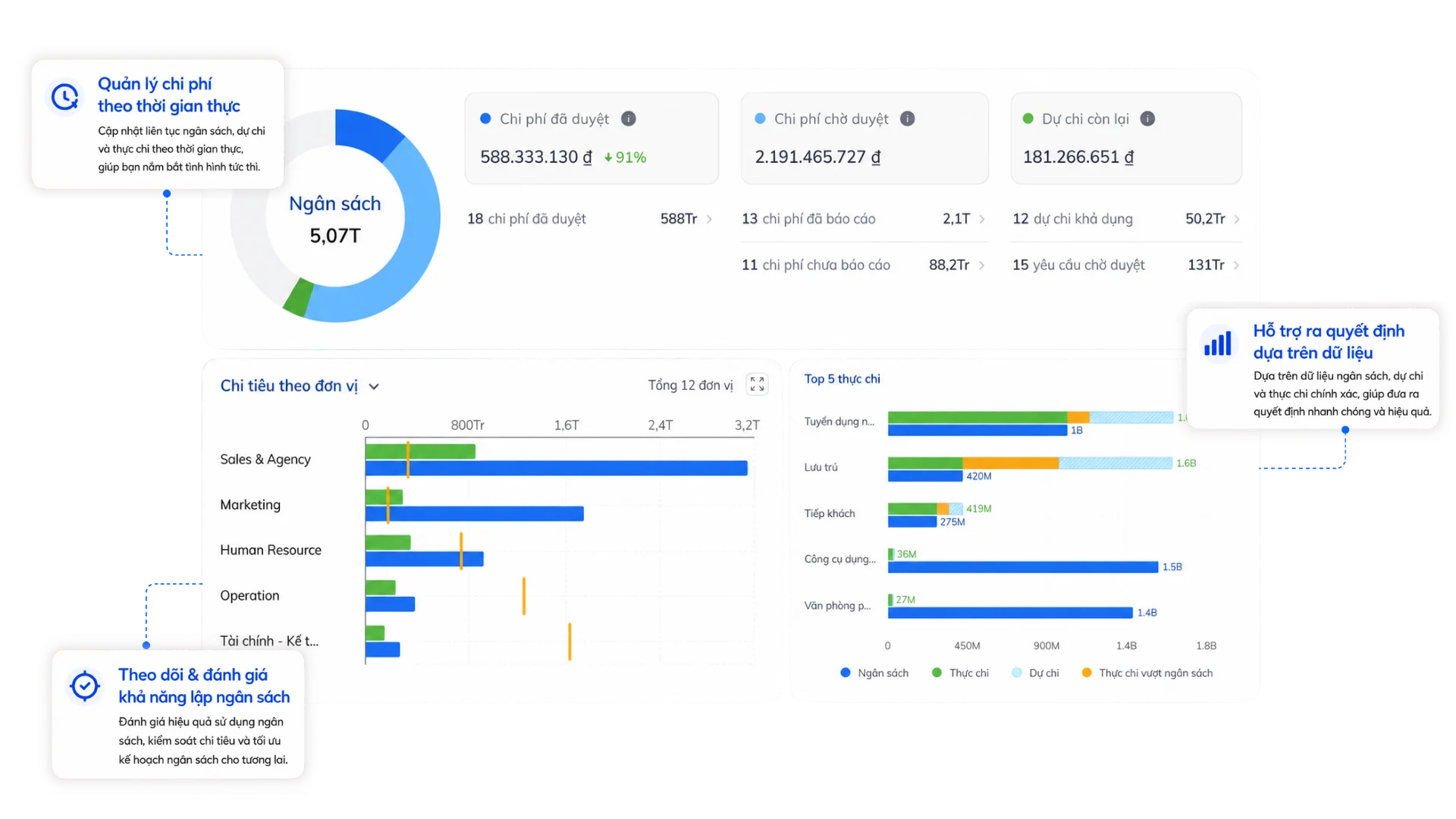
For businesses undergoing digital transformation, platforms such as Bizzi Expense It can support the standardization of the entire process from expenditure request, policy review, budget reconciliation, multi-level approval to advance management, reimbursement, and centralized expense tracking. Instead of using multiple separate tools, businesses can manage the entire lifecycle of an expenditure on a single platform, while helping CFOs track budgets and committed expenditures in real time.
Conclude
Effective cost control doesn't begin when the accountant receives an invoice or when the business makes a payment, but rather from the moment an expense is proposed. The earlier the control point is established, the greater the opportunity for the business to prevent overspending, non-compliance with policy, or unplanned expenses.
To deploy pre-audit costs To succeed, businesses need to build a comprehensive management system, in which: spending policy, spending limit, budget, approval process and post-audit mechanism They are seamlessly interconnected. When these components operate in harmony, the CFO and the Finance department can not only control incurred expenses but also proactively monitor proposed or committed expenses, thereby improving cash flow forecasting and optimizing budget utilization.
However, as businesses scale, managing pre-audits using email, Excel, or multiple disparate processes often leads to lengthy approval times, scattered data, and difficulty tracking budgets in real time. This is also when many businesses switch to specialized expense management platforms to standardize the entire process.
Bizzi Expense is the solution business cost management It is designed to digitize the entire lifecycle of an expense, from payment request, policy review, budget reconciliation, limit management, multi-level approval, arrive Advances, reimbursements, and payments. This allows businesses to build mechanisms. Control spending before it happens. in a consistent, transparent manner and with a significant reduction in manual processing steps.
In particular, the ability to track budgets in real time, automatically apply the Approval Matrix, and track the entire approval history gives CFOs a comprehensive view of the company's spending. Beyond supporting compliance with internal policies, Bizzi also helps the Finance department shorten processing time, improve data quality, and make quick decisions based on up-to-date information.
In the context of businesses increasingly focusing on proactive financial management and optimizing resource utilization, cost pre-auditing is no longer an option but has become a crucial foundation of modern internal control systems. Combining appropriate management processes with automation technology will help businesses control risks, maintain operational speed, and create a foundation for sustainable growth.
To experience Bizzi's solutions for free and receive one-on-one consultation from a financial expert, register to schedule an appointment here: https://bizzi.vn/dang-ky-dung-thu/