


Microsoft Dynamics 365 Finance is an ERP application focused on financial management within Microsoft's Dynamics 365 suite. The system supports functions such as general accounting, accounts payable/receivable, budgeting, cash flow, assets, closing, and financial performance analysis.
The key difference is: Dynamics 365 Finance is not the entirety of Dynamics 365.. This is a specialized application within Microsoft's ecosystem of ERP and CRM applications. Additionally, businesses may still encounter other terms used for this application. D365 F&O, D365FO or Dynamics 365 Finance & Operations In ERP documentation and projects, it's crucial to understand the proper relationship between these terms before evaluating a solution.
This article focuses on answering five questions: What is Dynamics 365 Finance, what business processes does it manage, what benefits does it offer, which businesses should consider it for, and what checks should be made before implementation?.
What is Microsoft Dynamics 365 Finance?
Microsoft Dynamics 365 Finance Finance is an ERP application specializing in financial management within the Microsoft Dynamics 365 ecosystem. According to Microsoft documentation, Finance supports business groups such as Payable Accounts, Receivable Accounts, budgeting, cash and bank management, fixed assets, financial reporting, finance insights, and business performance.
In other words, if ERP is a type of system used to manage and connect the core processes of a business, then Dynamics 365 Finance is a specific product The focus is on the financial management level. Therefore, the two concepts "ERP" and "Dynamics 365 Finance" should not be used as synonyms.
Finance is not limited to recording accounting transactions. Besides General Ledger, Payable Accounts, and Receivable Accounts, the system also covers budgeting, cash management, financial closes, fixed assets, financial reporting, and capabilities to support planning, forecasting, and business performance.
Businesses wishing to gain a broader understanding of the role of ERP can refer to this article. What is ERP? Top ERP software for accounting..
In short: Dynamics 365 Finance = Microsoft's ERP application for financial management; ERP = type of system; Dynamics 365 = business application ecosystem.
The name Dynamics AX may come across when businesses research the product history or upgrade projects from AX 2009/AX 2012, but this is not the official name for the current Finance product. Microsoft currently has separate documentation for upgrade or migration scenarios from Dynamics AX.
What are the differences between Dynamics 365 and Dynamics 365 Finance?
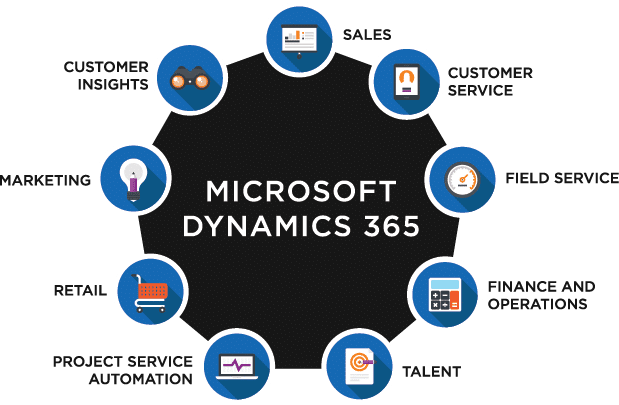
Dynamics 365 It is an ecosystem of Microsoft business applications, including the ERP and CRM suite. These applications can be used individually or in combination to connect data, processes, and teams across departments.
In that ecosystem, Dynamics 365 Finance The first application focuses on financial management, while other applications handle other business areas.
| Concept | Scope |
| Microsoft Dynamics 365 | The business application suite includes ERP and CRM. |
| Dynamics 365 Finance | Financial management and related financial processes |
| Dynamics 365 Supply Chain Management | Supply chain, inventory, procurement, production, and related operations. |
| Dynamics 365 Sales | CRM and sales management |
Therefore, not every Dynamics 365 application should be called a “Finance module.” Finance and Supply Chain Management may be part of the same end-to-end process, but they still have different application scopes. Microsoft documentation also clearly separates Finance groups such as Payable Accounts, Receivable Accounts, Budgeting, Cash and Bank Management, and General Ledger from Supply Chain Management groups such as Inventory Management, Procurement and Sourcing, Master Planning, and Production Control.
For example: A purchasing process can start with Procurement and Sourcing, pass through Product Receipt and Vendor Invoice, and then impact Payable Accounts and General Ledger. Therefore, it's not advisable to assume that the entire purchasing, warehousing, or production process falls under the purview of Dynamics 365 Finance.
What is D365 F&O / Dynamics 365 Finance & Operations?
D365 F&O, D365FO or Dynamics 365 Finance & Operations These are common terms used to refer to businesses when studying Microsoft's Finance and Operations ecosystem. However, D365 F&O should not be considered an absolute synonym for Dynamics 365 Finance..
In the current documentation, Microsoft still uses the concept. finance and operations apps This refers to the group of applications and platforms related to Finance, Supply Chain Management, and other operational applications. Microsoft documentation also includes separate content for Dynamics 365 Finance, Dynamics 365 Supply Chain Management, and Finance + Operations (on-premises).
Simply put:
- Dynamics 365 Finance → The focus is on financial management.
- Dynamics 365 Supply Chain Management The focus is on supply chain operations.
- Finance and operations apps / D365 F&O → A broader term often appears in product documentation, architecture, deployment, and history.
Therefore, when an article discusses financial capabilities such as GL, AP, AR, budgeting, cash management, or financial close, the key term should be Dynamics 365 Finance. Conversely, inventory, warehouse, procurement, or manufacturing should be defined within the scope of Supply Chain Management instead of being automatically assigned to Finance.
What business processes does Dynamics 365 Finance support?
Dynamics 365 Finance covers a broader range than simple transactional accounting, from General Ledger and financial close arrive Accounts Payable, Accounts Receivable, budgeting/planning, cash management, fixed assets, tax and business performance. Microsoft currently offers capability groups at the product level including financial planning and analysis, accounting and financial close, tax management, quote-to-cash, cash management, and business performance management.
In general, the scope of Finance's business can be envisioned as follows:
| Operations Team | Role in D365 Finance |
| General Ledger & Financial Close | Record, compile, and support the financial period closing process. |
| Accounts Payable | Manage transactions with suppliers, vendor invoices, and payment processes. |
| Accounts Receivable | Manage customer invoices, accounts receivable, credit, and collections. |
| Budgeting & Planning | Budgeting, budget control, and support for planning/forecasting. |
| Cash & Bank | Bank account management, liquidity, reconciliation, and cash forecasting. |
| Fixed Assets | Asset lifecycle management and related fixed asset operations. |
| Tax | Manage tax jurisdictions, rates, and tax configurations using supported functionality. |
| Business Performance | Financial analysis, planning, and providing insights for performance evaluation. |
Microsoft Learn now also separates the tutorial areas for General Ledger, Payable Accounts, Receivable Accounts, Budgeting, Cash and Bank Management, Fixed Assets, Financial Reporting, and Finance Insights.
A typical financial workflow can be visualized as a sequence:
Vendor invoice → Accounts Payable → Payment → Cash & Bank → General Ledger → Financial Close → Reporting
The key point is that Finance connects these operations within a single financial management model, rather than viewing each activity as an independent system.
Is Dynamics 365 Finance just accounting software?
Are not. Accounting is a core part of Dynamics 365 Finance, but the product range also includes budgeting, cash management, planning, collections, fixed assets, financial reporting, and business performance.
This range can be divided into four classes:
- Transaction accounting: Recording and processing financial transactions.
- Financial control: Control accounts payable, budget, assets, and closing procedures.
- Planning: Budgeting, forecasting, and scenario planning.
- Performance analysis: Analyzing financial data and operational insights to support decision-making.
Therefore, the CFO may be interested in Finance not only to record "how much has been spent," but also to track it. actual → budget → cash → close → performance within the same management environment.
However, Dynamics 365 Finance should not be equated with a standalone EPM or FP&A platform for all cases. The level of responsiveness depends on the licensed capability, version, configuration, and overall enterprise architecture.
What are the benefits of Microsoft Dynamics 365 Finance?
The value of Dynamics 365 Finance lies not only in the number of features, but also in its ability to connect financial processes and data into a unified management system. Microsoft positions Finance around financial agility, control, and insight, with capabilities ranging from forecasting and planning to accounting, closing, cash management, and business performance.
| Demand | Capability | Achievable value | Condition |
| Dispersed financial data | Financial management is centralized | Creating a more unified data source for Finance. | Master data and architecture are standardized. |
| Many manual operations | Workflow and Expenditure | Reduce repetitive tasks in automated processes. | The process must be designed appropriately. |
| Budgeting, forecasting | Budgeting & Planning | Assists in planning and tracking actual performance against the plan. | Input data and planning models must be reliable. |
| Closing the books and reporting | Accounting & financial close | Support for standardizing the closing and reporting process. | Clear process ownership and reconciliation |
| Liquidity management | Cash management | Enhance cash flow monitoring and forecasting capabilities. | Banking and transaction data must be properly interconnected. |
| Managing multiple legal entities | Legal entities, financial dimensions and related capabilities | Support for more complex financial models | The correct legal entity structure and localization need to be designed. |
| System connection | Integration/data capabilities | Integrate Finance with other applications and systems. | Architecture and integration scope must be evaluated. |
1. Centralize and standardize financial data.
When GL, AP, AR, cash, budgeting, and reporting are managed within the same application ecosystem, businesses have a basis to reduce the scattering of financial data across multiple files or systems.
However, "a system" does not mean "automatically clean data." Chart of accounts, master data, financial dimensions, business rules, and data ownership must still be standardized during the design process.
2. Reduce manual operations in automated workflows.
Dynamics 365 Finance offers a wide range of workflows and automation capabilities for financial processes. Microsoft is also expanding AI and agent capabilities to support financial tasks, but the actual level of automation depends on the feature, licensing, deployment, and release status at the time of deployment.
Therefore, benefits should be expressed in this way. “"Reduce manual operations in automated workflows"” Instead of claiming that the company will automate the entire Finance process.
3. Support for financial planning and forecasting
Finance now offers capabilities for financial planning, budgeting, and forecasting, and Microsoft is introducing scenario modeling and cross-functional planning to link financial planning with operational data.
This helped Finance shift from primarily aggregating historical data to tracking both. business plans, forecasts, and scenarios.
4. Support for financial closing, reconciliation, and reporting.
Accounting and financial closing is one of the key capability groups of Dynamics 365 Finance. Microsoft is also developing agent capabilities to support matching and reconciliation processing within the closing process.
However, the actual closing rate still depends on data quality, reconciliation processes, authorization levels, and the degree of standardization among legal entities.
5. Improve cash visibility and collections.
Finance provides cash management, cash-flow forecasting, and the ability to predict customer payments. These capabilities can help finance teams better track liquidity and manage accounts receivable.
The actual results still depend on the completeness and timeliness of banking data, AR, and related systems.
6. Support for multi-entity and multi-country models.
For businesses with multiple legal entities, currencies, or operations in multiple countries, the ability to manage finances on an individual entity and country/regional basis is a crucial factor when evaluating finance.
However, Being multi-country does not mean all countries have the same level of localization.. Microsoft has its own content and regulatory updates for each country/region, so businesses need to verify the actual support coverage for each market.
7. Connect with the Microsoft ecosystem and other systems.
Dynamics 365 is designed so that applications can work together and connect with the Microsoft ecosystem as well as the enterprise's existing systems.
In the field of finance, this opens up the possibility of building an architecture that connects financial systems, operational applications, reporting/analytics, and external systems. However, integration remains an architectural challenge that requires design; not all systems will automatically connect without evaluation.
Notes on AI, Copilot, and Agent: Microsoft is currently introducing many AI capabilities in Dynamics 365 Finance. However, Account Reconciliation Agent and Finance Agent in Microsoft 365 Copilot currently marked by Microsoft preview. Therefore, these capabilities should not be described as GA features or claimed to automatically handle all reconciliation, budgeting, or risk detection. The feature's state needs to be re-tested at the time of deployment.
Which businesses should consider Dynamics 365 Finance?
There is no fixed threshold of employee size to determine if a business is "large enough" or "eligible" to use Dynamics 365 Finance. The level of suitability depends more on the specific needs of each individual. The complexity of financial operations, the number of legal entities, integration requirements, localization, governance, and total cost of ownership (TCO).
Signs that Dynamics 365 Finance should be shortlisted.
Businesses may consider a Finance assessment if one or more of the following characteristics are present:
- There are many legal entities It needs to be managed within a unified financial architecture.
- Work multi-currency or multi-country.
- GL, AP, AR, cash, and budgeting are located on multiple systems or separate files.
- Procedure financial close and reporting It's becoming increasingly complex.
- CFOs need to improve their planning, forecasting, and cash visibility skills.
- Finance needs to be connected to operational systems.
- The company has made deep use of the Microsoft ecosystem.
- We have a Finance process owner and an ERP project owner with sufficient capabilities to manage change.
Signs that require closer evaluation.
Conversely, businesses should not make decisions based solely on product branding if:
- Just basic bookkeeping and financial reporting is needed.
- Chart of accounts and master data have not been standardized.
- There is no process owner assigned to Finance transactions.
- Requirements are constantly changing, but there is no governance.
- Localization for the Vietnamese market has not yet been verified.
- The plan is to customize too deeply instead of prioritizing standard capabilities.
- The total cost of ownership (TCO) does not fully account for licensing, implementation, integration, customization, infrastructure, support, and upgrades.
| Current status of the business | A level worth evaluating. | Next question |
| Many legal entities | High | How are consolidation and localization designed? |
| Fragmented financial data | High | How complex are integration and migration? |
| Microsoft deep ecosystem | High | Which architecture and licensing options are suitable? |
| Basic accounting skills are sufficient. | Weigh | Are complexity and TCO reasonable? |
| Custom deep | Consider carefully | What about maintenance and future upgrades? |
| Master data is not yet accurate. | It's not time to make a decision yet. | What data and processes need to be standardized first? |
If your business is in the process of considering the broader role of finance in its transformation strategy, you might want to refer to the following: What is Finance Transformation? To identify the management problem before delving into technology selection.
The important point is that this is decision guidance, This is not an official Microsoft eligibility requirement. For the same Finance product, a business with only one legal entity will have a very different scope, architecture, and TCO compared to a corporation with dozens of legal entities.
What needs to be evaluated before deploying Dynamics 365 Finance?
Before deciding to implement it, businesses need to have relatively clear locking mechanisms. finance scope, legal entities, data, deployment, localization, integrations, licensing, customization, security, project ownership and TCO.
A practical checklist should include:
- Which financial processes fall within this scope?
- How many legal entities, countries, and currencies does the business own?
- What are the specific requirements for GL, AP, AR, budget, cash, and fixed assets?
- Is cloud or on-premises deployment the right choice?
- Has the Vietnam localization been verified?
- What is the current status of the chart of accounts and master data?
- Which systems need to integrate with Finance?
- Which data needs to be migrated?
- To what extent does the standard capability meet the requirements?
- Which parts actually need customization?
- Which AI capabilities have been GA'd and which are still in preview?
- What are the requirements for roles, security, and segregation of duties (SoD)?
- Who is the Finance Process Owner?
- Who is the ERP project owner?
- What are the components of TCO: license, implementation, integration, infrastructure, customization, support, and upgrade?
Microsoft also recommends that businesses evaluate deployment options, subscriptions, and deployment plans before purchasing Finance and Operations apps.
If you need a more in-depth analysis of cost components, please refer to the article. What are the costs of implementing ERP? Instead of repeating the entire TCO content in this article.
Is Dynamics 365 Finance only deployed in the cloud, or is it available on-premises?
It's not just the cloud. Microsoft now allows finance and operations applications to be deployed. on the cloud or on-premises, with different architectures, administrative responsibilities, and scopes of capability.
| Deployment | Main features |
| Cloud | Microsoft manages ERP services; suitable when businesses want to reduce their responsibility for directly operating infrastructure. |
| On-premises | Deployment at the customer's data center requires the business to take on additional responsibilities for infrastructure, high availability, disaster recovery, and related management activities. |
Microsoft notes that on-premises capabilities are not supported on public cloud infrastructures like Azure public cloud, but can run on Azure Stack HCI and Azure Stack Hub. Additionally, some capabilities differ between cloud and on-premises; for example, current Microsoft documentation shows that Copilot capabilities are not available on-premises according to the current comparison table.
Therefore, deployment choices should not be based solely on "cloud or on-premises" preferences, but should also consider regulatory/compliance, connectivity, infrastructure, security, capability, and TCO.
Does Dynamics 365 Finance have Vietnamese VAS and tax requirements?
It is not advisable to assume that Dynamics 365 Finance automatically meets all Vietnamese VAS, electronic invoicing, and tax requirements without checking the specific localization.
Microsoft has a mechanism country/region-specific functionality and Globalization Studio to support requirements related to taxation, regulatory reporting, and local business practices. Microsoft also provides country/regional regulatory updates and allows partners to expand localization as needed.
In particular, localization is a highly variable field because local laws and regulations can change. Therefore, before implementing in Vietnam, businesses should verify at least:
- The version of Dynamics 365 Finance currently in use;
- Microsoft now supports country/region functionality;
- The required localization package or extension;
- ability to meet specific accounting and tax requirements;
- electronic reporting/e-invoicing;
- This part is due to Microsoft's native capabilities and this part comes from partners.
You shouldn't take a Microsoft Partner extension and call it the default native capability of Dynamics 365 Finance.
According to current Microsoft documentation, globalization services such as Electronic Invoicing, Regulatory Configuration Service, and Tax Calculation are organized according to a country/region-specific support model. Therefore, actual localization verification must be performed on a market- and version-by-market basis rather than inferring from the product's overall capability.
Conclusion: Is Microsoft Dynamics 365 Finance right for your business?
Microsoft Dynamics 365 Finance is an ERP application specializing in financial management within the Dynamics 365 ecosystem., This is not the entirety of Dynamics 365. The product covers multiple business layers from accounting, AP/AR, cash management, budgeting/planning to financial close and business performance, making it suitable for shortlisting when businesses have complex financial management requirements and need to connect multiple data sources and processes.
Before making a choice, businesses need to clearly distinguish between them. Finance with D365 F&O, Define product boundaries with Supply Chain Management, and check deployment, localization, integration, customization, security, and TCO. For AI capabilities, it's crucial to clearly differentiate between released features and those yet to be released. preview; As for Vietnamese localization, verification needs to be based on the actual version and requirements, rather than assuming that all local regulations are automatically met.
If your business is using Dynamics 365 Finance
After selecting Dynamics 365 Finance, the next challenge that may arise is: Connecting financial and accounting workflows with other business process systems or platforms..
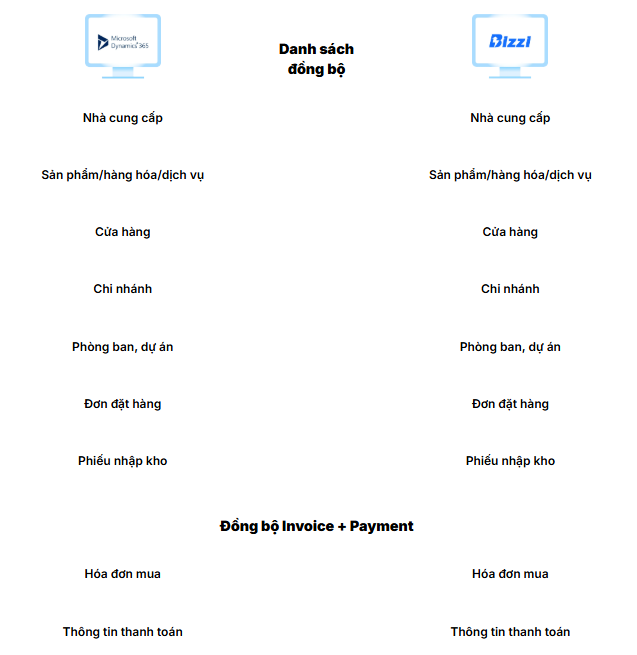
If your business is using Microsoft Dynamics 365 Finance and wants to evaluate how to connect your invoicing/accounts payable workflow to your existing ERP system, you can view the model details here. Bizzi integrates with Microsoft Dynamics 365 Finance.MThis integrated model can synchronize master data and documents such as Vendor, Item/Product & UOM, PO, GR, Purchase Invoice/Payment through mechanisms such as Excel/CSV, SFTP, or real-time API, depending on the architecture and integration needs of the business. It's worth noting that Bizzi is located at additional workflow/integration layer, This does not replace Dynamics 365 Finance, nor does it mean that businesses using Dynamics 365 Finance are required to use Bizzi.
Book your appointment here: https://bizzi.vn/dang-ky-dung-thu/