



Duplicate payments are an often-overlooked financial "loophole," but they can leak anywhere from 0.11 TP3T to 0.51 TP3T of a company's total budget. For a CFO, this isn't just an accounting error; it's a sign of a compromised Procure-to-Pay (P2P) management system.
This article will provide a detailed analysis. What is duplicate payment?Potential tax risks and a 5-step roadmap Control duplicate payments Using AI, we can optimize cash flow and protect working capital sustainably.
What are duplicate payments and how do they impact corporate capital leakage?
Before discussing solutions, accountants need to understand precisely what's going on. What is duplicate payment? and why it directly affects the efficiency of capital utilization.
Duplicate payment is a situation where a business makes multiple payments for the same financial obligation or invoice. This directly leads to capital leakage, reduces the virtual DPO (Deposit Per Account) and directly erodes the company's net profit.
It is necessary to distinguish between “Duplicate Invoice" and "Duplicate Payment"Duplicate invoices are just a data issue; the money hasn't left the account yet. But when duplicate payments occur, the money has actually left the business and become an AP Overpayment."
In financial terms, the capital leakage rate can be calculated using the following formula:
Capital Leakage Rate = (∑ Duplicate Payments / ∑ Total Spend) × 100
A ratio of only 0.2% out of a total expenditure of 500 billion VND is equivalent to 1 billion VND "stuck" at the supplier. Not only is the business losing money, but it is also losing... opportunity cost Because that cash flow could have been used to reduce debt or reinvest.
Duplicate payments also distort the Days Payable Outstanding (DPO) metric and prolong the Cash Conversion Cycle (CCC), leading CFOs to misjudge the effectiveness of working capital management.
To understand why this problem persists even with ERP in place, we need to look at the quality of the input data.
Why does unclean vendor data cause duplicate billing errors?
Even large ERP systems can fail if the source data isn't standardized. This is a risk that many CFOs haven't adequately assessed.
Inconsistent vendor master data is the cause of 60% duplicate payments. When a vendor exists under multiple different codes, the standard duplicate payment check mechanism is rendered ineffective.
Data fragmentation between the Purchasing and Accounting departments creates duplicate vendor entries in the vendor master file. A single vendor code can exist under multiple different transaction names; this phenomenon is called "vendor shadowing".
The risks aren't just about errors; they also create loopholes for internal fraud. When ERP system integrity deteriorates, controlling duplicate payments becomes almost ineffective.
Therefore, CFOs need to make "Data Sanitization" a recurring strategic decision.
At the technology level, Bizzi Bot can automatically verify the supplier's tax identification number (MST) against data from the tax authority, and warn if the MST already exists in the system. This ensures data is "cleaned" right from the input stage, significantly reducing the risk of duplicate payments later on.
Besides leaks cash flowThe problem becomes even more serious when it comes to taxes.
Tax and legal risks when businesses declare duplicate invoices
For the CFO and Chief Accountant, this is the real pain point.
The practice of paying and declaring duplicate invoices violates the principles of reasonableness and validity under the Tax Administration Law. Businesses may have expenses disallowed when calculating corporate income tax and be fined 20% for the underdeclared tax amount, plus a late payment penalty of 0.03%/day.
If the same invoice is subject to VAT deductions twice, the business faces a serious Tax Audit Risk. The formula for estimating the penalty is as follows:
Penalty amount = (Duplicate VAT x 20%) + Late payment penalty
- Case 1: This results in a shortfall in tax payable or an increase in tax refundable: Penalty 20%: the amount of underdeclared/incorrectly refunded tax plus late payment penalty.
- Case 2: No damage has been caused to the amount of tax payable: A fine of 5-8 million VND will be imposed according to the provisions of Articles 16 and 17 of Decree 125/2020/ND-CP.
- Error handling: Businesses need to reissue invoices and file supplementary adjustment declarations to reduce penalties.
According to Decree 123/2020/ND-CP and Circular 32/2025/TT-BTCWhen an electronic invoice is found to contain errors, the business must create a new one. Form 04/SS-HDDT This is to notify the tax authorities and make timely adjustments. If there is a delay in processing or repeated incorrect declarations, the business may be assessed as high-risk by the tax authorities during a tax audit.
Bizzi Bot assists in checking the operational status of suppliers at the time of payment and cross-referencing the list of declared invoices, helping Chief Accountants feel more confident when signing off on tax reports.
To prevent risks at their source, businesses need standardized control processes.
The 3-step cost control process prevents duplicate payments.
Effective control is not just about detecting errors, but about preventing them from leaving the account before the money even leaves.
The control process includes: pre-audit upon receipt of invoices, multi-way reconciliation before payment approval, and periodic post-audit. Automation is a key element for effective duplicate payment control.
Businesses need to establish a clear Approval Authority Matrix and ensure Segregation of Duties. The Approval Authority (AP) acts as a "gatekeeper" for the flow of funds in the Pre-payment Audit. If the email-based approval process is fragmented and lacks a Single Source of Truth, the risk of missing duplicate payment checks is very high.
Bizzi Expense Digitizing all payment requests on a single platform, automatically blocking existing invoice numbers. CFOs can approve them on mobile with full proof of reconciliation, significantly reducing human error.
At the heart of this process is the 3D matching mechanism.
3D matching mechanism3-way matching) helps to completely eliminate payment errors.
If asked about the fundamental solution for understanding What is duplicate payment? And how to eliminate it? The answer lies in 3-way matching.
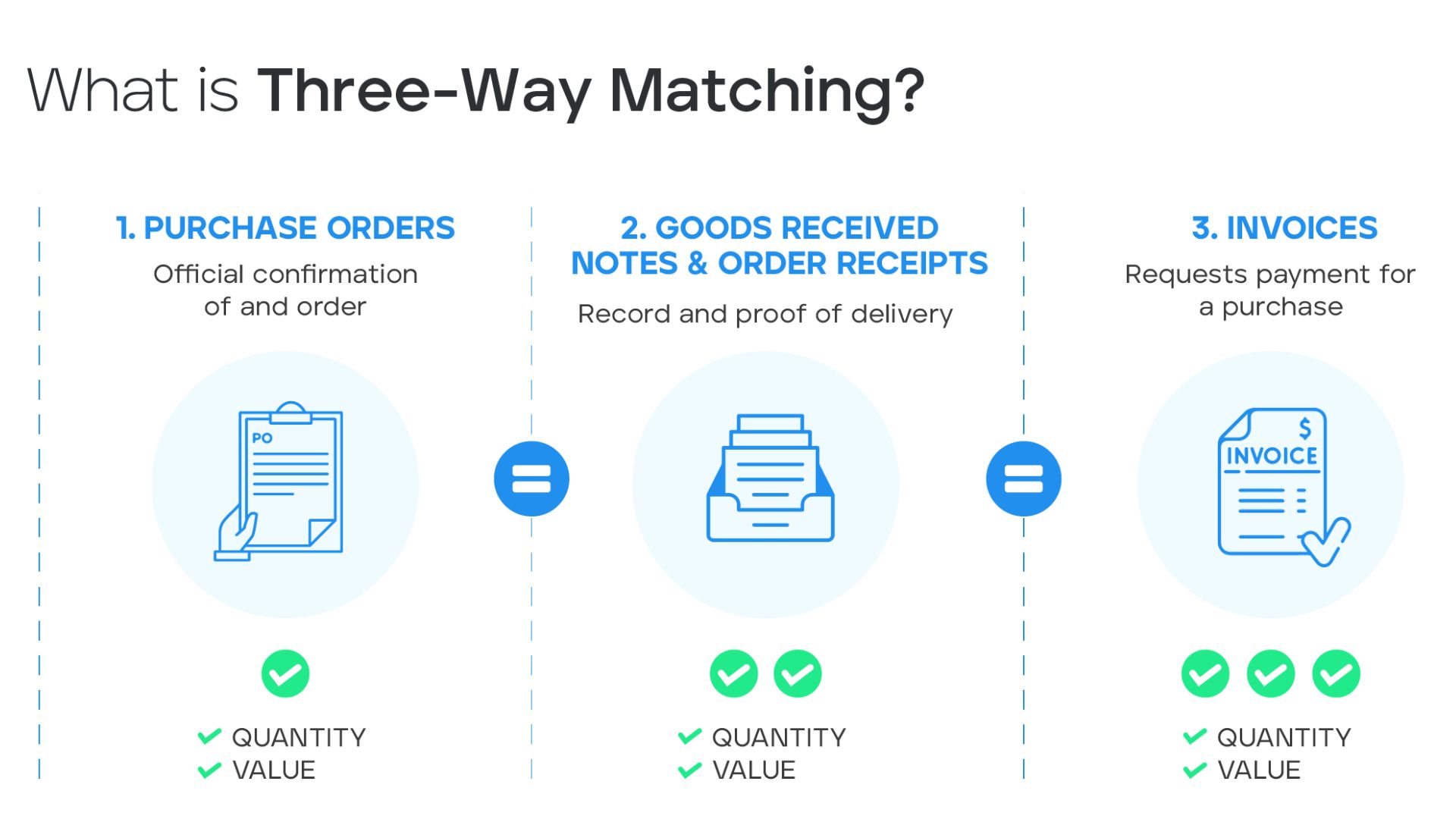
3-way matching is a method of matching data between Invoice, Purchase Order (PO), and Gross Receipt (GRN). Payment is only processed when these three documents match in quantity and unit price.
The core logic is: Invoice = Purchase Order = Gross Receipt. When the Price Variance or Quantity Discrepancy exceeds the allowed Tolerance Level, the system will block payment.
Bizzi Bot automatically extracts invoice data, connects to ERP to retrieve the corresponding Purchase Order (PO) and Gross Receipt (GRN). Only invoices matching 100% are pushed into the payment stream. This helps control duplicate payments right at the document level.
However, traditional ERP systems only catch exact matches.
Applying AI and Fuzzy Logic algorithms in controlling duplicate invoices.
This is a step forward that helps duplicate payment checks overcome the "Exact Match" limitation.
AI uses Fuzzy Logic and the Levenshtein Distance algorithm to detect nearly identical records, even with minor input errors.
Excel only supports Exact Match. Traditional ERP systems rely primarily on matching invoice numbers (100%). In contrast, AI can recognize "Corp" and "Corporation" as a similar entity.
Bizzi's AI scans invoice metadata including amount, date, tax code, and content. The system calculates the probability of duplication and issues a "High probability of duplication" warning before processing the transaction. As a result, the false negative rate is significantly reduced, improving the effectiveness of duplicate payment control.
If the money has unfortunately already been spent, the business needs a recovery plan.
How to build a recovery audit process to reclaim improperly spent funds.
Even when you already understand What is duplicate payment?However, CFOs still need a post-audit mechanism. A recovery audit is the process of reviewing payment history to find and recover duplicate payments. The process includes sending debit notes and agreeing to offset payments using credit memos.
Businesses should review data from the last 6–12 months. Communication with suppliers needs to be transparent to maintain long-term relationships.
Bizzi ARM provides a comprehensive overview of accounts payable, supports reverse reconciliation, and tracks deductions in subsequent payment periods, helping to optimize the collection process.
Frequently Asked Questions about Controlling and Handling Duplicate Payments
Below is a summary answering some questions related to duplicate payments, providing information about
Why are they ERP accounting software Can even large companies like SAP or Oracle still miss out on duplicate payments?
Most traditional ERP systems check for duplicates using an "Exact Match" mechanism, meaning they only block invoices if the invoice number matches 100%. If there is a single incorrect character, an added space, or a minor difference in input, the system will treat it as a completely new document.
This is why many duplicate payment check cases don't work as effectively as expected. AI platforms like Bizzi use Fuzzy Logic to identify "similar" records, filling a gap that pure ERP systems struggle to handle.
What should be done if duplicate invoices have already been declared for tax purposes?
If an invoice has already been included in the tax return, the business needs to identify the cause of the error. If the error originates from the supplier, a cancellation or adjustment of the invoice must be prepared according to regulations. If the error arises internally, the business must file a supplementary VAT tax return and submit Form 04/SS-HĐĐT as stipulated in Decree 123/2020/NĐ-CP. Timely handling helps minimize the risk of tax arrears and late payment penalties.
What is the actual cost of processing a duplicate payment?
Many CFOs only look at the monetary value of overpayments, overlooking the processing costs. In reality, the total cost of personnel, review time, and recovery transactions can range from $50 to $200 per case, not including the opportunity cost of cash "stuck" at the supplier. When the number of transactions is large, this cost accumulates into a significant amount.
How can we distinguish between unintentional errors and fraudulent behavior in duplicate payments?
Unintentional errors often occur sporadically, without a clear recurring pattern. In contrast, fraud typically shows signs of being concentrated around a specific vendor, recurring cyclically, and often occurring below high-level approval thresholds. Furthermore, suspicious transactions often arise close to the closing date of the accounting books. Analyzing historical data and tracking trends is crucial for detecting anomalies.
Can Bizzi Bot be integrated with accounting software in Vietnam?
Bizzi supports API integration with many popular systems such as MISA, FAST Accounting, as well as international ERP platforms like SAP and Oracle. This allows for bidirectional data synchronization and automated 3-way matching without disrupting existing systems.
Does the 3-way matching process slow down payment processing?
If performed manually, the three-way reconciliation process can be lengthy. However, when automated with AI, reconciliation takes only seconds. This not only speeds up approvals but also improves supplier relationships through timely and transparent payments.
What percentage of duplicate payments is considered alarming?
If the duplicate payment ratio exceeds 0.1% of total expenditure, it's a warning sign that there are significant gaps in the internal control system. At this level, the CFO should consider implementing automation and AI technologies to strengthen the duplicate payment control mechanism before the risk accumulates into larger losses.
Conclusion: Controlling duplicate payments is a cash flow protection strategy.
Clearly understand What is duplicate payment? This not only helps reduce accounting errors but also protects the company's profits and reputation. In the context of increasing pressure to optimize working capital, controlling duplicate payments must become a strategic priority for CFOs.
The combination of 3-way matching, automatic duplicate payment checks, and AI Fuzzy Logic is a modern approach to eliminating capital leakage. With Bizzi's AI platform, businesses can not only detect errors but also prevent them before money leaves the account.
By controlling duplicate payments, CFOs not only reduce tax risks but also optimize the cash conversion cycle and improve capital efficiency. In a fiercely competitive environment, this is a sustainable financial advantage.
To receive personalized advice on solutions to improve your business's financial management, book an appointment here: https://bizzi.vn/dat-lich-demo/