


SAP is a German technology company and one of the world's largest providers of enterprise management software. Founded in 1972, SAP has evolved from ERP systems like SAP R/2 and SAP R/3 to the current generation SAP S/4HANA.
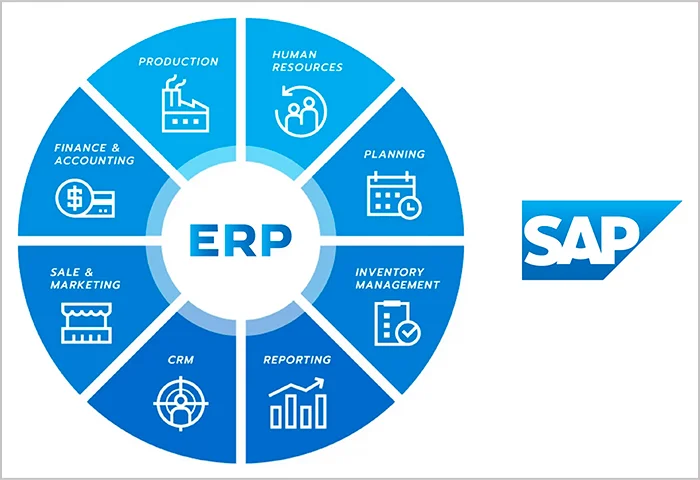
SAP ERP is a suite of ERP solutions developed by SAP., ERP helps connect processes such as finance, purchasing, sales, manufacturing, supply chain, and human resources on a unified data platform. SAP currently describes ERP as a system that connects the core processes of an enterprise, creating a unified view and a shared data source for management operations.
The key difference to distinguish right from the start is: ERP is a type of management system/method, while SAP is the provider and product ecosystem. Therefore, SAP and ERP are not two equivalent concepts for businesses to choose between "SAP or ERP". SAP ERP is one of the solutions in the ERP market.
What is SAP? What is SAP ERP?
What company is SAP and where is SAP software manufactured?
SAP SE is a German technology company., Founded in 1972 by five former IBM employees, the company is headquartered in Walldorf, Germany, and develops software for business process management.
SAP's history is closely tied to the challenge of enterprise data integration. From its early years, SAP aimed to build software capable of connecting business processes and enabling centralized data processing rather than fragmented data across departments. The subsequent SAP R/2 and R/3 products became crucial foundations in the development of the ERP market.
Therefore, when searching “"What is SAP?", "What software is SAP?", or "Which country does SAP software come from?"”, In short, it can be understood as:
SAP is a German technology company specializing in the development of enterprise software; SAP ERP is a suite of ERP solutions developed by SAP.
What does SAP stand for?
SAP stands for Systems, Applications, and Products in Data Processing. This name is derived from the company's original German name., Systemanalyse Programmentwicklung, which can be understood as "System Analysis and Program Development".
This point needs to be distinguished from some inaccurate interpretations on the Internet. SAP does not stand for "System Application Programming".
What is SAP ERP?
SAP ERP is an enterprise resource planning system developed by SAP., It is designed to connect core processes such as Finance, Human Resources, Manufacturing, Supply Chain, Sales, and Procurement in a unified system. SAP currently describes SAP ERP as providing a unified view of business operations and a shared data source.
Simply put:
- SAP = Product Vendor and Ecosystem
- ERP = Enterprise Resource Planning System
- SAP ERP = SAP ERP solution
Therefore, businesses don't "choose SAP over ERP." Instead, they choose an ERP solution where SAP is a vendor with a complete ERP ecosystem and corresponding business applications.
If you need to learn more about the ERP concept in general, you can refer to the following article. What is an ERP system?.
What are the differences between ERP and SAP?
This is one of the most confusing aspects when learning about SAP. ERP is the name of a type of management system; SAP is the name of a company and a technology brand that provides ERP and many other business solutions.
| Criteria | ERP | SAP |
| Nature | Type of management system/method | Company + Brand + Software Ecosystem |
| Scope | General concept | A specific vendor/ecosystem |
| Supplier | Many brands | SAP SE |
| For example | SAP, Oracle, Microsoft Dynamics, Odoo… | SAP S/4HANA, SAP ERP… |
| Appropriate question | Do businesses need ERP? | Is SAP the right ERP solution for you? |
Is SAP the same as ERP?
A large portion of SAP's core products support ERP, but SAP is not synonymous with ERP.
SAP offers a wide range of solutions to meet the diverse needs of businesses. ERP is a key product group within that ecosystem. Therefore, to say... “"SAP is ERP"” This could lead readers to misunderstand the relationship between vendor and product category.
A more accurate way to express it is: SAP offers ERP solutions; SAP S/4HANA is a next-generation ERP platform from SAP.
This is also why businesses should differentiate between ERP implementation needs and The choice of SAP as the ERP platform.
How does the SAP ERP system work?
The most important aspect of understanding SAP ERP is not memorizing a series of modules, but understanding them. How is a business transaction systematically linked from its inception to its financial impact and management reporting?.
The general flow can be visualized as follows:
Business transaction
↓
Business Module
↓
Shared / Master Data
↓
Accounting & Controlling Impact
↓
Reporting / Management Decision
For example, when a business purchases raw materials, the process doesn't end at the purchasing department. A purchase request can lead to a Purchase Order, receiving the goods, invoicing the supplier, recording accounts payable, and finally, payment.
Example of the Procure-to-Pay process
Purchase Requisition
↓
Purchase Order
↓
Goods Receipt
↓
Supplier Invoice
↓
Accounting Entry
↓
TQ
This is the value of ERP: A business event in one department can generate data and have an impact in other departments without having to recreate all the information from scratch.
Why does ERP need shared data?
An ERP system needs to manage many types of master data Transaction data and transactions are related. Some common objects include:
- Vendor;
- Personal;
- Material/Product;
- Chart of Accounts;
- Cost Center;
- Company Code;
- Plant;
- Document;
- Business Transaction.
For example, the same supplier may appear in the purchasing process, receiving invoices, recording Payable Accounts, and processing payments. If each department maintains its own set of data, the business is likely to encounter duplicate or inaccurate data, or require manual reconciliation.
Conversely, when data is managed within a unified architecture, transactions from different processes can be linked and used for finance, control, and reporting.
For example, a transaction goes through multiple SAP modules.
Let's assume the business purchases raw materials:
MM Processing Purchase Orders and Goods Receipts
→ Delivery data is recorded
→ Invoice checked
→ FI record accounts payable
Inventory and accounting data are updated.
→ Finance then uses this data to track accounts receivable and payments.
So, SAP ERP is not simply a collection of small software programs placed side-by-side.. The value of the system lies in the fact that business processes and data are connected in an end-to-end manner.
The main SAP ERP subsystems and the functions of each module.
SAP ERP is organized into numerous modules serving different business functions. However, when evaluating SAP, you shouldn't just look at the number of modules. More importantly, you need to understand... Which module owns the business logic, where is the data transferred, and what subsequent processes does it impact?.
SAP FI – Financial Accounting
SAP FI (Financial Accounting) Focus on the financial accounting class of the business.
The operations commonly associated with FI include:
- General Ledger;
- Accounts Payable;
- Accounts Receivable;
- Asset Accounting;
- Financial Reporting.
Finance receives and processes a large amount of financial data generated from other processes within the business. Therefore, Finance is not a "standalone module" but a crucial layer in the ERP architecture.
SAP Co-Controlling
SAP Co (Controlling) Focus more on cost management and information for internal management.
Common types of subjects include:
- Cost Center;
- Cost control;
- Profitability;
- Internal management accounting.
FI and CO are often mentioned together under the name SAP FICO, However, the two subsystems address two different business classes: FI is more geared towards... Financial Management, while CO serves Controlling and internal governance.
If you need to delve deeper into the accounting aspects, please refer to the following content. SAP accounting software.
SAP MM – Materials Management
SAP MM (Materials Management) Support processes related to supplies, purchasing, and inventory management.
Common business operations include:
- Procurement;
- Material Master;
- Purchase Order;
- Goods Receipt;
- Inventory.
MM has a direct link to Finance. For example, a delivery receipt or purchase invoice can have an impact on inventory and Accounts Payable.
SAP SD – Sales and Distribution
SAP SD (Sales and Distribution) Focus on the sales and distribution process.
A common thread might include:
Sales Order → Delivery → Billing
Once the billing is recorded, the data can impact revenue and Accounts Receivable in Finance.
SAP PP – Production Planning
SAP PP (Production Planning) To support the planning and implementation of production processes.
Some common types of subjects:
- Bill of Materials (BOM);
- Material Requirements Planning (MRP);
- Production Planning;
- Production Order.
PP can be linked with MM, inventory, and finance to form a process from material requirements to production and cost recognition.
What is SAP HCM?
SAP HCM (Human Capital Management) It is a group of solutions that serve human resource and workforce management processes.
At the overview level, HCM can be understood as the layer that manages the data and processes related to workforce, personnel, and human resource management activities.
SAP HCM should not be equated with the entire current SAP HR ecosystem, as SAP also has specialized products and platforms for human resource management.
Other modules businesses may encounter
Depending on the business model, the company may encounter additional functional groups such as:
- QM: Quality Management;
- PM: Plant Maintenance;
- EWM: Extended Warehouse Management;
- Competencies related to Project Management, Service, and Supply Chain.
Businesses don't necessarily need to deploy the entire module. The scope should be determined based on business processes, operational scale, level of integration, and governance requirements.
You can refer to the following article for more information. What are ERP modules? To differentiate the roles of ERP modules in general.
What are the differences between SAP ECC, SAP S/4HANA, SAP HANA, and SAP Fiori?
These four concepts often appear together, but not in the same class in SAP architecture.
To put it simply:
SAP
│
├── ERP
│ ├── SAP ECC
│ └── SAP S/4HANA
│
├── SAP HANA
│ └── Database / data platform
│
└── SAP Fiori
└── User experience / applications
What is SAP ECC?
SAP ECC (SAP ERP Central Component) It belongs to the previous generation of ERP, SAP S/4HANA, and is integrated with the SAP ERP 6.0 platform.
ECC has been widely used to integrate functions such as Finance, Materials Management, Sales, Production, and Human Resources into a single ERP architecture.
However, when evaluating existing ECC systems, businesses need to pay particular attention to the maintenance schedule. SAP has now announced... Mainstream maintenance for core applications in SAP Business Suite 7 until the end of 2027., Then, there is the option to extend maintenance until the end of 2030, subject to the terms and conditions published by SAP.
This makes the migration plan from SAP ECC/SAP Business Suite 7 to SAP S/4HANA a matter that businesses need to assess in terms of architecture, data, custom code, integration, and migration costs—rather than simply viewing it as a software upgrade.
What is SAP S/4HANA?
SAP S/4HANA is SAP's next-generation ERP system., Built on SAP HANA, it aims to handle data processing, analytics, and operations on a more modern ERP platform.
SAP describes S/4HANA as a new generation of ERP that utilizes in-memory technology and supports emerging technologies such as AI, machine learning, and analytics. Current S/4HANA versions are available in cloud models and other deployment options depending on the product.
So:
ECC and S/4HANA are different generations/platforms of ERP within the SAP ecosystem.
Businesses currently using ECC shouldn't just ask "should we switch to S/4HANA?", but need to evaluate the entire system. business process, data model, integration landscape, customization, compliance and business cases.
Is SAP HANA the same as SAP ERP?
No. SAP HANA is not an ERP system.
SAP HANA is a database and data platform, It uses an in-memory architecture to process data and support both transactional and analytical workloads.
It is possible to distinguish:
- SAP HANA: database/data platform technology;
- SAP S/4HANA: ERP runs on the SAP HANA platform;
- SAP ECC: Previous ERP generation before S/4HANA.
Therefore, "HANA" in S/4HANA is not the name of an accounting module or a standalone ERP version.
What is SAP Fiori?
SAP Fiori is SAP's design system and user experience (UX) layer., Fiori helps users interact with SAP applications through a modern interface on the web and mobile devices. SAP describes Fiori as a design system for SAP products that supports building business applications with a consistent experience.
Therefore:
SAP Fiori is neither an ERP module nor an ERP version.
It belongs to the class user experience/application interface, While SAP S/4HANA belongs to the ERP class and SAP HANA belongs to the database/data platform class.
What business processes does SAP ERP manage?
Instead of viewing SAP ERP as a list of features, a simpler way to understand it is to look at it in terms of... end-to-end business process.
Record-to-Report: Finance - Accounting
Record-to-Report (R2R) It encompasses the entire range of activities, from recording accounting transactions to aggregating, closing, and preparing financial statements.
Data from purchases, sales, assets, expenses, and other transactions can be imported into the Finance layer for accounting and reporting purposes.
Procure-to-Pay: Buy and pay
Procure-to-Pay (P2P) It begins with the need to purchase goods and ends when obligations to suppliers are paid.
A typical flow:
Purchase Requisition → Purchase Order → Goods Receipt → Invoice → Payment
This process clearly demonstrates how SAP links MM with FI/AP.
Order-to-Cash: Selling goods and collecting payment.
Order-to-Cash (O2C) It starts with the order and goes through delivery, billing, and payment collection.
A simple flow:
Sales Order → Delivery → Billing → Accounts Receivable → Collection
SD and Finance are therefore directly related in the revenue and accounts receivable process.
Plan-to-Produce: Planning and Production
Plan-to-Produce Connecting demand, production planning, raw materials, and production execution.
Data can be linked between:
Demand → MRP → Material → Production Order → Production → Cost
This process helps businesses view production not only from an operational perspective but also in relation to inventory and costs.
Inventory / Supply Chain
SAP can support the management of business processes related to materials, inventory, warehouse, and supply chain, depending on the architecture and scope of the solution deployed.
The key point is that inventory doesn't exist in isolation. Incoming, outgoing, manufacturing, sales, and transfers all generate transactions that need to be linked to other processes.
Hire-to-Retire / Workforce
Hire-to-Retire (H2R) This describes the process chain related to the workforce, from recruitment/onboarding to human resource management and operations throughout the employee lifecycle.
SAP currently organizes its ERP and cloud ERP solutions across multiple end-to-end processes, including procure-to-pay, order-to-cash, record-to-report, and processes related to workforce, supply chain, and service.
What is SAP accounting software? How does SAP ERP support Finance?
When searching “SAP accounting software”, “SAP accounting”, “What is SAP in accounting” or “SAP FICO”, It is important to understand that Finance is just one part of SAP ERP., not the entire system.
SAP FI handles Financial Accounting.
SAP FI focuses on Financial Accounting, including functions such as:
- General Ledger;
- Accounts Payable;
- Accounts Receivable;
- Asset Accounting;
- Financial Reporting.
The strength of SAP ERP lies in the fact that Finance data can be linked to operational transactions instead of being completely re-entered at the end of the process.
SAP CO supports Management Accounting/Controlling.
SAP Co provides a layer of information for internal management, especially:
- Cost Center;
- Cost Control;
- Profitability;
- Management Accounting.
Financial statements (FI) help reflect the financial situation as required by accounting; Certificates of Origin (CO) help businesses gain a deeper understanding of costs, profits, and management efficiency.
How does data from MM, SD, and PP enter the Finance system?
One of the most important aspects of learning SAP is understanding it. Transactions in the business module can have a financial impact..
For example:
PO → GR → Invoice
→ MM
→ FI/AP
Or:
Sales Order → Delivery → Billing
→ SD
→ FI/AR
In production:
Material → Production Order → Production Cost
→ PP/MM
→ Costing/Controlling
Therefore, Finance doesn't just receive data after other departments have finished their work. In an integrated ERP, Financial impact is created throughout business processes..
If you need a more in-depth look at the SAP accounting system, you can refer to the article. SAP accounting software.
The benefits of SAP ERP don't lie in individual modules.
The value of SAP ERP doesn't just come from a business having an additional Finance, Procurement, or Sales module. The greater benefit lies in... the link between data and processes.
A shared data source across departments.
When departments use a unified data architecture, businesses can reduce the need for each department to maintain its own master data and transactions.
This lays the foundation for viewing the business as a chain of activities rather than as separate "subsystems.".
Standardize end-to-end processes.
SAP ERP helps businesses standardize processes such as:
- Procure-to-Pay;
- Order-to-Cash;
- Record-to-Report;
- Plan-to-Produce.
Standardization doesn't mean every business has to use the same process. Businesses still need to identify areas that need to be configured according to their specific operations and areas that should adhere to standard processes.
Reduce manual reconciliation between systems.
When transactions are linked across modules, the need for data re-entry or reconciliation between independent systems can be reduced.
However, ERP That doesn't mean all reconciliation disappears.. Transactions with banks, marketplaces, external systems, or specialist applications may still require reconciliation.
Transaction control and tracing
ERP systems create transaction and document structures that help businesses track the origin of data through each step of the process.
For finance, this traceability is particularly important when examining documents, accounts payable, expenses, inventory, and transactions for reporting purposes.
Reporting and decision-making based on linked data.
When Finance data is linked to Procurement, Sales, Inventory, or Production, management reports can be placed within an operational context.
A CFO doesn't just see a revenue or expense number; they can trace back the business processes that generated that number.
Which businesses are suitable for SAP ERP?
SAP has a portfolio serving many industries and segments. However, that This does not mean that an enterprise-level SAP ERP implementation model is suitable for every business.. The selection should be based on the complexity of the business process, integration needs, and business case.
| Token | SAP level worth considering |
| Multiple companies/branches/legal entities | High |
| The Finance-Procurement process is complex. | High |
| Large Manufacturing/Supply Chain | High |
| The need for multinational standardization | High |
| Many systems require integration. | High |
| Very small business, simple process. | A thorough evaluation is needed. |
| Basic accounting skills are sufficient. | SAP enterprise ERP may exceed demand. |
SAP currently states that the industries using SAP ERP include manufacturing, retail, services, utilities, and consumer goods/wholesale; and emphasizes the ERP's ability to connect Finance, Supply Chain, Procurement, and core processes.
For small businesses or those with simple processes, the question shouldn't be... “"Can SAP do that?"”, but rather:Is the complexity and cost of SAP commensurate with the business requirements?
What preparations does a business need to make before implementing SAP ERP?
Implementing SAP ERP is a project that transforms processes, data, and the way a business operates. Therefore, preparation shouldn't begin with the question "which module to choose," but rather with... business process and control requirements.
Identify the business process before the software.
Businesses need to identify the processes to be managed, the process owner, inputs, outputs, and control points before deciding on system configuration.
A powerful ERP system, when implemented on an unclear process, can still generate many manual steps.
Normalize master data
Data such as:
- Personal;
- Vendor;
- Material;
- Product;
- Chart of Accounts;
- Cost Center;
- Organizational Structure
This needs to be reviewed before migration.
Unclean master data can create errors at many subsequent steps, from procurement to finance and reporting.
Define module scope
You shouldn't deploy a module just because "SAP has that module".
The scope should be defined based on:
Business Requirement → Process → Control → Data → Module
Only then can we determine which modules need to be deployed and which need to be integrated with other systems.
Integration landscape
Before going live, businesses need to map out the related systems:
- POS;
- eCommerce;
- WMS;
- CRM;
- Banking;
- e-Invoice;
- Payroll;
- Expense;
- Financial Automation.
In particular, it is necessary to identify Source of Truth for each business object and data synchronization rule.
Data migration
Data migration is more than just "moving old data to a new system." Businesses need to define:
- Which data is retained?;
- Which data needs cleaning?;
- Which data needs mapping?;
- Where is historical data stored?;
- What data needs to be checked after migration?.
Permissions and internal controls
ERP systems need to be designed with a system for granting access rights.
For example, businesses need to determine who has the authority to:
- Create a vendor;
- Create a purchase order (PO).;
- Review purchase orders;
- Acknowledged Goods Receipt;
- Invoice processing;
- Make the payment.
Authorization should not be viewed as a final technical step, but rather as part of internal control right from the design phase.
Change management and training
ERP changes the way users do their work. Therefore, training needs to be aligned with it. actual business process, It doesn't just instruct users which button to press on the software.
Deployment costs are not just about the license.
The total cost of owning SAP ERP may include:
Software + Implementation + Configuration + Integration + Data Migration + Infrastructure/Cloud + Training + Change Management + Support + Internal Resources
Therefore, comparing ERP systems solely based on license prices may not accurately reflect the project's lifecycle costs.
What supporting systems might SAP ERP require?
An ERP system doesn't necessarily have to handle all external workflows itself.
The architecture can be visualized in three layers:
Core ERP
SAP
↓
Finance / Procurement / Accounting
↓
Specialized Workflow & Automation Layer
Invoice / AP / Expense / Payment / e-Invoice
In this architecture:
- SAP ERP It serves as the core system and system of records for business objects within the designed scope;
- Specialized application to deeply process a specific workflow;
- Joint Connecting data between the two layers.
Therefore, adding a specialized system is necessary. This does not necessarily mean replacing SAP..
Conversely, if a peripheral process has high volume, many exceptions, or many manual operations, a dedicated automation layer can help the business better leverage its ERP investment.
How does Bizzi integrate with SAP ERP in the financial process?
For businesses already using SAP, the challenge is often not replacing the ERP system, but rather... Automating finance processes still involves many manual operations..
Bizzi has now announced integration capabilities with SAP S/4HANA, which can synchronize data groups such as Vendor, Product/UOM, PO, GR, and Invoice/Payment; the announced integration mechanisms include file import/export, SFTP, and real-time API depending on needs.
Example of a SAP – Bizz process
SAP
PO + GR
↓
Bizzi
Invoice Capture
↓
PO – GR – Invoice Matching
↓
Validated Invoice / Exception
↓
SAP
Debit / Payment
In this model, Bizzi can act as the automation layer for the AP process, while SAP continues to serve as the core ERP system.
According to information released by Bizzi, SAP S/4HANA integration can synchronize master data such as Vendor, Item/Product & UOM and documents such as Purchase Order (PO) and General Receipt (GR); Bizzi also supports reconciliation of the PO–GR–Invoice triple and various other synchronization mechanisms.
In the context of finance, this approach makes sense because the business... There's no need to change the core ERP system just to address a specific AP workflow..
Businesses currently using SAP can refer to the following information. Bizzi integrates with SAP to evaluate the suitability of the integrated architecture.
Frequently Asked Questions about SAP ERP
What is SAP software?
SAP is a German technology company specializing in the development of business process management software. SAP ERP is SAP's suite of ERP solutions, connecting processes such as Finance, Procurement, Sales, Manufacturing, Supply Chain, and HR.
What is SAP ERP?
SAP ERP is an ERP system developed by SAP to connect a company's business processes and data on a unified management platform.
What are the differences between ERP and SAP?
ERP is type of management system, and SAP is suppliers and product ecosystem. SAP offers ERP solutions, including SAP S/4HANA.
What country is SAP software from?
SAP is a technology company. Virtue, Founded in 1972, the company is currently headquartered in Walldorf, Germany.
What does SAP stand for?
SAP stands for Systems, Applications, and Products in Data Processing. This name originates from the company's original German name, Systemanalyse Programmentwicklung.
What is SAP FICO?
SAP FICO is the commonly used term to refer to two subsystems. FI – Financial Accounting and CO – Controlling. FI focuses on financial accounting, while CO serves cost management and internal management information.
What is SAP HCM?
SAP HCM is a suite of solutions for human resource and workforce management. Depending on the SAP ecosystem and scope of implementation, businesses can utilize different HR solutions.
Are SAP HANA and SAP S/4HANA the same?
Are not.
SAP HANA It is a database/data platform that uses an in-memory architecture. SAP S/4HANA It is an ERP platform built on SAP HANA.
What is SAP Fiori?
SAP Fiori is SAP's design system and user experience layer, providing simple, consistent interfaces and applications across web and mobile devices. Fiori is not an ERP module.
Is SAP software considered accounting software?
It's not just accounting software. SAP ERP includes Finance but also connects with Procurement, Sales, Manufacturing, Supply Chain, HR, and many other processes. The new SAP FI/CO group of functionalities is most directly related to Finance and Accounting.
Conclusion: SAP ERP is a management platform, not just accounting software.
What is SAP ERP software? Comprehensive management solution for every business While it's a useful way to phrase keywords, in practical terms, "comprehensive" shouldn't be understood to mean that SAP is automatically suitable for all businesses.
The core value of SAP ERP lies in its capabilities. Connecting business process, master data, transactions and financial impact on the same architecture. From Procure-to-Pay and Order-to-Cash to Record-to-Report, operational data can be linked with Finance instead of existing as separate systems.
For businesses considering SAP, the important question is not just... “What modules does SAP have?” Instead: Which processes will SAP become a system of record for, where will the data be stored, which systems need integration, and which workflows still require a dedicated automation layer?
Especially in the finance sector, ERP can provide a platform for accounting, AP, AR, controlling, and reporting, but it doesn't necessarily handle all external tasks. Processes such as invoice capture, AP workflow, matching, expense tracking, or high-volume processing steps can be evaluated for automation using specialized systems.
For businesses currently using SAP S/4HANA, Bizzi can be seen as a supplementary financial automation layer., Bizzi connects with ERP systems to automate several financial workflows without replacing the core SAP system. Bizzi now offers SAP integration methods including file integration, SFTP, and API, along with the ability to synchronize data and documents for AP processes.
Businesses can learn more about Bizzi's SAP integration solution To evaluate how Finance automation fits within the current SAP architecture.
Notes on accounting and invoicing when implementing SAP in Vietnam.
For SAP projects in Vietnam, the system configuration needs to be reviewed as follows: legal scope of application at the time of implementation, instead of defaulting to using accounting or invoicing configurations from a previous project.
Remarkable, Circular 99/2025/TT-BTC Regarding the corporate accounting system effective from January 1, 2026 and applies to fiscal years beginning on or after this date. The Ministry of Finance also confirmed that Circular 99 replaces Circular 200/2014/TT-BTC within the scope stipulated.
For electronic invoices, businesses need to review them. Decree 123/2020/ND-CP has been amended and supplemented by Decree 70/2025/ND-CP., with instructions at Circular 32/2025/TT-BTC, effective from June 1, 2025. Therefore, during the design process of SAP and integrated systems, Finance/Accounting should include... Accounting mapping, documents, electronic invoices, input data, and workflow control. Check requirements and UAT before going live.
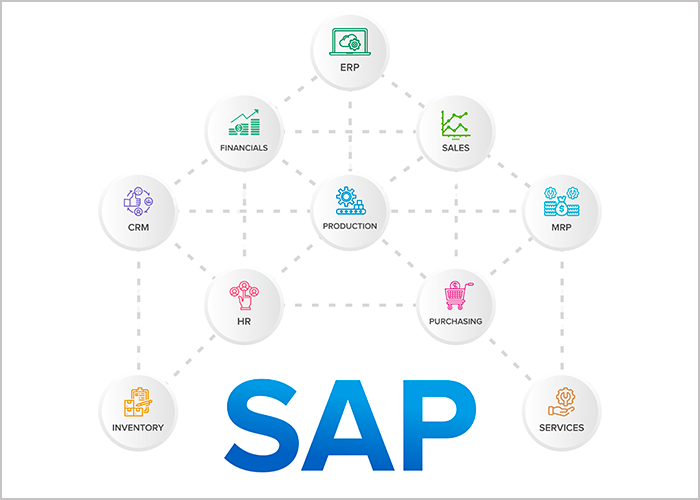
SAP ERP software is a powerful tool that helps businesses manage comprehensively, standardize processes and optimize performance. With the ability to integrate data, automate operations and support strategic decision making, SAP ERP has become an indispensable platform for businesses aiming for comprehensive digital transformation.
Before implementation, businesses should carefully assess their needs, choose the appropriate version and prepare a staff training plan. At the same time, combine SAP ERP with financial automation solutions such as Bizzi.vn to maximize investment efficiency.
Start your journey to optimize your business management today with SAP ERP and Bizzi.vn – your strategic partner in the digital age!