



During peak season, manually logging into dozens of supermarket portals to extract order data is draining the accounting department's resources. Even a small discrepancy in the SKU code or unit price entered into the ERP system can lead to SLA violations, payment rejections, and cash flow bottlenecks.
This article by Bizzi will provide an in-depth analysis. Automated order processing solution for supermarket suppliers Using RPA technology, CFOs can eliminate reconciliation risks and optimize working capital turnover immediately.
The nature of supermarket order processing from a Financial Management (O2C) perspective.
Processing supermarket orders (MT channel) It's not simply about warehouse operations or logistics; at its core, it's a process for handling financial data. Order-to-Cash (O2C) chainThis process begins with extracting purchase order (PO) data from the supermarket portal, performing data standardization (SKU mapping), recording it in the ERP system as a Sales Order (SO), and concludes with debt reconciliation to issue a valid invoice.
The biggest bottleneck lies not in inventory management but in the "data input bottleneck." When accountants or sales administrators have to manually enter each purchase order (PO) from Excel or PDF into the ERP system, the risk of errors in unit prices, SKU codes, or discount terms is very high. This discrepancy leads to supermarkets refusing payment, even though the goods have been fully delivered.
From a CFO's perspective, invoices and orders are no longer just accounting documents but are the "velocity of cash flow." When input data is incorrect or delayed, the entire on-the-go (O2C) cycle is prolonged, directly impacting working capital.
Bottleneck This is why many businesses, despite optimizing their logistics, still face cash flow problems. The solution lies in completely digitizing the first data touchpoint.
What is an automated order processing solution for supermarket suppliers?
The automated order processing solution for supermarket suppliers utilizes RPA technology to extract order data directly from the supermarket's portal, then automatically standardizes and synchronizes it into the ERP system to create sales orders and facilitate accounts receivable reconciliation.
The essence of this solution is Zero-touch processing – Data is transferred from the supermarket's system to the company's ERP system without manual intervention. This helps ensure data integrity from the source, a crucial factor in protecting profit margins.
Contrary to the common understanding (simply "receiving orders and processing deliveries"), in a B2B MT channel environment, order processing is essentially financial data management. If the data is incorrect from the start, every subsequent step (warehousing, invoicing, collecting payments) becomes a risk.
What financial risks arise from manually extracting supermarket order data?
Manually extracting order data from supermarkets creates a chain of risks that CFOs often only realize when cash flow has already been affected.
First of all input delayWhen accountants have to download files from multiple portals, process them in Excel, and then import them back into the ERP system, the processing time for each order can extend to hours. This prevents businesses from meeting their delivery SLAs, leading to contract penalties.
Secondly Data discrepancyCopy-paste errors, incorrect Excel formatting, or wrong SKUs can cause internal sales orders (SOs) to mismatch with supermarket purchase orders (POs). This results in returned goods, outstanding debts, and disrupted collection cycles.
Thirdly Hidden costs – the factor that CFOs are most concerned about. This cost is not only in terms of employee salaries but also includes:
- Accountant's overtime hours at the end of the month.
- SLA penalty value
- Revenue that is being delayed in collection.
The actual total cost may be much higher than the cost of investing in an automation solution.
The process of applying RPA technology to automatically extract order data.
RPA solutions allow businesses to fully automate the process of extracting order data from supermarkets without human intervention.
The operational process comprises three core steps. First, the Robotic Process Assistant (RPA) automatically logs into the supermarket portal 24/7 and downloads purchase order (PO) data. Next, the system uses AI/NLP to extract data and perform SKU mapping, converting the supermarket's product codes to internal codes. Finally, the data is standardized and directly pushed into the ERP system to generate sales orders.
The biggest difference with this solution is that robots completely replace manual operations. No more logging into each portal or processing data in separate Excel spreadsheets. At the same time, the system can detect unusual transactions right from the extraction stage.
With Bizzi, this process is implemented in a way that is optimized for the CFO:
- Bizzi Bot automatically accesses multiple supermarket portals.
- Data is normalized immediately upon extraction.
- ERP systems receive real-time data to support operations.
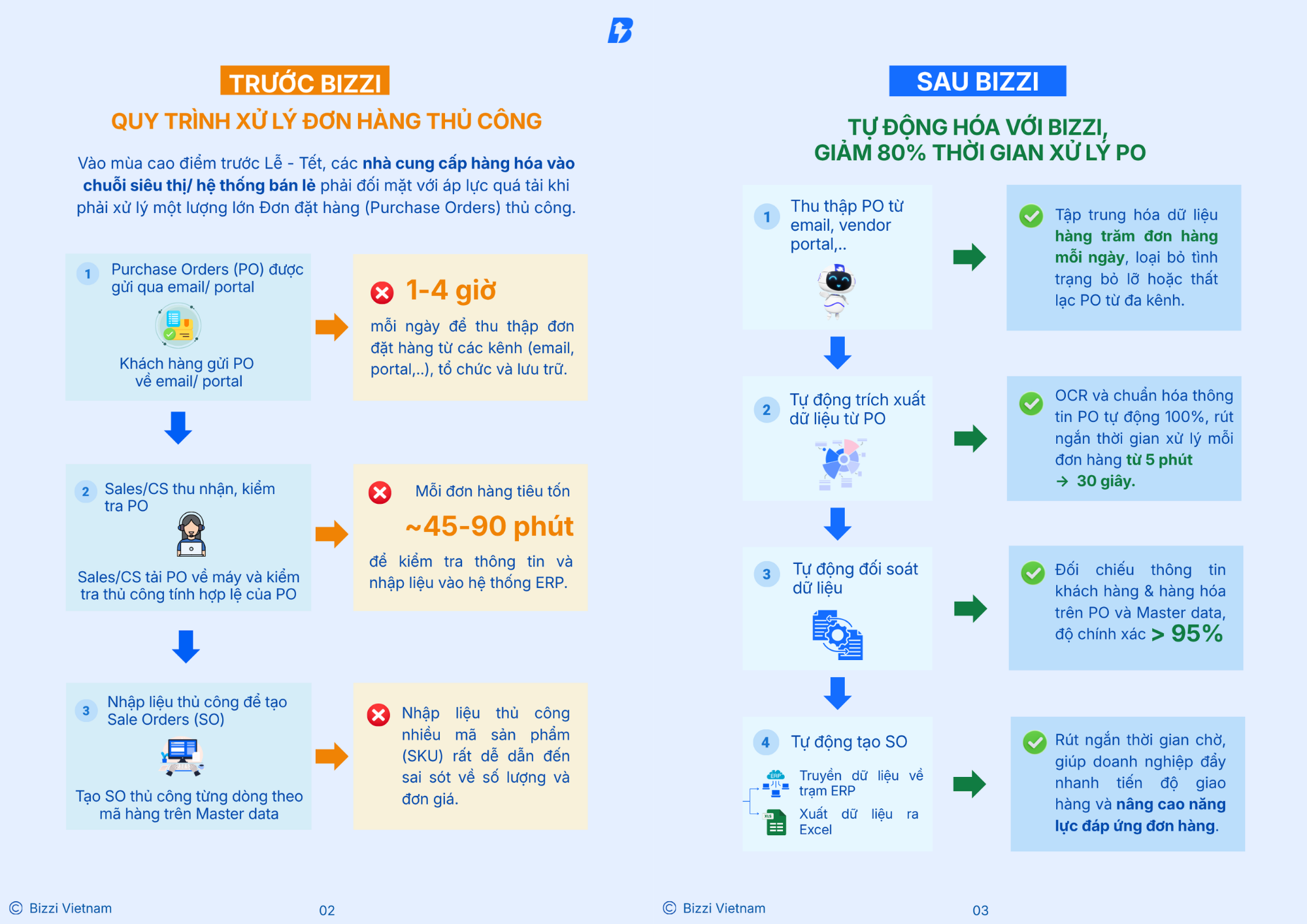
As a result, businesses reduced order processing time by up to 80% and had real-time data for decision-making..
What can CFOs do to increase accuracy and reduce the time it takes to create Sales Orders (SOs)?
To increase accuracy and reduce the time it takes to generate Sales Orders (SOs) from customer Purchase Orders (POs), CFOs should focus on implementing the following four core solutions:
1. Automate the order collection process.
Instead of having sales or customer service staff spend 1-4 hours each day checking emails and logging into supermarket/retail portals, use an automated system that consolidates all purchase orders (POs) into a single point of contact. This ensures no orders are missed and completely eliminates manual waiting time.
2. Using AI technology to “read” data (OCR)
Instead of manually entering data line by line (prone to errors and taking 45-90 minutes per order), CFOs should use OCR technology to extract data from purchase order files.
- Benefit: Convert PDF/Image files to digital data in just 30 seconds with absolute accuracy, eliminating errors in quantity or unit price.
3. Automatic product code matching (Mapping)
Discrepancies in product codes between the supplier and the customer (supermarket) are the main cause of incorrect orders. The system needs an automatic mapping feature:
- Match the Customer Item Code with the Internal ERP Item Code.
- It provides immediate alerts if there are discrepancies in unit prices or unusual product codes, allowing accountants to handle only exceptional cases instead of checking the entire inventory.
4. Direct connection to the ERP system
After the data has been extracted and reconciled, the system will directly push the information into the ERP system to generate the Sales Order (SO).
- Result: The process becomes a seamless flow from receiving the purchase order to generating the sales order in the ERP system, without requiring human intervention for data entry. This helps speed up delivery, especially during peak holiday seasons.
Optimize Cash Cycle (CCC) and reduce DSO through O2C automation.
Automating the O2C process significantly shortens the time from order placement to payment collection. When data is processed quickly and accurately, businesses can issue invoices sooner and expedite debt collection.
According to the formula: CCC = DIO + DSO – DPO
Reducing DSO through automation helps cash flow faster, thereby directly improving working capital. This is a strategic benefit that CFOs need when making technology investment decisions.
Managing risks associated with XML electronic invoices after successful order processing.
After processing the order, all transactions must be invoiced electronically and stored in accordance with current regulations. Decree 123/2020/ND-CP (amended and supplemented by Decree 70/2025/ND-CP) and related guidance documents, including Circular 32/2025/TT-BTCThe XML file of an electronic invoice is the original legal data and must be fully stored, ensuring its integrity and accessibility throughout the legally prescribed period (usually a minimum of 10 years).
In retail operations, businesses often generate additional types of adjustment invoices such as trade discounts, display fees, or debt offsetting. Without strict control over data structure and issuance conditions, businesses may face the risk of invoices being incorrectly formatted, recorded at the wrong time, or not meeting the validity standards according to current tax regulations.
Frequently Asked Questions about Processing B2B Orders in the Supermarket Channel
Processing B2B orders through the medium-term (MT) supermarket channel requires a rigorous process, focusing on accuracy, timeliness, and compliance with strict supermarket regulations (PO, product codes, expiration dates, invoices). Frequently asked questions revolve around inventory management, handling returns, optimizing delivery times, and managing documentation and accounts receivable.
Below is a compilation of frequently asked questions and issues:
What is the biggest risk when Sales and Accounting data are not synchronized?
Data discrepancies lead to incorrect invoices, rejected payments, and an increase in the Date of Sale (DSO). This directly impacts the business's operating cash flow.
Is the extracted data compatible with ERP?
The AI system will standardize data into formats such as XML, JSON, or CSV, ensuring compatibility with popular ERP systems like SAP and Oracle.
How does O2C digital transformation affect profitability?
Automation helps reduce operating costs, eliminate SLA penalties, and save hundreds of hours of manual labor, thereby significantly improving profit margins.
Conclude
In the context of the ever-expanding supermarket channel and increasingly stringent operational requirements, qorder processing Manual methods are no longer suitable for B2B businesses. The biggest bottleneck is not in warehouse operations, but in... financial data input stream – the place that determines the entire rate of revenue collection.
Automated order processing solutions for supermarket suppliers not only reduce the workload for accountants but also act as a "financial defense system," preventing data discrepancies, optimizing reconciliation, and shortening the cash cycle.
In addition to automated order placement solutions, with a platform like Bizzi, businesses can:
- Automatically extract order data from any portal.
- Real-time 3D verification
- Synchronize ERP and centralize cash flow management.
This is no longer the optimal operational option, but rather Strategic leverage helps CFOs control cash flow and achieve sustainable growth. in the modern B2B environment.
Download in-depth documents, industry reports, financial operating guides, and emerging technology trends related to... Intelligent automation in the Order-to-Cash (O2C) process. here.
To receive advice on effective corporate financial management solutions, schedule an appointment with Bizzi at: https://bizzi.vn/dat-lich-demo/