


Software SAP ERP has long been the “backbone” of modern business management systems. Not only popular in multinational corporations, SAP ERP is increasingly attracting the attention of many Vietnamese businesses thanks to its capabilities. Standardize processes, optimize resources and support accurate decision making.
The outstanding difference of SAP ERP compared to many other management systems is that The modules are tightly integrated with each other.Instead of each department using separate software, SAP ERP brings everything together on a single platform, helping data to be synchronized, transparent and immediately exploitable.
Join Bizzi to learn more about the subsystems in SAP ERP software in this article!
1. Overview of SAP ERP and subsystem structure
Before going into details, it is necessary to understand the concept of ERP and how SAP – the largest software corporation in Europe – has developed this solution into the world's leading management tool.
What is SAP ERP?
SAP ERP (Enterprise Resource Planning) is the world's leading enterprise resource planning system, developed by SAP SE – technology corporation from Germany. This is a comprehensive software platform that helps businesses manage most core activities such as: finance - accounting, production, sales, supply chain, human resources and many other areas.
Greatest strength SAP ERP is the tight integration between subsystems (modules). Thanks to that, instead of using many separate software, businesses can manage all data and processes on a single system, ensuring consistency, transparency and accuracy.
What is ERP Module?
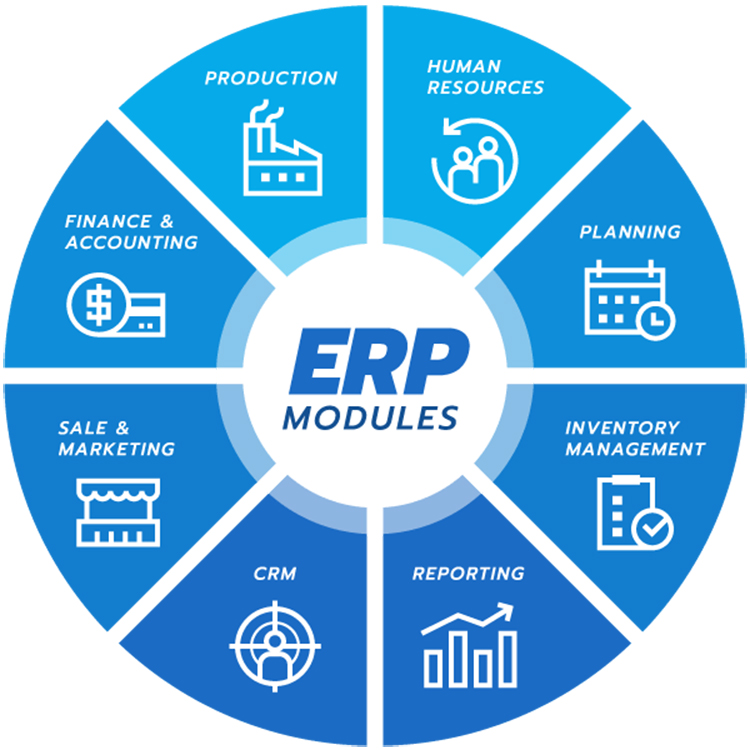
In SAP ERP, each module designed to serve a specific expertise: finance, production, human resources, sales, supply chain… Each module has its own function, its own data, but is still seamlessly connected to the entire system.
For example:
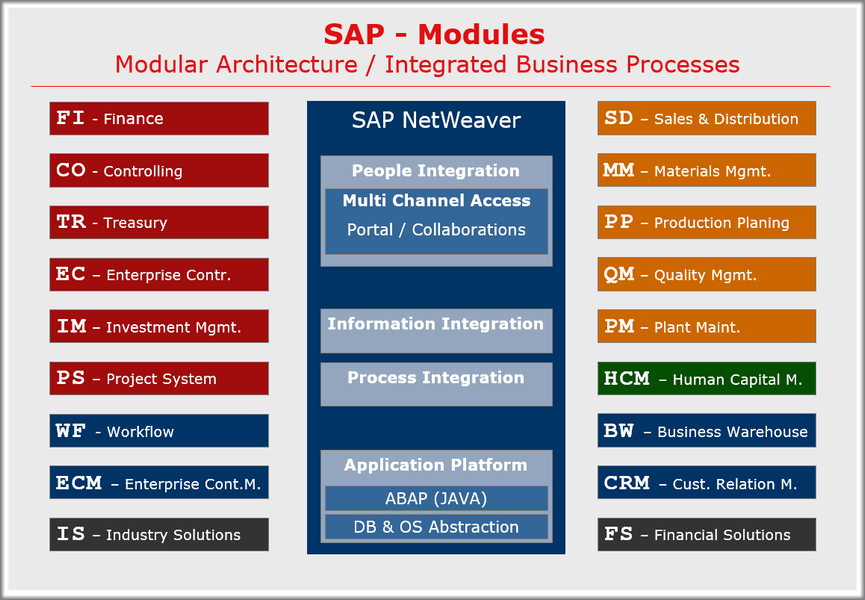
- FI/CO: accounting and financial management.
- MM: purchasing and materials management.
- SD: sales and distribution management.
- PP: production planning.
The subsystems in SAP ERP software have their own data and functions, but are still closely connected in the same platform, helping seamless information sharing.

The role of subsystem integration
One of the greatest values of SAP ERP is integration. Previously, businesses often encountered problems:
- Data is fragmented between departments.
- Information overlaps and is difficult to synthesize.
- Time consuming reporting, prone to errors.
With SAP ERP, businesses can:
- Discrete data processing: Eliminate data that is scattered across many departments and difficult to synthesize.
- Standardize the process: Help the entire enterprise adhere to a unified data standard.
- Improve management efficiency: Information is updated in real time, supporting leaders to make quick and accurate decisions.
2. Explore the subsystems in SAP ERP software
SAP ERP consists of various modules, divided into two main groups: functional subsystem (Functional Modules) serve business operations and technical subsystem (Technical Modules) act as the technological foundation.

Functional Modules Group: Business Operation Platform
This is the subsystem group that directly handles daily business processes, from finance, accounting to production and supply chain.
Accounting & Finance (SAP FI/CO)
SAP FI/CO is likened to The “heart” of SAP ERP, responsible for managing all financial and accounting activities in the enterprise.
- Outstanding subsystems:
- General Ledger
- Accounts Payable
- Accounts Receivable
- Bank Accounting
- Budgeting & Controlling
- Practical benefits:
- Automate recording of documents and accounting entries.
- Reduce 65% data error thanks to reduced manual data entry.
- Save 30% financial reporting time.
- Provide financial management reports according to international standards (IFRS, US GAAP).
Supply Chain & Sales Management (SAP SCM, SD, MM, PP)
This subsystem group supports businesses in optimizing the flow of goods, from raw material import to product distribution.
- SAP MM (Material Management): Automate the procurement process: from purchase requisition, approval, order to payment.
→ Helps businesses control inventory and avoid wasting raw materials. - SAP SD (Sales & Distribution): Manage the entire sales process: quotes, contracts, deliveries, invoices.
→ Tightly integrated with FI for instant revenue recognition. - SAP PP (Production Planning): Support production planning, bill of materials (BOM), production order management.
→ Businesses can Reduce production costs by up to 25% thanks to process optimization.
Other specialized administrative subsystems
- SAP HRM (Human Resource Management): Support the entire HR lifecycle: recruitment, employment contracts, payroll, benefits.
- SAP CRM (Customer Relationship Management): Manage customer data, analyze behavior, personalize experiences.
→ According to research, SAP CRM can help businesses increased 37% in revenue from existing customers. - SAP PS (Project System – Project Management): Allows real-time progress tracking, resource allocation, and project cost management.
Technical Modules Group: Core Technology Platform
If the functional subsystem group is the “operational department”, then the technical group is the “technological backbone” that helps the system operate smoothly.
- SAP ABAP: The core programming language allows customization of the system to business needs.
- SAP Basis: System administration, security, user authorization, and performance assurance.
- SAP HANA & SAP Fiori:
- SAP HANA: High-speed in-memory database, real-time big data processing.
- SAP Fiori: Modern user interface, optimized experience and increased productivity.
3. Overall benefits and how to choose the right SAP subsystem
SAP ERP implementation is not just about replacing management software, but also about bringing strategic changes in the way a business operates. When integrating subsystems in SAP ERP software, businesses will gain many outstanding benefits at both the operational and administrative levels.
Overall benefits of implementing SAP ERP
- Centralized, consistent data
-
- Previously, each department could use a separate software (Excel, internal accounting software, independent sales system). This caused data to be fragmented, duplicated, and difficult to synthesize.
- SAP ERP solves this problem completely with a unified database that is updated in real time. For example, when the sales department issues an invoice in the SD subsystem, the data is immediately recorded in FI/CO to reflect the debt and cash flow.
- Enhance financial transparency
-
- All transactions are recorded automatically, minimizing manual intervention.
- Financial reports are standardized according to IFRS or VAS (depending on configuration), helping businesses comply with auditing and tax regulations.
- Administrators can control costs for each department or project in real time.
- Support strategic decision making
- Integrate analytics and forecasting tools (SAP BI, SAP Analytics Cloud).
- The management can simulate the scenario: "If the cost of raw materials increases by 10%, how will the profit margin change?" → from there, build a response plan.
- Optimize operations & reduce costs
- Thanks to automation, businesses can reduce order processing time and shorten the cycle of collecting payments from customers.
- According to SAP statistics, businesses that apply comprehensive ERP reduce their average 23% operating costs and increase 19% labor productivity in the first two years of implementation.
How to choose the right subsystems in SAP ERP software
SAP ERP implementation is a large project, costing a lot of money and manpower. Therefore, businesses need to have a method to choose the right module to avoid waste.
- Identify specific business goals
- If businesses focus on optimization financial management, prioritize FI/CO.
- If the biggest problem lies in supply chain and production, need to select MM, PP, and SD.
- If businesses focus customer care, CRM is a necessary choice.
- Scale & Industry Assessment
- Large manufacturing enterprises: need to combine FI/CO + MM + PP to control from raw material purchase to product cost.
- Commercial enterprise: should focus on FI/CO + SD to manage cash flow and sales.
- Service business: often deploy FI/CO + PS to manage project and service costs.
- Cost-Benefit Analysis
- Don't choose modules as a "package" but invest in stages.
- For example, an SME might start with FI/CO for standardized financial management, then expand to SD or CRM once the system is operationally stable.
- Choose a reputable implementation partner
- SAP has a global partner ecosystem, but choosing the wrong one can lead to failure.
- Businesses should choose partners have experience in similar industry to shorten go-live time.
4. Why is it necessary to integrate subsystems in SAP ERP software with specialized financial solutions?
Although SAP ERP is a comprehensive management system, the reality of implementation in Vietnam shows that many businesses still encounter "bottlenecks" in the financial and accounting stages. The main reasons come from the large volume of documents, complex legal regulations and increasingly strict cost control requirements.
That is why, SAP ERP integration With a specialized financial solution like Bizzi is the strategic direction to optimize operations.
Remaining problems
Even after implementing the FI/CO subsystem, businesses still face some limitations:
- Manual invoice processing is time-consuming: When the number of input invoices reaches thousands per month, data entry and reconciliation in SAP becomes a burden for the accounting team.
- Lack of flexibility in debt reconciliation: ERP often handles rigidly according to standard procedures, while in reality Vietnamese businesses need a lot of customization when working with suppliers and customers.
- Actual cost management is not detailed: The FI/CO subsystem is strong in general accounting, but tracking costs incurred by each project, department or spending group is not really intuitive.
>> See more: Latest debt reconciliation report template Word, Excel filet
How Bizzi.vn complements SAP ERP
Bizzi.vn is a financial and accounting automation platform for businesses, built specifically to address these “pain points”. When integrated with SAP ERP, Bizzi brings clear added value:
- Automate the electronic invoice process: Bizzi is able to read and extract e-invoice data from various formats, then synchronize directly into the FI/CO subsystem in just a few minutes. This helps accountants completely eliminate manual data entry, reducing up to 80% errors.
- Real-time debt tracking: system of warning about upcoming invoices, analyzing cash flow of receivables and payables, supporting chief accountants and CFOs to strictly control financial obligations.
- Detailed cost & cash flow management: Bizzi allows expenses to be categorized by department, project or supplier. This allows CFOs to create detailed cash flow reports for quick decision making without manual operations on Excel.
- Legal compliance in Vietnam: Bizzi is designed to fully comply with regulations on electronic invoices, tax data standards and auditing requirements, helping businesses feel secure when comparing with authorities.

>> See more: Imexpharm chooses to integrate Bizzi solution with SAP ERP system to automate invoice processing
Integrated value
The key point here is: Bizzi does not replace, but complements SAP ERPWhile SAP ERP provides a comprehensive management platform, Bizzi helps handle “locally sensitive” financial operations in Vietnam, where the number of invoices, debts and tax regulations are very complex. Thanks to integration With this, the subsystems in SAP ERP software – especially FI/CO – become more flexible, compact and efficient, while helping businesses optimize accounting resources, improve cash flow control and make quick decisions.
Sign up to learn about ERP system integration solutions: https://bizzi.vn/tich-hop-erp/#signuperp
5. Frequently asked questions about subsystems in SAP ERP software (FAQ)
During the process of learning and implementing SAP ERP, businesses and individuals studying and working in the field of accounting and finance often ask many questions related to the subsystems. Below are some common questions and answers:
How many modules does SAP ERP have?
Currently SAP ERP has dozens of main and sub modules, divided into two groups:
- Functional modules: FI/CO, SD, MM, PP, HRM, CRM, PS…
- Technical modules: ABAP, Basis, HANA, Fiori…
Depending on the industry, businesses can choose to implement part or all of it.
What is the difference between SAP FI and SAP CO?
- FI (Financial Accounting): focus on financial accounting, serving reporting to external parties such as tax authorities, auditors, shareholders.
- CO (Controlling): focus on management accounting, tracking costs, internal profits to support management decision making.
These two subsystems are often deployed in parallel to create a comprehensive financial picture.
Which subsystem should small and medium enterprises use?
Depending on the industry and goals, but for SMEs, priority is often given to:
- FI/CO: standardize financial and accounting systems.
- SD/MM: sales management and material purchasing.
These modules are just enough for SMEs to control costs and cash flow without being too complicated or expensive.
Which SAP module should I learn to get a job easily?
The most popular and in-demand modules today are:
- FI, CO: for accounting, finance.
- SD, MM: for personnel in the business, purchasing, and logistics sectors.
In addition, with the trend of digitalization, SAP HANA and Fiori is also considered "hot" because it involves new technology.
Conclude
SAP ERP is a leading ERP system with the advantage of strong integration of many subsystems. Understand and choose correctly subsystems in SAP ERP software will help businesses optimize costs, improve management efficiency and maintain competitive advantage.
If you are interested in Automate financial processes and integrate SAP ERP with specialized solutions, please contact Bizzi.vn for detailed advice. Bizzi accompanies businesses on the journey of digital transformation and financial management optimization.
Monitor Bizzi To quickly receive the latest information:
- Facebook: https://www.facebook.com/bizzivietnam
- Linkedin: https://www.linkedin.com/company/bizzi-vietnam/
- Youtube: https://www.youtube.com/@bizzivietnam