



Debt reconciliation form This helps businesses and partners compare accounts receivable and accounts payable at a given time, identify discrepancies, and agree on the balances to be monitored. For signing confirmations, a Word file is more suitable; for checking multiple invoices and documents and calculating balances manually, an Excel file is more convenient.
Bizzi has prepared a 2026 model collection including editable Word file and Excel file with formulas, and also provide usage instructions to customers and suppliers, and conduct year-end reconciliation.
1. Download Word and Excel 2026 debt reconciliation statement templates.
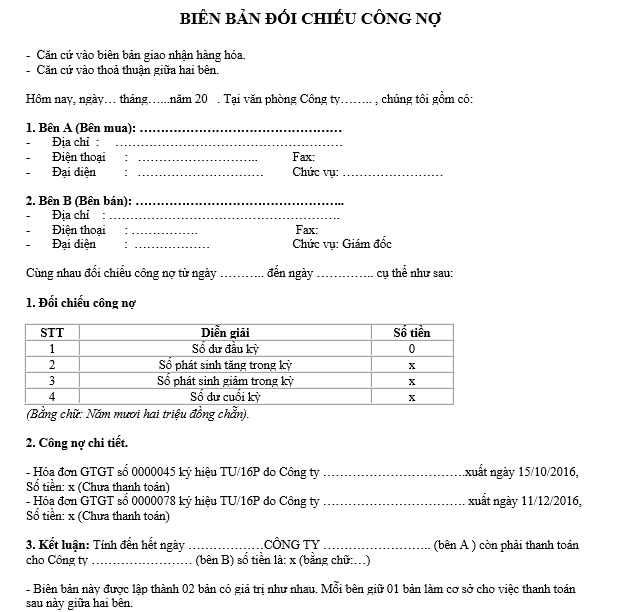
1.1. Sample debt reconciliation statement (Word file)
Suitable for sending a memorandum to a partner for verification, signature confirmation, or inclusion in accounts receivable records. The template includes information on both parties, a transaction table, beginning and ending balances, differences, and proposed solutions.
1.2. Excel debt reconciliation template with formulas
The workbook consists of 3 sheets: user guide, detailed reconciliation table, and summary report. The file automatically calculates the balance and difference between the two parties and supports marking the status as "Matched," "Pending Verification," or "Adjusted.".
1.3. Debt Reconciliation Minutes template in English
This is used when a business needs to send a reconciliation statement to a partner in English. Before signing, the terminology, currency, and transaction information need to be adjusted to match the actual contract.
| Demand | Suitable file | Use |
|---|---|---|
| Send to partner for signature confirmation | Word | Fill in the verified data, adjust the confirmation section and signatory according to actual authority. |
| Compare multiple invoices/documents. | Excel | Enter each transaction, counterparty data, and track the difference. |
| Reconcile customer accounts receivable. | Excel → Word | Check accounts receivable in Excel, then summarize the balances to create a report in Word. |
| Reconcile accounts payable with suppliers. | Excel → Word | Change the debt type to "Accounts Payable", reconcile invoices, and make payments before confirmation. |
| Finalize accounts receivable at the end of the year. | Excel + Word | Finalize the balances as of December 31st, process any discrepancies, and prepare a final confirmation report. |
2. What is a debt reconciliation statement?
A debt reconciliation statement is a document recording the results of comparing debt figures between two parties at a specific point in time. The data is typically reconciled from accounting records, invoices, contracts, payment vouchers, delivery or acceptance records, and related deductions.
The goal of reconciliation is not only to determine "how much is still owed," but also to clarify... Beginning balance, transactions during the period, amounts paid or deducted, ending balance, and the reason for any difference, if any..
2.1. Distinguishing, reconciling, confirming, offsetting, and transferring accounts payable.
| Document | Main purpose | When to use |
|---|---|---|
| Debt reconciliation minutes | Compare the data and identify the differences between the two sides. | Periodically, at the end of the period, before closing the balance, or when discrepancies arise. |
| Debt confirmation minutes | Confirmation of agreed-upon balances/debt obligations between the parties. | When proof is needed to confirm the amount of money still to be collected or paid. |
| Minutes of debt offsetting/counter-offering | Record the offsetting of receivables and payables as agreed. | When two or more parties have obligations that are offset against each other. |
| Minutes of debt handover | Delegating responsibility for monitoring accounts receivable records and status. | When there are changes in personnel, departments, or the person in charge. |
If the goal is to confirm the balance rather than reconcile details, you can use... Sample debt confirmation form. In case of needing to offset obligations between parties, please refer to... debt offset form.
3. What information should a debt reconciliation statement template include?
There is no single legally binding form that applies to all transactions. However, to ensure the record is easily verifiable and valid for use in business records, it should include all of the following information groups.
| Group | Content | Points to check |
|---|---|---|
| Information from both sides | Name of the entity, tax identification number, address, representative/authorized person. | Matches the contract and transaction records. |
| Time of comparison | Date of record keeping, date of balance closing, reconciliation period. | Distinguish between the data creation date and the data closing date. |
| Opening balance | The amount of debt carried over from the previous period. | Match the previously confirmed balance or closed balance. |
| Increase in occurrence | Invoices, supporting documents, quantities accepted, or arising obligations. | Check the document number, date, and value. |
| Payment/Deduction | Amounts paid, received, discounts, returns, or offsets. | Compare the bank statement and related documents. |
| Closing balance | The remaining amount will be monitored by both parties after reconciliation. | Specify the figures for each side if there are any discrepancies. |
| Difference | Amount, cause, and proposed solution. | Don't force a match when the documents are not yet complete. |
| Confirm | The competent/authorized person shall provide confirmation in an appropriate manner. | Verify the signing authority and internal procedures of the parties involved. |
4. How to prepare a debt reconciliation statement
-
Prepare accounts receivable data.
Extract balances and transactions according to the correct partner, reconciliation period, and type of debt. With Excel data, each row should correspond to a single transaction or document.
-
Compare source documents
Review invoices, contracts, payment documents, delivery/acceptance records, deductions, and related adjustments.
-
Compare the data between the two sides.
Include partner data in the same table to identify which items match, which are out of order, and which lack sufficient documentation.
-
Identify the cause of the discrepancy.
Adjustments should not be made simply to ensure both parties have the same balance. It is necessary to identify unrecorded transactions, duplicate entries, incorrect periods, outstanding payments, returns, or deductions that have not been updated.
-
Agree on the balance and handling plan.
Clearly state the agreed-upon balance; if there is a difference, specify the amount awaiting verification and the deadline for processing.
-
Confirm and save the record.
Keep records along with detailed data and related documents so that the cause of each outstanding debt can be traced.
5. How to handle discrepancies in accounts receivable/payable between two parties.
| Common causes | How to check | Solution |
|---|---|---|
| One party has issued the invoice, the other has not. | Check the invoice date, the date the document was received, and the accounting period. | Determine the correct period and update it according to actual records. |
| Payment has been made but not yet recorded. | Compare the bank statement, UNC/credit note, and transaction code. | Record payments or verify transactions that have not yet been reconciled. |
| Duplicate invoices/documents | Compare invoice numbers, document numbers, values, and transaction dates. | Duplicate records after verification. |
| Returns, discounts, or deductions have not been updated. | Review adjustment documents, agreements, and deduction records. | Update accounts receivable/payable based on valid supporting documents. |
| Offsetting unrecorded liabilities | Review the offsetting agreement/record and related obligations. | Record the transaction or update the status once all necessary documents are submitted. |
| Incorrect customer/supplier code | Verify the accounting object and partner code. | Adjust the correct target before finalizing the balance. |
6. How do you reconcile accounts payable and accounts receivable from different suppliers?
6.1. Customer Accounts Reconciliation Report
The focus is accounts receivableThe invoice should include the amount paid by the customer, deductions, and the remaining amount to be collected. Special attention should be paid to overdue or disputed amounts.
6.2. Supplier Accounts Reconciliation Report
The focus is Accounts PayableThis includes purchase invoices, amounts paid, advances/offsets, and outstanding liabilities. A thorough comparison with the payment schedule and bank statements is necessary.
To track accounts receivable regularly instead of just finalizing them at the time of recording, you can refer to the following: Excel file for managing and tracking accounts receivable..
7. Sample year-end accounts receivable reconciliation statement: what needs to be finalized?
Year-end reconciliation is usually performed before or during the closing process to clarify the balances as of December 31st and any remaining discrepancies. It is important not to record only the final balance while ignoring the transactions that led to that balance.
- Verify that the opening balance has been transferred to the correct partner.
- Compare all invoices/documents generated during the year.
- Compare the amounts received, paid, and payments awaiting reconciliation.
- Check returns, discounts, deductions, offsets, and adjustments.
- Determine the balance as of December 31st for each party.
- Record any outstanding issues separately instead of making adjustments without justification.
- Complete the confirmation and attach the detailed accounts receivable statement.

8. Is a debt reconciliation statement mandatory? Does it need to be signed and stamped?
8.1. Is there a legally mandated template?
Currently, there is no single legally mandated template for a debt reconciliation statement that all businesses are required to use. Businesses can develop templates that suit their specific transactions and control systems.
Circular 99/2025/TT-BTC Effective from January 1, 2026, this document provides guidance on corporate accounting procedures. However, the Word/Excel files in this article are sample forms to support data reconciliation and verification, not mandatory accounting forms issued separately under Circular 99.
8.2. Who should sign the minutes?
To increase its usability as a basis for comparison, the record should be certified by an authorized person or a representative appropriate to the transaction and procedures of each party. It should not be assumed that the absence of a seal automatically renders the record invalid.
8.3. Can electronic minutes be digitally signed?
The Law on Electronic Transactions 20/2023/QH15, effective from July 1, 2024, and Decree 23/2025/ND-CP, effective from April 10, 2025, provide the legal framework for electronic signatures and trusted services. When using electronic minutes, businesses need to choose a signing method that is appropriate to the legal conditions and the agreements/procedures of the parties involved.
9. Common mistakes when preparing accounts receivable reconciliation statements
- Only the ending balance is recorded, without a detailed transaction statement.
- Using data from a third party without cross-referencing it with the source documents.
- Combining the accounts payable of multiple customers/suppliers into a single document.
- Do not record the reason when the balances on both sides are still different.
- Incorrectly recording accounts receivable as accounts payable, or vice versa.
- Using a signatory who is not in line with the unit's authority or procedures.
- Not saving detailed files makes it difficult to trace back the transaction in the summary report.
- Because the reconciliation was only done at the end of the year, the discrepancies were discovered too late.
10. When is Excel no longer sufficient for managing accounts receivable?
Excel is suitable when the number of partners and transactions is manageable with just a few files. As the data increases, reconciliation often becomes difficult due to files being held by multiple people, inconsistent recovery status, and payments needing to be traced back against bank statements.
| Element | Excel is suitable when | The system should be considered when |
|---|---|---|
| Mass | Few partners, few transactions. | Multiple invoices, multiple customers, and multiple payment periods. |
| Debt reminder | It can be tracked manually. | You need to remind people by due date or according to a set schedule. |
| Payment reconciliation | The number of bank transactions is low. | There are several payments awaiting reconciliation with the statement. |
| Report | Just the basic balance is needed. | We need DSO, a report on the aging of the debt and its collection status. |
| Combination | One person or a small group. | Multiple departments monitor the status of accounts receivable. |
To understand the entire lifecycle from recording to tracking and retrieval, refer to debt management process in businesses and How to track DSO in cash flow management..
11. Automate your accounts receivable management and reconciliation process with Bizzi.
Word/Excel records only finalize balances at a single point in time. As transactions increase, the fragmented spreadsheets skew end-of-period reconciliation, prolonging the time spent searching statements and tracing original documents. To ensure accounts receivable match daily—not just periodally—the entire flow. Accounts Receivable (AR) It needs to run on an automated data stream.
From the sales process, Bizzi Invoice Issuing invoices correctly and directly recording them in the accounts receivable ledger minimizes missed invoices or discrepancies with customers. With multi-channel revenue streams (POS, e-wallets, e-commerce platforms), Bizzi RRS Match revenue with actual cash received in the bank account, and deduct exchange fees to determine the correct amount to be collected.
Data transfer Bizzi ARM: Monitor payment deadlines, send payment reminder emails/SMS according to a schedule, and write off debts when the bank confirms a balance — no more manually checking statements. The accountant retains the right to review and approve before recording.
A centralized source of accounts payable helps shorten the time required for periodic reconciliation statements and reduces data disputes with partners.
Register for a consultation and experience Bizzi's automated accounts receivable reconciliation solution:
>> Try the product: https://bizzi.vn/dang-ky-dung-thu/
>> Schedule a demo: https://bizzi.vn/dat-lich-demo/
12. Frequently Asked Questions about Accounts Reconciliation Statements
Is a debt reconciliation statement mandatory?
There is no single mandatory reconciliation statement template for all businesses and transactions. However, reconciliation or confirmation may arise from contracts, internal control requirements, audits, or records of specific transactions.
What are the differences between Word and Excel templates?
Word is suitable for presentation, printing, and signing. Excel is suitable for entering multiple transactions, calculating balances, and identifying discrepancies. Businesses can use Excel to reconcile details and then transfer the agreed-upon data to Word.
Is the customer accounts receivable reconciliation form different from that of the supplier?
The structure may be similar, but the nature of the balances differs. For customers, businesses primarily track accounts receivable; for suppliers, businesses primarily track accounts payable.
When should the year-end accounts receivable reconciliation statement be finalized?
Typically, businesses need to determine the balance at the end of the accounting period, such as December 31st for a fiscal year that coincides with the calendar year. The date of record-keeping and the date of closing the figures should be clearly separated.
If the figures from both sides don't match, can a memorandum of understanding still be signed?
A record can be made documenting the agreed-upon figures and the remaining discrepancies, along with the reasons or details awaiting verification. Figures should not be altered simply to make the record appear to "match" without sufficient evidence.
Does a debt reconciliation statement need to be stamped?
A general rule that a document is automatically invalid without a seal should not be applied. Businesses need to verify whether the certifying party has the appropriate authority or authorization, and also review the agreement and procedures of the parties involved.
Can a debt reconciliation statement be digitally signed?
Electronic forms may be used when the legal requirements for electronic transactions and signatures are met, and when they are consistent with the procedures and agreements of the parties involved.
How often should accounts receivable and payable be reconciled?
There is no single frequency that applies to all businesses. The frequency should be based on transaction volume, debt risk, contractual requirements, and control processes. Businesses with many transactions often reconcile periodically rather than waiting until the end of the year.