


In the data age, businesses cannot manage performance if data is not transparent, consolidated, and consistent. Enterprise Performance Management (EPM) is the bridge between operational data from ERP and business strategy—creating a “single source of truth,” the foundation for accurate, timely, and verifiable financial decisions.
This article provides a detailed analysis of the EPM mechanism for data transparency: from how the system ensures all financial figures are clearly displayed and traceable, to its ability to consistently consolidate data from various sources across the organization.
What is EPM? Why is data transparency fundamental to business performance management?
EPM (Enterprise Performance Management) An EPM is a comprehensive management system that helps businesses plan, forecast, analyze, and report on operational performance in a synchronized manner. While ERP focuses on recording daily transactions, EPM helps leaders understand and control the future through aggregated data, forecasts, and business performance analysis.
In financial planning and reporting, trust in data is paramount. A report may be beautifully presented, but if the data is inaccurate or of unknown origin, it cannot serve as a basis for strategic decision-making.
In reality, many Vietnamese businesses still face the problem of "data silos"—fragmented data across departments, disjointed Excel files, and a lack of change control procedures. The result is:
- Each department maintains a different “version of data.”
- FP&A requires hours of manual cross-checking and verification.
- CFOs find it difficult to make quick decisions because they don't know which numbers reflect reality.
EPM Data Transparency — Data transparency in EPM — refers to the ability of an Enterprise Performance Management system to ensure that all financial data is clearly displayed, traceable, consistent across departments, and reliable for decision-making.

EPM data transparency delivers three core values:
- TraceabilityEach number has a history of changes, the person who entered it, and the reason for the adjustment.
- ConsistencyThe same financial indicator is displayed consistently across all reports and departments.
- AuditabilityThe CFO can trace and verify directly within the system without needing to "request the original Excel file".
When data is transparent, FP&A teams can analyze with confidence, and CFOs can sign off on reports with confidence — knowing that every number is accurate and provable.
5 core components that make up a transparent data-driven EPM.
The EPM system achieves data transparency through five simultaneously operating technical components, forming a closed control loop from data source to final report.
Data Governance — A robust data governance framework
Data governance This is the foundational layer for unified control of all data within the EPM. This component includes three main elements: rules and procedures for data collection, approval, and updating; clear delegation of authority between roles (CFO, FP&A, sales department, plant); and standardization of data categories such as expense codes, accounts, and KPIs.
With governance, data is no longer a "gray area" but becomes an asset that is managed responsibly—the foundation for ensuring the accuracy and consistency of reporting.
Data Accuracy and Integrity — Ensuring data is correct, complete, and reliable.
Data is only valuable when it is correct and complete. Accuracy Ensure that the data accurately reflects actual operations (no errors, no duplication). Integrity Ensuring that data is not altered or corrupted during transmission, processing, or aggregation.
EPM supports this through three mechanisms: automated cross-checking (validation rules); recording of change history (audit trail); and alerts when data is missing, inconsistent, or exceeds thresholds. As a result, CFOs can have complete confidence in financial data without the need for manual verification.
Data Consolidation — Consolidating multi-source financial data
In most businesses, data is scattered across ERP, CRM, HRM, and internal Excel files. EPM acts as a consolidation layer, automatically aggregating data from these different systems, including financial reports (P&L, Balance Sheet, Cash Flow), budgeting and forecasting, and operational data from each subsidiary unit.
As a result, businesses have a consolidated and up-to-date financial picture in real time, instead of relying on time-consuming manual compilation.
Reference: Internal transaction reconciliation process
Data Lineage and Data Quality Management — Traceability and Quality Control
Data lineage This refers to the ability to trace the entire journey of data—from its origin to its appearance in the final financial report. For example, revenue in a consolidated report can be traced back to a specific invoice from the ERP system.
In conjunction with data quality management, EPM continuously monitors data completeness and validity; detects discrepancies in data entry, mapping, or merging; and provides a data quality dashboard for FP&A to easily monitor. This helps prevent errors before data is used for decision-making.
Single Source of Truth — A single and reliable source of data.
The ultimate goal of the EPM system is to create a “Single Source of Truth” (SSOT) – a unified, transparent, and synchronized data source for the entire enterprise. With SSOT: every department and every level of management works on the same data; there is no longer a situation of “separate Excel files for one department, separate data for another”; and all plans, forecasts, and actual results reflect a single version of the truth.
When a business has a true SSOT (Summary of Data Analysis), every decision—from budget adjustments to strategic planning—is based on validated data, no longer dependent on intuition or judgment.
How EPM implements data transparency: ETL process and multi-system integration.
The EPM system is designed to connect, consolidate, and standardize financial data from various sources, creating a unified and reliable data foundation through a rigorous technical process.
EPM Data Integration and ETL Process
Progress ETL (Extract — Transform — Load) It is the heart of data integration capabilities in EPM, operating in 3 steps:
- ExtractEPM automatically retrieves data from multiple sources — ERP, CRM, accounting systems, internal Excel files.
- TransformData is cleaned, logically checked, units and accounts are normalized, and formatted according to the management system's standards.
- LoadAfter processing, the data is loaded into a central data repository for use in reporting, planning, and forecasting.
Centralized Data Repository and Real-Time Synchronization
After the data is ETL, all the information is stored in Centralized Data Repository —the heart of EPM. Here, all financial data, plans, and actual results are stored in a structured manner. Changes to ERP or accounting systems will be incorporated. real-time synchronization (Real-time synchronization) allows FP&A and CFOs to access the same unified dataset — Single Source of Truth.
Metadata and Master Data Management (MDM)
EPM maintenance metadata (descriptive data) and master data (Standardized catalog) to ensure all information is interpreted consistently. Metadata helps to understand the meaning of each data field such as net revenue, gross revenue, or operating expenses. MDM manages a central catalog including subsidiary codes, cost centers, accounting accounts, and product catalogs. Therefore, even if data comes from many different systems, EPM can still understand and organize it according to the same structural standard.
Data Mapping and Normalization of Multi-Source Data
When integrating with different systems, data structures are often inconsistent. EPM uses data mapping To map corresponding information fields, including: mapping accounting accounts from different ERP systems to the same standard P&L system; standardizing currency units, expense codes, and accounting periods; applying validation rules to alert for missing, illogical, or duplicate data.
Cross-Department Visibility — Connecting finance, sales, and operations
EPM's particular strength lies in its ability to break down data barriers between departments. Finance The impact of actual sales and costs on the budget is immediately apparent. Department Sales and Marketing Access KPIs and revenue forecasts in real time. Department Operations and Production Gaining insight into cash flow and related budget consumption is crucial. The entire organization operates on a single dataset, improving interdepartmental collaboration and optimizing overall business performance.
Integrating EPM with large ERP systems
EPM connects directly with many popular ERP platforms such as SAP (S/4HANA, B1), Oracle Financials or NetSuite, Microsoft Dynamics 365, and custom internal systems. This integration enables automatic synchronization of revenue, expenses, accounts payable, cash flow, and budget planning—completely eliminating manual data entry or file uploads.
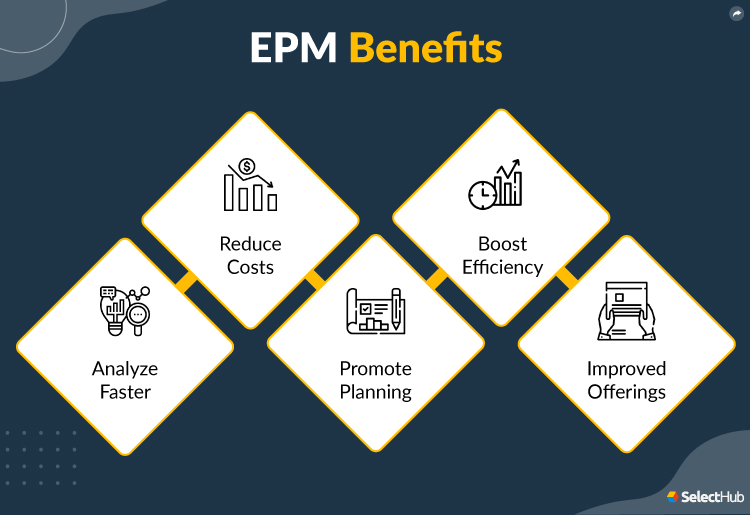
7 Benefits of EPM (Exclusive Data Management) for CFOs and FP&A
In a context where businesses increasingly rely on data for planning, forecasting, and decision-making, data transparency has become a top priority for CFOs and FP&A teams. An EPM system is a strategic solution that helps standardize, consolidate, and control financial data—ensuring all numbers are "action-oriented and reliable."
Reduce data discrepancies and manual errors
Previously, budgeting, forecasting, and report consolidation processes were often handled in Excel—prone to data entry errors, formula mistakes, and version overlaps. EPM automates this entire process, eliminating manual data entry and aggregation; synchronizing data from multiple sources with just a few clicks; and ensuring every change is clearly documented. CFOs can be confident that every report accurately reflects operational reality, free from “Excel risk.”
Increase data accuracy and traceability.
EPM provides audit trail — a detailed log of recorded events. Who entered the data, when, and what changes were made?This allows FP&A to trace the origin of each figure; verify the logic and validity of the data; and easily explain it to the Audit Committee, Board of Directors, or independent auditors. Data transparency not only helps reports be "accurate," but also helps CFOs prove that those figures are correct.
Consolidate financial data from multiple systems
EPM plays a role consolidation layerIt connects with ERP, CRM, HRM, accounting systems, and internal files. As a result, financial data is updated automatically in real time; all departments work on the same unified data set; and delays in consolidating reports from multiple subsidiaries or units are significantly reduced. The result is a “Single Source of Truth”—a single, reliable data source for the entire organization.
Improve compliance with financial standards.
EPM helps businesses standardize reporting structures and ensure compliance with international financial standards, including IFRS (International Financial Reporting Standards), VAS (Vietnam Accounting Standards), and SOX (Sarbanes-Oxley Act). The system automates the reconciliation process, eliminates internal transactions, records audit logs, and locks data by period — helping businesses Maintain transparency and be ready for audits at any time..
Improve the speed of analysis and decision making
With data consolidated and validated automatically, FP&A can focus on analysis instead of data entryEPM provides intuitive dashboards for analyzing revenue, expense, and cash flow trends; scenario planning capabilities to assess the impact of market fluctuations; and real-time reporting to help CFOs react quickly to changes. Decision-making is no longer based on emotion, but on data. accurate and timely data.
Supporting CFOs in risk management and data control
EPM allows CFOs to quickly identify anomalies in the data; Establish a multi-level approval process. To prevent errors; and to track access rights and edit history for each report. As a result, the system becomes... proactive financial data risk control tools, instead of only discovering the discrepancies after the report has been submitted.
Reduce reliance on Excel — Towards modern finance
Excel remains useful, but as businesses grow, it's no longer sufficient to guarantee data integrity and transparency. EPM inherits Excel's flexibility but upgrades it with automated control and approval processes; a user-friendly yet secure data entry interface; and a centralized storage system with enterprise data management capabilities. This is the way forward. Move from manual Excel to a smart finance platform, where all data is controlled, connected, and transparent.
EPM and financial data compliance control: security, audit, and GRC
In the modern financial environment, compliance and data control are vital. EPM not only assists in planning and reporting, but also serves as a comprehensive risk management and compliance control system for CFOs and FP&A.
Financial compliance and audit trail
EPM records the entire history of data manipulation and changes (audit trail), allowing businesses to trace who made the changes, what changes were made, and when. This ensures transparency in the reporting process, meeting auditing standards such as IFRS, VAS, and SOX. All financial reports become transparent. audit-ready — Ready for audit at any time without further preparation.
Role-based risk management and internal control framework
EPM setup Risk & Control Framework With strict role-based access control, the CFO has full overall oversight. FP&A personnel can only edit data within their assigned areas. Other users only have the right to view reports. This access control mechanism prevents unintentional errors and unauthorized changes, protecting the integrity of financial data.
Data traceability and compliance with the Sarbanes–Oxley Act (SOX)
EPM ensures data traceability at every level—from accounting transactions and cash flows to consolidated results. This is especially important to meet the Sarbanes-Oxley (SOX) standard and international financial regulations on transparency and internal controls. The ability to trace the entire data journey—from ERP and CRM sources to the final report—makes all changes verifiable and verifiable.
Internal control and operational transparency
EPM establishes automated internal control mechanisms, detects and alerts to data discrepancies, supports management in approving reports, plans, and budgets; and increases data reliability before submission to management. The system acts as an automated quality control layer, ensuring all data is validated before decision-making.
Governance-Risk-Compliance Framework (GRC Framework)
EPM acts as a unified GRC platform with 3 dimensions: Government — Establish standardized data structures and reporting processes; Risk — Monitoring financial risks, deviations from plans, and cash flow; Compliance — ensuring compliance with accounting standards and audit requirements. CFOs and FP&A can confidently make decisions based on transparent data, strict controls, and absolute compliance.
Application of EPM in corporate financial data transparency
EPM systems play a central role in consolidating, standardizing, and monitoring financial data across the entire enterprise. Below are some practical applications that EPM brings to organizations.
EPM in the Consolidation and Reporting Report
EPM automatically consolidates financial data from multiple subsidiaries, departments, or regions, eliminating manual Excel operations. Accounting standards such as IFRS or VAS are applied throughout the consolidation process, ensuring consistent reporting and no data duplication; intercompany eliminations are automatically removed; and data is synchronized in real-time from ERP or accounting software.
Data transparency in forecasting and budgeting.
In the process budgeting & forecastingEPM helps automate the collection of historical and actual data from operating systems; ensures all assumptions and scenarios are recorded, controlled, and traceable; and displays real-time dashboards to help leaders compare them. plan — reality — latest forecastFP&A can adjust forecasts as soon as actual changes occur, without waiting for the regular reporting cycle.
EPM helps CFOs control data risks.
CFOs often face risks from fragmented, inaccurate, or inconsistent data across systems. EPM helps by automatically checking data logic (validation rules), establishing audit trails to track changes, and providing alerts as soon as discrepancies are detected. CFOs don't need to wait until reports are submitted to know there's a problem — the system detects and notifies proactively.
Applications in multi-branch corporate models
For corporations or businesses with multiple subsidiaries and branches, EPM provides standardization of accounting and reporting systems across units; automatically consolidates multinational data across multiple currencies and languages; and allows FP&A to track the performance of each subsidiary within a single consolidated dashboard. This model helps the corporation operate as a unified entity rather than a collection of independent units.
Increase confidence with investors and auditors.
Data transparency is a key factor in helping businesses improve. credibility with investors Thanks to accurate and consistent financial reporting, time and costs are reduced across periods. financial audit; and it is easier to prove the data, its source, and the reporting process (data lineage). Businesses with transparent EPM often shorten the closing time for accounting records to 2–3 days instead of 2–3 weeks as before.
Indicators for evaluating data transparency effectiveness in EPM
Implementing EPM goes beyond automated planning and reporting; it also requires measuring the system's operational efficiency using specific KPIs. These KPIs help CFOs and FP&A assess the transparency, accuracy, and control of financial data after EPM is implemented.
| KPI | Meaning and objectives | Measure | Target threshold |
| Data Accuracy Rate (Data accuracy rate) | Evaluate the accuracy and consistency of post-consolidation financial data. | Exact records / Total records (%) | >98% |
| Consolidation Speed (Data consolidation speed) | Measure the time it takes to complete consolidated financial statements. | Number of days/reporting period to complete consolidation. | <1 day (real-time) |
| Reporting Transparency Index (Reporting Transparency Index) | Assess traceability and verify data. | Based on traceability, number of errors, and data source reliability. | 100% traceability |
| Audit Compliance Score (Audit compliance score) | Measure the extent to which internal audit and control standards are met. | Scoring is based on audit trail, role-based access, and audit readiness. | Complies with IFRS/VAS/SOX |
| Data Error Rate (Data error rate) | Monitor the frequency of data errors during the integration and consolidation process. | Number of errors generated / Total records processed (%) | <0.5% |
Comparing EPM, ERP, and BI in data management — Why is EPM more transparent in terms of data?
In the modern financial management ecosystem, three systems ERP — EPM — BI They are often mentioned together. However, each platform plays a different role in the data value chain, and only... EPM This is what truly helps businesses achieve transparency and consistency in financial data (single source of truth).
| Criteria | ERP (Enterprise Resource Planning) | BI (Business Intelligence) | EPM (Enterprise Performance Management) |
| Main function | Recording and processing operational transactions: accounting, purchasing, sales, inventory, human resources. | Visualization and data analysis from multiple sources to support decision making. | Financial performance management, plan, forecast, consolidate, and control enterprise data. |
| The nature of the data | The data is factual, detailed, and serves as a "record of the past." | Aggregated data, used for analysis and display. | Standardized, unified, and served data Planning — Forecasting — Strategic Analysis. |
| Level of transparency | Data is distributed modularly, with little ability to fully control. | Depending on the accuracy of the input data, no data origin management. | Have data governance, lineage tracking, audit trail — Transparent, traceable, and verifiable data. |
| Integration capabilities | No multi-company data consolidation. | Consolidate via manual reporting or temporary connections. | Automatically merge data from multiple systems → Single Source of Truth. |
| Compliance and control | Limited in accounting process, not ensuring IFRS/SOX standards for the whole enterprise. | No compliance control function. | Integration risk & control framework, audit-ready and ensure compliance with international accounting standards. |
| Main users | Accounting, operations, human resources. | Data analysis, marketing, sales. | CFO, FP&A, Board of Directors, internal audit department. |
EPM offers greater data transparency than ERP and BI for four main reasons: data governance rather than just storage (EPM controls the data lifecycle from entry, consolidation, approval to reporting); data governance and lineage enable traceability of each number; automatic standardization and consolidation across multiple ERP/CRM systems; and audit-ready and compliance with IFRS, VAS, and SOX standards.
EPM data transparency: Frequently asked questions from CFOs and FP&A
How does EPM help make financial data transparent?
EPM centralizes and standardizes all financial data from multiple sources (ERP, accounting, CRM, Excel files) in a single system — Single Source of Truth. The system records the entire process of data entry, processing, and consolidation, ensuring that every figure is clearly traceable, thereby creating transparency and consistency in financial reporting.
Can EPM guarantee data accuracy?
Yes. EPM employs an ETL (Extract-Transform-Load) process along with automated data validation rules to eliminate errors, duplications, or formatting issues. Additionally, its metadata and master data management system ensures consistency in account categories, expense codes, and currencies—guaranteeing accuracy and consistency throughout the entire organization.
Is the data in EPM traceable and auditable?
Absolutely. EPM is designed with audit trail and data lineage tracking—recording the entire history of data changes: who made the changes, when, and what changes were made. The system allows auditors to trace back to the original data source in the ERP or accounting department, and financial reports become audit-ready, meeting IFRS, VAS, and SOX standards.
How does EPM help CFOs trust reporting data?
Thanks to Single Source of Truth, every department in the business works on the same validated data set. CFOs can monitor dashboards in real-time and view consolidated reports without waiting for manual aggregation. Every change is recorded, traceable, and verifiable. EPM eliminates the doubt between “departmental reports” and “actual reports,” providing absolute data confidence for CFOs and FP&A in all financial decisions.
How is EPM different from simply using Excel to manage financial data?
Excel processes data in individual files, lacks version control, doesn't track change history, and is prone to formula errors. EPM provides a centralized environment where data from all systems is automatically merged, all changes are monitored and recorded, and CFOs can rely on displayed figures without manual verification. EPM transforms Excel from a storage tool into a true data management platform.
Conclude
EPM's data transparency is the foundation for automating financial reporting, helping CFOs, FP&A, and management make decisions based on accurate, traceable, and audit-ready data.
Through its five core components—data governance, data accuracy and integrity, data consolidation, data lineage, and a single source of truth—the EPM system transforms dispersed financial data into a unified, reliable, and verifiable source at every level of the organization.
When data is transparent, businesses not only have accurate reports—but also build a data-driven decision-making culture, the foundation for effective competition in the era of digital transformation.