


Omnichannel distribution has brought breakthrough revenue to the FMCG industry, but at the same time, it has created a data "nightmare" for the finance department. Thousands of fragmented input invoices, manual reconciliation processes, and the risk of fraudulent documents are silently stifling working capital.
This article by Bizzi provides a strategic blueprint and process for financial digital transformation, focusing on end-to-end process automation to help CFOs control cash flow, mitigate tax risks, and optimize return on investment (ROI).
What is digital transformation in finance for the FMCG industry?
Digital transformation of finance in the FMCG industry. This includes the application of technologies such as AI and RPA to automate the entire financial process – from processing incoming invoices (APs), managing expenses to reconciling accounts payable and generating real-time cash flow reports. Unlike overall digital transformation (ERP, CRM), the focus of Digital transformation in finance for the FMCG industry. It lies in optimizing financial operations and working capital.
In the context of FMCG with its extremely high transaction volume, small transaction values, and multi-channel distribution (MT/GT/eCommerce), manual processing almost certainly leads to "Working Capital Traps"—capital trapped in inventory, accounts receivable, and accounting delays.
The core difference is that the CFO's role also changes: from a data keeper to a strategic decision-maker based on real-time data. This is the foundation for businesses to shift from "recording the past" to "forecasting the future."
To fulfill this role, the finance department cannot operate with fragmented processes but requires a system. End-to-End Process Automation throughout.
How does end-to-end process automation reshape cash flow?
End-to-End (E2E) process automation is reshaping cash flow by Increase capital turnover speed, reduce operating costs, and optimize working capital.It eliminates manual "bottlenecks," for example, reducing refund processing time from 10 days to 2 days, automating input invoices to eliminate hidden costs, and accelerating the supply chain.
How does the Procure-to-Pay (P2P) process automatically optimize the cash cycle?
Automated Procure-to-Pay (P2P) This helps shorten the time it takes to process incoming invoices, eliminates document discrepancies, and increases budget control. When the process is fully digitized, CFOs can proactively adjust the DPO (Days Payable Outstanding) metric or take advantage of early payment discounts to optimize cash flow.
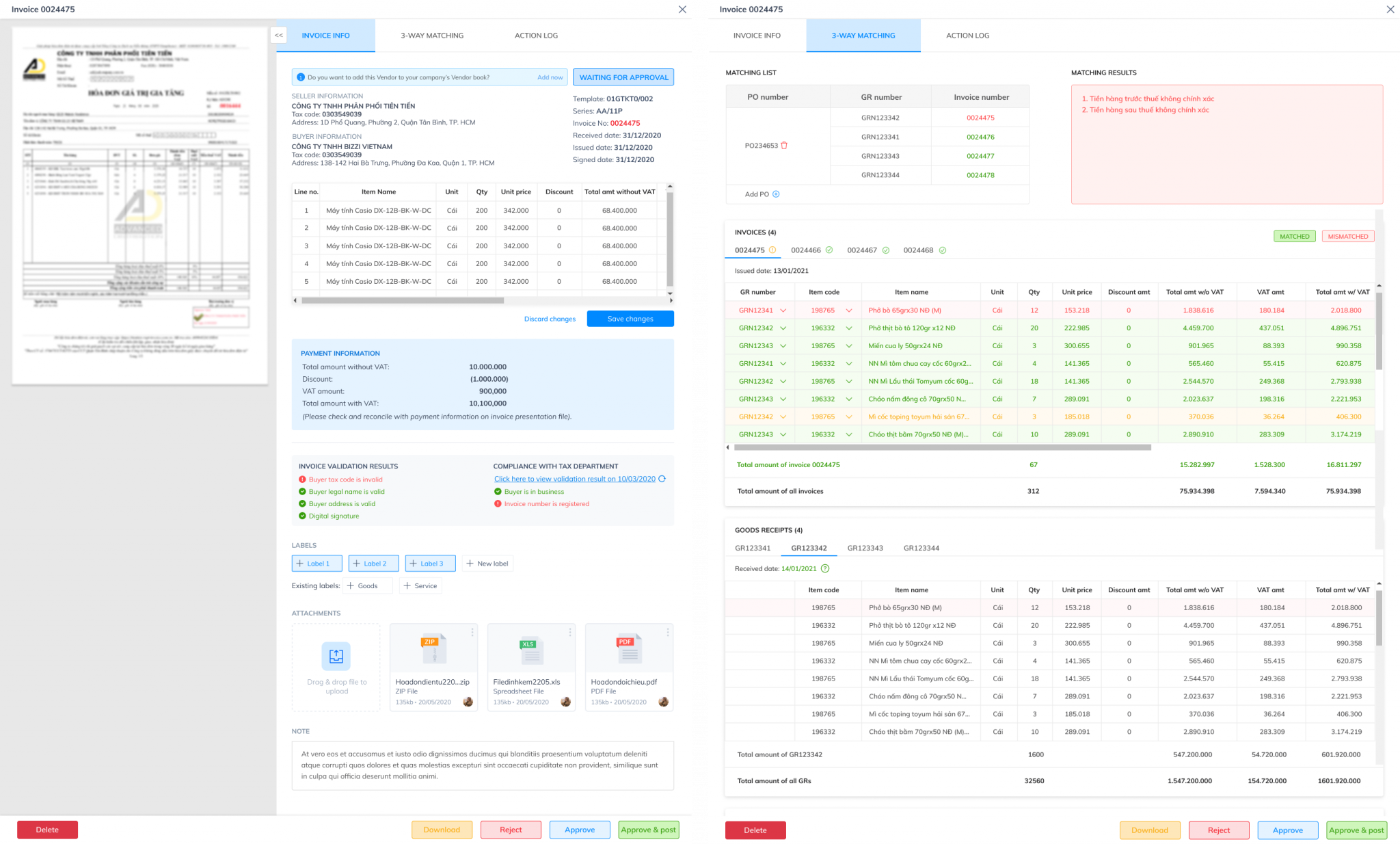
In practice, the biggest bottleneck lies in the manual reconciliation process between purchase orders (POs), receipts (GRs), and invoices. This is not only time-consuming but also creates risks of incorrect payments, duplicate payments, or overspending.
When applied End-to-End Process AutomationIn particular, with the 3-way matching mechanism, the entire process is monitored in real time.
With Bizzi, this process has been significantly upgraded:
- The system automatically reads and extracts invoices from emails/portals using AI.
- Data is instantly reconciled with Purchase Orders and Gross Orders on the ERP system.
- The transaction is automatically recorded in the general ledger (GL) without requiring manual input.
As a result, processing times were reduced from hours to seconds, while the risk of incorrect payments was almost completely eliminated.

What should CFOs do to prevent fraudulent invoices before the tax season?
To control tax risk, CFOs need a system capable of verifying invoices in real time, rather than manually checking them after expenses have been recorded.
A unique characteristic of the FMCG industry is working with thousands of small, independent suppliers in the GT channel. This increases the risk of violating regulations such as Circular 91/2026/TT-BTC replacing Circular 32/2025/TT-BTC and Decree 254/2026/ND-CP This replaces Decree 123/2020/ND-CP and Decree 70/2025/ND-CP. related to electronic invoices. The consequences may include:
- VAT not deductible
- Expenses are excluded when calculating corporate income tax.
- Tax arrears and late payment penalties may arise.
The solution lies in integrating technology into the control process. With Bizzi:
- The system automatically extracts tax identification numbers from invoices.
- Connect directly via API to the Tax Authority to verify operational status.
- Receive immediate alerts if you detect any suspicious invoices or unusual suppliers.
This creates a "tax defense" right from the start, instead of dealing with post-audits when it's already too late.
How to calculate ROI and TCO when investing in financial automation solutions.
To convince the management team, the CFO needs to clearly quantify the financial performance of the company. Digital transformation in the FMCG industry, instead of just focusing on operational benefits.
Total cost of ownership (TCO) includes software costs (SaaS), ERP integration, personnel training, and hidden maintenance costs. Meanwhile, ROI is calculated based on actual savings and financial benefits.
Recipe ROI of financial digital transformation: (Personnel cost savings + Tax risk mitigation value + Early payment discount – TCO) / TCO
The key point is that many businesses misjudge TCO (Total Cost of Ownership) by overlooking integration and operational costs. According to market research, nearly half of digital transformation projects fail because they don't account for these hidden costs.
From a strategic perspective, choosing a SaaS platform with API integration capabilities like Bizzi significantly reduces TCO compared to upgrading a cumbersome ERP system. This is how CFOs transform large capital expenditures (CAPEX) into flexible operating expenses (OPEX).
A 3-step roadmap for digital financial transformation in the FMCG industry (Smart Transformation Roadmap)
In the FMCG industry, financial digital transformation doesn't begin with AI or complex dashboards, but rather with data standardization and building a controlled operational platform. An effective roadmap typically goes through three stages of maturity: Digitization → Automation → Strategic Management.
The key point is that each stage addresses a different "bottleneck" in financial and accounting operations, from transaction processing and data control to effective business management.
Step 1: Financial Digitization – Standardizing data and foundational processes
This is the phase where businesses transition from manual operations to a digital data environment. The core objective is not simply "doing technology," but rather creating a unified and verifiable data source for the entire financial system.
At this stage, businesses typically implement the following:
- Cloud ERP
- Electronic bill
- Digital document management
- Standardize master data (original data such as suppliers, product codes, accounting accounts, etc.).
For FMCG companies, this step is particularly crucial because data is often scattered across numerous points of sale, distributors, and operating systems. If the input data is inconsistent, subsequent automation steps will continue to produce discrepancies.
The objectives of the digitization phase are:
- Eliminate disjointed data.
- Standardize the document processing procedure.
- Increase data accessibility and transparency.
- Reduce reliance on Excel and manual data entry.
In other words, this is the stage of building the "data foundation" for the entire finance transformation journey.
Step 2: Financial Automation – Increase productivity and reduce operating costs
Once the data has been standardized, businesses can then move on to automating end-to-end financial processes. This is the stage where technologies such as:
- RPA (Robotic Process Automation)
- IDP/OCR (Invoice Data Processing and Extraction)
- Machine Learning
- Gen AI
It has been put into practical operation.
Unlike the digitization phase, which focused solely on "data storage," automation focuses on:
- Process transactions faster,
- Reduce manual operations.
- and verify the data before accounting or payment.
In the FMCG industry, processes that are often prioritized for automation include:
- Invoice Processing (AP Automation)
- Reconciling the three documents: Purchase Order – Retail Price – Invoice
- Reconciling COD and O2C accounts receivable.
- Automatically write off bank debt.
- Synchronize ERP data in real time.
The greatest value of this phase lies not only in saving on personnel costs, but in creating a "digital workforce"—where the finance department shifts from data entry to control and analysis.
Then, the business can:
- Reduce invoice processing time.
- Reduce the exception rate (the percentage of exceptions that require manual handling).
- Increase touchless rate (rate of fully automated processing)
- Accelerate the book closing cycle and improve cash flow.
This is also the stage where CFOs can see the clearest ROI from financial automation.
Step 3: Strategic Management – Transforming data into operational capabilities
Once data is digitized and processes are automated, businesses have the necessary foundation to move on to the strategic management phase.
At this level, finance is no longer just a transaction processing department, but becomes a central hub supporting business decision-making. Common technologies include:
- EPM (Enterprise Performance Management)
- BI Dashboard
- Advanced Analytics
The goal is to consolidate data from multiple sources in order to:
- budgeting,
- cash flow forecast,
- Track business performance by SKU/sales channel.
- and optimize working capital in real time.
For FMCG companies, this is the stage where a CFO can:
- Track profitability by product category.
- forecast inventory demand,
- Cash Conversion Cycle (CCC) control,
- and make decisions based on near real-time data rather than end-of-period reports.
In other words, finance now shifts from "back-office" to "strategic business partner" – a strategic partner of the business.
In reality, many FMCG businesses fail not because of a lack of technology, but because their data and processes are not standardized enough for automation. This is why solutions need to be implemented in layers rather than "AI-izing" everything from the start.
Bizzi supports businesses in building a financial digital transformation roadmap that aligns with their mature business model:
- Digitizing financial data and documents
- Automatic invoice processing and 3D reconciliation.
- Synchronize clean data into ERP.
- Improve control over accounts receivable, payments, and cash flow.
Through solutions like Bizzi Bot, AP Automation, and automated reconciliation, FMCG businesses can gradually shift from manual operations to a data-driven, automated financial model, and move towards long-term strategic management.
Frequently asked questions
Digital transformation in the fast-moving consumer goods (FMCG) industry is not just about digitizing processes, but a core strategy to address the challenges of working capital and accounts payable (AP) management.
Below are frequently asked questions (FAQs) and answers on this topic, particularly in the context of supply chain optimization.
Will software automation solutions (RPAs) disrupt the existing ERP (SAP/Oracle) structure?
No. Modern financial automation solutions like Bizzi are designed with open integration in mind, operating independently of existing ERP systems rather than directly interfering with core operations.
In reality, many retail and FMCG businesses are using legacy ERP systems such as SAP ECC, Oracle E-Business Suite, Microsoft Dynamics, or Bravo. The biggest challenge is not replacing the ERP system, but rather the lack of standardized input data: manual invoice processing, fragmented reconciliation, and repeated data entry into multiple systems.
SaaS platforms like Bizzi address this issue by handling it at the “pre-accounting” layer. Specifically, the system will:
- Automatically receive and extract invoice data using AI-OCR.
- Verify the validity of the invoice and the supplier's status.
- Verify related documents such as PO (Purchase Order), GR (Warehouse Receipt), and invoices using a 3-way matching process.
- Standardize data before synchronizing it to the ERP system via API or secure integration mechanism.
This allows ERP systems to receive only "clean data" (data that has been verified and reconciled), instead of having to process raw data from multiple sources.
In terms of operations, this approach helps businesses:
- No need to "tear down" the old ERP system.
- Reduce the risk of data mismapping.
- Reduced implementation time compared to traditional ERP projects.
- Minimize downtime and disruptions to financial and accounting operations.
This is also why many CFOs prefer an "automation layer" strategy instead of replacing the entire core system, which is costly and has a long payback period.
How does O2C (Order-to-Cash) automation benefit the FMCG distribution industry?
In the FMCG industry, the large transaction volume and rapid turnover of goods make the O2C (Order-to-Cash) process one of the biggest bottlenecks in cash flow.
A distribution business may have to process thousands of cash-on-delivery (COD) transactions, bank transfers, and accounts receivable reconciliations daily from multiple channels such as supermarkets, distributors, e-commerce platforms, and shipping companies. If reconciliation is done manually, accountants are likely to encounter the following problems:
- Delay in writing off accounts receivable
- It is difficult to determine whether a payment is underpaid or overpaid.
- Outstanding debts that have not been reconciled.
- Extending DSO (Days Sales Outstanding)
O2C Automation Help solve this problem by:
- Automatically reconcile bank transactions with invoices and orders.
- Automatic debt cancellation (auto-reconciliation) based on pre-set rules.
- Warning about incorrect or unidentified payments.
- Synchronize accounts receivable data to the most recent real-time period.
For FMCG businesses, the greatest value is not just saving accounting time, but improving the cash conversion cycle (CCC). When accounts receivable are reconciled faster, businesses collect payments sooner, reducing working capital pressure and increasing the ability to reinvest in inventory.
Furthermore, standardized O2C data helps CFOs accurately track accounts receivable status by distributor, region, or sales channel, thereby better controlling the risk of bad debt.
Does storing digital invoices on a cloud platform meet the requirements for auditing and 10-year retention?
Yes, if the system fully meets the requirements for data storage, retrieval, and security as stipulated by current regulations.
According to the 2015 Accounting Law and current regulations on electronic invoices in Decree 123/2020/ND-CP (amended and supplemented by Decree 70/2025/ND-CP) and Circular 32/2025/TT-BTC, businesses are responsible for storing electronic invoices and accounting documents for a minimum period as prescribed by law.
In this context, the XML file of the electronic invoice is the original legal data and needs to be stored securely:
- Data integrity
- Accessibility during inspections and audits.
- Not illegally edited.
- The data can be retrieved throughout the entire storage period.
Modern cloud platforms like Bizzi meet this requirement through:
- Centralized storage system and access control
- Audit trail (operation log) for auditing purposes.
- Search and retrieve invoices instantly by tax code, invoice number, supplier, or time.
- Data backup and security according to international standards.
Compared to manual storage or scattered storage across email and personal computers, the cloud model significantly reduces the risk of document loss and speeds up the verification and reconciliation process during tax settlements or internal audits.
This also serves as a crucial foundation for businesses to implement comprehensive digital financial processes such as AP Automation, 3-way matching, and Record-to-Report (R2R).
Conclude
Digital transformation in the FMCG industry is no longer an option, but a mandatory requirement for businesses to protect and optimize working capital in an increasingly fragmented data environment. Implementation Digital transformation of finance in the FMCG industry through End-to-End Process Automation This helps CFOs solve three problems simultaneously: controlling cash flow, reducing tax risks, and optimizing operating costs.
Instead of spreading investments too thinly, businesses should start with the most obvious "bottlenecks," such as invoice processing and accounts receivable reconciliation. With a platform like Bizzi, the entire process from P2P to O2C can be automated, creating a transparent, accurate financial ecosystem ready for large-scale growth.
To receive advice on effective corporate financial management solutions, schedule an appointment with Bizzi here: https://bizzi.vn/dat-lich-demo/