



Managing the costs of a field sales team is always a headache for CFOs and Chief Accountants. Geographic dispersion exposes businesses to the risk of budget leaks, fraudulent business expense invoices, and invalid documentation leading to tax disallowances. Meanwhile, manual approval processes not only stifle cash flow but also reduce sales performance.
This article by Bizzi will provide a comprehensive digitalization strategy, helping businesses tightly control every Opex unit and optimize efficiency. sales cost management.
What are the costs associated with a field sales team?
The cost of the field sales team is total. Operating expenses (Opex) This issue arises when employees conduct sales activities in the field.
From a management perspective, the CFO needs to clearly differentiate three core cost groups. First, fixed costs such as base salaries and equipment depreciation. Second, variable costs linked to sales performance such as commissions. Third – and also the riskiest group – are travel and on-site expenses (T&E), including accommodation, fuel, and client entertainment.
Total market sales costs can be understood using the following formula: Personnel costs + Travel expenses + Entertainment/Marketing expenses at the point of saleIn particular, the T&E (Technical and Economic) group is a "budget black hole" due to the difficulty in controlling valid invoices and the ease with which fraud can occur. This is also the focus of the strategy. sales cost management Modern processes need to be addressed.

Understanding the cost structure is only the first step; the bigger challenge lies in managing the enormous volume of paperwork generated daily.
What are the cash flow and tax risks of managing sales expenses manually?
When businesses still operate using manual methods, managing the cost of sales will give rise to three major risks: losses due to fraud, tax risks, and bottlenecks. cash flow.
First and foremost is the risk of fraud and budget overruns. Employees may inflate fuel expenses, alter meal receipts, or submit duplicate documents. Small discrepancies, when repeated frequently, can result in significant losses that CFOs may find difficult to detect through manual checks alone.
Next is the tax risk. Invoices from restaurants, hotels, or gas stations can easily contain incorrect information or come from suppliers that are no longer operating. In that case, the expenses will be disallowed as deductible expenses when calculating corporate income tax, directly reducing after-tax profits.
Finally, there is the issue of working capital bottlenecks. Slow reimbursement processes due to paperwork approvals cause advances to be suspended, distorting cash flow reports and impacting the ability to manage capital.
These three risks form an “impossible triangle”: Sales wants quick reimbursement, accounting requires accurate documentation, and the CFO needs budget control. Manual processes are almost incapable of simultaneously meeting all three requirements.
How to set sales spending limits that comply with Corporate Income Tax regulations?
To effectively manage sales expenses and ensure tax compliance, businesses need to start by establishing a clear financial policy. This policy should specifically define limits on business travel expenses, entertainment expenses according to rank, and conditions for using valid invoices.
An expense is considered legitimate if it meets three core criteria: it serves business operations, is supported by complete and legitimate invoices and documentation, and is paid non-cash with transactions of 5 million VND or more. This is a fundamental principle for protecting expenses from tax authorities.
However, simply issuing regulations on paper is not enough. In reality, accountants cannot remember and manually check every clause for hundreds of invoices every day. Therefore, CFOs need to translate these regulations into "hard rules" on the system, combined with "soft rules" for flexible warnings.
For example, a business can set a limit on entertainment expenses that does not exceed 2% of regional revenue. If the limit is exceeded, the system will automatically alert or block the transaction. This represents a shift from passive to proactive control in cost management.
How to digitize the sales invoice approval and reconciliation process using AI?
Digitalization is key to comprehensively addressing the challenge of managing sales costs in a distributed environment. Instead of manual paper-based processing, businesses need an integrated system combining mobile approval and AI technology.
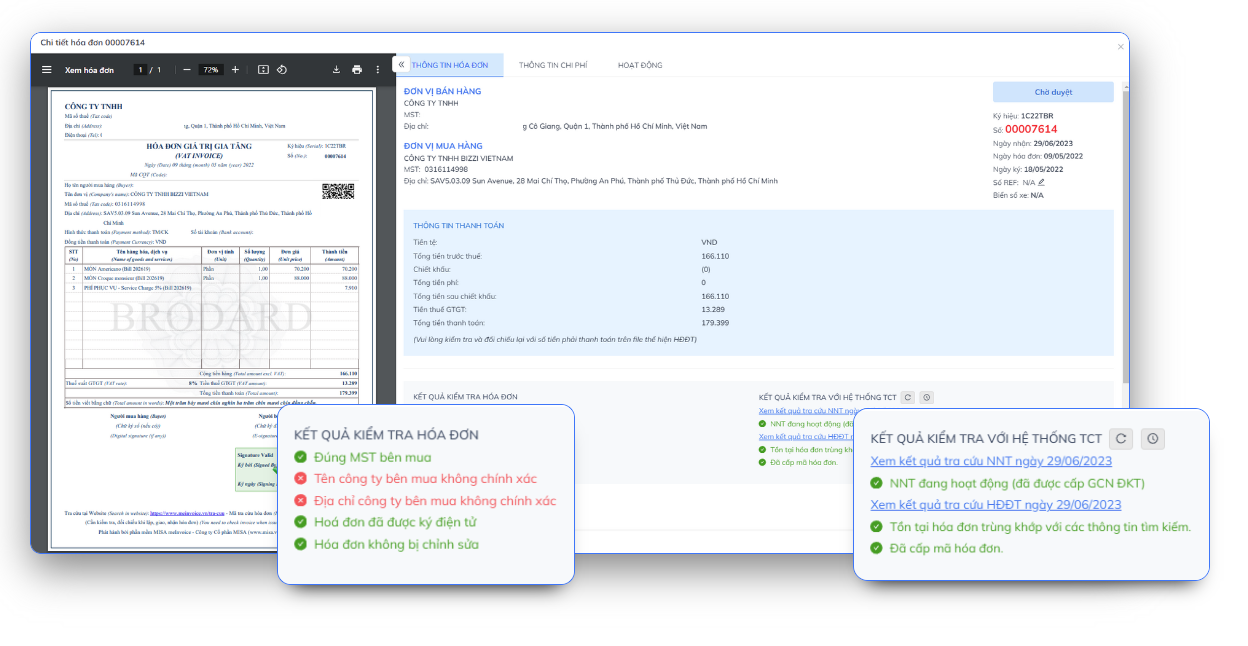
In the modern model, sales staff simply need to photograph the invoice and upload it to the application. The system will automatically extract data using OCR, check budget limits, and verify its validity with the tax authorities almost in real time.
Bizzi Expense acts as a budget controller, ensuring all expenses stay within approved limits. Simultaneously, Bizzi Bot uses AI to read invoices, verify tax identification numbers, and set up control barriers to detect duplicates and alert to fraud in just seconds.
The most important point is that all the cleaned data will be pushed directly into the ERP system. This gives the CFO a dashboard to track expenses in real time, significantly shortens closing time, and ensures tax records are always ready for audit.
In other words, automation not only helps "reduce the workload for accountants" but also transforms sales cost management into a proactive financial control system.
Frequently Asked Questions (FAQ) about field sales cost management
Field sales expense management focuses on optimizing travel, entertainment, and business trip expenses, ensuring transparency through digital tools. Frequently asked questions include reimbursement procedures, expense limits, use of management software, and valid documentation.
Below is a detailed set of Frequently Asked Questions (FAQs) on managing field sales expenses:
Do sales staff need receipts for lunch and travel allowances?
If the company has clearly stipulated the allowance (Per Diem) in its financial regulations or employment contract, this amount is still considered a reasonable expense and does not require an invoice.
How should an accountant handle a fuel receipt with the wrong company name?
In cases where the name is incorrect but the tax identification number is correct, the business can create an adjustment record. However, if using an automated system, this error will be detected from the outset and a request for a reissued invoice will be made promptly.
How are POSM and point-of-sale display costs managed?
These are non-trade expenses that need to be budgeted separately. When making payments, businesses should compare the proposed expenses, supporting evidence (display images), and invoices to ensure transparency.
Conclude
Managing the costs of a field sales team is no longer a simple accounting problem but a crucial financial strategy. When costs are dispersed and constantly accumulating, any gaps in control can lead to budget losses and serious tax risks.
The article highlighted three core pillars: understanding the cost structure correctly, controlling risks through financial regulations, and applying technology to automate the entire process. Of these, the shift from manual to digital management is a decisive factor in helping businesses both control costs and increase operational efficiency.
Solutions like Bizzi not only automate invoice processing but also establish a real-time cost control ecosystem. For CFOs, this is a tool to protect cash flow, optimize P&L, and build a sustainable long-term financial foundation.
To receive advice on effective corporate financial management solutions, schedule an appointment with Bizzi here: https://bizzi.vn/dat-lich-demo/