



Using personal cards for company expenses is not inherently invalid. In many situations, such as urgent business trips, online software payments, or unforeseen purchases of supplies, businesses can still allow employees or managers to use personal cards to make payments and then reimburse them later. However, without proper authorization mechanisms, payment documents, reimbursement records, and control procedures, this practice can increase risks related to taxation, internal control, transaction tracing, and cash flow management. Current regulations also impose certain conditions on documentation, payment methods, and expense records when businesses account for expenses or consider tax deductions; therefore, relying solely on invoices or card statements to assess the validity of a transaction is not sufficient.
In reality, the issue isn't the use of personal cards, but how businesses manage their use. If this becomes a regular payment method instead of a controlled exception, businesses will face numerous challenges regarding reconciliation, budgeting, auditing, and financial transparency. Therefore, to accurately assess the level of risk, it's necessary to first distinguish between employees being assigned or authorized by the company to make payments and those who independently use personal cards for company expenses.
Is using a personal credit card for company expenses always considered invalid?
No. An employee using a personal card to pay for company expenses does not automatically render the expense invalid. The company's ability to recognize and process the expense depends on the purpose of the expenditure, the invoice, the payment method, authorization, internal policies, and the documentation provided to the employee.
This is one of the most common misconceptions in many businesses. Many accountants or managers believe that simply paying with a card in an individual's name will disqualify the expense. In reality, The means of payment is just one element in the entire chain of documents., However, this is not the sole basis for assessing the validity of a transaction.
From a financial management perspective, businesses need to clearly distinguish between two commonly confused concepts:
- Authorized by internal procedures.Does the company allow employees to use personal cards in that situation?.
- Meeting requirements regarding documentation, records, and tax obligations.: Does the expenditure have sufficient grounds for recording, verification, and processing according to current regulations?.
An expenditure may be approved by management but still carries risks if there is a lack of invoices, payment receipts, or reimbursement documents. Conversely, a payment made with a personal card still carries risks. can be considered If the business can prove that this is an expense related to business operations and has complete documentation as required by applicable regulations, then the validity of the expense should not be assessed solely based on the use of a personal card.
Note: An expense cannot be deemed "acceptable" or "rejected" solely based on the method of payment. What is crucial is whether the business can provide supporting evidence. purpose of spending, right to execute transactions, chain of documents and refund process or not.
In cases where an employee is assigned or authorized to make payments.
In practice, businesses don't always have corporate cards or suitable payment methods readily available. Some unexpected expenses, such as airline tickets, hotel reservations, online software payments, or business travel expenses, may require employees to use personal cards.
For example, an approved employee per diem management Due to urgent circumstances, the company had not yet issued corporate ID cards. To ensure work progress, employees used their personal credit cards to purchase airline tickets as requested by the company. After completing the trip, employees submitted invoices and payment documents and followed the internal reimbursement procedures.
In this case, the nature of the transaction remains the same. expenses for business operations. If a business has clear spending regulations, decisions, or assignment procedures, and maintains complete documentation and follows proper reimbursement processes, the expenditure has grounds for consideration and processing according to current regulations. However, compliance with accounting and tax requirements still needs to be assessed on a case-by-case basis and according to the regulations applicable at the time the transaction occurred.
In cases where employees use personal cards without authorization and then request reimbursement, this applies.
Conversely, the risk increases significantly if employees Unauthorized transactions without approval or outside the scope of assigned duties.
Some common scenarios include:
- Purchase the goods first, then seek approval.
- The service bill exceeded the department's budget.
- Registering for software or online service packages that the business has not approved.
- Payment to suppliers not on the selected list.
In such cases, businesses must not only consider the validity of the documentation but also assess whether the expenditure actually serves business operations and aligns with internal spending policies. Without sufficient supporting evidence, the reimbursement process will be prolonged, leading to disputes between departments and increasing internal control risks.
Invoices, payment receipts, and refund documents all play an important role.
In the reimbursement process, many businesses focus only on the invoice and ignore the remaining documents. In reality, to build a audit trail To be comprehensive, businesses need to manage the entire chain of transaction records, including:
- Decision or basis for approving the expenditure.
- A legally valid invoice or receipt as required by regulations.
- Documents showing payment by personal card (such as statements or transaction confirmations when needed for verification).
- Request for reimbursement or request for payment.
- Documents proving the company reimburses employees.
This series of documents allows accountants, internal auditors, and management to trace the entire process from the moment the expenditure need arises until the company completes the reimbursement to employees. At the same time, it also serves as a basis for mitigating risks such as duplicate reimbursements, incorrect payments, or difficulty in proving the purpose of the expenditure.
The processing conditions also depend on the value and characteristics of the transaction.
There is no single rule that applies to all cases of personal card usage. The review process depends on many factors, such as:
- The value of the expenditure.
- The purpose is to support production and business activities.
- Payment methods used.
- Whether or not the employee is assigned or authorized to make payments.
- The set of records and documents kept by the business.
- Financial policies and internal spending regulations.
For large or frequent expenditures, continued use of personal cards will significantly increase the volume of reconciliation and control risks. Therefore, even though Using a personal card isn't always invalid., Businesses should still consider this as an exception mechanism, instead of the default payment method.

8 risks of employees using personal credit cards for company expenses.
Using personal cards to pay company expenses may address immediate needs, but if it becomes a routine practice, it carries significant financial, accounting, and internal control risks. Not only does it affect document reconciliation, but this payment method also reduces the transparency of cash flow, increases pressure on the accounting department, and makes it difficult for businesses to meet audit requirements and manage costs as operations expand.
Initially, many businesses accepted the use of personal cards by employees or managers due to the speed and flexibility of the process. However, as the number of transactions increased, this model gradually revealed limitations that could not be solved simply by adding more accounting staff or increasing manual checks.
Below are some common risks that businesses need to identify.
1. It is difficult to prove the business purpose of the expenditure.
One of the important principles when recognizing expenses is that businesses must provide proof for the expense. serving production and business activities.
When transactions are made using corporate cards, the relationship between the payer and the business is usually clearer. Conversely, if payments are made using personal cards, the business needs to provide more documentation to prove that this is an expense paid on behalf of the employee and not a transaction for the employee's personal needs.
Without supporting documents such as work assignments, approval emails, payment requests, or internal spending regulations, explaining the situation to auditors or management becomes more difficult.
2. Increased risk of missing or inconsistent documentation.
When employees use personal cards, receipts are typically collected after the transaction is complete.
During this process, businesses may encounter various situations such as:
- The invoice has either not been received or contains incorrect information.
- The payment receipt has been lost.
- The bank statement is no longer complete.
- Refund applications are submitted late or lack supporting documents.
Adding documents after days or weeks not only increases the workload for accountants but also disrupts the continuity of the record chain, affecting the traceability of the entire transaction.
3. Increased risk of duplicate payments or multiple reimbursements.
This is one of the common risks faced by businesses that still manage reimbursements using Excel or email.
For example:
- An employee submitted a refund request twice.
- Two departments jointly prepare documentation for a single expenditure.
- The accountant has processed the refund but hasn't updated the status on the system yet.
Without an automated reconciliation mechanism between invoices, reimbursement requests, and payment history, businesses are highly susceptible to problems. duplicate payments, This results in financial losses and lengthy processing times later on.
4. Reduced budgetary control.
When using a business card, businesses can set spending limits, restrict the types of purchases they can make, or require prior approval before transactions occur.
Conversely, when paying with a personal card, the expense is usually only considered after the transaction is complete.
This makes things difficult for businesses:
- Budget control by department.
- Prevent overspending.
- Track committed but unrecorded expenses.
- Forecast short-term cash flow requirements.
Essentially, businesses are shifting from a model. control before spending luxurious Processing after expenditure, This reduces the effectiveness of the internal control system.
5. Lack of audit trail when auditing or tracing transactions.
An expenditure is considered transparent when the entire processing procedure is traceable.
However, with personal card payments, the information is often scattered in many places:
- Approval email.
- Personal bank statement.
- Electronic invoices.
- Excel file for tracking reimbursements.
- Accounting documents.
When auditing or reviewing a transaction, accountants often spend a significant amount of time compiling records from various sources.
Not only does the lack of a affect operational efficiency, but it also impacts performance. audit trail Being too thorough also reduces the transparency of the internal control system.
6. Exerting financial pressure and negatively impacting employee experience.
When employees have to constantly use their personal funds to pay for company expenses, they face cash flow pressure, especially with large expenditures such as:
- International flight tickets.
- Hotel.
- Conference.
- The software has an annual subscription fee.
- Entertainment expenses.
If the reimbursement process is lengthy or requires multiple rounds of documentation, the employee experience will be negatively impacted, and a reluctance to make work-related expenses will develop.
In the long run, this is also a factor affecting the operational performance of the business.
7. Difficulty tracking cash flow and payment obligations.
For CFOs, payments made via personal credit cards create a "blind spot" in cash flow management.
Businesses only record payment obligations when employees submit reimbursement documents, while the actual transaction may have occurred days earlier.
This reduces the likelihood of:
- Cash flow forecast.
- Track expenses in real time.
- Project-based budget management.
- Evaluate committed but unaccounted-for expenses.
As businesses expand, this information lag can significantly impact the quality of financial decisions.
8. The process is expanding, but control is not keeping pace.
On a small scale, the use of personal cards may not create many problems.
However, as businesses grow with multiple branches, departments, and hundreds of employees incurring monthly expenses, this model quickly reveals its limitations.
Scaling up means:
- More reimbursement options.
- More levels of approval.
- More suppliers.
- Larger reconciliation volume.
If the process remains reliant on email and Excel, businesses will have to increase their accounting staff to handle the growing workload, while their ability to control the process does not increase proportionally.
The biggest risk lies not in the card itself, but in the management process.
As can be seen, using personal cards is not the direct cause of risk. Risk arises when businesses lack mechanisms to control transactions before, during, and after they occur.
If the use of personal cards occurs only in exceptional cases, with prior approval, complete documentation, and a clear reimbursement process, businesses can still maintain effective control. Conversely, if this becomes the default payment method, risks related to reconciliation, financial transparency, and cash flow management will increase with the scale of operations.
Therefore, instead of simply asking "should we use personal cards?", businesses need to build a control mechanism to determine When is it permitted to use it, who is allowed to use it, what documents are needed, and what is the reimbursement process?. This is also the content that will be analyzed in the next part of the article.
When might the use of personal cards be allowed as an exception?
Using personal credit cards to pay for company expenses should not become the norm. Instead, businesses should only consider this an exception in necessary situations, provided the expense is approved, has a clear purpose, stays within a specified limit, and the documentation is completed within a defined timeframe. This approach helps businesses maintain operational flexibility while ensuring internal controls and transaction traceability.
In reality, each business has its own unique operating characteristics. Therefore, instead of applying a rigid list, businesses should... can be regulated Cases where personal cards are permitted to be used: internal financial regulations or spending policies, while also clearly defining the approval authority and responsibilities of the person implementing it.
Common scenarios considered include:
- Urgent transactions require immediate processing to avoid impacting business operations.
- Employees who have not been issued company ID cards or do not have appropriate payment methods.
- The supplier only accepts one specific payment method, while the business is unable to accommodate it in a timely manner.
- The expense is of small value, occurs infrequently, and does not fall under the category of recurring expenses.
- Expenses incurred outside of working hours, during business trips, or at locations where the company finds it difficult to arrange other payment methods.
To mitigate risk, businesses should establish control conditions from the outset rather than addressing them after the transaction is complete.
| Control conditions | Target |
| This expenditure falls under exceptional circumstances and does not occur frequently. | Avoid making your personal card the default payment method. |
| Is approval required before or immediately after the transaction occurs in emergency situations? | Ensure that expenditures are controlled in terms of purpose and budget. |
| Within the limits set by the company's policy. | Control the value and scope of spending. |
| Intended use for business purposes. | To serve as a basis for recording and reconciling expenditures. |
| All invoices and related documents are available as per internal regulations. | Ensure traceability and reimbursement capabilities. |
| Submit the reimbursement application within the specified deadline. | Shorten reconciliation time and reduce document backlog. |
When exceptions occur, the important thing is not whether the business allows the use of personal cards, but rather... All transactions must be subject to the same control process.. From approval and document collection to reimbursement and reconciliation, standardizing processes helps reduce risks, enhance transparency, and lay the foundation for future auditing and financial management. This is also why many businesses are developing standardized processes. expense approval process A unified approach is needed to manage all expenses incurred under the exceptional circumstances mechanism.
Procedure for handling situations where employees have used personal credit cards for payment.
When employees use personal cards to pay company expenses, businesses should not rely solely on the receipt for reimbursement. Instead, the accounting department and approver should verify the purpose of the expense, the authority to process the transaction, relevant documentation, payment information, and the amount to be reimbursed before recording the expense and reimbursing the employee. This process reduces accounting, tax, and internal control risks and provides a basis for traceability during audits or disputes.
In practice, the documentation required will depend on the nature of each transaction and the company's internal policies. However, a standardized process typically includes the following steps:
Step 1. Confirm expenses related to business operations.
First, businesses need to determine whether the expenses were incurred to support their production and business operations. The expense report should include complete information such as: Date of issue, supplier, amount, purpose of expenditure and the department or project using the budget. This forms the basis for assessing the necessity of the expenditure before moving on to the next steps.
Step 2. Verify the approval or basis for allowing the transaction to proceed.
Accountants need to check whether the expenditure was pre-approved or falls under an exception according to company policy. If the transaction arises urgently, the documentation should include a justification and be approved by the competent authority immediately after it occurs to ensure transparency of the process.
Step 3. Collect invoices and related documents.
After confirming the purpose and authority, the business needs to gather a complete set of documents for reconciliation. Depending on the transaction, the documents may include invoices, contracts, quotations, acceptance reports, approval emails, or other related documents. Each document needs to be documented. linked to a specific transaction To create a continuous data chain, for auditing and later retrieval.
Step 4. Compare the information on the document with the payment transaction.
Next, accountants need to reconcile invoices with personal card payment transactions to verify important information such as the amount, payment date, supplier, and transaction details. In many cases, bank statements or transaction confirmations will be used as supporting documentation for reconciliation along with invoices and payment records.
Step 5. Check the budget and detect duplicate transactions.
Before reimbursing an advance, businesses should review the expenditure against the allocated budget and check whether the transaction has been previously requested for reimbursement or payment. This is a crucial step to limit instances of duplicate reimbursements, exceeding limits, or recording the same expense multiple times.
Step 6. Approve reimbursement, payment, and archive audit trail.
After the verification process is complete, the business approves and reimburses the costs. the person who used their personal card to make the payment according to internal procedures. At the same time, the entire history of processing, approval, and related documents needs to be centrally stored to form a complete record. audit trail, This helps to fully trace the transaction lifecycle when audits or internal reviews are needed.
See more articles on this topic: What is an advance payment? What is reimbursement? A comparison of advance payments and reimbursement in corporate financial management. in This
Reference checklist for processing reimbursements.
Note: The list below is for reference only. The actual documentation may vary depending on the type of transaction, internal policies, and governance requirements of each business.
| Documents to be checked | Purpose |
| Report expenses or request reimbursement | Confirm the payment details and the person making the request. |
| Decision or proof of approval | Provide proof that the expenditure was approved according to the procedure. |
| Invoices and related documents | To serve as a basis for recording and processing documents in accordance with applicable regulations. |
| Documents showing payment transactions | Compare with the invoice and confirm the expenses incurred. |
| Budget information or Cost Center | Control budgets and allocate costs. |
| Employee return file | Acknowledging that the company reimbursed the correct recipient. |
For example, a registration employee software subscriptions for work purposes Payments are made via personal credit cards because the provider does not support other payment methods. When requesting monthly reimbursements, accountants need to cross-check the software usage request, management approval, electronic invoices, payment transactions, and allocated budget before processing the reimbursement. This process helps businesses fully control the lifecycle of the expense instead of just checking the invoice at the end.
However, post-transaction review only helps mitigate risks after a transaction has occurred. To improve control effectiveness, businesses need to shift their focus to approving and controlling spending before it even begins., This, combined with a digital process, allows for tracking the entire status of an expense from its inception to its final reimbursement. This also forms the foundation for building a transparent and sustainable expense management system.
A three-tiered control framework to reduce reliance on personal cards.
Instead of completely banning the use of personal cards, businesses should build a multi-layered control framework to manage risk from the moment the expense is incurred until after the reimbursement is completed. An effective model typically includes three layers: establishing policies before spending, controlling at the time of the transaction, and monitoring after the transaction. This approach helps businesses significantly reduce risks related to documentation, budgeting, and reconciliation, although it cannot completely eliminate all errors in the operational process.
For a CFO, the goal isn't to check every single transaction, but to design a system to... All expenditures are controlled according to the same principle., Regardless of whether the transaction is made using a business card or a personal card.
Three-layer control framework
| Control layer | Target | Time of application |
| Level 1 – Policy Establishment | Clearly define the regulations and scope of use. | Before expenses are incurred |
| Level 2 – Transaction Control | Ensure that expenditures are used for the intended purpose and within the budget. | During the transaction process |
| Level 3 – Verification and Monitoring | Identify deviations, assess trends, and improve processes. | After the transaction is complete |
Level 1 — Policy Setting
The first layer of control acts as a governance "barrier" before any expenditures are incurred. If the policy is clear, most risks can be prevented from the outset instead of having to be dealt with after the transaction is complete.
Businesses should specify the following:
- This section outlines the cases where personal cards are permitted and the cases where the use of business-provided payment methods is mandatory.
- The expense categories are subject to an exception mechanism.
- Payment limits are set based on job title, department, or expense group.
- The person authorized to approve the expenditure is responsible for the amount of the expenditure.
- The deadline for submitting reimbursement documents and supporting evidence is after the transaction has occurred.
- Regulations regarding data security and privacy when using personal card statements or information include the redacting of information unrelated to business expenses.
A more detailed policy reduces reliance on individual interpretations and provides a consistent basis for accountants, approvers, and internal auditors when processing documents.
Level 2 — Transaction Control
If the first class answers the question “"Permitted or not"”, then the second class focuses on “"Is the expenditure being made in accordance with policy?"”.
Instead of waiting until employees submit reimbursement requests, businesses should implement control measures at the time transactions occur.
An effective process typically includes:
- Provide advance approval for non-emergency expenditures.
- Attach each expenditure to a specific budget, department, project, or cost center for easy tracking.
- Collect invoices and related documents immediately after the transaction is completed to reduce the risk of loss or missing information.
- Set up alerts when spending exceeds limits, goes over budget, or fails to meet internal policy conditions.
These mechanisms are not intended to automatically conclude that a transaction is fraudulent, but rather serve as a mechanism for... early warning This allows accountants and approvers to have more information to assess the situation before processing the reimbursement.
Level 3 — Verification and Monitoring
Even after a transaction has been approved and reimbursed, businesses still need to maintain monitoring to detect risk trends and continuously improve processes.
At this level of control, businesses should focus on activities such as:
- Reconcile invoices, payment transactions, and reimbursement requests to ensure all data reflects the same expenditure.
- Detect transactions that show signs of irregularities, such as values significantly exceeding usual limits, transactions occurring outside of policy, or multiple similar expenditures appearing in a short period of time.
- Check for duplicate refunds or payments.
- Monitor processing and reimbursement times to identify outstanding or unusually prolonged cases.
- Analyze trends in personal card usage by department, expense group, or transaction type to assess whether the exception mechanism is being abused.
This data not only serves auditing purposes but also helps CFOs identify bottlenecks in the process, thereby adjusting policies, limits, or payment methods to suit each stage of the business's development.
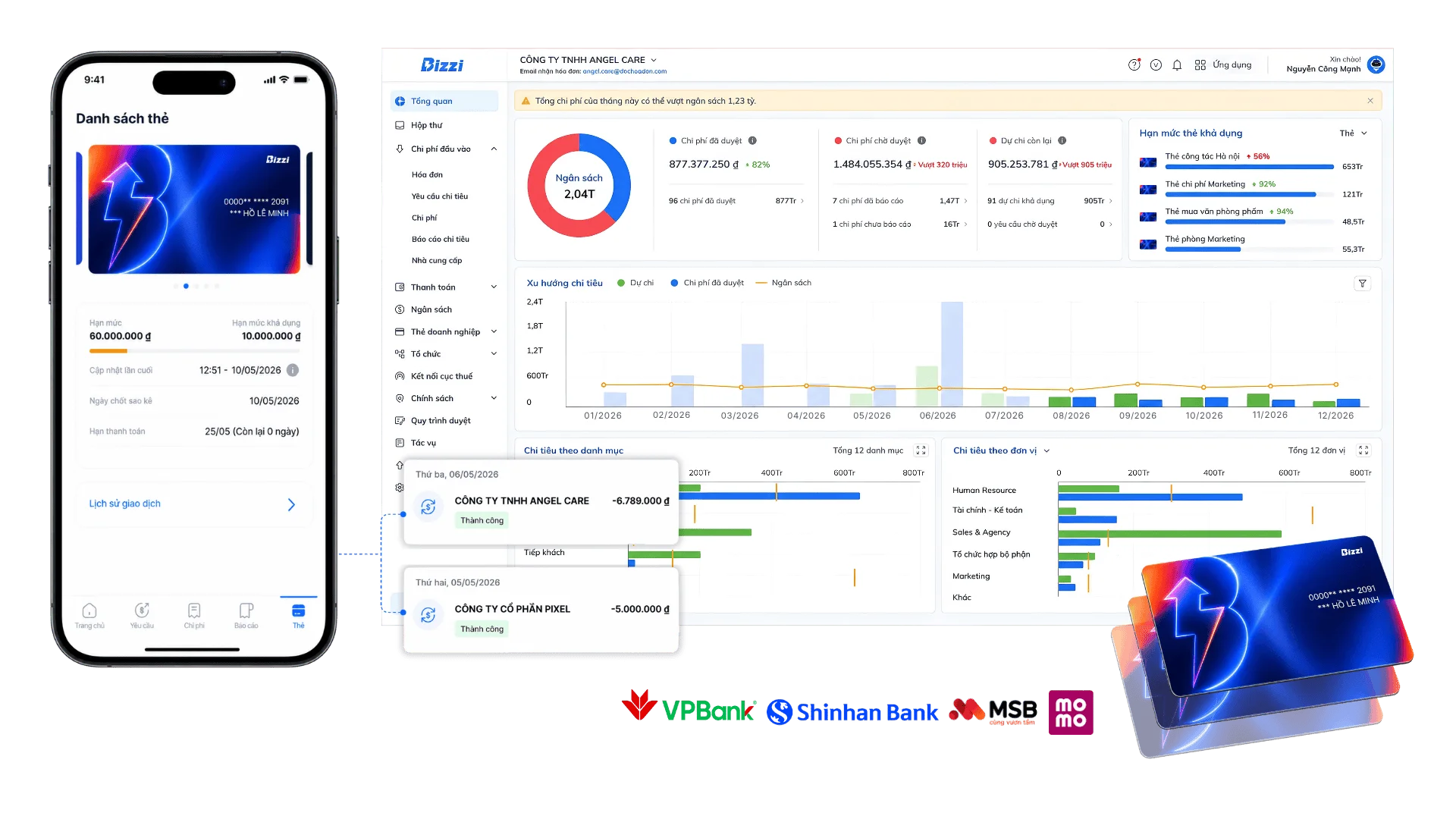
These three layers of control work most effectively when they are interconnected. a unified process Instead of managing with multiple separate tools, this is also the approach taken by the platforms. business cost management modern like Bizzi Expense, This allows businesses to establish spending policies, configure approval flows based on limits, manage budgets, collect documentation, and track the entire reimbursement process all within a single system. As a result, CFOs not only control individual expenditures but also gain an overall view of personal card usage, spending policy effectiveness, and potential risks, enabling them to make data-driven management decisions.
Personal card, credit card, or business card: Which option should you choose?
There is no single payment method suitable for all expenses. Personal cards should only be used in exceptional and infrequent situations; advances are appropriate for anticipated expenses; while business or corporate cards are suitable. virtual business card It is more suitable for recurring transactions with high frequency and requiring the ability to control limits and trace the entire transaction lifecycle.
Instead of asking "which method should I choose?", the CFO should evaluate based on Frequency of occurrence, level of risk, and control requirements for each expense category. For example, an emergency payment for an employee's business trip could be processed using a personal card under an exception mechanism. Conversely, recurring payments such as SaaS software, advertising costs, AI platform subscriptions, or cloud computing services should be moved to enterprise-controlled payment methods to reduce reimbursement volume and improve manageability.
| Criteria | Personal cards and reimbursement | Advance | Business Card / Virtual Card |
| Suitable use case | Exceptions, occurring infrequently. | The planned expenditure | Recurring or recurring expenses |
| Advancer | Staff | Business | Business |
| Pre-approval | It may be overlooked if handled urgently. | Common | It can be configured according to the procedure. |
| Audit trail | Depending on the quality of the refund application | Medium level of contact tracing | It's better to integrate it with a cost management system. |
| Limit control | Short | According to the amount of money advanced. | According to the limits, policies, and rights granted. |
| Cash flow burden for employees | Higher | Lower | Lower |
| Reconciliation speed | Slower due to the need to collect post-transaction records. | Medium | Faster when transaction data is automatically synchronized. |
From a management perspective, Business cards or virtual cards do not completely replace the control process., However, it can help businesses standardize approval processes, set limits per employee or department, and improve traceability when combined with expense management solutions and business cards. With solutions such as Bizzi Expense Pay, Businesses can configure pre-approval processes, manage spending limits, and synchronize transaction data with expense records on the same system, significantly reducing manual reimbursement volume and shortening reconciliation time.
Businesses don't need to switch all payment methods at once. Instead, they should prioritize high-frequency, high-value, or frequently reimbursed expense categories to achieve the most effective control.
The roadmap to transitioning from personal cards to controlled spending.
The transition shouldn't begin with banning the use of personal cards, but rather with measuring usage frequency, categorizing recurring expenses, and gradually shifting recurring expenditures to a business-controlled method. This approach helps businesses maintain operational flexibility while reducing reliance on manual reimbursement processes.
A practical implementation roadmap can be divided into the following phases:
30-Day Phase: Current Situation Assessment
- Compile statistics on personal card payment transactions over the last three accounting periods.
- Categorize by department, purpose of expenditure, supplier, and transaction value.
- Identify expense groups that frequently recur or generate reimbursements.
60-Day Phase: Policy Standardization
- Develop a list of cases where the use of personal cards is permitted under an exception mechanism.
- Standardize the approval, reimbursement, and documentation requirements processes.
- Choose a high-frequency spending category to test a business card or virtual card, instead of continuing to use your personal card.
90-Day Phase: Measurement and Expansion
After implementation, businesses should monitor several KPIs to evaluate the effectiveness of the process. These metrics need to be adjusted to suit the size and operating model of each business.
Priority Tracking Checklist
- □ Percentage of transactions using personal cards by department.
- □ Rate of timely submission of documents.
- □ Average processing time for reimbursement.
- □ Number of exceptional transactions per period.
- □ Percentage of expenditures that have been transferred to a method controlled by the business.
Instead of aiming to completely eliminate the use of personal cards, businesses should prioritize converting high-frequency and high-risk expense categories, then expand the scope once the process is stable. With platforms like Bizzi Expense Pay, businesses can integrate expense request management, approvals, limits, corporate cards, and transaction reconciliation on a single system, allowing for a step-by-step, measurable, and operationally aligned transition.
Before implementing any solutions, CFOs should begin by reviewing current spending processes to identify areas of reliance on personal cards and prioritize improvements to transaction groups that have the greatest impact on cost management efficiency.
Frequently asked questions
Is it permissible for employees to use their personal credit cards to pay for company services?
Have, in certain cases Businesses may allow employees to use personal cards to pay for business-related expenses. However, this should be considered a exception mechanism, This is not the default payment method. Recognition and reimbursement will depend on the purpose of the expense, internal policy, approval records, invoices, and related documents, rather than solely on the use of a personal card.
What documents does a company need to provide when refunding employees?
A reimbursement file typically needs to fully reflect the entire process of how the expense was incurred. Depending on the transaction and the company's policy, the file may include documents demonstrating: purpose of spending, decision or evidence approve, legal invoice or document, the document shows payment by personal card and business documents reimburse workers. Businesses should standardize their expense records by category to facilitate reconciliation and auditing.
Is it necessary to ask the staff to provide a full card statement?
Not necessarily. Businesses should only collect this information. The necessary information to verify transactions related to company expenses., Avoid requesting full statements unless absolutely necessary. When using statements or transaction screenshots, privacy principles should be applied by masking irrelevant transactions and personal information, and clearly defining data storage and usage in internal policies.
Is it sufficient for an invoice to be in the company's name but paid with a personal credit card?
Are not. The invoice is only one part of the documentation for the expenditure. To assess the validity and process reimbursement, businesses also need to consider the purpose of use, the right or basis for the expenditure, payment documents, and the approval process according to internal policies. The assessment will depend on the characteristics of each transaction and relevant applicable regulations.
Should the use of personal credit cards be completely banned?
Not necessarily. In reality, there are situations such as urgent work, overtime payments, or suppliers only accepting a specific payment method that require businesses to apply an exception mechanism. However, frequently occurring or large-value expenses should gradually be shifted to payment methods controlled by the business to reduce risk and improve management efficiency.
Do business cards completely eliminate the risk of misuse of funds?
No. Business cards are just... a control support tool, However, it cannot completely replace the management system. Businesses still need to develop clear spending policies, establish appropriate approval processes, manage documentation, conduct reconciliation, and monitor regularly to minimize risks arising during the spending process.
Conclude
The risk of using personal cards for company expenses lies not in the card itself, but in how the business designs and operates its control processes. In many practical situations, employees paying with personal cards is unavoidable. However, if this becomes a regular spending method instead of a managed exception, businesses will face numerous challenges regarding reconciliation, budget control, transaction tracing, and financial transparency.
To reduce reliance on personal cards, businesses should start by reviewing three core areas:
- Policies and authorization mechanisms: Clearly define the circumstances under which personal cards can be used, who has the authority to approve them, the applicable limits, and the procedures for handling exceptional expenditures.
- Documentation and audit trail: Standardize the documentation for each expense type, ensuring a complete link between expense requests, approvals, invoices, payment vouchers, and reimbursements to guarantee traceability throughout the transaction lifecycle.
- Expenditures should be shifted to a method controlled by the business: Prioritize recurring, high-frequency, or high-value payments by using corporate cards, virtual cards, or centralized payment solutions to reduce manual reimbursement volume and improve management efficiency.
For businesses moving toward a modern cost management model, the combination spending policy, approval process and technology This will be more effective and sustainable than simply tightening controls after transactions. Platforms like Bizzi Expense Pay This system supports businesses in digitizing the entire process, from expense requests and approvals to limit management, corporate/virtual card issuance, reconciliation, and document archiving, all within a unified system. This allows CFOs and the Finance department to track expenses in real time, reduce reliance on individual cards, and gradually build a transparent, efficient, and scalable management system.