



A template for business travel expense regulations is an internal document that specifies the applicable subjects, conditions for business trips, expenditure limits, required documents, procedures for advances and reimbursements, and approval authority. A clear regulation not only helps businesses control their budgets and standardize payments, but also reduces disputes, minimizes document-related risks, and provides a foundation for digitizing the entire business travel expense management process.
In this article, Bizzi will introduce the structure of a Sample regulations on business trip expenses in enterprises., Key provisions that need to be included and how to effectively implement regulations using modern cost management processes.
What are regulations regarding travel expenses?
The travel expense policy is an internal document that specifies how a company manages, approves, and pays for expenses incurred when employees travel on business.
This is one of the important documents in a company's financial management system, helping to clearly define which expenses are allowed to be paid, the conditions for application, the maximum spending limit, the required documentation, and the responsibilities of each department in the implementation process.
Many businesses often confuse the two regulations on travel expenses and business expense procedures, while these two documents serve completely different purposes.
| Criteria | Regulations on travel expenses | Business expense procedures |
| Answer the question | What expenses were incurred? How much? Under what conditions was payment made? | Who creates the proposal? Who approves it? Where should the documents be submitted? When will payment be made? |
| Purpose | Establish policies and management principles. | Standardize the implementation steps. |
| Target audience | All staff and management | Staff, accountants, finance, and approvers |
| Management values | Budget control and policy consistency | Ensure Optimizing the business expense process, operating continuously |
For the Finance and Accounting Department, the regulations on travel expenses are not only a document guiding payment but also a basis for:
- Control the budget for work activities by department or project.
- Standardize the list of documents that need to be collected.
- Limit expenditures that exceed budgets or are not for the intended purpose.
- Reduce disputes between employees, managers, and the accounting department during settlement.
- Increase transparency and accountability in audits or inspections.
In other words, the regulations determine “"How much is allowed to be spent?"”, and the instruction process “"How should the spending be carried out?"”. Businesses can only achieve effective cost control when both are implemented in a coordinated manner and applied consistently.
When does a business need to issue a policy on business travel expenses?
Businesses should establish regulations on travel expenses when travel costs are incurred frequently or when there is a risk of disputes, budget overruns, or lack of documentation.
In small businesses with a low number of business trips, handling expenses on a case-by-case basis may still meet operational needs. However, as the scale expands, multiple departments incur expenses, or the business undertakes numerous projects in different locations, the lack of a unified regulation will lead to inconsistent approval and settlement processes.
Some signs that indicate a business should develop or review its travel expense policy include:
- Employees frequently travel for business. Both domestically and internationally, numerous expenses arise related to travel, accommodation, entertaining guests, or working with partners.
- There are many branches, departments, or projects. This leads to each unit applying a different payment method, making it difficult for the accounting department to reconcile accounts.
- The cost of airfare, hotels, taxis, or other transportation accounts for a large portion of the total expenses., This needs to be controlled through clear limits and policies.
- Accountants frequently receive files that lack invoices or supporting documents., This requires repeatedly requesting additional information from staff, thus prolonging the settlement process.
- Approval management based on subjective feelings., The lack of unified criteria regarding work standards, target groups, or objectives leads to the risk of complaints or budget overruns.
- Businesses want to standardize the advance payment and reimbursement process., The regulations clearly specify the conditions for receiving advances, the deadline for submitting documents, and the handling of overdue advances.
- The CFO or Finance Manager needs to monitor the operational budget in real time., Instead of only seeing the figures after the final accounting summary at the end of the period.
The purpose of issuing these regulations is not to create additional administrative procedures, but to help businesses standardize management principles from the outset. When all parties clearly understand which expenses are payable, what documents need to be prepared, and who has the authority to approve them, the work and settlement process will be faster, and the risks arising during internal audits or inspections will be significantly reduced.
What sections does a sample regulation on business travel expenses include?
A model travel expense regulation should include the scope of application, conditions for business travel, reimbursable expenses, limits, supporting documents, approval process, and exception handling.
An effective regulations should not only specify payment levels but also create a comprehensive control framework from the initial need for the work to the final settlement. This helps businesses ensure operational flexibility while maintaining budget control and record-keeping for accounting and auditing purposes.
The table below summarizes the important content that businesses should include. Sample regulations on business trip expenses in enterprises..
| Part of the regulations | Purpose of control | Content should include |
| Purpose of issuance | Explain the reasons for establishing the regulations. | Cost transparency, payment standardization, budget control, and improved governance efficiency. |
| Scope of application | Identify the target audience. | Employees, managers, collaborators, branches or subsidiaries |
| Conditions for business trips | Avoid unauthorized trips. | Purpose of the mission, time, location, approver, requirements before departure. |
| The expense has been paid. | Limit disputes | Travel expenses, accommodation, taxi fares, meals, business trip allowances, and other incidental expenses related to work. |
| Unpaid expenses | Preventing misuse of funds. | Personal expenses, expenses without valid supporting documents, expenses for purposes other than official duties, or expenses not approved. |
| Expenditure limits | Budget control | Limits vary by rank, work area, expense type, department, or project. |
| Advances and reimbursements | Cash flow management | Conditions for advance payments, limits, deadlines for final settlement, and handling of overdue advance payments. |
| Documents | Accounting and archiving services | Invoices, e-tickets, bookings, statements, work reports, payment vouchers, and related documents. |
| Approval process | Clarifying responsibilities | The roles of staff, direct managers, finance, accounting, and leadership in each step of the process. |
| Exception handling | Control over expenditures exceeding budget limits. | Special approval conditions, reasons for exceeding the quota, supplementary documents, and the competent authority for decision-making. |
| Validity and updates | Change management | Effective date, review cycle, and department responsible for updating and disseminating the regulations. |
In fact, businesses should not simply copy the regulations of other organizations and apply them as is. Expense limits, payment scopes, approval processes, and documentation requirements should be designed to suit the size of the business, its industry specifics, organizational structure, and internal financial policies.
A well-structured policy will serve as both a guideline for employees and a tool to help the Finance and Accounting department control costs, reduce risks, and assist the CFO in monitoring the effective use of the operational budget across the entire enterprise.

Sample of regulations on travel expenses (for reference)
Businesses can use the framework below as a sample travel expense policy, then adjust it according to organizational size, budget, staffing levels, and operational specifics to suit their actual operations.
There is no single standard expense policy template that suits every business. For example, a manufacturing company may need specific regulations for work at the factory or construction site, while a service company may incur significant expenses for client meetings, seminars, or market research. Therefore, the framework below should be considered a foundation for businesses to develop their internal regulations rather than applying the template verbatim.
Download the latest updated Business Trip Expense Form for free at This
Article 1. Purpose of issuance
This regulation aims to establish principles for managing, advancing, settling, and controlling business travel expenses incurred during the performance of tasks assigned by the enterprise.
The goal is:
- Standardize the use of operational budgets.
- Ensure that expenses are used for legitimate business purposes.
- Standardize procedures among staff, managers, and the Finance and Accounting department.
- Increase transparency and accountability during audits or internal reviews.
Article 2. Scope and subjects of application
These regulations apply to individuals or units sent on business trips by the enterprise according to approved decisions or plans.
The subjects may include:
- Full-time employee.
- Management staff.
- Probationary employees (if specified by the company).
- Collaborators or experts are assigned to perform tasks on behalf of the business.
- Branches, representative offices, or subsidiary units.
Businesses should also clearly define the scope of application for domestic business trips, international business trips, or project-based trips.
Article 3. Principles for payment of travel expenses
All business trip expenses will only be considered for payment if the following conditions are fully met:
- To serve directly the purpose of work or production and business activities.
- Within the scope of duties approved by the competent authority.
- Adhere to the company's travel expense limits and policies.
- All invoices, receipts, or supporting documents are available as required by internal regulations.
- The process of proposal, approval, and settlement was carried out correctly.
For unplanned or overspent expenses, businesses should establish a separate approval mechanism for exceptions.
Article 4. Payments
Businesses should clearly define the categories of expenses that are permitted for payment in order to minimize divergence in interpretation between departments.
Typically includes:
- Airline, train, bus, or public transport tickets.
- Taxis, ride-hailing services, or other means of transportation used for work.
- Accommodation costs such as hotel or guesthouse stays.
- Accommodation allowance according to internal policy (if any).
- Meal expenses during business trips are covered according to established limits.
- Parking fees, toll fees, baggage fees, or other reasonable expenses incurred in connection with official duties.
- Other expenses may be subject to prior or supplementary approval by the competent authority as per regulations.
Article 5. Expenses that will not be reimbursed
To reduce disputes during the settlement process, the regulations should clearly define which expenses are not covered by the payment policy.
For example:
- Spending to meet personal needs.
- The expenditure is unrelated to work duties.
- Expenses that lack supporting documentation or do not meet internal regulations.
- Expenditures exceeding the allocated budget but not granted with an exception.
- Expenses incurred after the end of a business trip without a valid reason.
- Costs incurred due to personal error or violation of company regulations.
Article 6. Travel expense limits
Standards should be established based on the financial capacity and specific operational characteristics of the business, rather than applying a single standard to all cases.
Businesses can set regulations based on criteria such as:
- Rank or title.
- Work location (city, inter-provincial, overseas...).
- Types of expenses (travel, accommodation, food, etc.).
- Department or project.
- Length of service or nature of duties.
Clearly defining spending limits helps Finance control the budget from the outset and reduces the number of exceptions that need to be processed.
Article 7. Advances and Reimbursements
The regulations should specify:
- Conditions for receiving an advance payment before a business trip.
- Documents required when requesting an advance payment.
- Advance payment limits vary depending on the type of work.
- The deadline for submitting reimbursement documents is after the trip ends.
- How to handle situations where the actual amount spent is lower or higher than the amount advanced.
- Measures to be taken regarding overdue advances that have not yet been settled.
Clearly defining repayment deadlines will help businesses limit the accumulation of long-standing advance payments.
Article 8. Payment documents and records
To facilitate accounting, auditing, and post-audit processes, businesses should clearly define the list of documents required for submission during final settlement.
Typically includes:
- Proposal or decision to send someone on a business trip.
- Payment or reimbursement request form.
- Invoices and supporting documents are valid according to internal regulations and current legal provisions.
- Electronic tickets, hotel bookings, or service confirmations.
- Statement of incurred expenses.
- Report on work results (if requested by the company).
- Approvals related to any overspending (if applicable).
Article 9. Approval Procedure
The regulations should clearly define the responsibilities of each party throughout the entire process of handling travel expenses.
A common approval process includes:
- Employees create work requests or payment requests.
- Direct supervisors review the purpose and needs of the work.
- The Accounting or Finance department reviews budgets, quotas, and supporting documents.
- The Finance Manager or authorized person approves any exceeding limits or exceptions.
- Process payments and maintain records as required.
Clearly defining the roles of each level helps reduce processing time and increase traceability when inspections are needed.
Article 10. Handling of expenses exceeding the prescribed limit.
Not all expenditures exceeding the allocated budget will be refused payment. However, the regulations need to clearly specify the conditions under which exceptions will be considered.
Typically, overspending is only processed when:
- There are valid reasons that are directly related to the job duties.
- There is sufficient documentation to prove it.
- Approved by the competent authority under an exceptional procedure.
- This is clearly documented in the settlement records for future verification.
Article 11. Responsibilities for Implementation
The regulations should clearly define the responsibilities of each department to avoid overlapping during implementation.
- Staff: Prepare work proposals, use budget funds for their intended purpose, maintain proper documentation, and settle accounts within the specified timeframe.
- Direct supervisor: Consider the work requirements, verify the necessity, and approve according to authority.
- HR/Admin: Assist in coordinating tasks (if assigned) and collaborating on the implementation of internal policies.
- Accounting and Finance: Checking documents, reconciling expenses, processing payments, maintaining records, and preparing reports.
- Management or authorized persons: Approve special cases and review the implementation of regulations.
Article 12. Effective Date and Review
The regulations need to clearly state:
- Effective date.
- The scope of replacement of previous regulations (if any).
- The department responsible for guidance and implementation.
- The cycle for reviewing and updating standards or adjusting policies (for example, annually or when there are major changes in business operations).
Businesses should also incorporate mechanisms for updating regulations when changes occur in operating models, organizational structures, or relevant legal regulations. This ensures that regulations remain relevant to current practices and maintains effective long-term control over business travel expenses.
Free Download Sample regulations on business trip expenses in enterprises. here
How to establish appropriate travel expense limits for businesses.
Travel expense allowances should be designed based on rank, location, type of expense, and budget, rather than applying a single rate to all cases.
The travel expense allowance is the "backbone" of the travel expense regulation. If the allowance is too low, employees will find it difficult to perform their duties and will frequently have to request exceptional approvals. Conversely, if the allowance is too high or lacks clear criteria, the business will face difficulties in controlling the budget and evaluating the effectiveness of expense utilization.
Instead of setting a fixed rate for all employees, businesses should establish performance standards based on multiple criteria to ensure fairness while also being appropriate to the specifics of their operations.
| Standard criteria | Example application | Note on control |
| Rank | Employees, managers, leaders | Avoid dividing it into too many levels, as this makes operation and updates difficult. |
| Area | Within the province, inter-provincial, international | Regular price reviews should be conducted based on market price fluctuations. |
| Cost Type | Flight tickets, hotels, meals, taxis | Clearly define what payments are and are not allowed. |
| Department/Project | Sales, project implementation, consulting | Aligned with the budget of each cost center or project. |
| Exception | Urgent work, special event | Clearly define the approval level and required supporting documents. |
1. Establishing performance standards based on hierarchical levels.
Not all positions have the same work requirements and accommodation standards. Therefore, businesses often group staffing quotas by job title or management level.
For example:
- Staff: Economy class, hotel according to standard rates.
- Management: Higher accommodation or allowances may be applied depending on the nature of the job.
- For directors or senior managers: separate rates apply, tailored to the specific requirements of hosting clients or working with partners.
The grouping should be reasonable to avoid generating too many exceptions and complicating the approval process.
2. Establishing performance standards based on work location.
Business travel expenses can vary significantly between different locations or countries. Therefore, businesses should establish limits based on geographical scope rather than applying a single rate to all trips.
For example:
- Provincial-level work.
- Inter-provincial work.
- Working in cities with a high cost of living.
- Overseas business trips (if the company requires them).
The standards should also be reviewed periodically to reflect fluctuations in ticket prices, accommodation costs, or market changes.
3. Establishing cost standards based on cost categories.
Each cost category has different characteristics and levels of control. Therefore, regulations should specify separate rules for each category instead of just stipulating the total payment amount.
Common groups include:
- Airline tickets, train tickets, or other means of transportation.
- Hotel or accommodation costs.
- Taxis, ride-hailing services, or vehicles used for work purposes.
- Food expenses.
- Work allowance.
- Other reasonable incidental fees.
For each group, businesses should clearly define payment limits, applicable conditions, and cases that are not covered.
4. Establishing standards based on the nature of the trip.
Not all business trips have the same requirements. A market research trip, project implementation, or client meeting may incur different expenses than a training trip or internal meeting.
Businesses can be categorized by:
- Sales activities.
- Project implementation.
- Training or workshops.
- Market research.
- Working with partners or clients.
This classification method helps budgets accurately reflect the actual needs of each activity instead of applying the same standard to all cases.
5. Link cost estimates to departments, cost centers, or projects.
For businesses with multiple business units or undertaking multiple projects simultaneously, the travel expense allowance should be linked to the budget of each unit. cost center, department or project.
This approach helps to:
- Monitor budget usage by unit.
- Compare the costs between the projects.
- Early detection of budget overruns.
- Assist the CFO in evaluating the effectiveness of travel expense utilization.
6. Establish an exception handling mechanism.
No matter how detailed the regulations are, there will always be instances where exceeding the limits is necessary, such as urgent business trips, sudden increases in airfare, or special requests from customers.
Instead of handling each case on an emotional basis, businesses should clearly define the following:
- Under what circumstances may an exception be considered?.
- Who has the authority to approve it?.
- Additional documents are needed for explanation.
- The timing of the approval (before or after the expense is incurred).
A clear exception mechanism helps businesses maintain operational flexibility while ensuring that all overspending is justified and fully documented.
Documents and records required for reimbursement of travel expenses.
The travel expense reimbursement file should include three groups: the basis for the business trip, supporting expense documents, and the final settlement approval.
An expense supported only by an invoice is not sufficient for a complete settlement. Businesses need to prepare complete documentation to prove that the business trip was approved, the expenses incurred were for work purposes, and the payment complied with internal regulations.
The checklist below outlines the documents businesses typically require when processing reimbursements for business expenses:
- Job request or decision to send on a business trip.
- Estimate costs or request for advance payment (if any).
- Flight tickets, train tickets, or hotel bookings.
- Electronic invoices or invoices that are valid according to current regulations.
- Receipts, bank statements, or payment documents (if any).
- A list of expenses incurred during the business trip.
- Work report or report on work results (if required by regulations).
- Request for payment or reimbursement.
- Approval by the competent authority according to internal procedures.
Businesses should standardize the list of required documents directly in their regulations so that employees know what to prepare before and after a trip, and also reduce the time accountants have to spend requesting additional documents.
Common mistakes when drafting regulations on travel expenses.
The most common mistake is copying a general set of regulations without aligning them with the company's actual budget, approval process, supporting data, and operational practices.
Many businesses issue regulations on business travel expenses, but after a while, numerous exceptions arise, disputes arise in payment, or settlements take a long time. The reason often lies not in the regulations themselves, but in the fact that their content does not accurately reflect how the business operates.
Some common errors include:
- The regulations template is too general., It only states the principles without providing specific standards for each cost group.
- There is no clear distinction between reimbursable and non-reimbursable expenses., This leads to each department understanding and applying the regulations in a different way.
- No repayment deadline is specified., This has led to many outstanding advances accumulating over a long period.
- There is no exception approval mechanism. For expenses exceeding the allocated budget or arising unexpectedly.
- Responsibilities are not clearly defined. between staff, management, HR/Admin, accounting, and finance.
- The regulations do not specify a complete set of mandatory documents., This resulted in inconsistencies in the settlement records.
- Do not link regulations to departmental budgets, cost centers, or projects., This reduces the effectiveness of spending control.
- Failure to update regulations when the business expands., This has led to many regulations becoming outdated.
- Regulations exist, but the implementation process remains fragmented., Approvals via email, chat, or paper documents are fragmented and difficult to trace.
A regulation is only truly effective when its provisions are translated into operational procedures and applied consistently throughout the entire enterprise.
How does the travel expense regulation differ from the travel expense procedure?
Regulations are a set of principles and standards, while procedures are the methods for implementing those principles through each step of proposal, approval, expenditure, settlement, and reconciliation.
These two concepts are often used interchangeably but serve different purposes. Regulations define how a business is allowed to spend, while procedures guide how to implement them to ensure all spending complies with the regulations.
| Criteria | Regulations on travel expenses | Business expense procedures |
| Answer the question | What will be paid, at what amount, and under what conditions? | Who does what, when, and at what step? |
| Document type | Internal document | Workflow or SOP |
| Focus | Policies, standards, and documentation | Proposal, approval, expenditure, settlement, reporting |
| Main users | HR/Admin, Finance, Accounting, Leadership | Staff, managers, accountants, finance |
| Internal linking | This could be a link to an article on optimizing business trip expense processes and managing travel costs. | The backlink to the article on the sample regulations for travel expenses is for reference. |
Businesses should establish regulations first, then translate those regulations into specific procedures and forms to ensure consistency in implementation.
How can we put the regulations on travel expenses into practical operation?
Regulations are only effective when they are translated into a practical process of budget approval, control, document verification, and expense reporting.
One reason many regulations remain only on paper is that businesses haven't translated the terms into specific operating procedures. This means employees still submit requests via email, managers approve them through messaging apps, and accountants continue to compile data manually.
To ensure the regulations are effectively implemented, businesses should translate each provision of the document into practical action steps:
- Convert the terms and conditions into a proposal form.
All business trip requests should be standardized using a unified form, including the purpose of the trip, duration, department, project, and estimated cost. - Convert quotas to limits and issue warnings.
The system or Finance department can automatically check for overspending before approval, instead of detecting it during the final settlement. - Convert approval levels into approval workflows.
Establishing approval flows based on hierarchy, budget, department, or project helps reduce subjective approvals and provides a complete record of processing history. - Convert the document list into a checklist for filing a claim.
Employees know exactly which documents need to be submitted, thereby reducing the rate of incomplete applications and shortening settlement time. - Transform the exception mechanism into a special approval rule.
Expenditures exceeding the allocated budget or arising outside of the planned budget require specific conditions, approval, and clear supporting documentation. - Convert settlement data into a cost dashboard.
CFOs and Finance Managers can track business trip expenses by department, project, employee, or budget to detect overspending trends early and optimize policies.
This also represents a shift from document-based expense management to data-driven management. When regulations are integrated into the digital process, businesses not only reduce manual operations but also increase budget control, access to approval history, and support subsequent audits and post-audits. This also forms the foundation for effectively deploying expense and expense management solutions on a single system.
How does Bizzi Expense help enforce regulations on business travel expenses?
Bizzi Expense helps businesses implement travel expense regulations by digitizing the entire process, from requesting business trips, approval, advance payments, settlement, document collection, to final accounting and expense reporting, all on a single platform.
In reality, many businesses have established fairly comprehensive regulations on business travel expenses, but implementation still relies on emails, Excel spreadsheets, or internal chat groups. This leads to inconsistent policies and operational procedures, resulting in numerous cases of exceeding allowances, lack of documentation, or delayed settlements.
With Bizzi Travel & Expense, The regulations in the policy can be configured directly into the system to automatically support control throughout the lifecycle of a business expense.
Standardize spending policies according to target groups.
Businesses can establish travel expense policies based on various criteria, such as:
- Employee, manager, or leader level.
- Department or Cost Center.
- Project.
- Work area.
- Types of expenses (airfare, hotel, taxi, allowances, entertainment, etc.).
As a result, each work request will be cross-referenced with the corresponding policy right from the start, helping to reduce unauthorized expenses.
Control your budget before expenses arise.
In addition to budget limits, Bizzi Expense also allows you to track your budget by:
- department;
- project;
- Cost Center;
- program or campaign.
When a proposed task risks exceeding the budget or the configured limit, the system can issue a warning so that the approver can consider the risks before the funds are used. This is a step forward from post-exposure examination luxurious pre-expenditure control, This helps Finance to be more proactive in budget management.
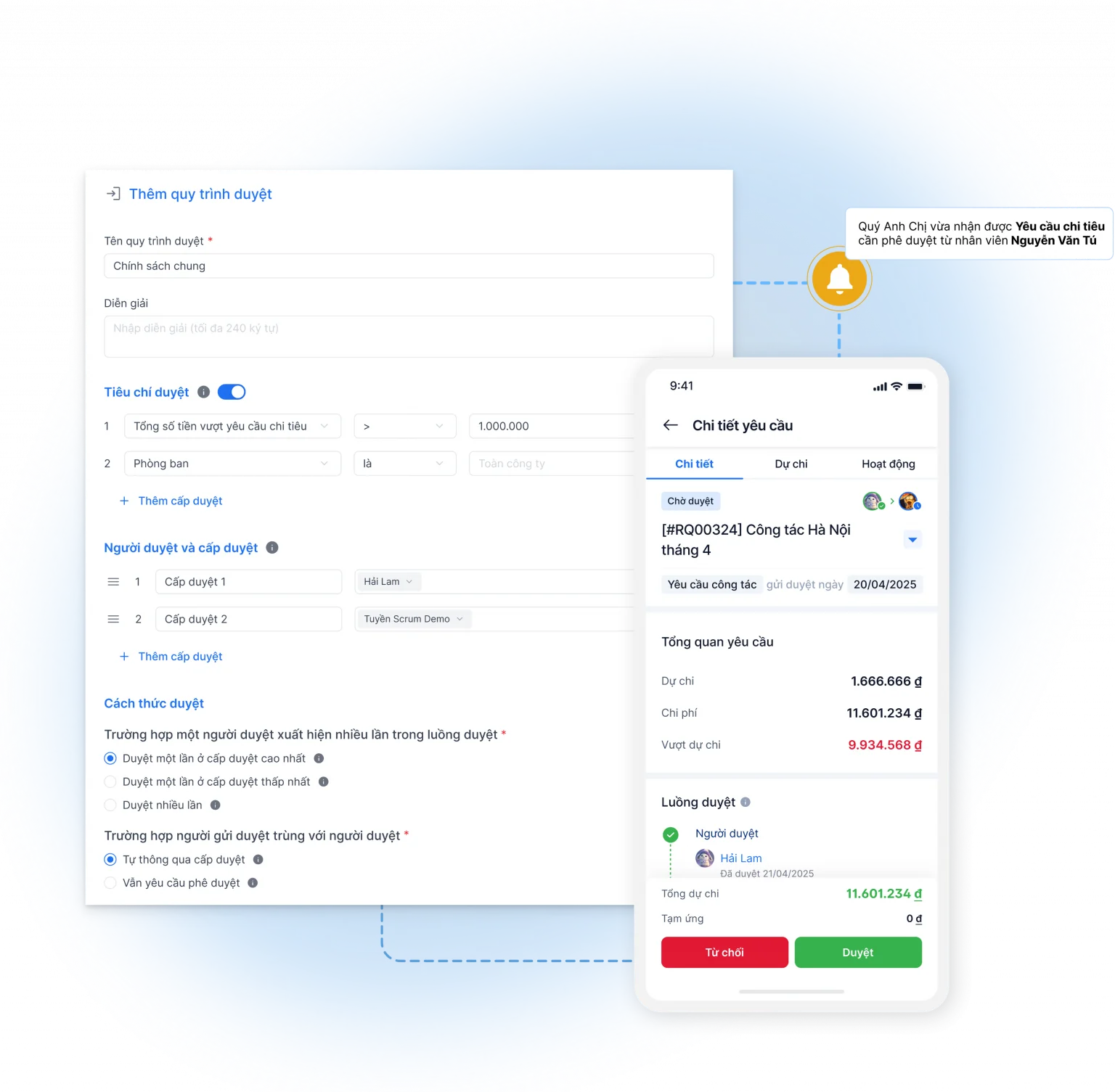
Automate the approval process
Instead of sifting through emails or messages, businesses can build Approval Workflow under various conditions such as:
- the value of the expenditure;
- department;
- employee rank;
- type of expense;
- project;
- budget.
Managers can approve directly via the web or mobile app, and the entire processing history is saved for auditing and post-audit purposes.
Manage advances and settlements within a single process.
One common challenge for businesses is tracking business trip advances.
Bizzi Expense supports:
- Create an advance payment request;
- Track the status of each advance payment;
- Manage the repayment deadline;
- Compare the advance payment, actual expenses, and the amount to be reimbursed or paid additionally.
This allows Finance to easily manage outstanding advances and limit prolonged settlement periods.
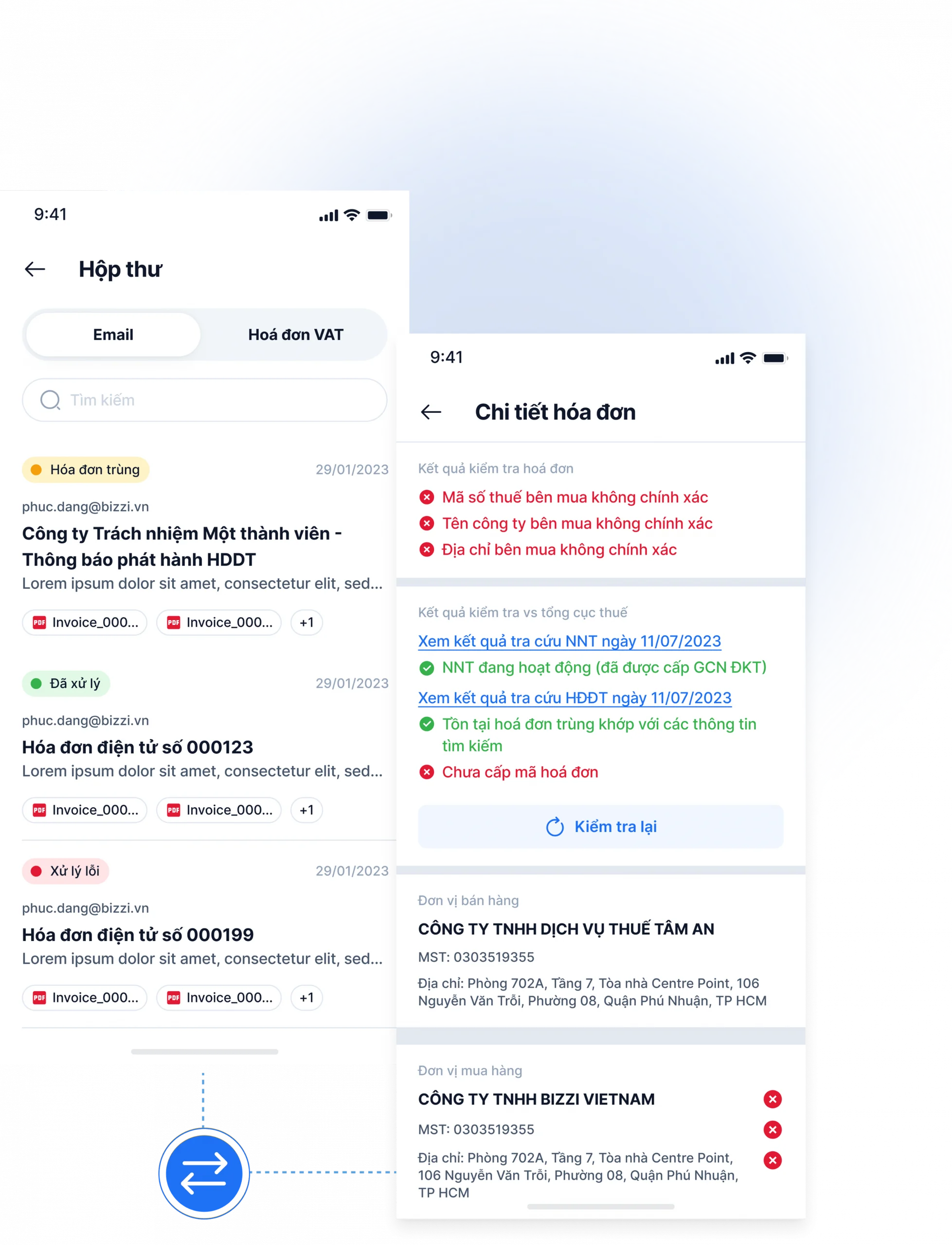
Automated document collection and verification
Invoices are a crucial part of expense reporting. Instead of employees sending invoices through multiple channels, Bizzi Expense supports document collection directly during the settlement process. Automatically check input invoices.
The system can:
- Receive and store electronic invoices;
- Digitizing documents;
- Check the invoice information;
- Detecting duplicate invoices or unusual data;
- Link the supporting documents to the corresponding payment request.
This significantly reduces the time spent reviewing documents and increases retriability when businesses require post-audit or inspection.
Synchronize data for accounting and management reporting.
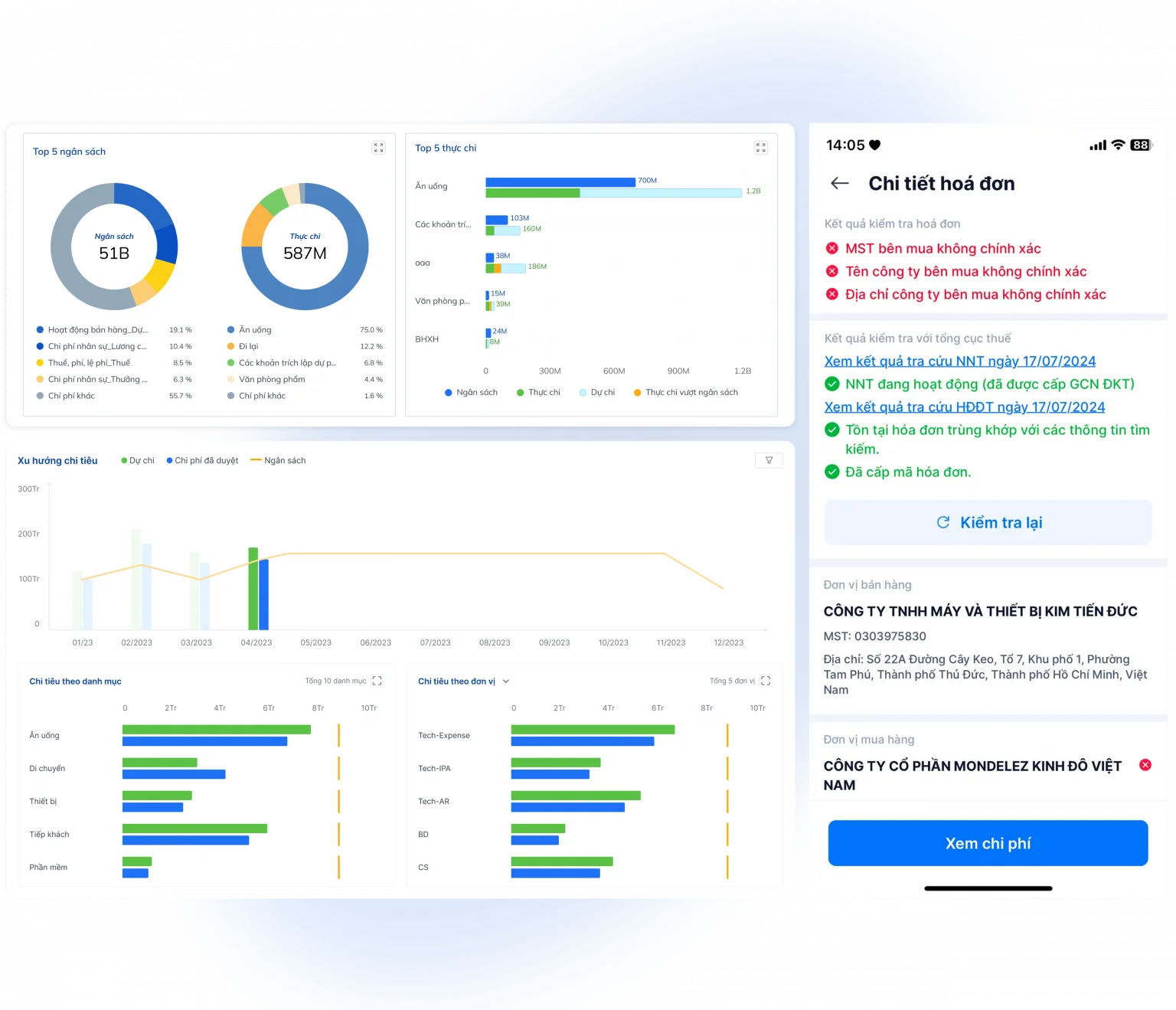
After the final settlement is complete, cost data can be aggregated in various management dimensions such as:
- department;
- Cost Center;
- project;
- staff;
- expense categories;
- time.
Real-time reports enable CFOs and Finance Managers to monitor budget usage, identify unusual spending, and make faster decisions without manually compiling data from multiple sources.
Instead of simply serving as a tool for recording expenses, Bizzi Expense helps businesses transform the terms of their travel expense policy into operational rules that are applied throughout the entire process, from request and approval to payment, settlement, and reporting. This contributes to improved compliance, increased traceability, and reduced risks during audits or post-audits.
FAQ regarding the sample regulations on travel expenses
Is it mandatory for businesses to issue regulations on business travel expenses?
The law does not mandate that all businesses must issue their own regulations on business travel expenses. However, for businesses that frequently incur business travel expenses, establishing internal regulations helps standardize processes, reduce disputes, control budgets, and provide a basis for approval, payment, and explanation when necessary.
Which department should draft the regulations on business trip expenses?
Typically, regulations on travel expenses are developed in coordination with... Finance/Accounting, HR/Admin and specialized departments. The management or authorized person will review and approve it before issuance to ensure it aligns with the company's financial policy and operational practices.
Does the sample regulations for travel expenses need to specify a limit?
Yes. Setting limits is one of the most important aspects of the regulations on business travel expenses. Businesses should establish limits based on rank, location, type of expense, or department to create a basis for budget control and handling cases of exceeding the limits.
Do business trip expenses require invoices?
In many cases, businesses should require valid invoices or supporting documents for expenses incurred to support accounting, tax, and internal control purposes. The specific list of supporting documents should be clearly defined in the business expense regulations and implemented in accordance with current legal provisions.
Can travel expenses be covered by a fixed allowance?
Yes. Many businesses use a lump-sum payment system for certain expenses such as accommodation, meal, or travel allowances. However, the lump-sum amount, scope of application, and payment conditions should be clearly defined in the regulations to ensure transparency and consistency.
Will expenses exceeding the allocated budget be reimbursed?
This is possible if the business has an exception handling mechanism. Generally, overspending is only considered when there is a valid reason, complete documentation, and approval from the competent authority according to established procedures.
How often should the regulations on travel expenses be reviewed?
Businesses should conduct periodic reviews, such as annually or whenever there are changes in organizational structure, budget, operating model, or significant fluctuations in market costs. Regular updates ensure that regulations remain relevant to actual operations.
How does the regulations on travel expenses differ from the procedures for handling travel expenses?
The regulations on travel expenses stipulate... What expenses are covered, at what rates, and under what conditions?, and the procedure for handling business expenses is also provided. Who performed the action, when did it happen, and in what order? From work proposals, approvals, advances, to final settlements and reconciliations. These two documents complement each other to build a system. business cost management in general and effective work in particular.
Conclude
One Sample regulations on business trip expenses in enterprises. It only truly becomes effective when applied consistently in daily operations. As the business expands, the number of business trips increases, and more departments are involved in the spending process, managing expenses using email, Excel, or disjointed paper documents will cause the Finance department to spend a lot of time checking, reconciling, and explaining.
Instead of simply establishing regulations on paper, businesses should transform regulations regarding quotas, budgets, approval processes, documentation, and settlements into digitized procedures. Bizzi Expense, Businesses can configure spending policies, manage business expenses, advances, reimbursements, check invoices, track budgets, and generate reports on a single, unified platform. When combined with Bizzi Expense Pay, Furthermore, the process has been expanded from approval to payment and data reconciliation, helping CFOs and Finance Managers increase their ability to control costs, reduce operational risks, and build a more transparent financial management system as the business grows.
Sign up for a free trial now to discover the ultimate cost management solution for your business, designing fast, transparent, and efficient task approval processes.
- Register now: https://bizzi.vn/dang-ky-dung-thu/