


Costs are only truly controlled when a business manages the entire lifecycle of an expense – from budgeting, establishing spending policies, approval, document verification, to tracking actual spending and analyzing discrepancies. business cost control solutions Efficiency not only helps reduce losses but also supports CFOs in making data-driven decisions in real time.
In reality, many businesses don't lack expense data; they lack a robust system to connect data from various departments, documents, invoices, and approval processes. When information is scattered across email, Excel, and multiple separate software programs, it becomes very difficult for the finance team. corporate budget control The remaining tasks involve identifying expenditures exceeding budget or evaluating the effectiveness of cost utilization by department or project.
To sustainably control costs within a business, CFOs need to establish cost management processes before, during, and after expenses are incurred, while gradually applying technology to automate tasks such as verification, approval, and reporting.
To avoid confusing cost control with cost reduction, it is first necessary to correctly identify the nature of cost control activities within a business.
What is business cost control?
Cost Control businesses are The budgeting process, including establishing spending policies, approval, document verification, expenditure tracking, and variance analysis, aims to ensure that all expenditures serve the intended business objectives, stay within budget, and adhere to established procedures.
Many businesses still understand cost control simply as cutting budgets or restricting spending. However, this is only a very small part of financial management. The goal of cost control in businesses It's not about spending as little as possible, but about ensuring that every expenditure creates value, complies with policy, and is transparently accounted for.
They can be distinguished as follows:
| Work | Target |
| Cut costs | Reduce or eliminate certain expenses. |
| Cost Control | Ensure that expenses are incurred for the intended purpose, within budget, according to procedures, and at the right time. |
This is especially important for fast-growing businesses, where the number of expenses, suppliers, and departments increases. Looking only at the total cost at the end of the month makes it difficult for businesses to determine:
- What expenses are being incurred?.
- Which department, project, or cost center does the expenditure belong to?.
- Was the expenditure approved according to the correct procedure?.
- Are the documents and invoices complete and valid?.
- What is the remaining budget for each unit?.
For example, a business trip expense might not exceed the company's total budget, but it could still violate spending policies if it exceeds the prescribed limit or lacks valid documentation. In this case, the risk lies not in the amount of money but in the fact that the expenditure did not comply with the control process.
That's also why CFOs increasingly need to monitor expense data in real time instead of relying solely on end-of-period accounting reports. When every expenditure is linked to a budget, department, project, and approval status, businesses can detect early signs of budget overruns or off-plan spending before it impacts cash flow and business performance.
Once we understand cost control as a system rather than a single cost-cutting action, the next question is why many businesses still lose control of costs despite having budgets and accounting reports.
Why is it difficult for businesses to control daily costs?
Businesses struggle to control daily expenses because spending data is often scattered across purchase requests, approval processes, invoices, advances, reimbursements, payments, and accounting reports. When these data sources are not interconnected, it is difficult for CFOs to track budgets and identify risks in a timely manner.
Even with annual budgets or regular financial reports, many businesses still struggle to control daily costs. This is not due to a lack of regulations, but rather to fragmented operational processes that rely heavily on manual operations.
Costs are dispersed across multiple departments.
In a business, expenses can arise simultaneously from purchasing, sales, marketing, operations, or human resources departments. Each department uses a different form or tool to request expenses, making it difficult for the finance team to have an overall view of the budget situation.
For businesses with multiple branches or projects, aggregating data from multiple sources increases the risk of missing or delaying the recording of expenses.
The approval process lacks standardization.
Many businesses still approve payments via email, text message, or paper documents. This leads to several problems, such as:
- It is not clear who approved it.
- It is unclear which budget the expenditure was approved on.
- It is difficult to trace the history of changes when inspections or audits are needed.
- Communication between departments takes a lot of time.
Without an audit trail, businesses also face difficulties in determining responsibility if errors occur or if expenses outside of established policies are incurred.
The budget is not updated in real time.
Many businesses create very detailed budgets at the beginning of the year but manage them using Excel or separate spreadsheets. When an expense is proposed or approved, the budget isn't updated immediately, so the CFO isn't aware of it.
- How much of the budget has been used?.
- Which amounts are only projected expenditures?.
- Which amount was actually spent?.
- Is there enough remaining budget to continue with the approval process?.
It wasn't until the end-of-month report was compiled that the company discovered it had exceeded its budget.
The supporting documents and invoices are not consistent with the expenditure.
An expenditure is only truly complete when accompanied by valid invoices and supporting documents. However, in practice, finance teams often have to deal with situations such as:
- The employee submitted incomplete documentation.
- The invoice contains incorrect information.
- The supporting documents do not match the payment request.
- Payment records are lost among multiple emails or folders.
This not only slows down the payment process but also increases accounting and tax risks.
The report comes after the decision.
In many businesses, expense reports are only compiled at the end of the month or quarter. By then, expenses have already been incurred and cash flow has been affected, leaving CFOs only able to deal with the consequences instead of proactively preventing them.
The lack of real-time data also reduces the ability to adjust budgets or change spending policies when the market fluctuates.
Common bottlenecks in cost control
| Bottleneck | Signs in business | Financial impact |
| Manual approval | Reviewing emails, chats, or documents. | Difficult to trace responsibility, easy to overlook. |
| Fragmented budget | I don't know the remaining budget. | Easy to exceed budget |
| Documents lacking verification | Incorrect or missing information on the invoice. | Increased accounting and tax risks |
| Late reporting | The total will be compiled at the end of the month. | CFOs react late to cost fluctuations. |
The above issues show that, in order to cost control in businesses For efficiency, businesses need not only to create budgets but also to connect spending data, documents, invoices, and approval processes within a single management system.
These bottlenecks demonstrate that to effectively control costs, businesses need to clearly understand which cost groups they are controlling before designing processes.

Which cost categories does a business need to control?
Businesses should control costs by category—operations, purchasing, business trips, personnel, suppliers, projects, and other incidental expenses—to accurately identify risks, allocate budgets appropriately, and apply suitable approval processes for each expense type.
Not all expenses carry the same level of risk or require the same control procedures. Categorizing expenses into groups helps CFOs and finance teams design appropriate budgets, spending policies, and approval processes, while also monitoring the effectiveness of expense utilization across business units.
Operating costs
These are the recurring expenses incurred to maintain business operations, such as:
- Office rental
- Electricity, water, internet
- Stationery
- Software and SaaS services
- Outsourcing services
- Maintenance and repair costs
The characteristic of this expense category is that the value of each item may not be large, but they are incurred periodically. Without regular review, businesses can easily maintain expenses that no longer provide value or that are duplicated across departments.
Purchase cost
This includes the cost of purchasing raw materials, equipment, assets, software, or services used in business operations.
This cost group is typically linked to the purchasing process and therefore needs to be controlled from the initial stages of requesting a purchase, selecting a supplier, approval, receiving goods, and reconciling invoices.
Common risks include:
- Buy now, get approval later.
- Missing quotation or purchase order.
- Do not compare the order, the received goods, and the invoice.
- Payment was not made in accordance with the contract terms.
Business trip and entertainment expenses
These are common expenses incurred by businesses with sales teams or personnel who travel frequently, including:
- Airline tickets
- Hotel
- Taxi, a means of transportation.
- Eat and drink
- Reception
- Conferences and seminars
Without a clear spending policy, this expense category can easily exceed the budget or lack valid documentation when claiming reimbursement.
Personnel costs related to operations
In addition to salaries, businesses incur many other expenses related to human resources operations, such as:
- Allowance
- Advance
- Refund
- Training costs
- Recruitment
- Welfare
These expenses need to be allocated to the correct department or project to accurately reflect the operating costs of each unit.
Supplier costs
These are payments due under contract or per individual purchase invoice.
Businesses need to monitor closely:
- Contract value
- Payment terms
- Bill
- Debt
- Payment term
A lack of reconciliation between contracts, invoices, and accounts payable can lead to duplicate payments, overdue payments, or disputes with suppliers.
Project-based costs or Cost Center
For businesses with multiple projects or business units, linking costs to each cost center helps CFOs assess financial performance more accurately.
If you only track total enterprise costs, it's difficult to determine:
- Which projects are exceeding their budget?.
- Which department is using its budget inefficiently?.
- Profit margin of each business unit.
Cost categories and how to control them.
| Cost group | Common risks | Control methods |
| Operating costs | These issues arise periodically but are rarely reviewed. | Budgeting by category |
| Purchase cost | Buy now, approve later. | Proposal and approval process |
| Cost of work | Exceeding limits, lacking documentation. | Spending policy and bill checking |
| Supplier costs | Overdue or delayed payments | Compare contracts, invoices, and accounts payable. |
| Project costs | Profit and loss for each project are unclear. | Track costs based on cost center and budget. |
Categorizing expenses not only helps businesses control each expenditure but also serves as a foundation for building budgets, establishing spending policies, and designing appropriate approval processes.
Once the cost groups that need to be controlled have been identified, businesses need to move from a list of expenses to a specific operational process so that costs are controlled before they become financial problems.
What steps should a cost control process in a business include?
An effective cost control process should encompass cost classification, budgeting, establishing spending policies, approval, document verification, tracking actual expenditures, and analyzing discrepancies for periodic improvement.
Instead of only checking invoices or reports after expenses have been incurred, businesses should design a process to control the entire lifecycle of an expense. This helps prevent risks from the outset and provides comprehensive data for the CFO to assess budget efficiency.
Step 1. Categorize costs by category, department, and project.
Control objectives: Clearly identify which category the expenditure belongs to, which department or project it serves, and who is responsible.
Businesses should establish a unified expense catalog, incorporating cost center information, project codes, and responsible persons, so that all expenses are traceable.
Common mistakes when doing it manually: Grouping multiple expenses into the same category makes it difficult for CFOs to identify the root cause of the costs.
Step 2. Set a budget and spending limits.
Control objectives: Set spending limits before any expenses arise.
The budget should be allocated as follows:
- Monthly or quarterly.
- Department.
- Project.
- Expense list.
This creates a "control threshold" for comparison between projected expenditures, actual expenditures, and remaining budget.
Common mistakes when doing it manually: The budget only exists in an Excel file and is not updated when expenditure requests arise.
Step 3. Implement the spending policy.
Control objectives: The regulations clearly specify which expenses are permitted, the payment conditions, and the required documentation.
An effective spending policy should stipulate:
- Limits are set for each type of expense.
- Required documents.
- Conditions for advance payments and reimbursement.
- Payment terms.
- Approval is granted based on the value of the expenditure.
Common errors: The policy was issued but not applied consistently across departments.
Step 4. Standardize the proposal and approval process.
Control objectives: Control expenses before the business commits to making payments.
The process needs to be clearly defined:
- Proponent.
- Approver.
- Approval granted.
- Approval requirements.
- Processing status.
Common errors: Purchasing goods first and then seeking approval makes the control process merely a formality.
Step 5. Check invoices, receipts, and payment information.
Control objectives: Ensure that the expenditure qualifies for accounting recognition and payment.
The finance team needs to check:
- The invoice is valid.
- All documents are complete.
- Supplier.
- Tax identification number.
- Payment value.
- Contract terms.
Common errors: The invoice does not match the requested payment or lacks supporting documentation.
Step 6. Monitor projected expenses, actual expenses, and remaining budget.
Control objectives: Continuously update the impact of each expenditure item on the budget.
In addition to the amount paid, businesses should also track:
- The application is awaiting approval.
- The payment has been approved but not yet made.
- The amount has been incurred.
- The budget has been used.
- Remaining budget.
Common errors: Only recording expenses after payment prevents CFOs from seeing upcoming expenses.
Step 7. Analyze budget discrepancies.
Control objectives: Identify the reasons why costs exceeded or fell short of the plan.
The analysis should be conducted as follows:
- Department.
- Project.
- Expense list.
- Supplier.
- Cost center.
Instead of just looking at the total budget overrun, CFOs need to know where the difference is coming from in order to adjust spending plans or policies.
Common errors: Comparing only total costs without analyzing the root causes is a mistake.
Step 8. Automate alerts and reports.
Control objectives: Providing real-time data reduces reliance on manual aggregation.
A modern cost management system should support:
- Real-time dashboard.
- Budget overrun warning.
- Reports can be generated by department, project, or expense category.
- Track the status of your expenses.
- Audit the trail of the entire process.
Common errors: The finance team spends too much time compiling data instead of analyzing and advising management.
In fact, the effectiveness of cost control in businesses It depends not only on whether or not there are processes in place, but also on whether the business chooses a management method that suits its size, complexity, and growth rate.
Processes provide a control framework, but to operate effectively in practice, businesses need to combine various cost management methods instead of relying solely on budgets or accounting reports.

When should businesses use cost control software?
Businesses should consider using cost control software when the number of expenses increases, approval processes have multiple levels, budgets are allocated to multiple departments or projects, and the finance team can no longer track performance effectively using Excel. The software's goal is not to replace administrative processes, but rather to standardize data, reduce manual operations, and provide real-time information to support decision-making.
In the early stages, many businesses can still manage expenses using Excel combined with email or internal forms. However, as operations expand, the volume of transactions increases, and more departments are involved in the spending process, this method gradually reveals many limitations.
Signs that indicate a business should switch to a specialized management system include:
- Multiple departments, branches, or projects may generate expenses simultaneously.
- Each month, we process hundreds of payment, advance payment, or reimbursement requests.
- The approval process goes through multiple levels of management.
- Budgets are frequently exceeded, but this is only discovered when compiling the final reports.
- The finance team spent a lot of time gathering documents from emails, chats, and various other sources.
- The cost report still has to be compiled manually.
- The CFO cannot simultaneously track projected expenses, actual expenses, and remaining budget in real time.
- Businesses need to retain a history of audit trail operations for internal control or auditing purposes.
Signs that indicate a business needs a cost control system.
| If your business is experiencing this situation... | Risk | System requirements |
| Approval via email or chat | Difficult to trace responsibility | Approval Workflow |
| Budget management using multiple Excel files. | Easy to exceed budget | Budget Tracking |
| Disaggregated documents | Errors in accounting and reconciliation | Document Management |
| The end-of-month report has just been completed. | Slow decision-making | Real-time dashboard |
| There are many types of advances and reimbursements. | Difficult to control cash flow. | Expense Management |
It should be noted that Excel remains a suitable tool for small businesses with a relatively small number of expenses.. However, as processes become increasingly complex, reliance on spreadsheets makes data synchronization difficult, lacks the ability to alert users to budget overruns, and fails to fully record the processing history of each expenditure.
Instead of trying to expand manual processes, many businesses are opting for expense management software to standardize workflows, reduce data entry, and increase the ability to track budgets in real time.
Businesses can refer to the following for more information. business expense management software to choose a solution that suits the scale and operating model of your business.
How does Bizzi Expense help businesses control their costs?
Bizzi Expense helps businesses control costs by centralizing spending data, budgets, approval processes, and reporting on a single system, reducing manual tasks for finance teams and enabling CFOs to monitor cost performance in real time.
Unlike fragmented expense management across Excel, email, and various separate software programs, Bizzi Expense is designed to support the entire expense management process, from the initial need to the final payment.
1. Standardize expenditure proposals and approval processes.
One of the reasons businesses lose control of costs is that expense requests are sent through multiple channels, making it difficult to track their status and assign responsibility for processing them.
Bizzi Expense helps:
- Standardize the expenditure request form.
- Establish approval flows based on management levels.
- Track the status of each expense.
- Record the processing history (audit trail) for the entire process.
Value to the CFO
- Transparency of accountability.
- Reduce the practice of purchasing first and seeking approval later.
- It's easy to trace back when an audit or internal review is needed.
2. Monitoring the budget across multiple management dimensions.
Budgets are only effective when they are continuously updated throughout the operational process.
Bizzi Expense supports budget tracking via:
- Department
- Cost center
- Project
- Expense list
- Business Unit
This allows the CFO to observe:
- The budget has been used.
- Remaining budget.
- Expenditures are pending approval.
- The expenditure risks exceeding the budget.
Instead of just seeing the end-of-period figures, businesses now have additional data to adjust their plans during the implementation process.
3. Centralized management of expense documents and information.
In many businesses, documents are often sent via email or stored in multiple folders, making it difficult to cross-reference and verify them.
Bizzi Expense helps improve focus:
- Request for payment.
- Bill.
- Payment voucher.
- The records relate to each expenditure.
As a result, the finance team significantly reduced the time spent searching for information because:
- Reconciliation.
- Accounting.
- Pay.
- Auditing.
- Tax settlement.
If a business processes many incoming invoices, Bizzi Expense can also be combined with other solutions. automatic invoice processing Bizzi Bot is used to extract data, verify documents, and reduce the risk of errors before payment.
4. Real-time cost reporting
A cost control system is only truly valuable when managers can see the data at the moment they need to make decisions.
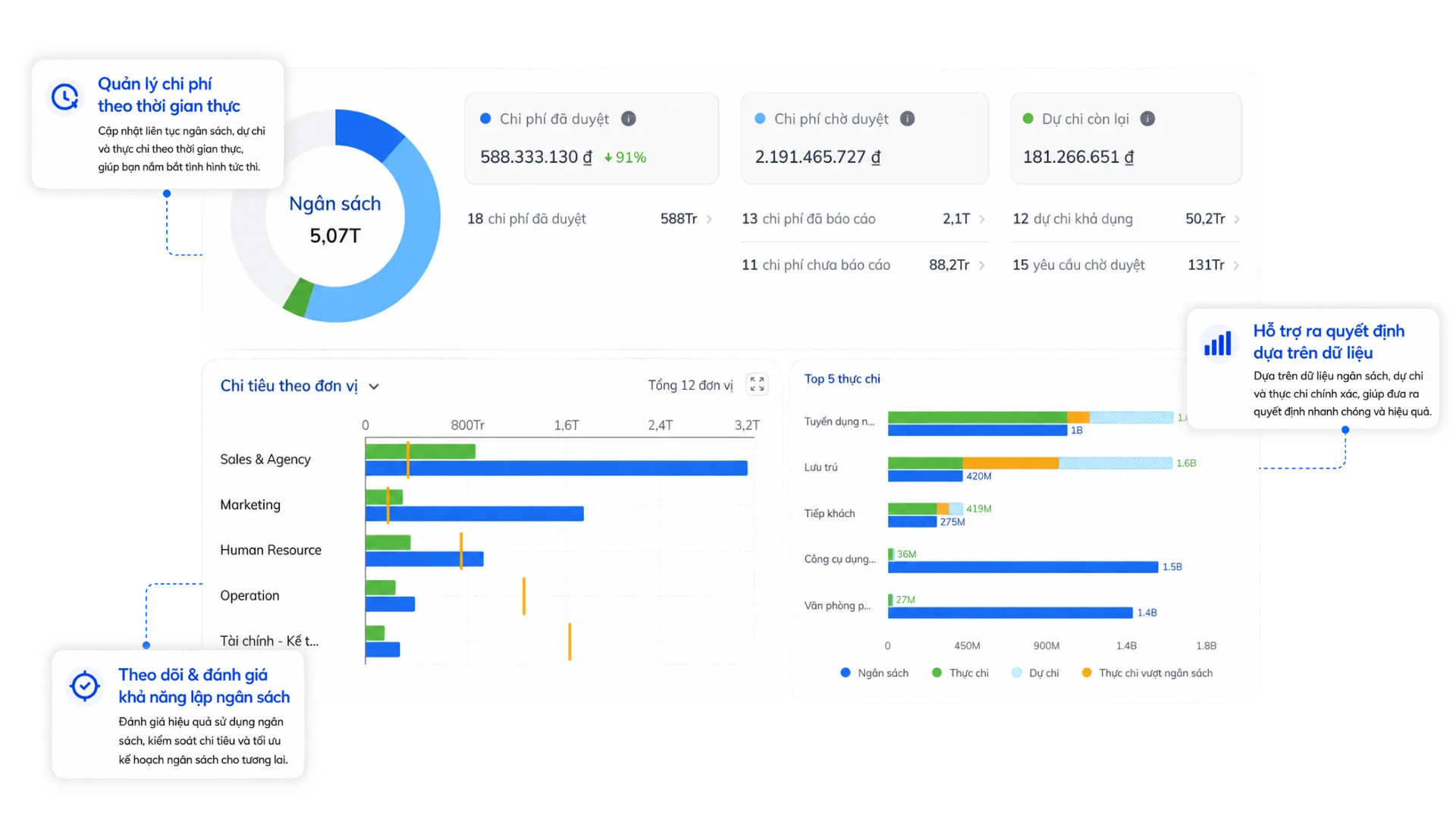
Bizzi Expense supports dashboards with multiple viewing angles:
- By department.
- According to the project.
- According to the expense category.
- According to the person who made the proposal.
- According to the approval status.
- According to the budget.
Thanks to continuously updated data, CFOs can detect:
- Expenditures exceeding policy limits.
- The department has an unusually high rate of budget expenditure.
- The project incurred costs that exceeded the planned budget.
- These expenses are impacting cash flow.
5. Connect with Bizzi's Financial Operations ecosystem.
Cost control is not a standalone process but is directly related to invoices, accounts payable, and cash flow.
In the Bizzi ecosystem:
- Bizzi Expense Responsible for managing costs, budgets, and approval processes.
- Bizzi Bot Assisting with invoice processing, document verification, data reconciliation, and tax risk reduction.
- Bizzi ARM Expand your capabilities for managing accounts receivable and payable, and tracking cash flow.
This integration helps businesses build a seamless Financial Operations process instead of managing each task separately.
What support does Bizzi Expense provide in each cost control challenge?
| Cost control issues | Bizzi Expense support | Value for the finance team |
| Proposal for fragmented expenditures | Standardize the proposal and approval process. | Easy to monitor processing status |
| Budget is difficult to control. | Track budgets by department and project. | Early detection of budget overrun risks. |
| Distributed documents | Centralize expense data and supporting documents. | Reduce reconciliation time. |
| Manual reporting | Dashboard and real-time reports | Supporting CFOs in making faster decisions. |
If your business manages budgets, expense requests, and documentation across multiple systems, Bizzi Expense can be the starting point for standardizing the process. cost control in businesses, This increases transparency and reduces reliance on manual processes.
Checklist for evaluating the current cost control system.
A good cost control system should help businesses answer questions such as: which budget does each expense belong to, who approved it, are the supporting documents valid, how much has been spent, and how much budget remains. If these questions remain unanswered, businesses should review their current processes.
Self-Assessment Checklist
Please mark “"Have"” If your business has met the following criteria:
☐ Costs have been categorized by department, project, or cost center.
Each expense category has a clear budget and limits.
☐ The expenditure policy specifies all types of expenses, supporting documents, and approval levels.
☐ All expenses are approved before they are incurred.
☐ The finance team can track the status of each expenditure request.
☐ Documents and invoices are attached to each expenditure.
☐ The CFO can track the budget used and the remaining budget in real time.
☐ The system provides alerts when expenses exceed the budget or policy.
☐ Expense reports are available by department, project, category, and requester.
☐ The entire process includes audit trail records for internal auditing and control purposes.
Assess the maturity level of the system.
| Number of "Yes" answers“ | Level of control | Suggested actions |
| 0–3 | Manual, high risk. | Standardize expense categories, budgets, and policies. |
| 4–6 | It has the infrastructure but lacks real-time data. | Standardize workflows and reporting. |
| 7–10 | The control system is relatively good. | Continue to optimize automation and the admin dashboard. |
The checklist's results are not intended to judge whether a business is "good" or "not good," but rather to identify priority areas for improvement before investing in technology solutions. Once data, processes, and approval authority are standardized, the application of automation will yield significantly better results in terms of both processing speed and quality of control.
FAQ about cost control in businesses
Cost control is the process of establishing budgets, monitoring, and optimizing expenditures to minimize financial risks and increase profits. It is a core activity that ensures sustainable growth and a competitive advantage for any business.
Below is a list of frequently asked questions (FAQs) compiled to help businesses set up and operate the system. cost management report optimal:
How is cost control different from cost reduction?
Cost control involves managing expenses according to objectives, budgets, and policies; while cost reduction involves decreasing or eliminating certain expenses.
These two concepts are often confused but are fundamentally different. Cost reduction focuses on decreasing the amount spent, while cost control aims to ensure that all expenditures serve business objectives and deliver commensurate value.
In many cases, a business may still increase costs if that investment helps expand revenue, improve operational efficiency, or reduce long-term risk. Therefore, CFOs should not only focus on how much the business spends but also evaluate the business. Is the payment correct or not?.
Do small businesses need to control costs?
Yes. Small businesses especially need to control costs early on because a lack of processes from the start can make it difficult to trace unexpected expenses as they scale up.
In the initial stage, businesses can build a simple process with:
- Expense list.
- Basic budget.
- Expenditure policy.
- The approval process is clear.
As the number of expenses, personnel, and departments increases, businesses can gradually add automated workflows and management systems to avoid having to change entire processes later.
Does cost control slow down the approval process?
Not necessarily. If the process is clearly designed regarding approval levels, limits, and documentation requirements, cost control can help speed up approvals by reducing manual exchange steps.
In fact, the reasons for process delays often stem from:
- There are no regulations regarding who has the authority to approve it.
- The records and documents are incomplete.
- Approval can be obtained through various channels such as email or text message.
- The processing status cannot be tracked.
When workflows are standardized and automated, approvers can receive requests at the right time, and the finance team doesn't have to waste time compiling or manually prompting processing.
Should you control costs using Excel or software?
Excel is suitable when the expense scale is small, but software is more appropriate when a business needs multi-level approval, real-time budget tracking, and audit trail recording for each expense.
| Criteria | Excel | Software |
| Small businesses | Fit | It may not be necessary yet. |
| Multi-level approval | Limit | Fit |
| Budget tracking | Mostly handcrafted. | It can be updated automatically. |
| Over budget warning | Handmade | It is possible to set up alerts. |
| Audit trail | Difficult to manage | Save the full processing history. |
| Real-time reporting | Limit | Fit |
Businesses don't necessarily need to replace Excel right from the start. However, as expense data grows and processes become more complex, using a specialized system will help reduce reliance on manual operations and improve control.
What metrics should a CFO monitor to control costs?
CFOs should monitor budget utilization rates, discrepancies between projected and actual expenditures, departmental expenses, project-based expenses, overspending, and average approval times.
Some commonly used KPIs include:
- Budget Utilization
- Budget Variance
- Cost by Department
- Cost by Project
- Policy Violation Rate
- Approval Cycle Time
- Expense Reimbursement Cycle Time
- Pending Payment Amount
Regularly monitoring these metrics helps CFOs detect unusual trends and adjust the budget before it impacts the company's financial performance.
What features should cost control software have?
Cost control software should support budget management, proposal and approval processes, document management, budget overrun alerts, real-time reporting, and a complete history of processing.
In addition to core features, businesses should also prioritize solutions that offer the following capabilities:
- Connect with ERP or accounting software.
- Manage costs by department, project, and cost center.
- Check the invoice and supporting documents before making payment.
- Track accounts payable and cash flow.
- Assign user permissions based on roles.
Platforms like Bizzi Expense It also expands management capabilities by connecting expense data with invoice processing and accounts receivable, helping businesses build a synchronized Financial Operations process instead of managing each transaction separately.
The above questions show that cost control in businesses It's not just the responsibility of the accounting department; it's a financial management capability that needs to be built on a foundation of data, budgets, processes, and technology. When these elements are closely interconnected, businesses will be able to proactively control spending and support leadership in making faster and more accurate decisions.
Conclude
One business cost control solutions Effective spending not only helps limit extra expenses but also gives CFOs a comprehensive picture of spending patterns to make timely decisions. Instead of only discovering problems when compiling end-of-period reports, businesses should build a comprehensive control system from budgeting, approval, document verification to tracking actual spending and analyzing discrepancies in real time.
With Bizzi Expense, businesses can standardize their entire process. cost control in businesses On a unified platform: manage expense requests, track budgets by department and project, automate approval processes, centralize documentation, and provide real-time dashboards for CFOs and Finance Managers. Combine with Bizzi Bot for invoice and documentation processing and Bizzi ARM for... debt and cash flow management, Bizzi helps businesses build transparent Financial Operations systems, reduce reliance on manual processes, and enhance financial control capabilities.
👉 Sign up for a Bizzi demo. To explore how businesses can transition from managing expenses using Excel to a modern, transparent, and data-driven cost management system.
Monitor Bizzi To quickly receive the latest information:
- Facebook: https://www.facebook.com/bizzivietnam
- Linkedin: https://www.linkedin.com/company/bizzi-vietnam/
- Youtube: https://www.youtube.com/@bizzivietnam