



Optimize employee expense advances, reimbursements, and settlements. This not only helps businesses shorten document processing time but also increases budget control, reduces errors, and limits risks in the spending process. As the number of employees, projects, and expenses increase, managing with spreadsheets or manual processes can easily lead to lost documents, delayed settlements, and a lack of transparency in cash flow.
Many businesses are now shifting from traditional advance payment management methods to a digitized process, seamlessly connecting the entire process from expense request, approval, payment, invoice collection to accounting. This not only helps the finance department reduce manual workload but also provides CFOs with real-time spending data to make faster and more accurate decisions.
In this article, Bizzi will analyze common bottlenecks in the process of employee expense advances, reimbursements, and settlements; and guide businesses in building effective control processes and applying them. Enterprise cost management solutions The aim is to optimize the entire lifecycle of an expenditure.
1. Why do businesses need to optimize the entire process of advance payments, reimbursements, and expense settlement?
Once a business understands what advances and reimbursements are, the next step is to control the entire cost lifecycle, from the request to the final settlement.
Many businesses now have advance payment and reimbursement procedures in place, but the operational process still relies on email, Excel spreadsheets, paper documents, or various fragmented systems. As a result, the Finance and Accounting Department spends a significant amount of time monitoring open advance payments, reconciling documents, handling discrepancies, and compiling data for reporting.
This is also what sets this article apart. Instead of re-explaining business concepts, the article focuses on... How to optimize the entire process of employee expense advances, reimbursements, and settlements. to help businesses:
- Control your budget even before any expenses arise.
- Reduce the time for reimbursement and settlement.
- Reduce the number of prolonged advance payments.
- Standardize documentation for accounting, tax, and auditing purposes.
- Build timely cost data for the CFO and Finance Manager.
If you need to understand the basic concepts, you can refer to the article. "What is an advance payment, and what is reimbursement?" before continuing with this content.
Optimization is not a single step, but the entire cost lifecycle optimization.
In modern businesses, an employee expense doesn't end when the money is transferred. The expense is only truly complete when all the data, documentation, and reconciliation have been fully verified.
The standard procedure typically includes eight consecutive steps:
- Request for paymentEmployees create advance payment requests or payment proposals for work-related purposes.
- ApproveManagement and the finance department review the budget, spending policies, and limits before approval.
- Funding or payment methodBusinesses can provide advances or offer suitable payment methods such as corporate cards, virtual cards, or payment on behalf of others, depending on the specific case.
- Costs incurredEmployees use the budget to perform work within the approved scope.
- Submit documentsInvoices, receipts, and related documents are compiled to prove the expenditure.
- ReconciliationAccountants check documents, comparing them with advances, payment transactions, and internal policies.
- SettlementConfirm the actual amount spent, handle any discrepancies, and settle the advance payment.
- Data recording and reportingCosts are updated in the accounting system for management reporting, budget tracking, and auditing.
If any of the above steps are still performed manually or lack data, the entire process may be prolonged, affecting settlement deadlines, the accuracy of financial reports, and the ability to control costs.
Therefore, instead of just improving the advance payment or reimbursement process, businesses should view the entire process from a broader perspective. end-to-end, from anterior limb – medial limb – posterior limb. This also forms the basis for building a transparent cost management system, reducing risks, and creating reliable financial data for management decisions.
See more articles about What are B2B payment methods? This

2. Why are advances, reimbursements, and expense settlements often delayed?
The process of advances, reimbursements, and expense settlements is often slow because businesses only monitor the process after the money has been spent, while approval data, invoices, documents, and settlement status are scattered across multiple systems or exchanged manually.
In many businesses, advances and reimbursements are still processed via Excel spreadsheets, email, or messaging applications. Each step in the process – from requesting payment, approval, payment, document collection, to final settlement – involves multiple departments but lacks a unified platform for tracking status. This forces the Finance and Accounting department to spend more time compiling information, reminding staff, and cross-checking documents instead of focusing on control.
As businesses grow in size with more departments, projects, or branches, these bottlenecks become more apparent. Not only do they prolong settlement times, but they also slow down the closing process, impacting the accuracy of financial reporting and the CFO's ability to track cash flow.
Common bottlenecks in the process of advances, reimbursements, and expense settlements.
| Bottleneck | Manifestations | Impact on the Finance team |
| The request for expenditure was not in accordance with regulations. | Lack of expenditure purpose, budget, department, or related project. | The accountant had to contact the applicant multiple times to request additional information before processing the request. |
| Decentralized approval | Reviewing emails, chat applications, or documents. | Difficult to track status, no audit trail (Inspect history) complete |
| Advances with no settlement deadline. | The employee held onto the advance payment for too long without returning it. | An increase in outstanding advances affects cash flow management. |
| Late or incomplete submission of documents | Invoices and receipts are sent separately after payment has been made. | Delayed settlement, extended accounting period closing time. |
| Manual comparison | Accountants must verify each transaction against the supporting documents. | It's time-consuming, prone to errors, and can lead to duplication. |
| Missing monitoring dashboard | It's unclear which payments are pending approval, reimbursement, or final settlement. | CFOs and Finance Managers lack timely data for cost management. |
Post-expenditure controls are always more expensive than pre-expenditure controls.
A common mistake is that businesses only begin verification when employees submit reimbursement requests. By then, the money has already been paid, and amending or supplementing information often takes a long time and involves multiple parties.
For example, an employee travels on business and pays for many expenses with personal funds. After the trip, the employee gathers the invoices, fills out the reimbursement form, and submits it to the accounting department. If there are missing VAT invoices, incorrect project information, or the travel expense limit is exceeded, the file will be returned for further information. This process can be repeated multiple times, causing the settlement process to drag on from several days to several weeks.
Meanwhile, if, right from the initial request for an advance payment or expenditure, the system requires full disclosure of the purpose of use and budget, cost center (Cost center), project and implementation approvals are carried out according to internal policy, and most errors are eliminated before funds are disbursed. When employees reimburse, accountants mainly check the completeness of the documents rather than having to re-verify the entire transaction.
The problem lies not with the people, but with the process.
Many businesses attribute delays in reimbursement to employees forgetting to submit documents or a lack of cooperation. However, in reality, the majority of delays stem from the lack of digitized processes and a lack of mechanisms for tracking progress.
When each expense has a clear status such as Proposed – Under approval – Advance payment received – Awaiting further documentation – Settlement in progress – Completed, Combined with an automated task reminder mechanism and centralized storage, both employees and the Finance department know exactly what the next step should be.
This is also the approach taken by modern expense management platforms such as Bizzi Expense Pay The goal is: instead of just supporting payments, the system will digitize the entire lifecycle of an expense, from proposal, approval, payment, invoice collection to reimbursement and settlement. This will significantly reduce manual processing time, minimize outstanding advances, and improve the quality of data for accounting, auditing, and financial management.
Once bottlenecks in the current process have been identified, the next step is to develop a standardized process for advances, reimbursements, and expense settlements, where each expense is monitored throughout the entire process, from pre-incurrence to final settlement.
3. How to control employee costs before expenses are incurred.
Businesses should shift from a model of checking only after employees submit documents to a pre-expenditure control model, where limits, budgets, and approval conditions are confirmed before funds are used.
Many businesses still manage expenses using a "pay now, check later" approach. This process might be suitable when the scale is small, but as the number of transactions increases, only controlling expenses after they occur leaves the finance team in a reactive position. Accountants must constantly deal with budget overruns, missing documentation, or expenditures that violate policies, while refusing payment or requesting refunds after the money has been spent is often time-consuming and prone to disputes.
Conversely, businesses with mature financial management processes are shifting to a model. Pre-spend control. Instead of waiting until the reimbursement stage to review, the system will confirm the budget, limits, and approval authority from the moment the spending need arises.
What is the difference between Reactive Control and Pre-spend Control?
| Criteria | Reactive Control | Pre-spend Control |
| Control time | After the staff has spent the money | Before the money is used |
| Focus | Check invoices, documents, and settlements. | Review policies, budgets, limits, and approval authority. |
| Risk of exceeding budget | High | Lower prices are achieved through early control. |
| The ability to prevent misuse of funds. | Restricted because the transaction has already occurred. | Restrictions may be imposed right before checkout. |
| The workload of an accountant | Manual exception matching and handling | Focus on controlling truly unusual cases. |
| Value to the CFO | Report after the incident has occurred. | Proactively manage cash flow and budget. |
The biggest difference between the two models lies in their governance objectives. Reactive Control It helps detect errors after the expense has been incurred, while Pre-spend Control The aim is to reduce the likelihood of errors occurring from the outset.
What are the benefits of pre-expenditure control?
For businesses with numerous advances, travel expenses, or daily operating expenditures, pre-expenditure control not only speeds up the process but also improves the quality of financial data.
Some notable benefits include:
- Reduce non-regulatory expenditures. This is due to the requirement to declare the purpose of use, type of expense, and business basis before submitting the request.
- Limit budget overruns. when the system checks budgets by department, project or cost center (Cost center) before approval.
- Reduce disputes during the reimbursement process. Because the spending terms were agreed upon and approved from the beginning.
- Reduce the time accountants spend tracking down documents., This is because each expenditure is linked to a responsible person, a deadline for submitting documents, and a clear processing status.
- Increase transparency for CFOs and Finance Managers., This helps track pending, approved, or paid expenses in real time instead of waiting until the end of the period.
More importantly, when every expenditure is linked to the budget, project, and approver from the outset, financial data becomes more complete and consistent. This speeds up the process of settlement, management reporting, auditing, and cost analysis, while significantly reducing subsequent adjustments.
From manual control to expense management on a unified platform.
To effectively implement a pre-expenditure control model, businesses need more than one payment tool. It's crucial that the entire process, from expenditure request and approval to payment and document collection, is connected on a single platform.
This is also the direction of Bizzi Expense Pay in the ecosystem business cost management. Instead of simply facilitating payment transactions, the solution helps businesses establish policy-based approval processes, control limits and budgets before funds leave the account. After payment, transaction data continues to be linked with invoices, documents, and settlement processes, creating a seamless data flow for reconciliation, accounting, and auditing.
This approach helps businesses shift from a "fix errors after they occur" model to a "prevent risks from the outset" model – an increasingly important factor for CFOs as demands for cost management, cash flow control, and financial transparency grow.
After effectively controlling the pre-expenditure phase, the next step is to standardize the advance payment, reimbursement, and settlement processes so that all expenditures are tracked throughout, from the request to the accounting and documentation stages.
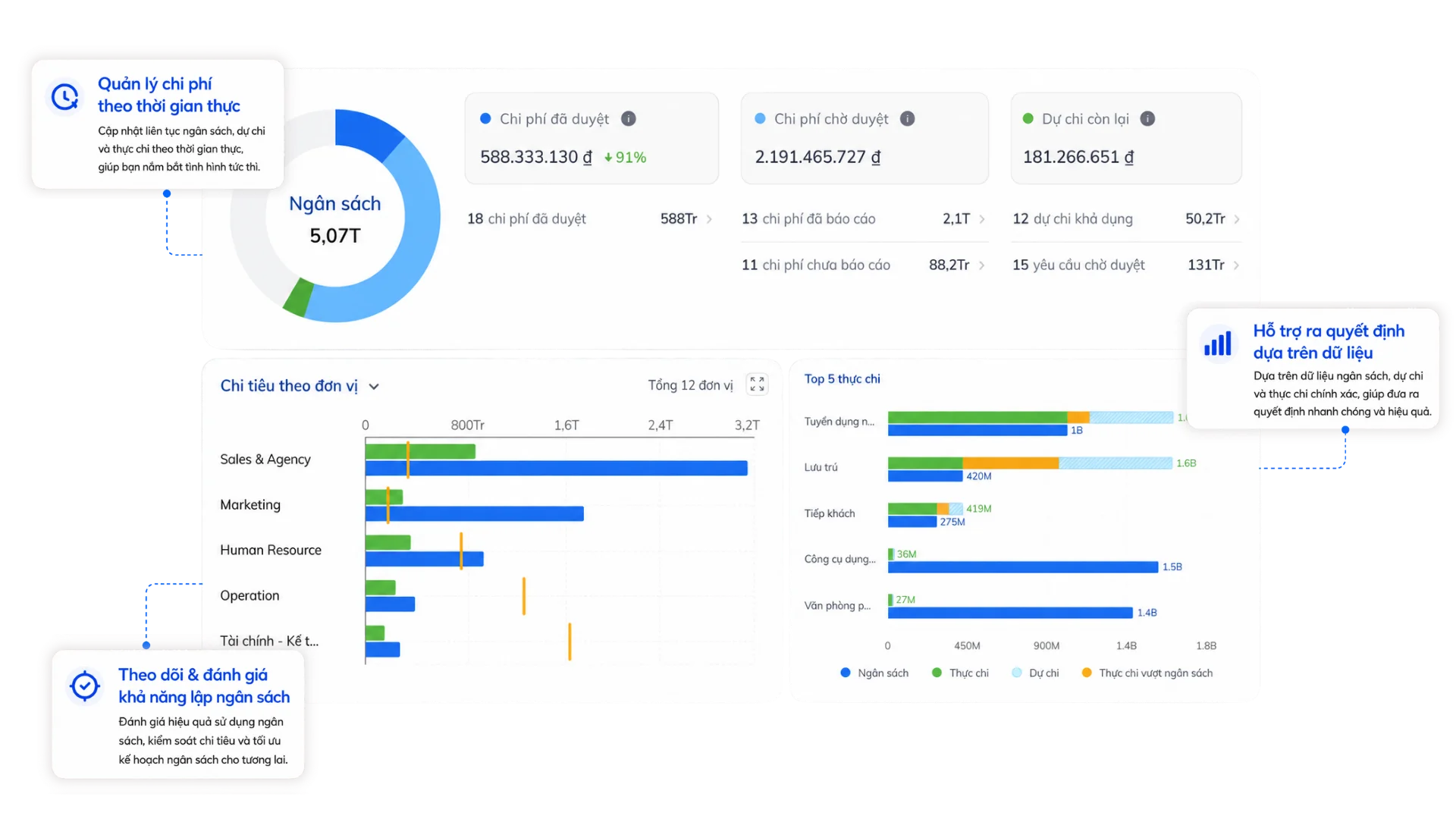
4. Optimized procedures for employee expense advances, reimbursements, and settlements.
The optimal process for employee expense advances, reimbursements, and settlements should include all three layers of control: pre-expenditure control, monitoring during expenditure, and post-expenditure settlement. This approach helps businesses not only process documents faster but also reduce the risk of budget overruns, missing documentation, and long-standing outstanding advances.
Instead of viewing advances, reimbursements, and settlements as three separate processes, businesses should manage them as a unified lifecycle of an expense. Each step requires clear data, processing status, and accountability to ensure transparency and traceability.audit trail) throughout the process.
1. The employee creates a payment request or an advance payment request.
The process should begin with employees submitting expense requests instead of incurring expenses and then seeking approval.
A complete proposal should include:
- Purpose of spending.
- Types of expenses (business trips, entertainment, purchases, marketing, etc.).
- The department or unit that uses the budget.
- Project or cost center (Cost center) related.
- Estimated amount.
- The period of use or the time when the cost is incurred.
Standardizing information from the outset significantly reduces the number of instances requiring multiple document submissions during the reimbursement process.
2. The system or Finance team reviews the spending policy.
Before approval, businesses need to verify whether the proposal meets internal regulations.
The items to be checked include:
- Does the expenditure fall under the category of items eligible for advance payment?.
- It falls within the prescribed limits.
- Is there still budget available?.
- You are eligible for an advance payment.
- List of required supporting documents to be submitted after an expense is incurred.
This step helps businesses shift from a "check after spending" model to a "control before spending" model, thereby significantly reducing off-budget expenses.
3. Manage approvals by role and budget.
Approval should not be based on personal feelings or solely on the direct supervisor's approval.
Businesses should build approval flows based on criteria such as:
- The value of the expenditure.
- Department.
- Project.
- Type of expense.
- Budget allocation is decentralized.
For example, business trip allowances below a certain amount may only require department head approval, while larger expenses or those related to project budgets may require additional approval from the Finance Manager or CFO.
A clear approval process helps reduce backlogs and ensures that every decision has a processing history for future audits.
4. The business provides the funds or chooses a suitable payment method.
After approval, the business proceeds to disburse funds or choose a payment method suitable for each transaction.
Depending on the fiscal policy, the expenditure may be made through:
- Transfer.
- Cash.
- Business cards.
- Virtual card (Virtual Card).
- Form household For payments made on behalf of employees or suppliers.
In many businesses, the combination Bizzi Expense Pay With an approval process that ensures payments are only made after all budget and spending policy conditions are met, instead of being processed independently like traditional payment methods.
5. The employee incurs the expense and keeps the supporting documents.
After using an advance payment or making a payment, employees must retain complete documentation proving the transaction.
Depending on the type of expense, the supporting documents may include:
- Electronic invoices.
- Payment receipt.
- Airline ticket or boarding pass.
- Confirm your hotel reservation.
- Book services.
- Detailed list.
- Acceptance report or related documents.
Businesses should clearly define the required documentation for each expense category to avoid incomplete records during tax settlement.
6. Employees submit reimbursement or settlement documents on time.
One of the reasons why advances are often delayed for extended periods is that businesses do not clearly specify a repayment deadline.
The deadline for submitting applications should be determined on a case-by-case basis, for example:
- After the business trip ended.
- After the project is completed.
- After the expense was incurred.
- According to the internal settlement cycle.
Attaching deadlines to each expense and establishing a reminder mechanism significantly reduced the number of late submissions, while also helping the Finance team close the accounting period on schedule.
7. Accounting reconciliation of requests, expenditures, and supporting documents.
This step verifies whether the actual expenditure is consistent with the approved proposal.
The accountant needs to reconcile:
- The amount has been approved.
- The actual amount spent.
- Valid invoices and supporting documents.
- The difference between the plan and the reality.
- Internal spending policy.
If a business implements a digital process, most of the data is already linked from previous steps, so reconciliation will be faster and reduce repetitive data entry.
8. Handling discrepancies after final settlement.
After the reconciliation is complete, the business needs to handle the discrepancies according to its internal policy.
There are usually three cases:
- The amount spent was less than the advance payment: The staff will refund the remaining amount.
- Excess spending is still legal: The business will make the additional payment after approval.
- Excessive spending that is not in line with policy: Handle the matter according to internal regulations or require the employee to pay the excess amount themselves.
Standardizing the handling process helps ensure consistency across departments and minimizes disputes during the settlement process.
9. Close the advance payment and update the expense report.
After the settlement is complete, the advance payment needs to be changed to the "completed" status and updated in the management reporting system.
Costs should be categorized according to multiple data dimensions such as:
- Staff.
- Department.
- Project.
- Cost center (Cost center).
- Type of expense.
- Accounting period.
As a result, CFOs and Finance Managers can monitor budgets in real time, assess spending trends, and make data-driven operational decisions instead of manually compiling information from multiple sources.
From discrete processes to closed-loop processes on a single platform.
When the steps from proposal, approval, payment, document collection, reimbursement, and settlement are connected on the same system, businesses not only shorten processing time but also improve the quality of financial data. Bizzi Expense Pay, The payment process is linked to cost and documentation management from the outset, helping to minimize lost records, reduce outstanding advances, and create audit trail This applies throughout the entire lifecycle of each expenditure.
Once the process is standardized, businesses can further improve efficiency by digitizing document collection, automating reimbursement reminders, and tracking processing status in real time, instead of relying on emails and manual spreadsheets.
5. Checklist of documents and data required for employee expense settlement.
A complete accounting record should not only include invoices but also sufficient data to prove that the expenditure was for the intended purpose, approved by the right person, within the budget, and in accordance with internal spending policies. Standardizing the information to be collected from the outset will help businesses shorten reconciliation time, reduce requests for additional documentation, and improve the quality of data used for accounting, auditing, and financial management.
In reality, many reimbursement requests are rejected not because of missing invoices, but because of a lack of linking information between the expense and the approved request, or insufficient basis to determine which project, department, or budget the expense belongs to. Therefore, businesses should develop a unified checklist applicable to all expenses, while flexibly adjusting it according to each type of transaction and internal regulations.
Checklist of information needed when settling employee expenses.
| Information Group | The data should be |
| Request information | The proposer, department, project, or cost center (Cost center), purpose of expenditure, content of work |
| Approval information | Approver, approval date, approval level, approved limit or budget. |
| Cost information | Type of expense, amount, date of occurrence, provider or service provider. |
| Document | Invoices, payment receipts, booking confirmations, statements, photographic documentation, or other relevant documents specific to each transaction. |
| Reconciliation | Advance payment amount, actual amount spent, difference to be reimbursed or additional payment. |
| Processing status | Awaiting documents, under verification, settled, completed, or returned for further information. |
| Accounting entries | Accounts or expense items, departments, projects, accounting periods, and other accounting information as per internal regulations. |
It's not enough to just collect documents; you also need to collect verifiable data.
A set of documents containing only invoices is insufficient for accountants to verify that the expenditure fully meets management requirements. Businesses typically need additional data related to the expenditure request, approval history, and payment information for verification throughout the entire process.
For example, for a business trip expense, in addition to hotel or airline tickets, the documentation typically needs to include the business trip request, approval decision, advance payment information, and post-trip settlement statement. When all the data is linked, accountants can quickly determine whether the expenditure is within the approved budget, for the correct recipient, and within the approved scope of work.
Data standardization facilitates faster settlement and reduces risk.
Standardizing checklists not only reduces processing time but also lays the foundation for future digitization and automation. When every expense is linked to its processing status, responsible person, and complete documentation, the Finance team can easily track missing records, identify exceptions, and generate reports by employee, department, or project.
In fact, many businesses choose to digitize this process using platforms such as Bizzi Expense combine Bizzi Expense Pay To centralize expenditure requests, approvals, payments, and documentation on a single system. This ensures data is seamlessly linked from the initial expenditure request to final settlement, and is also properly archived. audit trail (Processing history) serves reconciliation, auditing, and internal management purposes.
Note that the list of documents and data to be collected may vary depending on the type of expense, accounting regulations, and management policies of each business. Businesses should establish clear internal regulations to ensure consistency throughout the entire process of advance payments, reimbursements, and expense settlements.
6. Which KPIs help CFOs evaluate the effectiveness of the advance payment and reimbursement process?
CFOs shouldn't just track the total amount spent, but need to measure the overall operational effectiveness of the advance payment, reimbursement, and expense settlement processes. Indicators such as approval time, on-time reimbursement rate, outstanding advance balances, and document quality will clearly reflect the level of cost control and productivity of the Finance and Accounting department.
As businesses expand and the number of daily expenses increases, relying solely on end-of-month summary reports makes it difficult for CFOs to identify bottlenecks early. Establishing a system is therefore crucial. KPIs for cost management Appropriate measures help businesses evaluate process effectiveness, identify risks promptly, and provide a basis for optimizing expenditure management policies.
| KPI | Meaning | What is it used for? |
| Average approval time | Measure the processing speed of payment or advance requests. | Shorten the bottleneck in the approval process. |
| On-time repayment rate | Measure employee compliance levels. | Reduce outstanding advances and expedite settlement. |
| The outstanding advance balance is currently open. | Reflects amounts that have been advanced but not yet settled. | Internal debt and cash flow control |
| The rate of returned documents | Measure the quality of documents submitted by employees. | Improve guidance on documentation and filing procedures. |
| Overspending rate | Evaluating the effectiveness of pre-expenditure controls | Adjusting and approving budget policies. |
| Average settlement time | Measure the processing efficiency of the Finance team. | Identify the steps that need to be automated or standardized. |
| Costs by department/project | Monitor actual budget usage. | Support in budgeting, performance analysis, and cost control. |
Key KPIs CFOs should track in real time
Instead of simply aggregating data at the end of the accounting period, many businesses are shifting to monitoring operational metrics in real time to detect anomalies earlier. For example:
- How many advance payment requests are awaiting approval?
- How many advances have passed the repayment deadline?
- Which department frequently exceeds its budget?
- Which type of expense has the highest rate of returned documents?
- Which employees or projects have large outstanding advance payments?
This information helps CFOs proactively adjust policies before risks impact cash flow or accounting deadlines.
KPIs are only truly valuable when the data is updated automatically.
A common practice is that many businesses still compile KPIs using Excel or gather data from various sources such as email, spreadsheets, and accounting software. This often results in reports that are slow, inconsistent, and fail to accurately reflect operational performance.
When the advance payment, reimbursement, and settlement processes are digitized, data from expenditure requests, approvals, payments, documents, and settlements can be linked on the same system. This allows KPIs to be continuously updated, significantly reducing the time spent compiling reports for the Finance team, while providing the CFO with a more accurate view of the company's cost management effectiveness.
7. When should businesses automate advances, reimbursements, and expense settlements?
Businesses should automate when the number of employee expenses increases rapidly, documents are scattered, many advances are pending, or the finance team can no longer control expenses before money is spent. This indicates that the manual process has reached its limits and is struggling to meet requirements for speed, transparency, and risk control.
In the early stages, small businesses can still manage advances using forms or spreadsheets. However, as the number of employees, projects, and transactions increases, manual tracking can easily lead to slow approvals, lost documents, difficulties in reconciliation, and time-consuming report compilation.
Signs that indicate a business should automate
If your business is experiencing one or more of the following situations, it's time to consider implementing business expense management software and integrated payments:
- Staff frequently inquire about the approval status of payment requests or advances.
- The accountant had to remind them many times to collect the invoices and documents for the reimbursement.
- Many advances remain unsettled even after business trips or projects have ended.
- The costs arise from various channels such as cash, bank transfers, personal cards, business cards, or e-wallets.
- Budgets by department or project cannot be tracked in near real-time.
- The approval process is conducted via email or messaging apps, lacking a monitoring history and making it difficult to trace.
- Documents are frequently lost, sent in the wrong format, or submitted after the deadline.
- The CFO only has access to cost data after the accounting department has completed its end-of-period summary, which reduces their ability to manage effectively.
Decision Table: When should we switch to automation?
| Current situation | It is possible to continue with manual methods. | It should be automated. |
| Fewer expenses, fewer staff. | Have | Not mandatory |
| Multiple business expenses | Difficult | Consider |
| Multiple project-based costs | Difficult to control | It should be prioritized. |
| Numerous small on-site expenses | Easily lost | It should be prioritized. |
| Budget control is necessary before spending. | Excel is not enough. | It should be automated. |
| A real-time dashboard is needed for the CFO. | Manual reporting is often slow. | It should be automated. |
Automation not only helps to process things faster
Many businesses believe the goal of automation is to reduce data entry time. In reality, the greater value lies in... Standardize the entire cost management process..
When steps from expenditure proposal, approval, payment, document collection, reconciliation to final settlement are connected on a single platform, the finance team can significantly reduce repetitive tasks while improving pre-expenditure control. CFOs also have complete and timely data to monitor budgets, detect anomalies, and make financial decisions faster.
8. How can Bizzi Expense Pay optimize this process?
For Bizzi, the optimal approach is to connect cost management, approval, payment, document collection, and data reconciliation processes within a single operational workflow. Instead of using multiple separate tools for each step, businesses can manage the entire lifecycle of an expense – from the moment the need arises until the final settlement is completed.
1. Standardize the process for requesting and approving expenditures.
Bizzi Expense supports the digitization of the process for requesting expenses, advances, travel expenses, and operating expenses. Requesters can fully declare the purpose of the expense, department, project, budget, and other required information right from the start.
The system supports setting up approval flows based on multiple criteria, such as:
- The value of the expenditure.
- Department or unit.
- Project.
- Budget.
- The role of the approver.
As a result, businesses shifted from a post-payment audit model to pre-expenditure control, This helps limit expenditures outside of established policies and reduce the risk of exceeding the budget.
2. Expand your payment options with Bizzi Expense Pay
After the proposal is approved, Bizzi Expense Pay It acts as a payment layer directly connected to the expense management process.
Depending on their operational needs, businesses can choose from various suitable payment methods such as:
- Business cards.
- Virtual Card.
- Payments made on behalf of businesses.
- Other electronic payment methods are subject to company policy.
For virtual cards, businesses can proactively set them up:
- Spending limit.
- Validity period.
- Allowed spending categories (MCC Block).
- The intended use varies depending on the project, campaign, or vendor.
This significantly reduces the need for employees to advance personal funds, while also increasing control over expenses before they arise.
3. Easier document collection and reconciliation.
One of the reasons for delays in settlement is that documents arrive late or do not match the actual transaction.
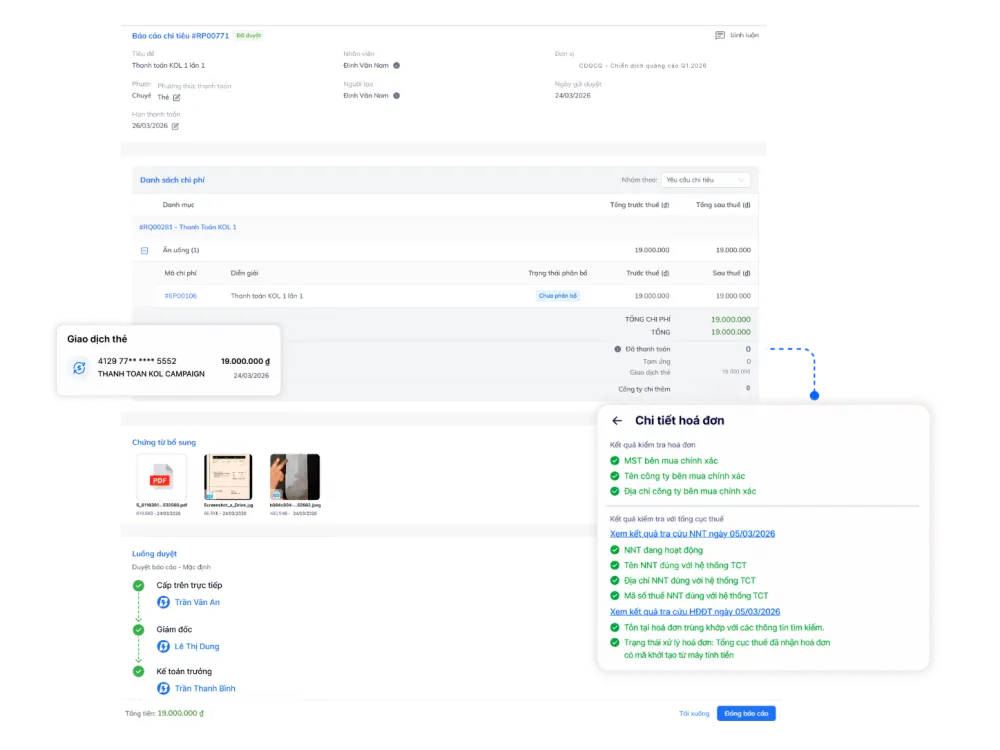
In Bizzi's process, invoice and receipt images can be collected immediately after a transaction occurs. The system provides support for business expense or corporate spending (Smart T&E) problems. Optical Character Recognition (OCR) to extract data from invoices, thereby significantly reducing manual data entry.
Information from the document can be compared with:
- Request for payment.
- Payment transaction.
- Advance payment.
- Supplier.
- The company's spending policy.
As a result, the Finance team processes reimbursements and settlements faster, while minimizing data discrepancies.
4. Data synchronization and increased control.
When all data is stored on one platform, businesses can track the status of each expense in real time, including:
- Awaiting approval.
- Payment has been made.
- Waiting for additional documents.
- Currently undergoing verification.
- The accounts have been settled.
- The accounting has been completed.
Linking data between expenditure requests, payments, documents, and the accounting system also significantly reduces manual reconciliation, while supporting audit trail for internal management and auditing purposes.
9. Optimal implementation roadmap for advances and reimbursements for the Finance team.
The finance team should implement the plan in stages, starting with policy standardization, then digitizing processes, and finally automating payments and reconciliation. This approach helps businesses reduce the risks of transition while creating a unified data foundation for subsequent automation steps.
1. Review current policies
First, businesses need to review all regulations related to advances and reimbursements, including:
- What types of expenses are eligible for advance payment?.
- Who has the authority to approve it?.
- Limits for each target group.
- The reimbursement period is after the work is completed or after the expenses are incurred.
- The types of documents that need to be submitted.
Standardizing policies from the outset will help reduce the number of exceptions to the rules later on.
2. Standardize required forms and data.
Each expenditure request should be standardized according to a unified template, including information such as:
- Purpose of expenditure.
- Department.
- Project.
- Expense item.
- Related budget.
- The amount requested.
- Expected supporting documents (if any).
The more complete the input data, the smoother the approval, payment, and settlement process will be.
3. Design the approval flow based on risk level.
Not every expense is necessary. expense approval process They are similar. Businesses should build flexible approval flows as follows:
- The value of the expenditure.
- Type of expense.
- Department.
- Project.
- The extent of budget overrun.
This approach ensures control while avoiding lengthy processing times for small expenses.
4. Set up automatic status and alerts.
An effective process should allow the Finance team to track the status of each expense throughout its processing lifecycle, for example:
- Awaiting approval.
- Advance payment has been made.
- Costs are being incurred.
- Waiting for documents.
- The reimbursement deadline has passed.
- The final settlement is underway.
- The advance payment has been paid.
Automated alerts help prevent situations where documents are forgotten to be submitted or advances are left pending for too long.
5. Automate repetitive steps
Once the process has been standardized, businesses can prioritize automating time-consuming tasks such as:
- Reminder about the repayment deadline.
- Collect and OCR documents.
- Reconcile the transaction against the payment request.
- Monitor advance payment balances.
- Compile a cost dashboard by department, project, or accounting period.
A tiered implementation approach allows businesses to effectively manage change and improve operational efficiency without disrupting the Finance team's activities.
10. FAQ
How does optimizing advance payments and reimbursements differ from simply issuing regulations on advance payments?
The advance payment regulations stipulate the principles and responsibilities of the parties, while Optimizing employee cost processes The focus is on how businesses implement these measures in practice. This includes digitizing expense requests, automating approvals, tracking status, collecting documents, and reconciliation to reduce processing time and minimize errors.
How can we reduce the number of employees withholding advances?
Businesses should clearly define repayment deadlines, establish tracking status for each advance payment, and implement an automated reminder system. Simultaneously, pre-expenditure control and assigning responsibility for settlement to each request will significantly reduce outstanding advance payments.
Should there be a deadline for repaying advances after a business trip?
Yes. Businesses should establish repayment deadlines that are appropriate to their size and operational characteristics. Clearly defining the deadlines for submitting documents and settling accounts makes it easier for accountants to track transactions and helps finalize figures for the correct accounting period.
Should businesses exercise pre-expenditure control or post-expenditure verification?
Pre-expenditure control is generally more effective because it helps verify budgets, limits, and payment terms before funds are used. Post-expenditure control is still necessary but primarily serves to reconcile and finalize accounts.
When should you use a business card or virtual card instead of a cash advance?
Business cards or virtual cards are suitable for online expenses, business travel, advertising costs, and recurring software or service fees. These methods help reduce the need for personal cash advances, increase control over spending limits, and facilitate reconciliation processes.
What data do accountants need to process employee expense claims more quickly?
In addition to invoices or receipts, records should include complete expense requests, approval information, expense type, project, department, payment transaction, and settlement status. The more complete and standardized the data, the faster the verification and accounting process will be.
Which businesses are suitable for managing advances and reimbursements using Bizzi Expense?
Bizzi Expense is suitable for businesses with numerous business expenses, project costs, operating expenses, or those requiring centralized approval and settlement processes. When combined with Bizzi Expense Pay, Businesses can integrate cost management, payments, document collection, and reconciliation into a single process, increasing transparency and significantly reducing manual processing.
Conclude
Optimizing employee expense advances, reimbursements, and settlements not only shortens document processing time but also enhances budget control, reduces error risks, and increases transparency throughout the entire expenditure management process. Instead of focusing solely on processing expenses after they have been incurred, businesses should establish a comprehensive control process from expense request, approval, payment, settlement, and accounting, while gradually digitizing repetitive tasks to reduce pressure on the Finance and Accounting department.
Bizzi Expense This is a suitable solution for businesses to digitize the process of requesting, approving, advancing, reimbursing, and settling employee expenses on a centralized platform. It's ideal for businesses needing enhanced pre-expenditure control and integration of payment data with expense management processes., Bizzi Expense Pay This helps streamline the operational flow from approval, payment, and document collection to reconciliation and synchronization of accounting data. This forms the foundation for the Finance team and CFO to build a transparent, efficient cost management process that is ready to scale with the company's growth.
To receive advice on effective corporate financial management solutions, schedule an appointment with Bizzi here: https://bizzi.vn/dat-lich-demo/
Please refer to the document on Financial Management Regulations at This