



Discrepancies in data between the Inventory and Accounting departments during the closing period are always a "blind spot" that poses a devastating risk to a business's profit margin. When data is fragmented and documentation is delayed, CFOs are forced to make decisions based on outdated financial reports, leading to the risk of tied-up working capital or incorrect cost of goods sold.
This article analyzes The role of 3-Way Matching automation – the most important bottleneck in Procure-to-Pay processThis helps businesses standardize input financial data, thereby optimizing cash flow and supporting inventory management.
What is real-time inventory management from a Financial Management perspective?
Real-time inventory management is not simply a tool for tracking the quantity of goods, but a financial system that allows CFOs to directly control the value of working capital at any given time. When data is instantly synchronized between the physical warehouse and the accounting/ERP system, businesses can record accurate inventory values according to accounting standards such as VAS 02, instead of relying on periodic inventory counts which are prone to errors.
In essence, real-time inventory management This is a transition from "counting inventory" to "monitoring cash flow frozen in inventory." Each unit of goods is no longer a single object, but becomes part of working capital that needs continuous optimization. To achieve this, the system must connect identification devices (barcode, QR, RFID) with the ERP/WMS platform, creating a single "Single Source of Truth."
The core difference lies in the CFO's perspective: inventory is not a static asset but rather unreleased cash flow. Therefore, Real-time inventory optimization This is a proactive strategy to prevent cash flow losses, rather than dealing with the consequences after an inventory audit.
The lack of this synchronized system is the reason why data is fragmented and disjointed – the source of a host of serious financial risks.

What significant risks are posed by fragmented data between Inventory and Accounting?
When information is not synchronized in a timely manner between the Warehouse department (responsible for physical inventory) and the Accounting department (responsible for financial recording), businesses face three key risks:
- Cost of Goods Sold (COGS) Discrepancies DInventory valuation: In practice, it is common for warehouses to record that they have received all the goods (with a warehouse receipt – GRN), but the accountant has not yet received the invoice, or the amount on the invoice differs from the purchase order (PO).
- Month-end close delay: Manually cross-referencing thousands of documents extends the closing period by 5-7 days, delaying the Board's ability to make strategic decisions.
- Compliance risks and expense disallowance: If discrepancies or inaccuracies occur without proper documentation, mismatched documents will violate accounting principles (especially in the context of increasingly stringent regulations on electronic invoices such as Circular 32). The tax authorities may disallow legitimate expenses, directly harming net profit.
When information is not synchronized in a timely manner between the Warehouse department (responsible for physical inventory) and the Accounting department (responsible for financial recording), businesses face three key risks:
- Cost of Goods Sold (COGS) Discrepancies DInventory valuation: In practice, it is common for warehouses to record that they have received all the goods (with a warehouse receipt – GRN), but the accountant has not yet received the invoice, or the amount on the invoice differs from the purchase order (PO).
- Month-end close delay: Manually cross-referencing thousands of documents extends the closing period by 5-7 days, delaying the Board's ability to make strategic decisions.
- Compliance risks and expense disallowance: If discrepancies or inaccuracies occur without proper documentation, mismatched documents will violate accounting principles (especially in the context of increasingly stringent regulations on electronic invoices such as Circular 32). The tax authorities may disallow legitimate expenses, directly harming net profit.
How can a CFO balance OSA and working capital turnover?
To Improve the OSA (On-Shelf Availability) score. Without increasing excess inventory, CFOs need to rely on real-time inventory data to accurately calculate reorder points and economic order quantities (EOQ). This is fundamental to maintaining high OSA while optimizing capital turnover.
Financially, attempting to push OSA to near-perfect levels by stockpiling goods will deplete free cash flow. This will cause the DIO (Days Inventory Outstanding) to rise, resulting in capital being tied up in inventory instead of being reinvested.
The formula DIO = (Average Inventory / Cost of Goods Sold) × 365 clearly shows the relationship between inventory and financial performance. When applied... real-time inventory managementThe variables in this formula become dynamic data, helping CFOs make timely purchasing decisions using the Just-in-Time (JIT) model.
The key difference is that instead of maximizing OSA at all costs, businesses need to optimize OSA based on data. This ensures that goods are always available when needed, but without creating dead stock or capital pressure.
However, for these models to function accurately, the input data must be tightly controlled right from the document reconciliation stage.
Why does 3-Way Matching automation help verify inventory levels and order quantities?
For ERP systems or warehouse management software (WMS) to function accurately and reflect real-time inventory values, input data must be "cleaned" right from the reconciliation stage.
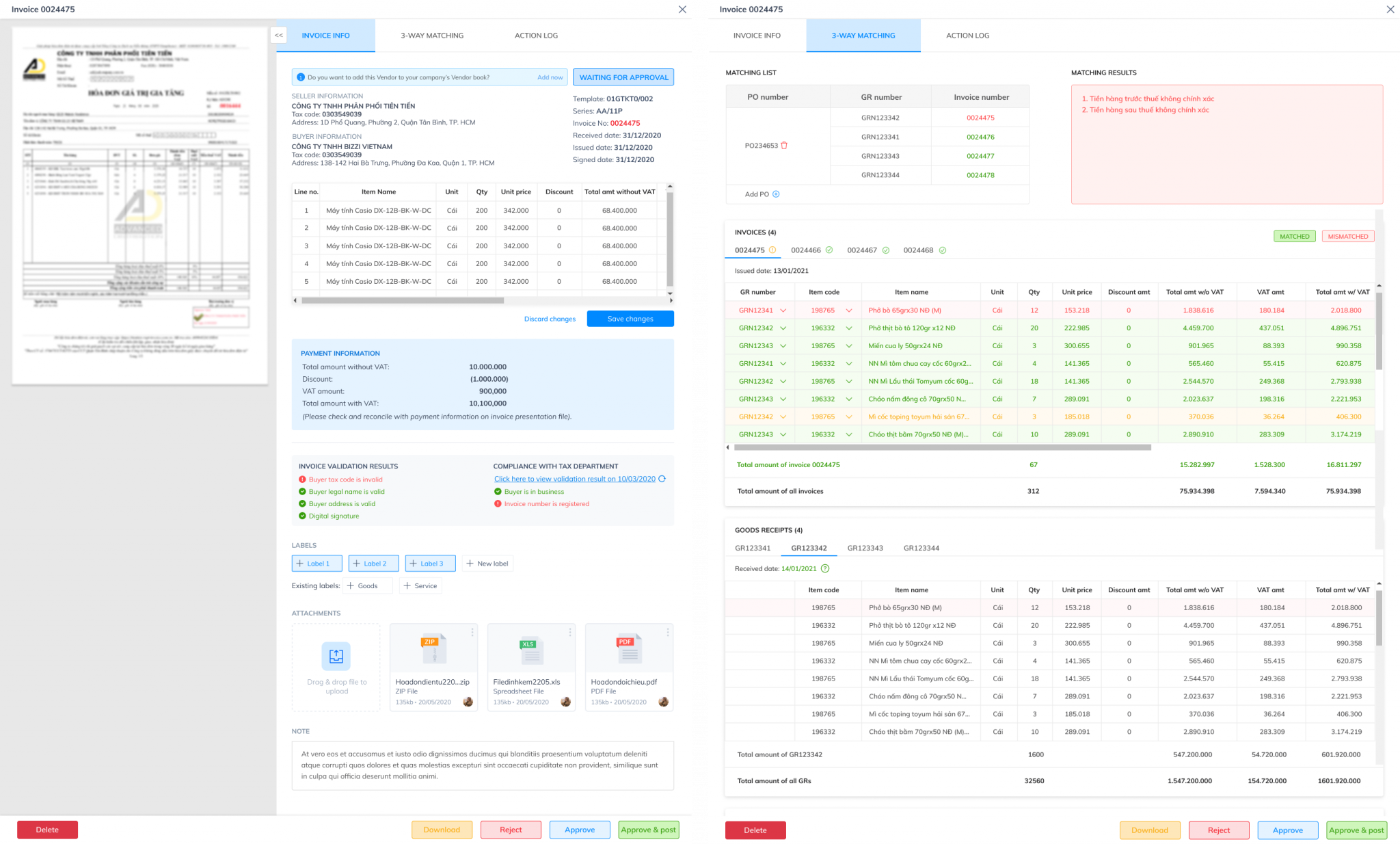
Automated three-way reconciliation is a core financial control mechanism that helps synchronize and verify data between: Purchase Order (PO) – Goods Receipt (GRN) – Purchase invoice.
Instead of spending hundreds of hours each month searching for errors in Excel, a technology solution (like Bizzi Bot, which uses AI/RPA) will perform this process with absolute accuracy:
- Automatically extract invoice information and cross-reference it with PO/GRN data from ERP/WMS systems.
- Immediately flag and block the payment process if any discrepancies in price, quantity, or specifications are detected.
- Ensure that only valid transactions with complete documentation from all three parties are recorded in the ledger and payment orders are processed.
What steps should the chief accountant take to standardize the closing period when implementing real-time inventory management?
To maximize the benefits of real-time inventory managementThe Chief Accountant needs to completely switch from batch processing to real-time data synchronization. This requires the system to integrate APIs between WMS and ERP, ensuring that all inventory changes are immediately recorded in the ledger.
Another crucial element is establishing an exception handling process. Situations such as damaged goods, returns, or inventory discrepancies need to be automatically recorded and categorized by the system, rather than being handled manually at the end of the period.
Furthermore, the aging report needs to be continuously updated to facilitate the provision for inventory devaluation in accordance with accounting regulations. This is a point that most traditional inventory management systems fail to address, but it is of great significance in ensuring financial transparency.
When these processes are automated, businesses not only shorten the time it takes to close the books but also improve the accuracy of the entire financial reporting system.
Frequently Asked Questions about Real-Time Inventory
Real-time inventory is a system that updates the quantity of goods immediately when a transaction occurs, helping businesses avoid shortages or surpluses and optimize warehousing costs. Frequently asked questions include: How to synchronize data across multiple channels, handle discrepancies, establish safe inventory levels, and troubleshoot system errors during inventory checks..
Below are detailed frequently asked questions (FAQs) about real-time inventory:
How does real-time inventory management impact the Cash Flow Statement?
The system helps reduce the amount of cash tied up in excess inventory, thereby directly improving cash flow from operating activities (CFO) on the cash flow statement.
How can we quantify the ROI of a 3D reconciliation system?
ROI is calculated based on the number of manual accounting hours reduced (saving up to 80% of time), the value of incorrect/duplicate payments prevented, and personnel cost savings from scaling up without hiring additional Accounts Payable (AP) staff.
How should inventory discrepancies be properly accounted for?
The difference should be recorded in account 1381 (assets awaiting processing), then processed according to the verification results and transferred to expenses if necessary.
Does the company's current ERP system integrate an automated 3D reconciliation solution?
It is entirely feasible. Advanced document processing platforms can operate in parallel and connect data bidirectionally with existing ERP systems (via API or RPA) without interfering with or replacing the core ERP structure.
Does increasing OSA pose a risk of bad inventory?
Yes, it can be done manually. But with real-time data and AI-powered demand forecasting, businesses can increase OSA while maintaining optimal inventory levels.
What benefits do FMCG businesses gain from this solution?
The FMCG industry benefits greatly from its high turnover rate. The system helps shorten the collection cycle and optimize payments, thereby significantly improving cash flow.
Conclude
Real-time inventory management It is no longer just an operational choice but has become a core financial strategy in this context. The data is fragmented and disjointed. between the Warehouse and Accounting departments. Only when the ERP system is fed with accurate input data can the business function effectively. Real-time inventory optimization, creating a solid foundation for the supply chain department. Improve the OSA (On-Shelf Availability) score.This also helps CFOs free up working capital and increase transparency in financial reporting.
Acting as a "filter" for input data, Bizzi's 3D reconciliation solution functions as an intermediate automation layer, validating and matching data from invoices, gross receipts (GRNs), and purchase orders (POs) before recording them in the system. Thanks to this source of "clean" and real-time financial data, the problem... real-time inventory management The problem is thoroughly addressed at its root, and a comprehensive data foundation is provided for the strategy. Digital transformation in retail finance It was built.
If your business is stuck with a manual reconciliation process that's causing inventory discrepancies, now is the time to upgrade your workflow – where documentation risks are eliminated, restoring an accurate financial picture to drive growth.
To receive advice on effective corporate financial management solutions, schedule an appointment with Bizzi here: https://bizzi.vn/dat-lich-demo/