
Business loans involve a company receiving a sum of money from a lender to use for an agreed-upon purpose, timeframe, and conditions, with the obligation to repay. With bank loans, it's crucial not only to have all the necessary paperwork prepared but also to be able to explain where the money will be used and what cash flow will be used to repay the debt.
This article focuses on business loans from credit institutions. The conditions of each bank, products, and required documents may vary; submitting a loan application does not mean approval or eligibility for disbursement.
Identify the amount of money you need and when you need the funds before choosing a loan.
Businesses should start by examining their income and expenditure schedules instead of using all projected expenses as the basis for their loan request. It's crucial to identify when the shortfall will occur, how long it will last, and which sources of income can be used to repay the debt.
Hypothetical example: In the same period, the business needs to spend 600 million VND, has 200 million VND available, and expects to receive 100 million VND before payment. The projected shortfall is 600 - 200 - 100 = 300 million VND. This is an estimate of cash needs, not the credit limit the bank will approve.
If 100 million in sales revenue arrives after the payment due date, that revenue is not enough to cover the shortfall on the payment date. Businesses also need to retain only the necessary cash for regular operations, instead of considering the entire account balance as readily available funds.
For purchasing, inventory, or waiting for customer payments, compare the loan term with the cycle. working capital. Purchasing machinery or undertaking long-term projects requires a repayment plan that aligns with the timeframe for generating cash flow, rather than automatically resorting to short-term loans.
| Decision | Needs to be checked | It should not be interpreted as |
|---|---|---|
| Single loan or credit limit | One-time or recurring demand; conditions for installment withdrawals. | There is a limit that allows you to withdraw the entire amount immediately. |
| Short-term or medium- to long-term | Time of money collection and repayment schedule | Longer terms are always more suitable. |
| Is there or isn't there collateral? | Product policy, credit profile, and collateral requirements. | All business loans must be secured by collateral. |

What loan eligibility requirements must businesses meet?
Article 7 of Circular 39/2016/TT-NHNN and its amendments stipulates fundamental conditions regarding legal capacity, legitimate capital use purposes, capital utilization plans, and financial capacity to repay debts. These conditions should be separated from the individual approval criteria of each credit institution.
- Legal capacity: When the borrower is a legal entity, it is necessary to verify the civil legal capacity and authority of the signatory. Loans for the operation of a private enterprise may fall under the category of loans taken out by an individual who is the business owner; it is crucial to correctly identify the borrower in the application. A representative signing on behalf of a legal entity does not automatically qualify as an individual borrower.
- Legitimate purpose: Provide a detailed description of the expenditure, the payer, and supporting documents. Don't just state it generally as "supplementing working capital" when the bank needs to clarify the transaction.
- Plan for using the capital: The regulations specify the need for funds, how they will be used, the timeframe for implementation, and the source of repayment. There are exceptions to the requirement that the plan for using the funds be feasible for small-value loans; however, these exceptions should not be interpreted as exemption from documentation or automatic approval.
- Ability to repay debt: Clarify cash flow and existing obligations. Profits on the report do not necessarily mean there is cash available to pay off debts on their due date.
Key legal milestones to note: Circular 29/2026/TT-NHNN, effective from August 15, 2026, amends Circular 39. Businesses need to check the applicable conditions at the time of loan application, especially when reusing old documents or registering electronically. Confirm with the credit institution the list of documents and conditions of the product being accepted.
Credit history, operating time, industry, revenue, collateral, and equity participation level may be included in the assessment or product criteria. There is no basis for making a bank's set of criteria the same for all businesses.
Newly established businesses should inquire with the bank beforehand whether they will accept their client base and what documents they will accept for operational evaluation. They should not create fictitious reports, contracts, or revenue figures to meet application requirements.

Loan applications require proof of five groups of information.
Article 9 of Circular 39 requires customers to provide information, documents, and data proving their loan eligibility and other documents as instructed by the credit institution. The list below is for preparation purposes only and does not replace the official list that the bank sends to each application.
| File group | Documents often need to be cross-referenced. | Points that need clarification |
|---|---|---|
| Legal aspects and jurisdiction | Business registration, articles of incorporation, information of the legal representative, power of attorney; internal decisions when within the scope of approval. | The borrower is the correct legal entity, the signatory is the correct person, and the documents are still in compliance with the registration changes. |
| Financial situation | Financial statements, tax reports, accounts receivable or payable ledgers or summaries, bank statements, and explanatory documents as required. | Data periods, consistency, and discrepancies require explanation; it is not assumed that all records must include two years of reporting. |
| Purpose of capital utilization | Contracts, orders, estimates, invoices, or documents relevant to the transaction and the stage of execution. | Amount, recipient, payment schedule, and amount already paid. |
| Source of repayment | Cash flow forecast, debt collection schedule, existing loan obligations, projected principal and interest repayment schedule. | Which revenue streams are actually usable when due; what are the options for delayed collection? |
| Loan security, if applicable. | Property records, ownership documents, and valuation and collateral documents as per guidelines. | Will the property be accepted? Who is entitled to make the commitment? What are the costs and timeframe for completion? |
Banks may also request information about related parties if required by law. Businesses should request a specific list of documents, confirmation of the receiving contact, and instructions on how to send them securely, instead of submitting entire data repositories or unnecessary personal documents.
Prepare a unified explanation before submitting it.
The finance manager should reconcile revenue, accounts receivable, inventory, and balances across reports; clearly indicating any figures that are not finalized or require further investigation. If accounts receivable are high but customers are slow to pay, explain the impact on repayment sources instead of simply stating increased revenue.
Internally, determine who is authorized to work with the bank, sign contracts, and approve loans or collateral. Specific authority must be based on regulations, rules, and actual transactions; it should not be assumed that the director can decide every case.
What is the loan application process from application to disbursement?
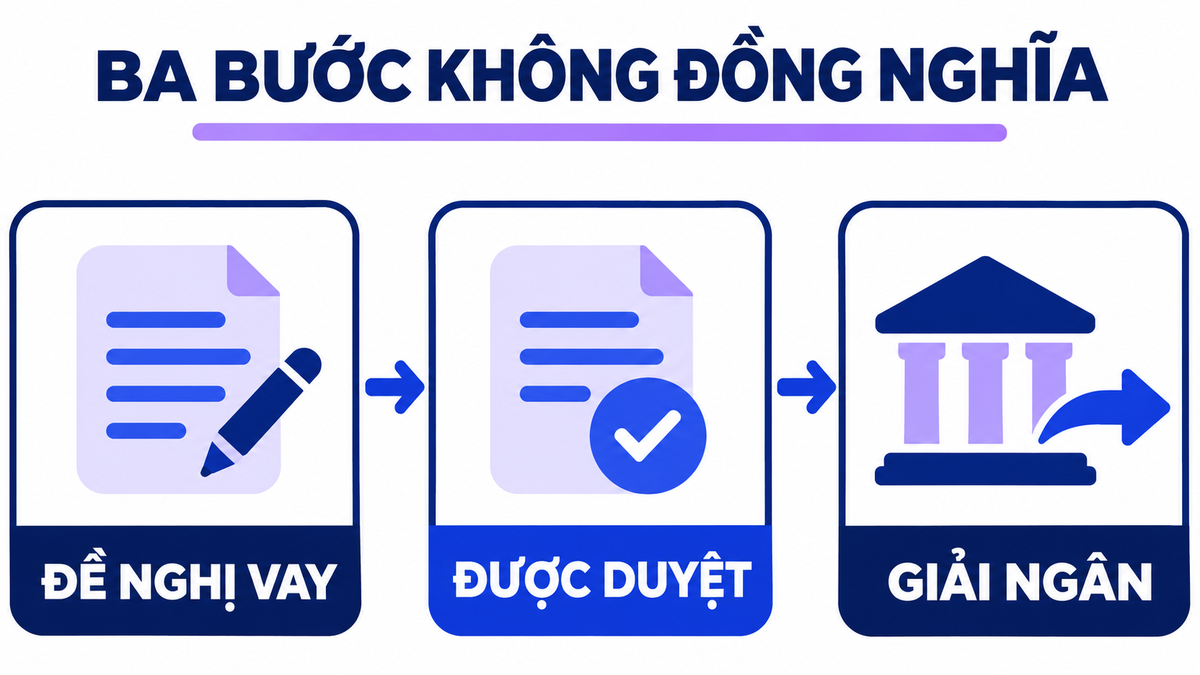
Businesses need to track each output: document list, assessment results, approval conditions, and disbursement documents. A notification of application receipt is not necessarily a commitment to provide funding.
- Determine your debt needs and repayment sources. Schedule expenses, income, and shortfalls over time. The output is a capital requirements table along with assumptions, not just a single loan request figure.
- Exchange products and request a list of documents. Ask about the recipient, purpose, timeframe, and guarantee. The output is a list of documents, contacts, and points requiring further information.
- Submit the application and explanation. Submit the correct set of documents, mark the version, and respond to requests for additional information with accurate details. Record the content and time of the information provided.
- Receive the results and review the approval criteria. Verify the credit limit or amount, term, interest and fees, collateral, and withdrawal conditions. If approval is not granted, clarify the details or reasons as per applicable regulations.
- Sign and fulfill the terms and conditions before disbursement. Verify the authority, contract, any security procedures, and documentation for each withdrawal. Signing the contract does not equate to receiving the money.
- Disbursement, utilization, and debt repayment monitoring. Verify the actual amount disbursed, the recipient, and the agreed-upon purpose; retain records of capital utilization, track principal and interest repayment dates, and fulfill information provision obligations.

Is the processing and disbursement timeframe fixed?
A timeframe like 24 hours or 7–14 days should not be used as a general commitment. The timeframe depends on the product, the completeness of the documentation, the content requiring assessment, the collateral, and the disbursement conditions. Ask about the starting point for processing, what is still missing, and what might cause the projected schedule to change.
Disbursed funds are not automatically transferred to the borrowing company's account. The disbursement method, beneficiary, and documentation must comply with applicable regulations, the purpose of the loan, and the approved agreement.
Check the costs and repayment schedule before signing.
Compare loans for the same amount and duration, rather than just comparing advertised interest rates. Read the terms and conditions, promotional periods, and subsequent adjustment options.
- What is the basis for calculating interest rates? Is it a fixed rate or a reference rate plus a margin? When are they adjusted?
- Do the principal and interest repayment schedules coincide with the time the business receives the money?
- Are there any early repayment fees, security fees, or other charges; when do they arise and who collects them?
- What documents and conditions are required for each withdrawal, and what is the expiration date of the available limit?
- What are the notification obligations and contractual procedures for handling late payments or breaches of contract?
Businesses should consider adding a scenario involving delayed payments or lower-than-expected sales. If the payment schedule is only feasible if all customers pay on time, the plan should be discussed again before committing.
When a loan doesn't suit your actual needs, you can compare different options. providing capital for businesses. Each form of financing has its own conditions and obligations; not all sources of funding should be considered bank loans.
At what stage does Bizzi Financing facilitate the connection of funding sources?
Bizzi Financing It is a platform connecting businesses with financial partners. Businesses can register their information, submit applications, and track steps related to credit limits and disbursement requests on the platform, depending on the applicable service.
Bizzi Financing does not directly assess or provide funding. Financial partners conduct assessments and make decisions based on their own profiles, financial capacity, credit history, and conditions. Applying on the platform does not guarantee approval, lower interest rates, or receipt of funds within a fixed timeframe.
Before submitting the application, businesses still need to finalize the loan purpose, repayment source, and authorized person. Upon receiving the results, check the funding agency, credit limit conditions, and requirements for each disbursement, just as you would when working directly with a financial institution.
Frequently Asked Questions When Preparing for Business Loans
Can newly established businesses apply for loans?
Discussions and requests for consideration are possible, but approval depends on legal conditions, the product, and the results of the assessment. It is necessary to inquire with the bank about which business group they are accepting and what documents can demonstrate the business's operations, the purpose of the loan, and its ability to repay.
Does not having collateral mean you can't get a loan?
That conclusion cannot be drawn for all loans. Some products are not based on collateral, but banks still conduct assessments and have their own criteria. No collateral does not mean no documentation is required or approval is guaranteed.
If a business is profitable, is it able to repay its debts?
That's not enough to draw a conclusion. The money could be tied up in accounts payable or inventory, while the payment obligations are due before the collection date. A cash flow schedule is needed, taking into account all existing liabilities.
Does having the budget approved mean the funds have been disbursed?
No. The credit limit is the approved range subject to specific conditions; each withdrawal request must also meet applicable requirements. The actual outstanding balance also differs from the unused credit limit.
Does submitting an application online skip the verification step?
This should not be interpreted that way. The online channel is a method for receiving and processing transactions; legal conditions, customer identification, and credit granting decisions must still be met as applicable.
Legal reference source: Consolidated document 86/VBHN-NHNN dated June 30, 2026, read together Circular 29/2026/TT-NHNN. When preparing the actual application, confirm the list and conditions with the receiving credit institution.