
Capital financing is the process of arranging financial resources for a business to operate, invest, or develop. Funding can come from owner contributions, retained earnings, loans, supplier credit, or a conditional assistance program. Borrowing is a form of financing, not its opposite.
To choose a source of funding, businesses need to determine the amount needed, the timeframe for use, and the source of repayment or the plan to create value for investors. Even easily accessible funding can be stressful if the repayment date is before the collection date.
How does capital financing differ from loans and grants?
Capital financing is a broad concept; borrowing falls under the category of debt financing. When borrowing, businesses are obligated to repay the principal, interest, and fees according to the contract. When raising equity capital, investors receive ownership rights as agreed; businesses do not repay the capital contribution according to a repayment schedule like a regular loan.
Grants are a special case. A support program may not require repayment of the principal but still has limitations on eligibility, expenditure purposes, expected outcomes, and reporting obligations. The term "grant" should not be understood as meaning that businesses always receive money for free.
For example, a business owner contributing an additional 500 million VND, a bank providing a 500 million VND loan, and a supplier agreeing to payment after delivery can all help arrange financial resources. These three methods create different rights, obligations, and payment schedules.
Internal capital and external capital
Internal capital can come from retained earnings and cash freed up through inventory management and accounts receivable collection. However, reported profits do not necessarily mean cash is readily available in the account: uncollected credit sales have not yet been used to pay suppliers.
External capital comes from additional owner contributions, new investors, lenders, or credit partners. The internal/external classification is different from the debt/equity classification; the two criteria should not be combined.
What sources of funding can businesses obtain?
Each source of funding comes with different obligations. Businesses need to compare the intended use, repayment capacity, and ownership rights before making a choice.
| Source | Suitable when | What in return? | Needs to be checked |
|---|---|---|---|
| Capital contributions and retained earnings | There are internal funding sources, or the owner can contribute additional funds. | The owner bears the risk and opportunity cost. | Available funds, capital contribution procedures, reserve fund. |
| Borrow from a bank/financial institution | There is a plan for using capital and cash flow to repay debt. | Principal, interest, and fees; may include collateral. | Term, repayment schedule, adjusted interest rate, disbursement conditions |
| Capital contributors | We need development capital and are willing to share ownership rights. | Dilution of ownership stake; management rights by agreement. | Valuation, voting rights, divestment terms |
| Trade credit | The supplier agrees to sell on credit. | Pay on time; early payment discounts may be forfeited. | Due date, credit purchase limits, supply impact |
| Financing accounts receivable/leases | Capital is needed for specific transactions or equipment. | Fees and obligations as per contract structure | Eligible receivables, recourse, property ownership |
| Crowdfunding/support program | Meet program objectives or appropriate mobilization models. | Commitment to use money, deliver products, or other benefits. | Conditions, responsibilities, and legal basis of each model |
Equity capital: own capital, angel investors, and investment funds.
Angel investors may participate at an early stage; venture capital funds typically seek businesses with growth potential that meet their selection criteria. Equity funds may be interested in more established businesses. These are selection trends, not the same conditions for all investors.
Investors will examine the team, market, product, business results, and value creation opportunities. Businesses need to prepare a rationale for using the capital, development milestones, and revenue assumptions; the fundraising plan needs to be cross-referenced with data and documentation during the due diligence process.
Receiving funding doesn't automatically mean the founder loses all control. The extent of influence depends on the proportion of capital contributed, voting rights, and the power to approve decisions and governance agreements. Before accepting funding, it's crucial to understand these rights rather than simply comparing the amount of investment.
Loans and overdrafts: check your cash flow before choosing a credit limit.
Single-transaction loans can serve a specific purpose; limits allow withdrawals based on needs and agreed-upon conditions. Overdrafts allow spending exceeding the account balance within the granted limit, suitable for certain temporary shortfalls. The ability to withdraw cash quickly should not be used as a substitute for a repayment plan.
Interest rates may be fixed for a period or subject to adjustment. Loans may or may not be secured, depending on the product, the borrower's profile, and the lender's decision. Therefore, it should not be assumed that all loans have stable interest rates or require collateral.
Trade credit, accounts receivable financing, and financial leasing.
Trade credit is established when a supplier purchases goods from a business and pays for them later. This funding is tied to the purchase and sale relationship and is not the same as a loan from a finance company. Businesses must respect the agreed-upon due dates; intentionally delaying payments can reduce credit limits and disrupt the supply chain. [Reference indicator] number of days to pay DPO It helps track actual payments, but it does not replace the terms of individual invoices.
Accounts receivable-based financing can help convert a portion of a transaction's value into cash sooner. It's necessary to check if the transaction qualifies, who bears the risk of non-payment, and the associated fees. Not all invoices are eligible for financing.
Leasing is an option to consider when a business needs to use equipment but doesn't want to pay the full purchase price upfront. Comparing the total lease cost, term, maintenance, insurance, and terms of ownership transfer or contract termination, leasing is not necessarily cheaper than buying with debt financing.
Crowdfunding and support: the commitment must be read carefully.
Funding from development funds or programs typically has criteria regarding eligibility, sector, and intended use. Businesses should only include this funding in their plans once appropriate decisions or agreements have been made; the funds being sought do not yet need to be readily available.
Crowdfunding can follow a model of contributions, receiving products/rewards, or financial benefits. These models do not have the same obligations. Issuing ownership rights or guaranteed returns requires separate legal scrutiny; it cannot be assumed from a foreign platform that businesses in Vietnam are free to raise funds in a similar manner.
Choose funding sources based on needs and payment schedules.
Choose your funding term based on how long it takes for the money to be repaid, rather than just choosing where the funding is currently available. Newly established businesses without stable cash flow need to consider their debt repayment capacity. Growth businesses may need capital for both long-term assets and inventory; established businesses may still experience cash shortages due to seasonality or delayed customer payments.
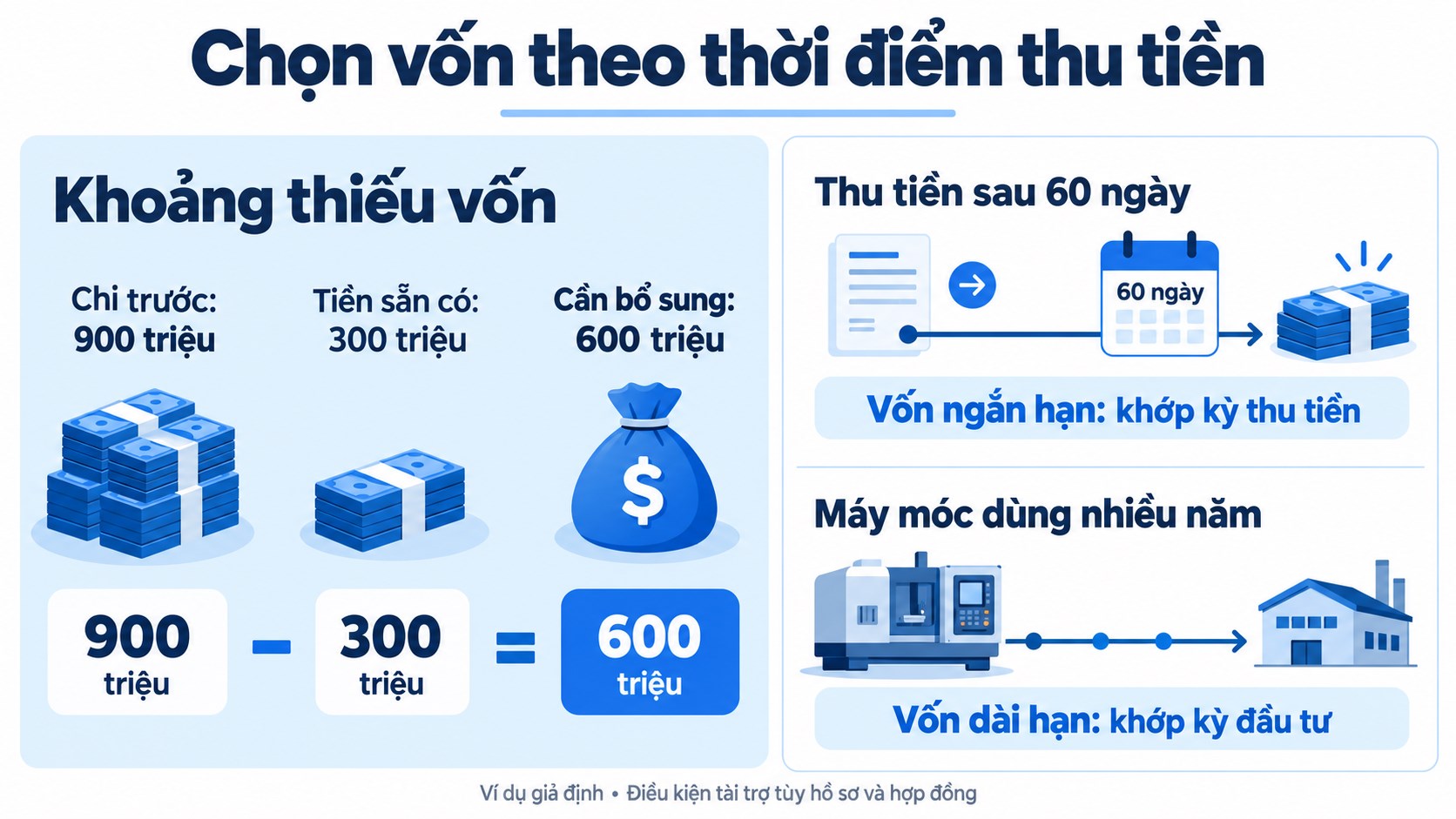
Funding for short-term orders differs from funding for machinery used for many years. If machinery is financed with debt that matures very soon, the business must rely on refinancing or other sources of funds before the investment generates sufficient cash flow. This is a term risk, even if the plan is profitable.
Before seeking external funding, review the following: working capital and timing of receipts and disbursements.Outstanding debts, slow-moving inventory, cash tied up in transactions, and upcoming payment deadlines. Borrowing more simply to cover up an unresolved cash collection bottleneck is not advisable.
For example: a shortfall of 600 million VND in one order cycle.
Suppose the business needs to spend 900 million VND to fulfill an order, has 300 million VND available for this option, and expects the customer to pay after 60 days. The initial capital needed is: 900 - 300 = 600 million VND. This is a hypothetical example and does not include contingencies or unforeseen expenses.
Businesses need to create a realistic payment schedule and collection dates, then test the scenario where the customer is 15 days late. If payment is due on the 45th but collection is on the 60th, the plan will still result in a shortfall at the time of payment. Negotiations on payment schedules, customer payment terms, or credit terms are possible; profitable orders should not be considered a guarantee that loans will always be repaid on time.
Don't confuse revenue, profit, and debt repayment.
Revenue recorded may not yet be collected; profit may be tied up in accounts receivable or inventory. The source of repayment needs to be a readily available cash flow that can be delivered on schedule, after setting aside funds for essential operations. At least one scenario of lower sales or slower-than-expected collection should be tested, and the available contingency funds should be determined.
Compare the total cost and benefits before signing.
Compare the actual amount received, usage period, and repayment schedule. The listed interest rate does not fully reflect fees, collateral, or administrative obligations.
For example, a loan includes fees, not just the percentage of interest.
Suppose you borrow 600 million VND for 60 days, with a simple interest rate of 10%/year, a 365-day basis, and no reduction in the outstanding balance during the period. The assumed interest is... 600,000,000 × 10% × 60/365 ≈ 9.86 million VND. If you add the 1% fee to the loan amount, the total interest and fees will be approximately... 15.86 million VND, excluding other charges.
If fees are deducted before disbursement, the business will only receive 594 million VND, falling short of the initial requirement by 6 million VND. It's important to understand the calculation method and fee collection dates; this example should not be used as a quotation or a method applicable to all contracts. For loans, accounting needs to be monitored. interest expense According to the contract and check the recording method and specific tax conditions.
Example of equity investment: no interest paid, but dilution occurs.
Assume the pre-investment enterprise value is agreed upon by both parties at 4 billion VND, the investor contributes 1 billion VND and has no other special rights. The post-investment value is 5 billion VND, and the investor's percentage is... 1/5 = 20%. The existing owner still has 80% in this simplified model.
In reality, there are also preferential clauses, voting rights, employee stock options, or conversion clauses. Therefore, one should not compare equity investment with borrowing based solely on the phrase "no interest"; both ownership rights and how value will be distributed in the future must be evaluated.
- What is the total amount received after fees?
- Is the interest rate fixed or adjustable? Is there a promotional period and a post-promotion rate?
- Do the principal/interest repayment dates match the payment collection dates?
- Are there any early repayment fees, sales commitments, or additional asset obligations?
- Who bears the risk of customer non-payment in accounts receivable financing?
- What veto, priority, or divestment rights do investors have?
6 steps to prepare a funding application.
The application must demonstrate both the need for capital and the ability to fulfill the commitment. The specific list of requirements varies depending on the funding provider; there is no single set of documents or approval timeframe for all businesses.
- Determine the purpose and the amount of money. Separate order capital, operating capital, and investment capital; record the equity amount along with the amount needed for additional funding.
- Prepare cash flow forecasts. Show income, expenses, repayment dates, and scenarios for customers who are late in payment; use well-founded assumptions.
- Prepare legal and financial documents. Gather all required business documents, financial reports, management data, and existing obligations information.
- Prepare transaction evidence or investment plans. Orders, contracts, invoices, payment schedules, or equipment quotations help explain where the money will be used.
- Compare and negotiate terms. Review total costs, guarantees, and payment schedules; with investors, review valuation and governance rights.
- Follow-up after receiving funding. Compare the actual amount received, the purpose of use, the repayment schedule, and the reporting commitments; detect cash flow discrepancies early for discussion.
ACCA Application Guide It also emphasizes the purpose of the funding, financial statements, and cash flow forecasts. These are general preparation principles; the review conditions in Vietnam remain in accordance with applicable regulations and contracts.

When the application is incomplete or the terms are beyond one's tolerance.
It's important to clarify the reasons for the initial rejection, the required additional documents, and any areas where improvements are possible. Avoid submitting with inaccurate data or accepting payments exceeding cash flow simply because of urgent capital needs. Consider adjusting the project scope, purchasing schedule, or investment timeline before reassessing the requirements.
For investors, a lack of consensus on growth targets, governance, and divestment timing can create conflicts later on. With loans, risks often lie in repayment schedules, interest rate adjustments, and reserve funds. These conditions should be assessed at the time of selection, not after the capital has been utilized.
Frequently Asked Questions about Funding
Can newly established businesses access capital?
There may be suitable funding sources, but not all funding firms accept startup applications. It's necessary to check the stage of operation, industry, business plan, financial capacity, and criteria of the funding firm; approval is not guaranteed without careful consideration.
If there is no collateral, what are the options for obtaining a loan?
Products can be found based on profile, transactions, or equity financing. The lack of collateral does not eliminate the need for credit assessment and repayment capacity; the conditions of each product must be checked.
Is equity capital free?
No. Owners bear the risk and expect a return on their investment; receiving additional capital could dilute their ownership stake. The absence of a fixed interest rate does not mean there is no cost of capital.
Are guarantees and letters of credit cash that can be received immediately?
Don't assume that's the case. These are tools that facilitate payment/transaction commitments under specific conditions, different from funds disbursed into your account. Ask clearly which tool actually covers the outstanding payment.
Bizzi Financing assists in connecting funding sources.
After identifying their needs and repayment capacity, businesses can explore Bizzi Financing to access financial partners. Bizzi Financing connects supply chain and working capital financing needs with financial partners. The published process includes registration, application submission, and approval; only after a credit limit is granted can the business activate it and request disbursement.
Bizzi does not directly assess or fund; this is done by its financial partners. Credit limits, interest rates, collateral requirements, and approval likelihood depend on each partner's profile and policies. A suggested result or registration does not constitute a commitment to provide funding.
If the need is to supplement funds for the trading cycle, prepare the required amount, payment schedule, and relevant documents before the meeting. When discussing with the consultant, confirm the suitability of the product, the approval criteria, and the total cost of the proposed plan.
Before accepting funding, review cash flow and obligations.
Effective financing begins with identifying the specific cash deficit and determining when the funds will be returned. Compare debt, equity, and other options involved in the transaction by the total costs, obligations, and benefits. Before signing, assess the feasibility of the plan even with delayed payments or lower-than-expected business results.